



Abstract
Previous research of metal magnetic memory (MMM) primarily focused on uniaxial stress-magnetic field behaviors and the judgment criterion of stress concentration zone mainly depended on the tangential and normal component of MMM signals. Magnetic field gradient was only mentioned as an auxiliary condition. In this paper, the variation characteristic of magnetic field gradient under bending load was investigated. Four-point bending tests of Q235B I-steel beams were carried out. The results show that all magnetic field gradient curves are centrosymmetric about midpoint of measurement line. The position of concentrated load can be preliminarily predicted by the mutational point of magnetic field gradient slope on the flange and accurately judged by the zero-crossing position of magnetic field gradient on the web. Whether a specimen is under eccentric compression or not, can be determined by comparing average characteristic parameter values on both sides of specimen. The variation law of magnetic field gradient on both the flange and web can be well explained by the modified Jiles-Atherton model, which is constructed by replacing stress
Keywords
Introduction
In recent years, structural steel buildings have developed rapidly and been widely used. However, early damage of steel members will inevitably occur due to the action of complex stress condition and will occupy the most part of the whole service life [1]. With the accumulation of early damage, the normal operation and safety of the whole structure will be affected due to the degradation of stiffness and stability [2]. Therefore, the detection for early damage under complex stress state is necessary. Metal magnetic memory (MMM) has been demonstrated to be capable of diagnosing early damage and stress concentration of ferromagnetic material. The physical basis of MMM is self-magnetization under the action of stress. MMM measures the stress-induced surface magnetic fields of ferromagnetic materials under the excitation of geomagnetic field [3]. Therefore, MMM is an effective method for evaluating early damage, stress concentration and even preventing the occurrence of abrupt structural failure [4].
Recently, MMM method has received much attention due to several advantages since its first report and scholars worldwide have conducted much research. Bao et al. [5] investigated the variation of stress-induced magnetic field under tension and found that the peaks in the tangential component curve can determine the local stress concentration caused by cracks and dislocation. Guo et al. [6] measured the surface magnetic field intensity of Q345R during tensile tests, the result showed that the normal component signals decreased with a rise in stress, and then reversed to the initial field when the stress was greater than 160 MPa. Dong et al. [7], Hu et al. [8] and Roskosz and Bieniek [9] also researched variation of magnetic field during uniaxial tensile experiments and obtained corresponding results. However, previous research of MMM primarily focused on the effect of uniaxial tensile stress on the MMM signals, which can’t be applied in structural steel buildings. Because most of structural steel members (i.e. beam and slab) are mainly subjected to bending loads during service. In addition, the criterion to distinguish the stress concentration zone mainly depended on the tangential and normal component of MMM signals, magnetic field gradient was only mentioned as an auxiliary condition, which would easily lead to missing and false detection. Actually, magnetic field gradient can effectively restrain the effect of uniform background magnetic field and enhance the detection precision [10]. Therefore, the change law of magnetic field gradient under bending stress state should be investigated.
To this end, four-point bending tests of Q235B I-steel beams are carried out in this paper. The object of this work is to explore the variation characteristic of magnetic field gradient induced by different bending loads. The possible reason underlying the distribution of magnetic field gradient is analyzed and discussed by modified Jiles-Atherton model.
Chemical composition of Q235B low carbon steel (wt. %)
Chemical composition of Q235B low carbon steel (wt. %)
Mechanical properties of Q235B low carbon steel
Experimental method
The tested material is Q235B low-carbon steel, which is widely applied in steel structure field due to its excellent mechanical properties. Its chemical composition and mechanical properties are listed in Tables 1 and 2. The Chinese 14# hot-rolled I-steel beam with a length of 1500 mm was employed in four-point bending test, with a section size of 140 mm
Sketch of specimen and measurement lines (unit: mm).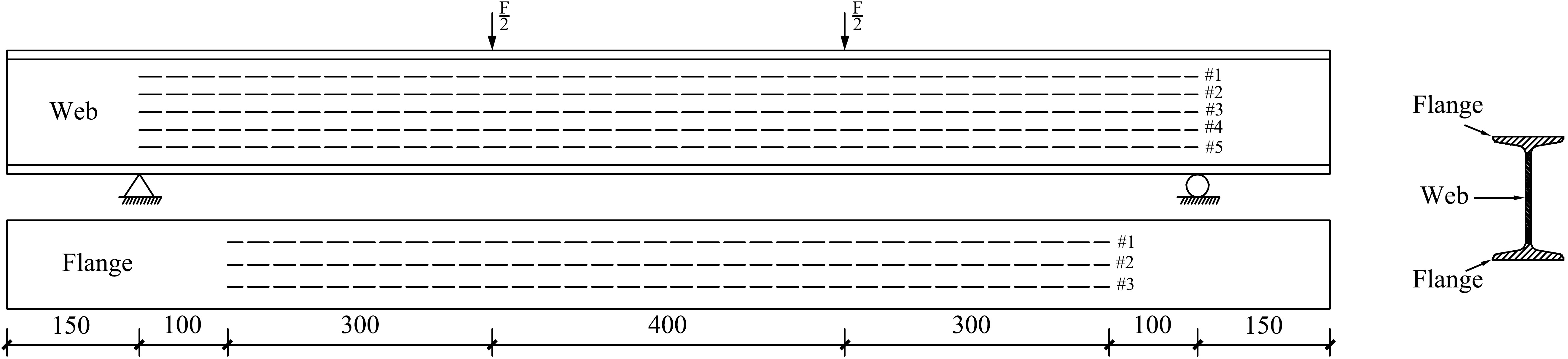
The bending tests were carried out on YAW5000 hydraulic servo-actuated machine, whose loading error was within
Force versus displacement curve at mid-span of steel beam.
Because the magnetic field is a vector field, the changes in position and environment have significant impact on magnetic field gradient values. Thus the measurement was always performed at the same location and in the same environment [12]. When the specimen was loaded to a pre-set value, the magnetic signal along each measurement line was measured three times. To reduce the experimental error, the average of the measurement was considered as the best estimate of magnetic field gradient and the standard uncertainty of magnetic field gradient was estimated by standard deviation. The distribution of the data was characterized by standard error bars.
Theoretical background
An applied stress can alter the macro-magnetic properties of ferromagnetic materials due to the magnetic moments rotation and domain wall motion. Such a phenomenon is called magneto-mechanical effect. In order to explain magneto-mechanical effect, the Jiles-Atherton model [13] was proposed based on the law of approach and effective field theory.
According to law of approach, the magnetization of ferromagnetic material would move irreversibly towards the anhysteretic magnetization, the relationship between the anhysteretic magnetization
where
Effective field theory means that the magnetization under magnetic field
where
For an isotropic material under uniaxial stress state, the magnetic field
where
where
where
Using the magnetostriction data measured by Kuruzar and Cullity on polycrystalline iron [19], the parameter values are given:
where
Substituting Eq. (7) into Eq. (2), the final equivalent effective magnetic field is obtained
Thus, it can be concluded that the magnetic field
Although it has been widely employed in the research of MMM for its definite physical meaning and relative consistency with experiment results, Jiles-Atherton model still has some fundamental limitations. For example, this model is only valid under uniaxial stress state and can’t be applied directly to complex stress state.
Based on Euler-Bernoulli theory, bending loads will cause zero stress at the neutral axis, tensile stress in the lower region of the beam, and compressive stress in the upper region of the beam. Therefore, the studies on magnetic field gradient along measurement line 1 on the flange as well as lines 1 and 5 on the web were conducted to explore the effect of bending load on magnetic field gradient. Since the distributions of magnetic field gradients along each measurement line under different loads exhibit the similar trend, the gradients under F
Distribution of gradient 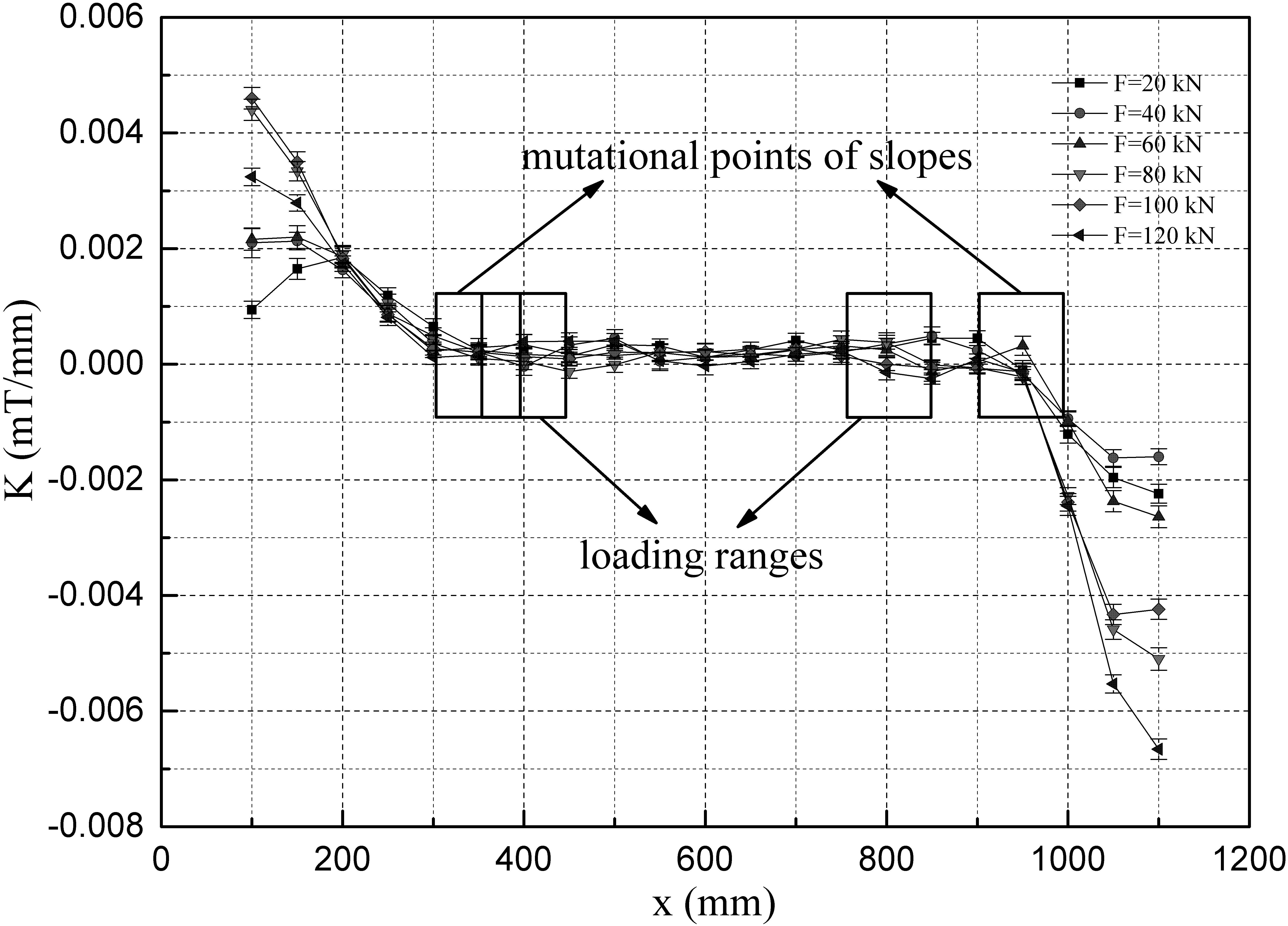
Figures 3 and 4 show the variation of magnetic field gradient
Figure 3 indicates that magnetic field gradient curve on the flange decrease monotonically along with measurement line. The variation of magnetic field gradient is slight, nearly close to zero in the pure bending region, whereas the magnetic field gradient in the non-uniform bending region shows an approximately straight line with negative slope. There exist mutational points of magnetic field gradient slope at interface of each region. Therefore, the mutational point can be used to preliminarily predict the position of concentrated load. However, this judgment criterion has a certain error. The mutational point is located outside of loading position. Further research should focus on magnetic field gradient curve of the web.
Distribution of gradient 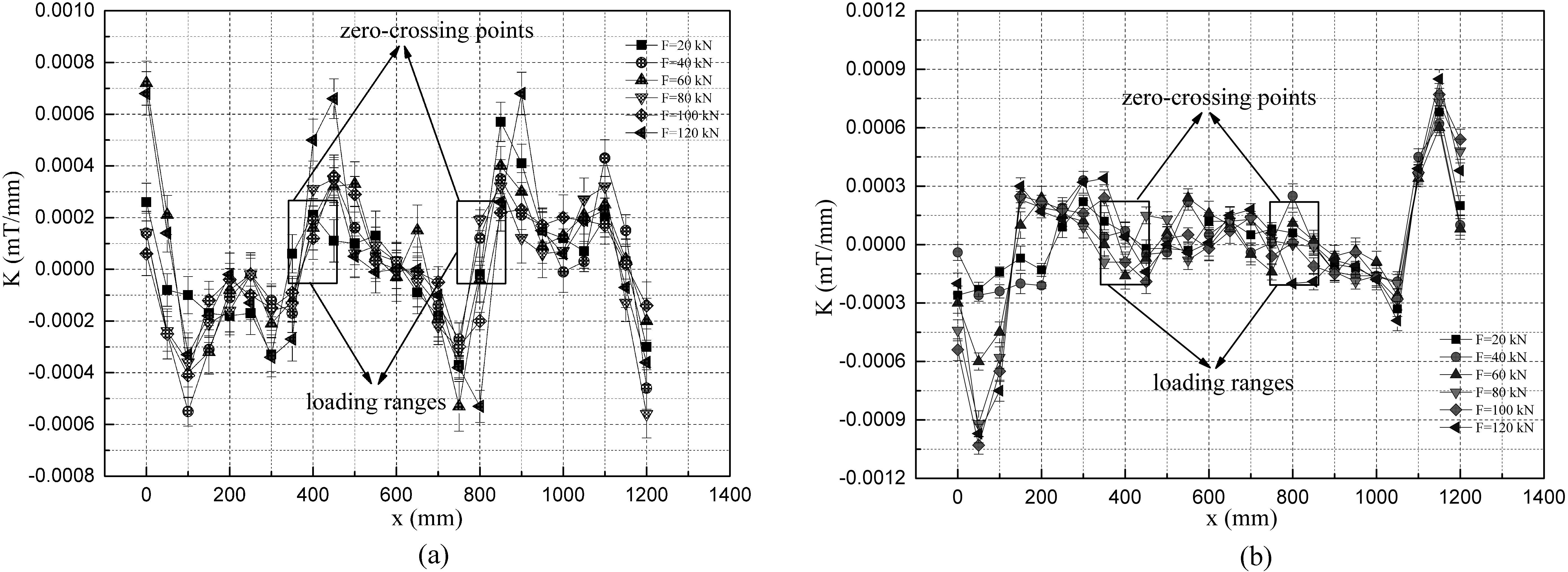
Figure 4 shows that the magnetic field gradient curve exhibits double peak-peak changes and passes through zero. To research the positional relationship between concentrated load and zero-crossing point of magnetic field gradient on the web, the statistics of zero-crossing points close to loading positions are listed in Table 4. For the zero point not on measurement point, the zero-crossing position is identified by linear interpolation method. According to Table 4, the zero-crossing positions on the left and right sides of magnetic field gradient along lines 1 and 5 are not fixed, namely occur zero drift. The drift of zero-crossing position mainly concentrates in the range that concentrated loads act over (360 mm–440 mm and 760 mm–840 mm). In addition, the average zero-crossing positions under different loads are all within the range of concentrated loads. Therefore, the zero-crossing position of magnetic field gradient on the web can be used to judge the position of concentrated load.
Characteristic parameters on the flange (F 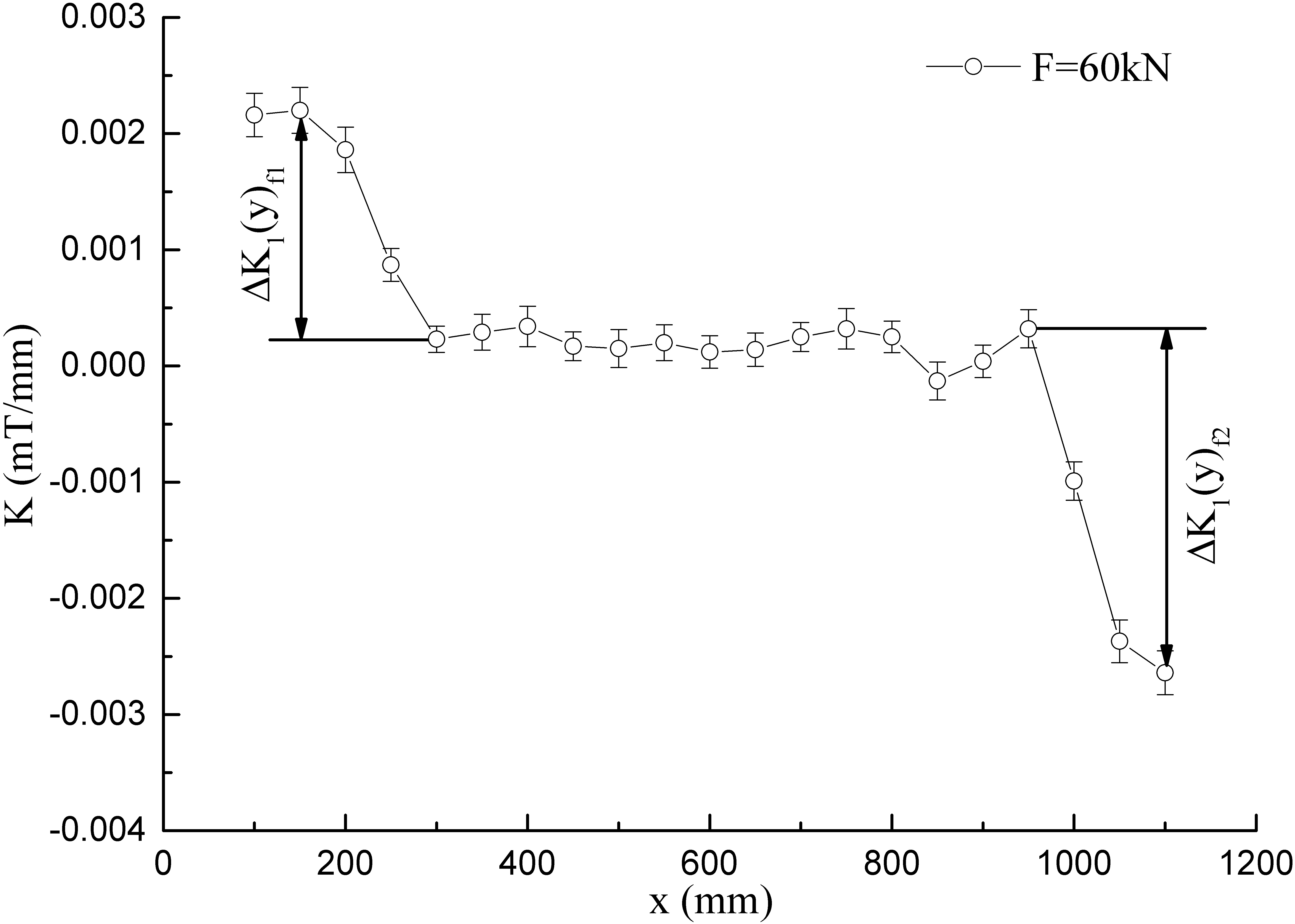
Characteristic parameters on the web: (a) measurement line 1 and (b) measurement line 5 (F 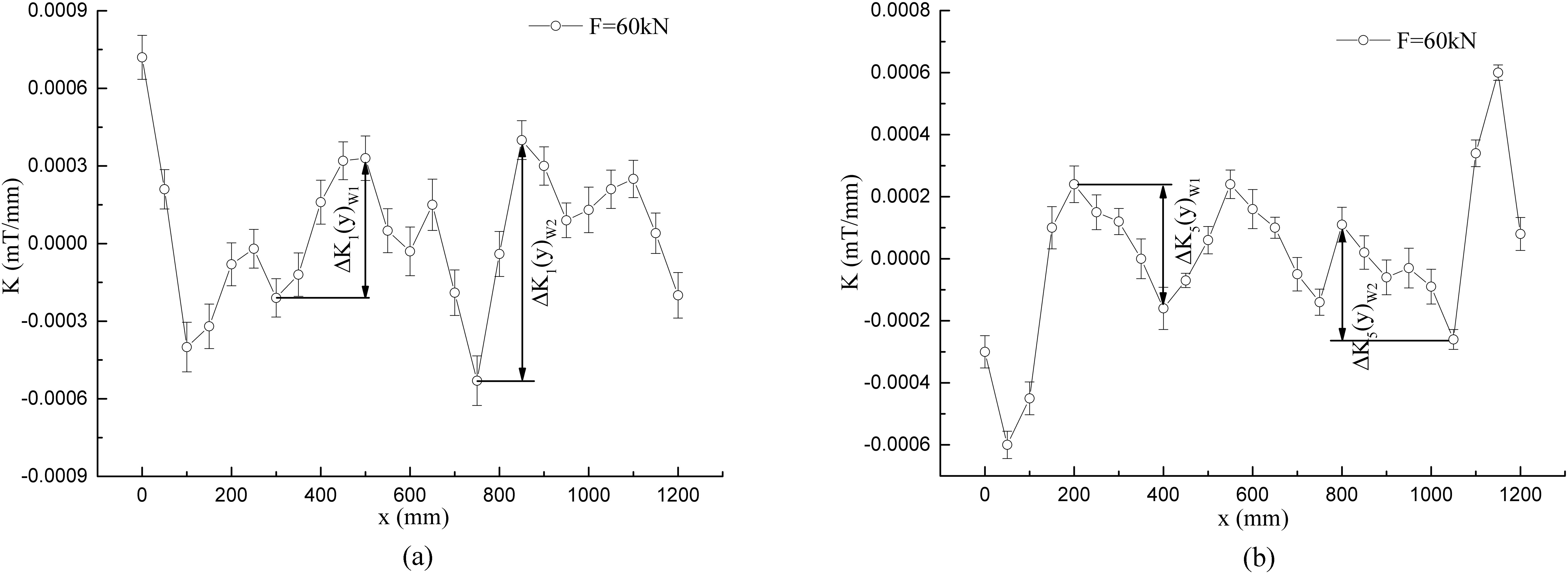
After the experiment, the deformations on both sides of specimen were observed. It is shown that the deformation of beam on the right in the stress concentration zone is greater than that on the left. Such a phenomenon is caused by eccentric compression of beam. The left and right loading values are not equal during the loading process. To explore the relationship between deformation degree of specimen and magnetic field gradient, several characteristic parameters of gradient curve are extracted as shown in Figs 5 and 6. Table 4 lists characteristic parameter values of magnetic field gradient under different loads. According to Table 4, it is obvious that the right average characteristic parameter values are greater than the left, which are consistent with the deformation degree of experimental result. However, the perform-
| Zero-crossing | Load (kN) | Average | |||||||||||||
|---|---|---|---|---|---|---|---|---|---|---|---|---|---|---|---|
| position | 10 | 20 | 30 | 40 | 50 | 60 | 70 | 80 | 90 | 100 | 110 | 120 | 135 | position | |
| Line 1 | Left | 421.2 | 342.3 | 350.0 | 373.6 | 398.2 | 371.4 | 359.5 | 365.6 | 377.9 | 371.4 | 361.8 | 367.5 | 329.4 | 368.5 |
| Right | 821.0 | 801.7 | 779.3 | 784.6 | 790.2 | 804.5 | 798.8 | 781.0 | 825.6 | 823.8 | 824.7 | 833.5 | 792.1 | 804.7 | |
| Line 5 | Left | 392.6 | 437.5 | 418.8 | 429.2 | 359.1 | 350.0 | 405.0 | 418.8 | 496.2 | 386.4 | 394.5 | 411.1 | 400.0 | 407.6 |
| Right | 800.0 | 850.0 | 861.4 | 850.0 | 807.1 | 778.0 | 812.5 | 800.0 | 740.6 | 804.2 | 728.8 | 761.5 | 761.1 | 796.6 | |
Characteristic parameter values of magnetic field gradient under different loads (
ance of magnetic field gradient along line 5 on the web is opposite, which is consistent with the phenomenon observed by Yi et al. [21]. The explanation for this phenomenon is that the supports were magnetized before the test, and the superposition between the magnetic signals along line 5 and the interference signals generated by the supports was occurred during loading process. Consequently, whether a specimen is under eccentric compression or not, can be determined by comparing average characteristic parameter values on both sides of specimen.
According to the previous analysis, the magnetic signals along line 5 on the web were affected by the two supports during the test, which is inconsistent with the actual behaviors. Thus, there are no analysis and discussion about magnetic field gradient along line 5.
Magnetic field gradient
where
where
Given that the web of steel beams are subjected to both bending stress
where
Therefore, Jiles-Atherton model is modified by replacing stress
where
Since the measurement lines on the flange are located at the extreme tension fiber of steel beam, all the measurement points are only subjected to bending stress
Stress diagram under bending load on the flange.
Figure 7 shows the stress diagram of the flange under four-point bending load (Because of symmetry, only left half is shown.). In the pure bending region, the stress value
where
where
The resulting magnetic field gradient
where
In the pure bending region, the reason why the magnetic field gradient curve resembles a horizontal line, nearly close to zero is that magnetic field gradient
Different loads only change the magnitude and do not change the variation trend of equivalent stress. Here, the specimen under F
Since the web of steel beam is subjected to both bending stress
where
Relationship between the calculated 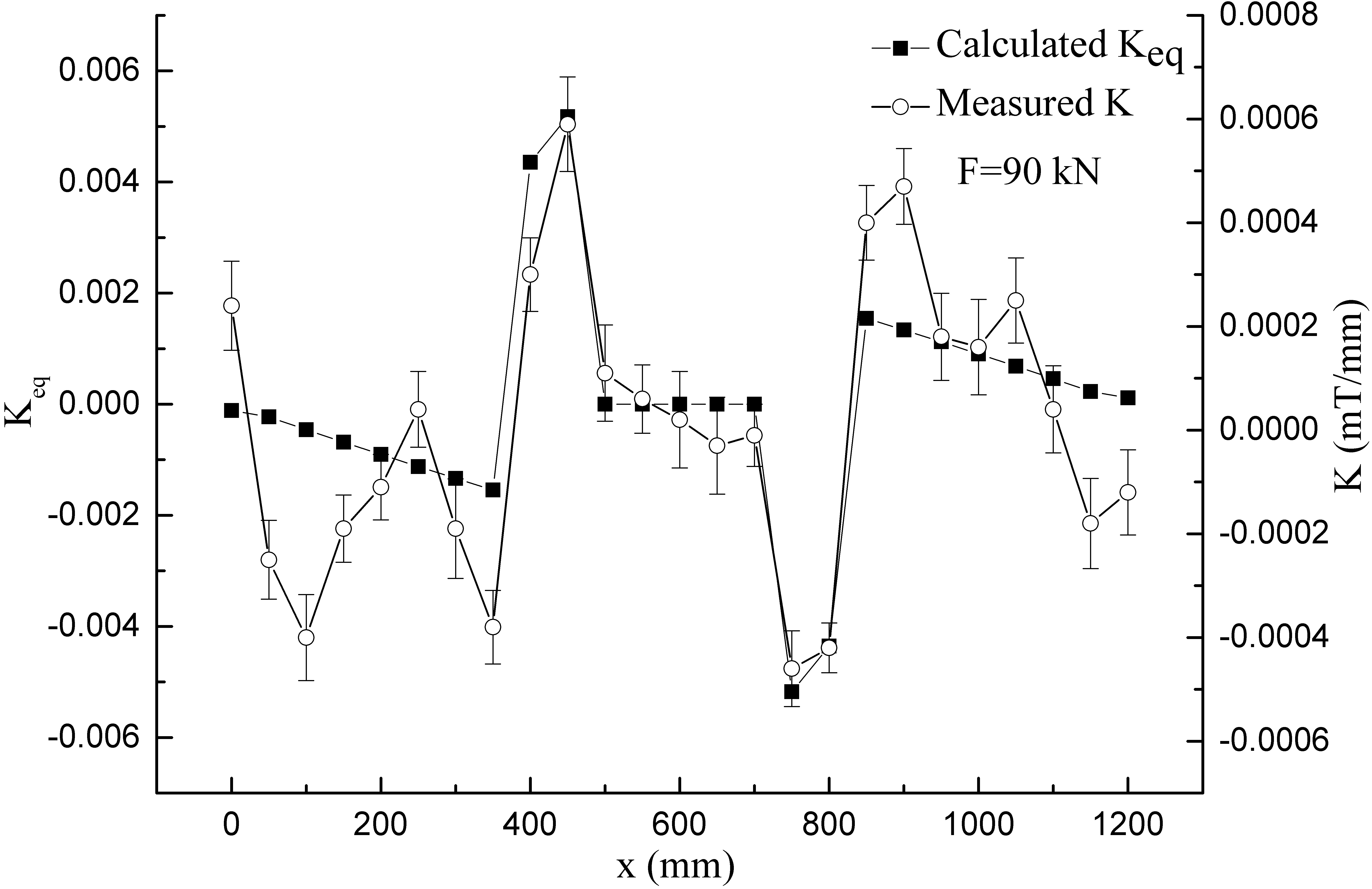
By substituting Eq. (18) into Eq. (12) and normalizing the calculation results, the distribution of calculated magnetic field gradient
Four-point bending tests of steel beams were conducted to analyze the influence of different loads on the values of magnetic field gradient. The characteristic parameter of magnetic field gradient is extracted. The possible reason underlying the distribution of magnetic field gradient is analyzed and discussed by modified Jiles-Atherton model. The following conclusions were obtained:
The magnetic field gradient curve exhibits the similar variation trend during loading process, which is centrosymmetric about the midpoint of measurement line. In the pure bending region of steel beam, the variation of magnetic field gradient is slight, nearly close to zero. In the non-uniform bending region, the magnetic field gradient shows an approximately straight line with negative slope. The position of concentrated load can be preliminarily predicted by the mutational point of magnetic field gradient slope on the flange and accurately judged by the zero-crossing position of magnetic field gradient on the web. Whether a specimen is under eccentric compression or not, can be determined by comparing average characteristic parameter values on both sides of specimen. The modified Jiles-Atherton model is constructed by replacing stress
Footnotes
Acknowledgments
The authors are grateful for the financial support received from the National Natural Science Foundation of China (No. 51578449, No. 51478383) and the General Programs of the Shaanxi Provincial National Science Foundation (No. 2015JM5192).