



Abstract
Light electric vehicles (LEVs) have attracted growing attention by the governments worldwide due to their advantages of zero emission, low noise and energy saving. Interior permanent magnet synchronous motor (IPMSM) is a popular choice for LEVs drive systems because of its high power density, excellent flux-weakening capability and high efficiency. The different rotor structures of IPMSMs can affect the performance of the LEV drive system. And their electromagnetic parameters play the decisive role on the control performance of the motor. In this paper, the conventional inset-type IPMSM and the V-shape IPMSM are designed and compared based on finite element method (FEM). Moreover, the field-weakening performances in these two topologies are studied. Besides, the prototypes with these two rotor structures are manufactured and tested to experimentally verify the correctness of the FEM analysis.
Keywords
Introduction
With the global energy crisis and environmental damage, electric vehicle (EV), especially the light EV (LEV), such as 2-seat golf car, multi-purpose farm vehicle, and 2-person patrol car, will be dominant in the future transportation to cope with the aforementioned problems. The drive motors for LEVs require the high power, high torque density, and high efficiency as well as good field-weakening capability [1, 2]. Compared with surface-mounted permanent magnet synchronous machines (SPMSMs), interior PMSMs (IPMSM) have higher PM utilization. The reluctance torque of IPMSM can be used sufficiently due to its flux path difference between
The rotor structure of IPMSMs significantly affects the machine performance, which can be optimized during the design process by selecting the proper dimensional parameters to extend constant power operation [4, 5, 6, 7]. In [8], the authors presented a method to improve the magnetic torque of IPMSM by adjusting the PM barrier shape. The results show that the shape of PM barrier is a key parameter to optimize the output torque. In [9], the electromagnetic characteristics of distributed winding PMSMs with five different rotor topologies are compared, it show that the
In this paper, two distributed winding IPMSMs with V-type and conventional inset-type PM rotors are designed and compared. The electromagnetic performances of the two machines are analyzed in detail in terms of the field-weakening and efficiency by using finite element method (FEM). The FEM predictions are experimentally validated by the measurements on two prototypes.
Prototypes and parameters
Figure 1 shows the rotor prototypes of the conventional inset-type PM and V-type PM IPMSMs respectively. The stators and windings of these two IPMSMs are identical for fair comparison of the electromagnetic performances. The main parameters of these two motors are listed in Table 1.
Two types of IPMSM prototypes with different rotor structures. (a). Inset-type IPMSM. (b). V-type IPMSM.
Main parameters of Two IPMSMs
No-load Flux density and EMF
The no-load field distributions and radial air-gap flux density waveforms of inset-type and V-type IPMSMs are depicted in Figs 2 and 3, respectively. It shows that the peak flux density of V-type IPMSM is larger than that the inset-type one, which implies that the V-type machine can obtain higher power density and torque density to improve the low-speed performance for EV drive.
No-load flux density distributions. (a). Inset-type. (b). V-type.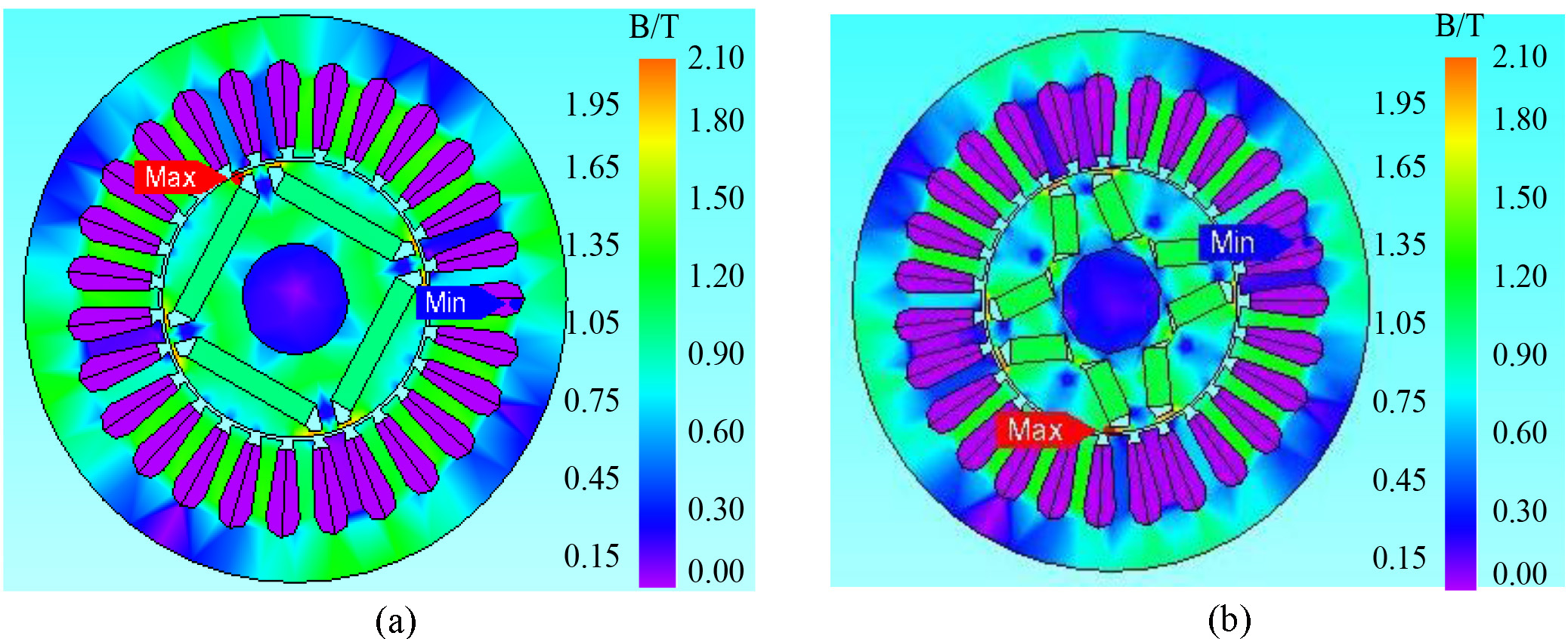
No-load radial air-gap flux density waveforms. (a). Inset-type. (b). V-type.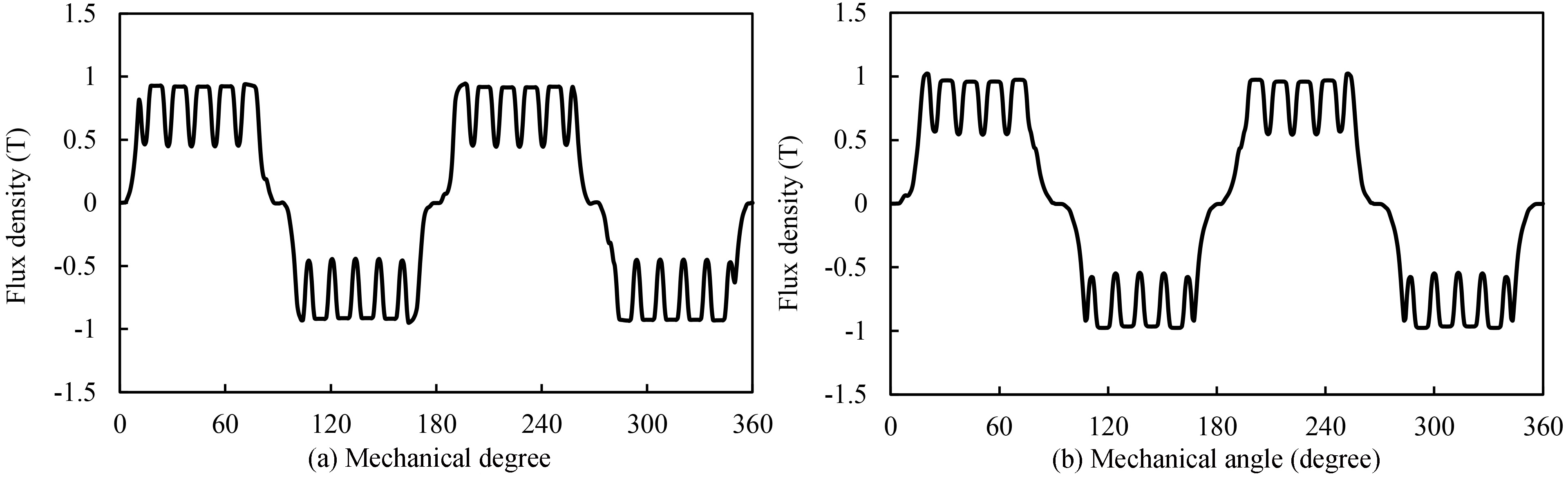
Generally, the ideal waveform of EMF in PMSM is sinusoidal. However, the PM magnetization direction, the winding design and the machining accuracy can bring the harmonic in EMF to cause the torque ripple. Moreover, this harmonic can also increase the harmonic loss to decrease the efficiency. The no-load EMFs of these two IPMSMs are shown in Fig. 4. By using transient FEM, the no-load EMF amplitudes of V-type and inset-type IPMSM are 200 V and 210 V respectively at rated speed 3000 r/min. As can be seen from Fig. 4, the EMF amplitude of V-type is higher than the inset-type, which is caused by the effective flux-concentration of V-type rotor.
No-load EMFs of two type IPMSMs. (a) Inset-type. (b). V-type.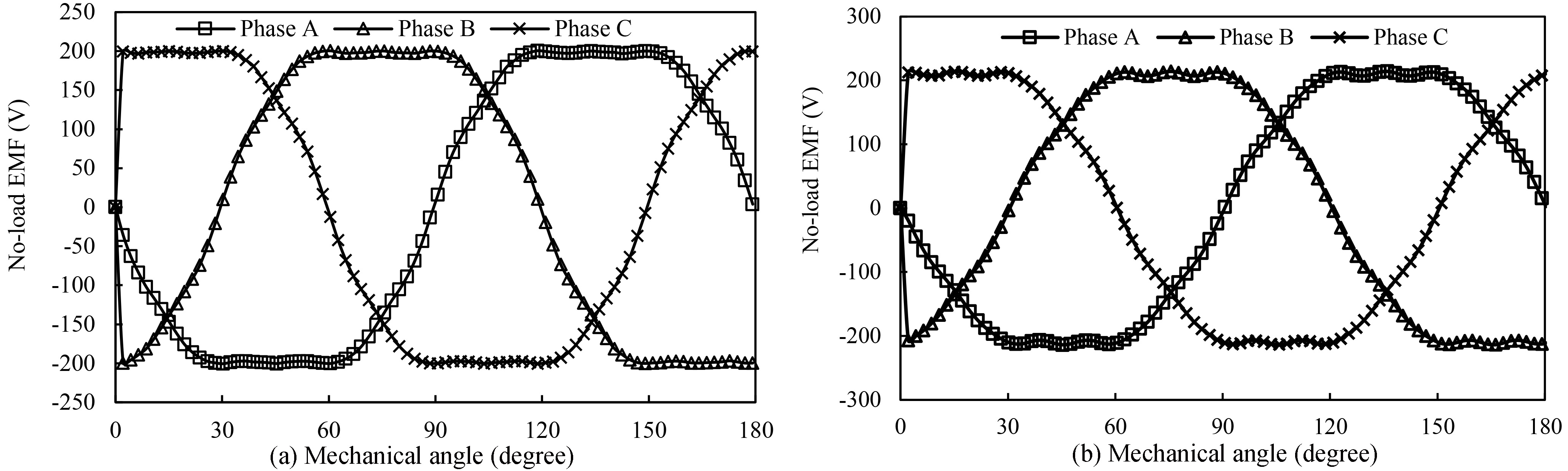
The harmonic of EMFs can be calculated by Fourier decomposition, which are shown in Fig. 5. The results illustrate that the V-type has lower THD (total harmonic distortion) than inset-type one, as listed in Table 3.
Fourier decompositions of two EMFs. (a). Inset-type. (b). V-type.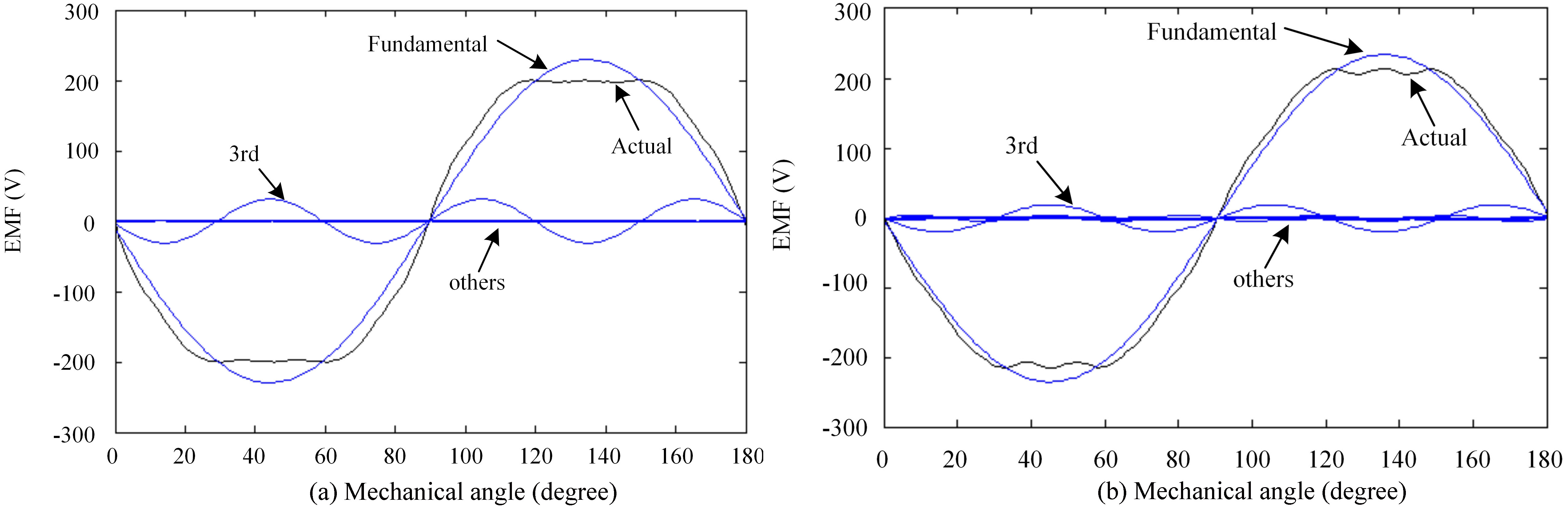
| Harmonic order | Inset-type IPMSM | V-type IPSM |
|---|---|---|
| 3 | 13.73% | 8.34% |
| 5 | 0.87% | 1.83% |
Peak cogging torque and torque ripple
The cogging torque is produced by the tangential force due to the interaction between the stator slots and PMs, which leads to vibration and acoustic problems at operation. To reduce the cogging torque, the slot skewing can be adopted in these two type IPMSMs [17].
Besides, apart from the cogging torque, there is an additional component contributing to the torque ripple under load, which is produced by the interaction between the MMF and the airgap flux harmonics. This component can be influenced by the geometry change of the machine design, such as the number of stator slots, the number of poles, the PM angle, and the slot opening width. Therefore, the airgap flux density distribution needs to be sinusoidal to reduce the torque ripple.
The cogging torques of these two IPMSMs are plotted in Fig. 6. It shows that the peak value of cogging torque of V-type IPMSM is larger than that of the inset-type one. The rated output torques of the two machines are shown in Fig. 7, which illustrates that the V-type machine suffers from higher torque ripple. The f peak cogging torque and output torque are compared as listed in Table 3.
Cogging torques of two type IPMSMs. (a). Inset-type. (b) V-type.
Rated output torque and torque ripple.
Salient rate and flux-weakening rate
The 
Speed-torque curves. Speed-power curves.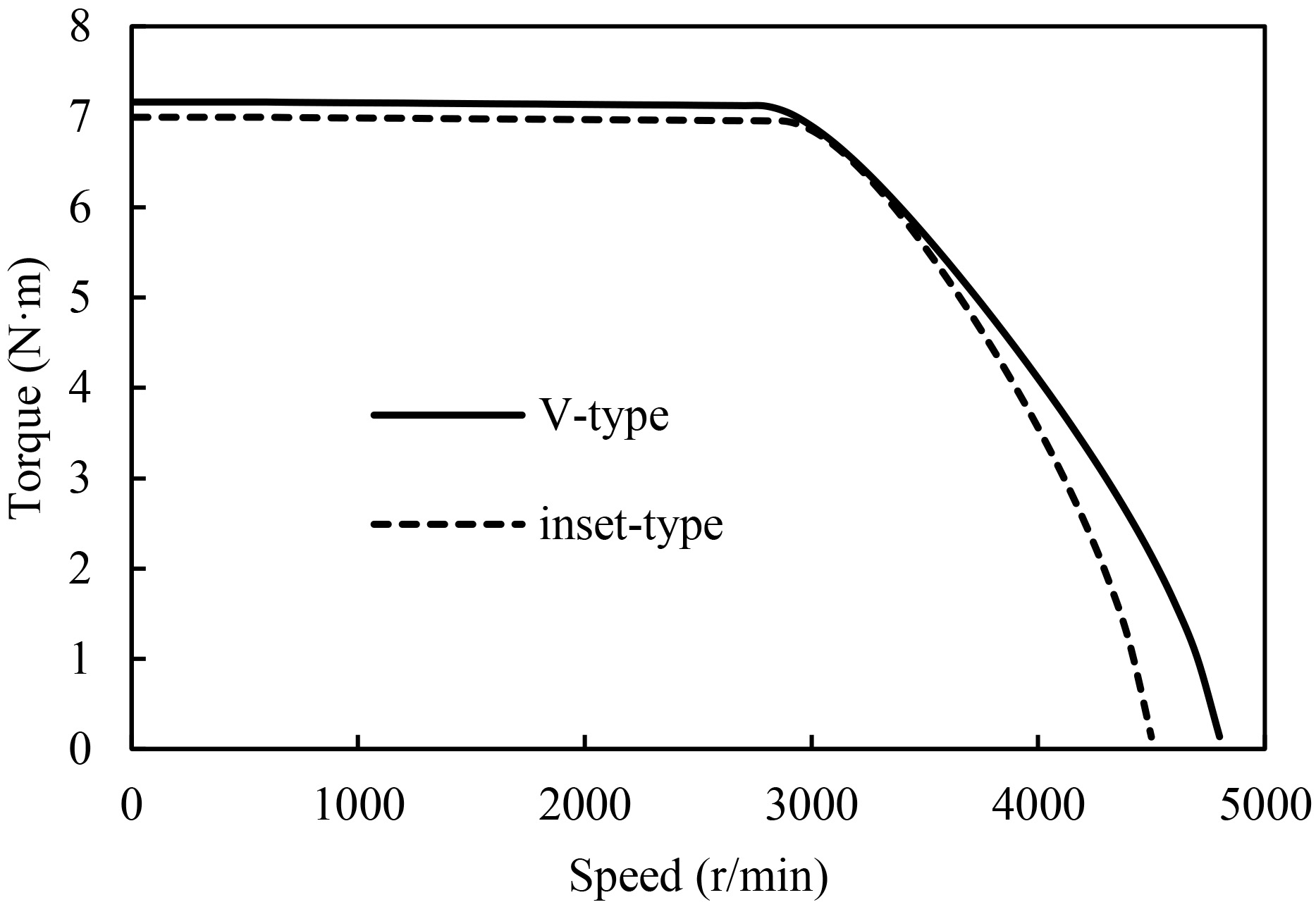

The speed range under constant power operation is determined by the field-weakening ability of IPMSM, which is significant for the EVs. This flux-weakening rate
where
In IPMSMs, the
Efficiency maps. (a). inset-type. (b). V-type.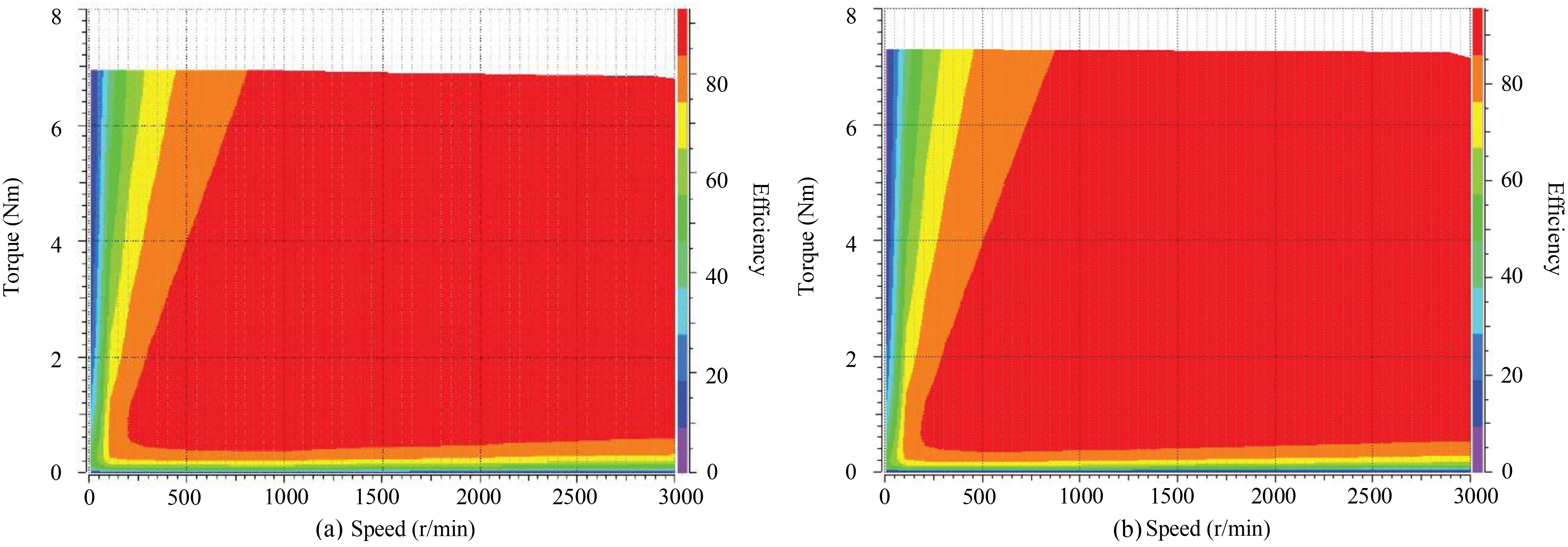
Experimental platform.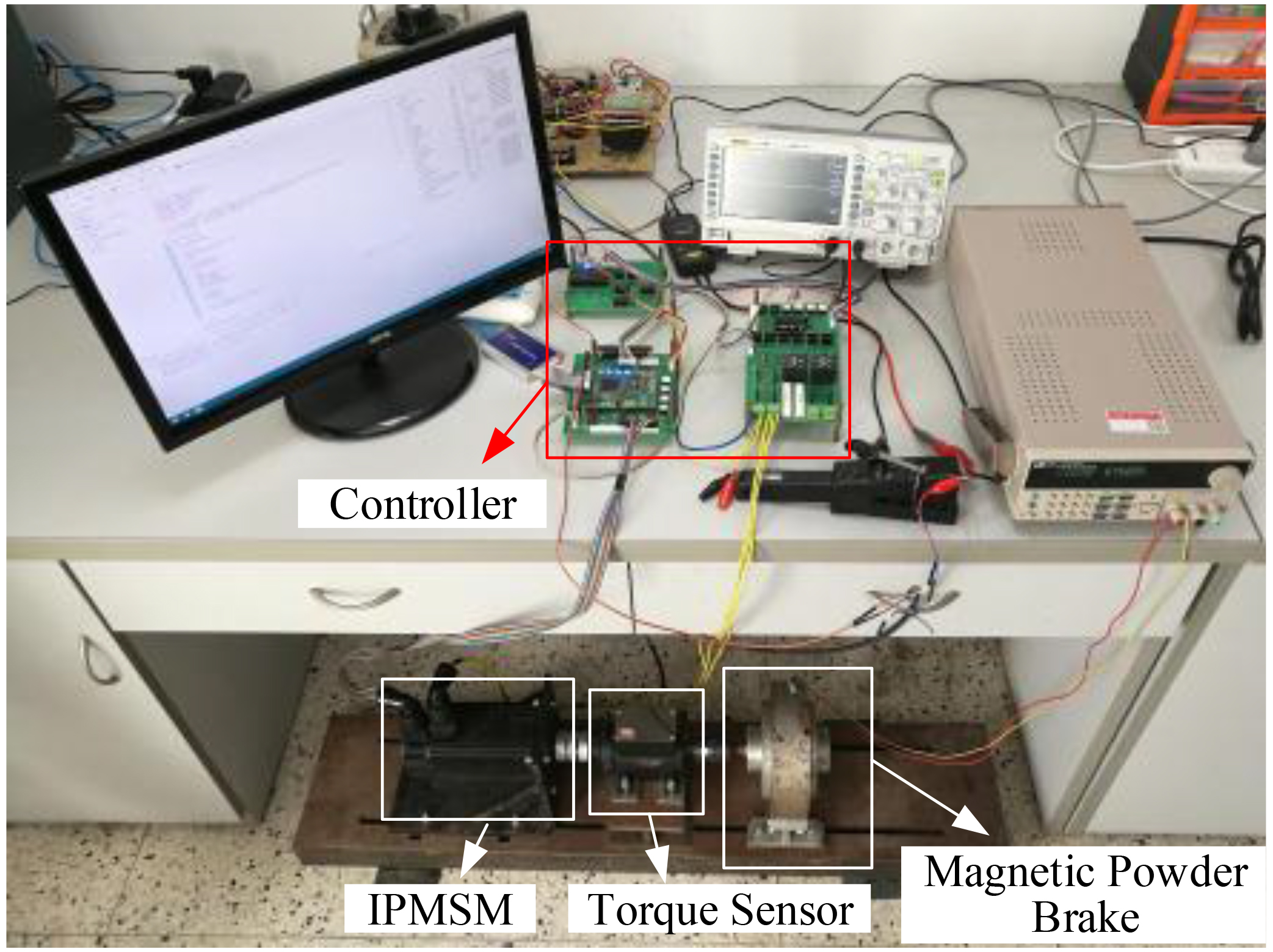
The torque/power-speed curves under the rated current of inset-type and V-type IPMSMs are depicted in Figs 10 and 10, respectively. The results illustrate that the field-weakening ability of V-type machine is better than that of the inset-type one to obtain a wider speed range. Therefore, the higher flux-weakening rate is helpful for the speed range extension under constant power operation.
The efficiency maps of the two IPMSMs with different speeds and torques are plotted in Fig. 11, the results show that the maximum efficiency of V-type machine is slightly higher than that of the inset-type one.
The experiment platform is built as shown in Fig. 12, which consists of the prototypes, the torque-speed transducer, the magnetic powder breaker and the control circuit.
The no-load line EMF waveforms of these two machines at the speed at 3000 r/min are obtained in Fig. 13. The no-load line EMF magnitudes of inset-type and V-type machines are 200 V and 210 V respectively, which are lower than the calculated results due to the skewing slot in the stator core and the assembly tolerance.
No-load experiment. (a). inset-type. (b). V-type.
The torque-speed curves of the machines can be obtained by on-load experiment, which is realized by changing the load torque and the
Torque-speed curves. Power-Speed curves.

In this paper, the electromagnetic characteristics of conventional inset-type and V-type IPMSM are compared by FEM and experiment. The effective flux concentration of V-type machine can suppress the harmonic components of back-EMF, and increase the back-EMF magnitude as well as the rated torque. Besides, the V-type machine shows better field-weakening ability to obtain a wide speed range and higher efficiency to satisfy the requirement of LEV. Two prototypes are manufactured to experimentally verify the FEM analysis, which are useful to the future machine optimization for applying in LEV.
Footnotes
Acknowledgments
This work are supported by the National Natural Science Foundation of China for Youth (51407094), the Natural Science Foundation of Jiangsu Province for Youth (BK20140785), the Scientific Research Project of Nanjing Institute of Technology (YKJ201534). And thanks Nanjing Scifine Electrical Technology Company Limited for manufacturing the prototypes.