



Abstract
In this paper, flexible piezoelectric devices (FPEDs) connected by springs are discussed with the aim of improving operational bandwidth of an energy harvesting system. A theoretical method, based on beam theory, electromechanical coupling and the transfer matrix method, is presented for calculating displacement and voltage responses. Validity of the presented method is discussed by comparison with experimental results, which are obtained from coupled FPEDs excited by a shaker. The effects on system behaviour of attaching springs is discussed based on both the presented method and experimental results.
Keywords
Introduction
Energy harvesting methods that use functional materials have been developed in recent years to take advantage of an abundant but underutilized energy source [1]. Vibration energy harvesters, which utilize vibrations to generate electric power, typically comprise a piezo-ceramic material and steel [2,3]. The authors of this paper have previously proposed an energy harvester, called a flexible piezoelectric device (FPED), consisting of a piezoelectric film (PVDF) and soft materials, such as silicon rubber and PET [4–8]. The majority of vibration energy harvesters work most effectively near their resonant frequency. However, the frequency band for ambient vibration energy is typically broad, so practical use depends on development of technologies for harvesting broadband energy. For example, the vibrational acceleration of a vehicle engine, an abundant source of vibration energy, ranges from 1 to 20 ms−2, and its frequency ranges from 50 to 100 Hz [9].
Many designs and techniques for broadband energy harvesters have previously been proposed and can be found summarized by Lihua Tang et al. in [10]. Zengtao Yang et al. have presented numerical results obtained from two piezoelectric energy harvesters connected with a spring, and discussed the possibility of broadband energy harvesting using springs [11].
A simple and effective means to improve the active range of an energy harvesting system, whilst considering manufacturing costs, is the use of energy harvesters coupled via springs, where each harvester has a distinct natural frequency. In this paper, we discuss FPEDs connected by springs and present a theoretical evaluation method for evaluating the operating displacement and voltage based on beam theory and the transfer matrix method. The validity of the presented method is demonstrated by comparing the results of the presented method and experiments performed using a shaker and three spring-coupled FPEDs. The effects of attaching individual energy harvesters with springs, from the viewpoint of both the presented method and experimental results, is also discussed.
Theoretical evaluation method
Introduction
Developing a reliable theoretical evaluation method for the prediction of system dynamics and power generation performance is important in cost effectively designing and optimizing a FPED. One possible evaluation method is finite element, however, when an ultrathin film is included in the structure of the FPED, modeling via this method becomes highly complicated and time consuming. For a basic shape of energy harvester, the method which can provide accurate results in short computational time is beam theory, and therefore this is the method which will be considered in this paper.
Figure 1 shows a schematic representation of FPEDs connected by springs. In this section, a theoretical evaluation method, considering both electro-mechanical coupling from the piezoelectric material and coupling forces from connecting springs, is introduced. Figure 1 shows the basic composition of a FPED. The FPED is comprised of flexible materials (silicon rubber, PET and etc) and a piezoelectric film (PVDF).
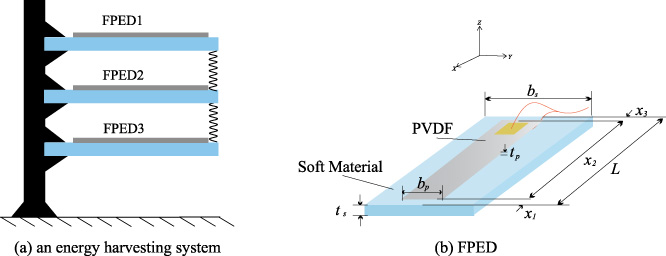
FPEDs connected by springs and the basic composition of FPED.
In this study, it is assumed that the FPED behaves and can be modeled as a beam structure. The equation of motion for the q
th mode of a single energy harvester [6] can be written as
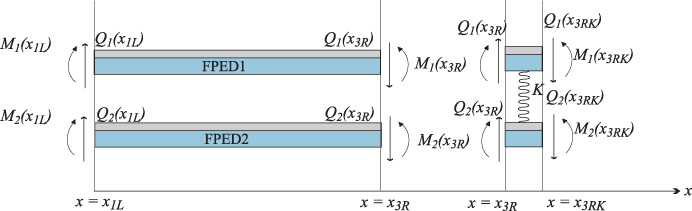
Schematic diagram of the shear force and the bending moment for 2 FPEDs connected with a spring.
The electrical circuit of piezoelectric material can be written as
Experimental setup and FPEDs
Figure 3 shows a representation of the experimental setup. The support condition of each FPED is cantilevered and the clamping structure is attached to a shaker. Springs are installed to connect the FPEDs at their free end. An accelerometer is used to control the amplitude of the acceleration, and a laser displacement sensor is used to measure the displacement of the FPEDs. A voltmeter with an internal resistance of 1 MΩ is used to measure the output voltage of the FPEDs. To obtain the frequency response function, a fast Fourier transform is applied to a time series data with enough period for each excitation frequency. The excitation frequency is swept across a range using increments of 1 Hz with maintaining the constant acceleration of the base.

Experimental setup.

Composition and geometry of FPED1, FPED2 and FPED3.
Figure 4 shows the composition and geometry of each FPED. The FPEDs used in this study are of unimorph configuration. The anisotropic principal axis of the PVDF lies along the length of the FPED. The natural frequencies of FPED1, FPED2, and FPED 3 are 47.1 Hz, 49.2 Hz, and 51.2 Hz, respectively, and are altered by changing the thickness of the adhesive layer. The sizes of the PVDFs are determined by considering impedance matching, with ratio, 𝛼, representing the impedance of the PVDF to the impedance of external load. Since the external load is the constant value, 1 MΩ, in this study, 𝛼 depends on the connection: 𝛼 is 1.000 for the series connection case, and 0.114 for the parallel connection case. Therefore, it is expected that the series connection will show better harvester performance, and this expectation will be discussed in Section 3.2.
Figure 5 shows both the experimental results and the theoretically predicted results for the FPEDs, which are not connected with springs. The acceleration in this case is 10 ms−2. The voltage amplitude is obtained by applying a fast Fourier transform to the time series data of the output voltage. To conduct the theoretical evaluation method, the measured dimensions shown in Fig. 4 and the material constants of PVDF E p = 3.5 GPa and d 31 = 20 pCN−1 are used [8]. As shown in Fig. 5, the theoretically predicted results agree well with the experimental results. It is also observed from the figure that the power of the series connection case shows better energy harvesting performance when compared with the parallel connection case because of the impedance matching as predicted in Section 3.1. The output voltage of the series connection is not equal to the sum of the output voltage of the individual FPEDs because of the existence of the capacitance of the PVDF.

Experimental and theoretically predicted results for the voltage generated by individual FPED, and voltage when FPEDs are connected in parallel and series without springs.
Figure 6 shows theoretically predicted results superimposed by experimental data when FPEDs are connected via 2 springs each with a mass of 4.2 g and spring constant of 490 Nm−1. As in the case without springs, good agreement is also achieved. The inclusion of springs adds mass to the FPEDs and therefore the natural frequency of a coupled system is seen to reduce; a phenomenon captured by the model. More importantly, when comparing with independent device behavior, although the peak output voltage increased when coupling devices, the active area decreased, from 6.6 Hz to 3.3 Hz, due to the spring being overly rigid causing devices to move in unison (strong coupling). Figure 7 shows the mode shape, obtained from the theoretical model, for this configuration. As shown in this figure, the devices move in unison and this result supports the experimental results shown in Fig. 6.
Figure 8 shows comparisons in harvester performance when using different springs; one with a spring constant of 90 Nm−1 and a mass of 0.7 g, and another with a spring constant of 490 Nm−1 and a mass of 2.1 g. Again, good agreement between the theoretical model and experimental data is obtained. As expected, (i) the dominant resonant frequency when using the 2.1 g spring is lower than that when using the 0.7 g spring, and (ii) the maximum output power with the heavier spring is larger in comparison to that obtained with the lighter spring. This improved performance is likely to occur as a result of the tip mass effect whereby the springs are acting as tip masses, hence increasing system deflection. This result highlights that spring selection will greatly affect the behavior an energy harvesting system comprising of spring coupled FPEDs.

Comparison of experimental and theoretically predicted results when FPEDs are electrically connected in series with and without springs (490 Nm−1, 2.1 g).
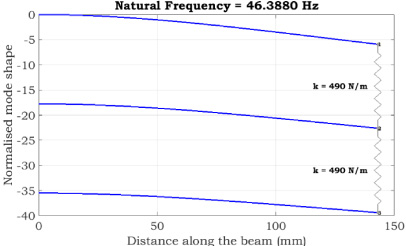
The fundamental mode shape for FPEDs connected via springs (490 Nm−1 and 2.1 g). Generated by the presented theoretical method.
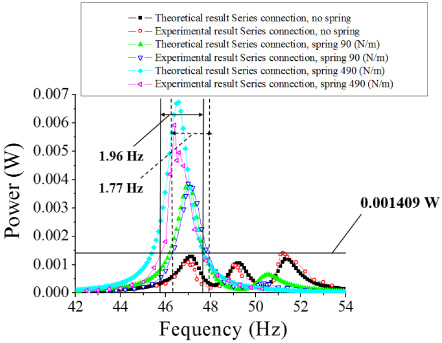
Experimental and theoretically predicted results of power when FPEDs are connected by springs with various spring constant and mass.
Figure 9 shows the theoretically predicted output power when using n FPEDs with and without springs. The difference in the natural frequency between FPEDs is approximately 0.5 Hz. The results obtained without any spring connection between devices show an improvement in operational bandwidth, however, the overall maximum power level is rather low. In contrast, the results obtained from spring coupled devices, show vast improvements in the maximum output power with increase at least 4 fold in comparison to the non-coupled case. Although it is not the case in this example, the operational bandwidth can be also improved, however, this improvement is strongly influenced by the mass of spring. As shown in Fig. 9, the installation of springs will both increase the output power of an energy harvesting system, and modify the resonant frequency of the energy harvesting system.
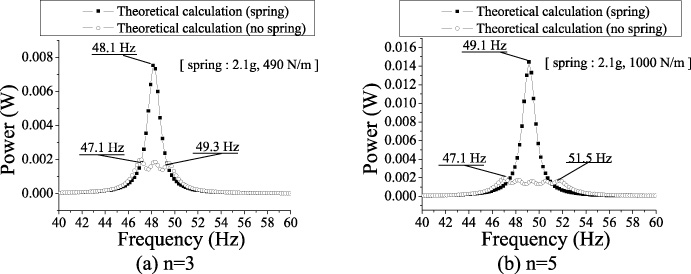
Theoretically predicted results for the output power when using n FPEDs.
In this paper, flexible piezoelectric devices (FPEDs) connected by springs are discussed with the aim of improving operational bandwidth of an energy harvesting system. A theoretical method, based on beam theory, electromechanical coupling and the transfer matrix method, is presented for calculating displacement and voltage responses. Validity of the presented method has been confirmed through the comparison between the experimental and the theoretically predicted results. Conclusions of this study can be summarized as follows:
The operational bandwidth of an energy harvesting system can be improved by increasing the number of FPEDs, and it is preferable that the difference in natural frequencies between devices is small. Attaching springs will affect system behavior and causes maximum output voltage to increase and the natural frequency of the system to decrease. A hard spring with a tuned mass is preferable for the improvement of maximum output power whilst only causing small changes in the natural frequency.
Footnotes
Acknowledgements
This research was supported by JSPS KAKENHI Grant Number JP15K06685.