



Abstract
A novel neural electrode based on small-deflection theory to reduce the tissue injury caused by micromotion was designed to improve the lifetime of neural electrode. The results of the finite element analysis revealed that the novel neural electrode showed excellent micromotion-attenuation capability. And designing a reasonable size of opening area can effectively improve neural electrode-brain tissue interface mechanical states. The novel electrode is inferred to prolong the lifetime of neural electrodes.
Introduction
Neural electrodes have a wide range of applications in both clinical practice and experimental research, such as neurosurgical treatment for chronic pain, Parkinson’s disease, tremors and dystonia [1–3]. As the interface between the brain tissue and the external device, neural electrode is the key component in the neural recording and stimulating system. However, the lifetime of recording and stimulating neural prostheses is quite short, usually less than a month. Even though some researchers have achieved neural recording for a period of several months [4–6], it still cannot meet practical requirements.
Many studies have been conducted on increasing the long-term stability of neural electrodes. In the vivo experiments, the sustained reactive response, will progressively lead to device failure over the long term [4,7]. In this process, inflammation, astrocyte proliferation, reactive astrocytes and the growth of astrocytes lead to the encapsulation [8]. Other possible causes for encapsulation include poor biocompatibility of the implanted substrate material, chronic contact with the meninges, and especially the relative micromotion between the neural electrode and the brain tissue, which is one of the most important factors underlying the long-term success of an implanted electrode [9,10].
Three main micromotion sources were investigated in previous studies: (1) mechanical sources, which include the vibrations transmitted to the electrode via its attachment system with the skull, (2) behavioral sources, which comprise movements of the entire body, and (3) physiological sources, which include the cardiac rhythm and fluctuations in respiratory pressure. Surface micromotion displacements in anesthetized rats have been observed to be 2–25 μm due to pressure changes during respiration and 1–3 μm resulting from vascular pulsations [11,12]. In this work 3 μm was selected as the displacement applied to simulate the micromotion.
The focus of previous studies on electrode technology was mostly on improving the biocompatibility of the material or designing a flexible electrode to reduce the negative impact of the micromotion [6,13]. Some researchers, such as Jonas Thelin, Henrik Jorntel, found that the brain tissue response increases when implanted devices are tethered to the skull [14]. However, the importance of the method as how the neural electrode connected with the skull attracted few notices. Thus, we designed a novel neural electrode based on small-deflection theory, which is assumed to improve the stress conditions of the interface between the electrode and the brain tissue.
In recent years, there are more and more applications of small-deflection in structure engineering, such as flexible large-span bridges, buildings and other structures with plate and shell structures under moving loads and seismic loads [15]. As other successful cases of using thin holes on engineering modification designs, it is assumed that the damping thin plate can be applied to the rational design of neural electrodes. And the damping effects can be optimized by designing the openings of neural electrodes.
Thus, the aim of this study is to design a neural electrode with a square hole, which has capability of vibration attenuation based on small-deflection theory. The novel neural electrode is supposed to greatly reduce the vibration, which is validated by numerical simulation method. This design is significant for improving the stability of neural electrodes in a long term and increasing the survival rate of the implants.
Materials and method
Preliminary design
The novel neural electrode was designed based on the geometry of a common silicon-substrate single-shank electrode, using the computer aided design software Pro/ENGINEER’s Wildfire 5.0 (Parametric Technology Corporation, US). The electrode A1x16-3mm-50-177 (Neuro Nexus Technologies, Ann Arbor, MI) model was chosen to be the reference electrode (sampled E0) because of its widespread use for both chronic and acute recording. The geometry model of the reference electrode was illustrated in Fig. 1.
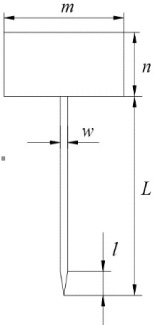
The electrode A1x16-3mm-50-177 model.
The thin plate refers to the object whose thickness is much smaller than the length and width. The aim of deflection theory is to study the internal stress states of the thin plate under external loads. The intermediate surface and the thickness of the sheet are the main geometric characteristics of thin plates. According to the thin plate geometry, when the deflection of thin plate is less than 1/5 the thickness of the thin plate, the problem is usually defined as a small deflection case.
According to the external load and geometric form, external lateral loads, the thickness is much smaller than the width of the flat sheet, some minor factors can be ignored. With the introduction of some of the basic assumptions deflection, plate bending mechanic model can be abstracted. Kirchhoff basic assumption is the basis of small-deflection theory. The openings were evenly distributed on the plate as the opening width of a, length b of the square hole, the hole spacing and hole length is the longitudinal direction.
The openings were evenly distributed on the plate as the opening width of a, length b of the square hole, the hole spacing and hole length is the longitudinal direction, from the side of l∕2. Beam bending moment acts pure V , provided its overall length L = (n +1)l, one end fixed boundary conditions, free end, as a classic cantilever.
Based on material mechanics, the displacement of the cantilever end shear strain and shear was generated:
The strain can be shown as
As the stress Δ = 𝛾L
C
, the below equation can be obtained by the principle of virtual work F:
In pure bending moment deflection equation:
The deflection ratio is examined to be
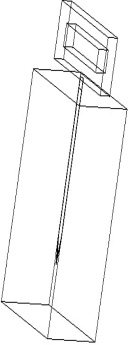
The 3D finite element models of the electrode-brain tissue interface.
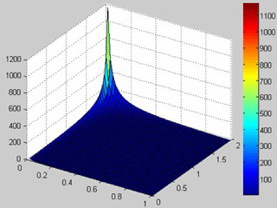
The relationship between the opening size and the deflection ratio.
The 3D models of the electrode-brain tissue interface were developed in Pro/ENGINEER’s Wildfire 5.0, which is illustrated in Fig. 2. In this study, it is assumed that the neural electrodes are implanted in brain. Each model has two components: a single-shank electrode and cortical brain tissue. Assuming that the strain effects are expected to be localized near the electrode, the geometric representation of the brain is limited to the region surrounding the electrode. The boundaries of the brain model are defined to have sufficient distances from the microelectrode to avoid the disruption of the strain field. The dimensions of the electrode are a = 0.1 mm, b = 1.4 mm (sampled E1); a = 0.2 mm, b = 1.4 mm (sampled E2); a = 0.4 mm, b = 1.4 mm (sampled E3). Then the 3D finite element models of the electrode-brain tissue interface were developed in ANSYS 11.0 (ANSYS, Inc., Canonsburg, PA) with the general format IGS which devised from the 3D model. In static analysis, we applied the displacement Δ = −3 μm along longitudinal (Z-axis) to simulate the micromotion. The silicon-based electrode was simulated based on a linear elastic model with a Young’s modulus of 200 GPa, a Poisson’s ratio of 0.278 and a density of 2.34 g/cm3 [11,12] while the brain tissue was considered to be linear elastic and nearly incompressible for the static analysis [11].
At the initial status of the simulation, the surfaces of the electrode and brain tissue are in contact with each other. The interface between the brain and the electrode is created using ANSYS Contact Manager: the electrode is assigned as the rigid part of the model and the brain is assigned as the flexible part of the model, and the interface adhesion condition was simulated with the friction coefficient of 0.05 [11].
Results and discussion
Static analysis with a linear elastic brain model was conducted to investigate the effects of the novel neural electrode.
Table 1 shows the effects of hole sizes on the stress in brain tissue. A longitudinal (Z-axis direction) displacement Δ = −3 μm was applied on the electrode. The results of FEA showed that the maximum Von Mises stress of the brain tissue model was 437.808 Pa as to E0. With novel electrodes, the maximum stresses of the brain tissue were decreased to 294.982 Pa, 282.4 Pa and 292.201 Pa for E1, E2 and E3, respectively.
The maximum Von Mises stress of the brain tissue model
The maximum Von Mises stress of the brain tissue model
The maximum Von Mises stress of the novel neural electrodes
The maximum von Mises stress caused by the novel electrodes based on small deflection theory showed significant reduction in brain tissue compared to the reference electrode. The results showed that the stresses in brain tissue decreased by 32.6%, 35.5% and 33.3% for E1, E2 and E3. And with the changes of the opening area, the maximum von Mises stress in brain tissue varied a bit. It is supposed that the modification of the electrode caused the electrode to be more deflected compared to the reference electrode under micromotion, which is good for the tissue stress reduction.
The effects of neural electrode models on the tissue stress were shown in Table 2. A longitudinal (Z-axis direction) displacement Δ = −3 μm was applied on the electrode. The maximum Von Mises stresses of E0 was shown in Table 2 as 6794.3 Pa. The maximum stress of the novel neural electrodes were 5153.21 Pa, 4381.65 Pa and 4487.94 Pa, respectively for E1, E2 and E3.
The maximum von Mises stress of the novel electrodes based on small deflection theory showed a significant reduction. The results showed that the stress in brain tissue decreased by 24.2%, 35.5% and 33.9% for E1, E2 and E3. And the maximum Von Mises stresses of the electrodes varied with the change of the opening area. The impact of the opening area of the novel electrode on the stress in brain tissue are smaller than E0. It is assumed that the greater the area of the opening is, the greater the deflection will be, which then causes lower stress in the tissue and electrode. However, if the cross section area decreases to the critical point, the electrode could not be considered as a small disk any more. At the same time, the small deflection theory is unsuitable to the novel electrode.
Von Mises stress of the brain tissue and the electrode is considered to be the most important parameter. That is because the higher stress means severer injury. It can be inferred that the novel electrode with the opening area of a = 0.2 mm, b = 1.4 mm is the optimal solution among the four electrodes, because E2 can guarantee that the maximum stress in brain tissue and neural electrode is relatively minimal (both reduced by 35.5%).
Therefore, the novel neural electrode is expected to have the effective vibration reduction capability, reducing the damage to brain tissue. As a result, the lifetime of the electrode is supposed to be extended. At the same time, the new vibration reduction structures based on small-deflection theory can be manufactured on the plane of the electrodes, which are expected to be widely used to optimize the design of electrode in the future. Moreover, experiments are underway in our lab to verify the effectiveness of this design.
In summary, based on small-deflection theory, the novel neural electrodes can significantly improve the brain tissue-electrode interface mechanical states. The new vibration reduction neural electrode structure with sufficient mechanical properties can effectively improve von Mises stress distributions of the electrode-brain contacts under different micromotion environments. The opening area can help to reduce the maximum stresses in brain tissue by 32.6%, 35.5% and 33.3% for E1, E2 and E3, while the maximum stresses in neural electrode decreased by 24.2%, 35.5% and 33.9% for E1, E2 and E3.
Therefore, the novel neural electrode is expected to have the effective vibration reduction capability, to reduce the damage on brain tissue. And the life of the electrode is presumed to be extended. At the same time, the new vibration reduction structures based on small-deflection theory can be manufactured on the plane of the electrodes, which are expected to be widely used to optimize the design of electrode in the future.
Footnotes
Acknowledgements
The authors gratefully acknowledge the financial support from the National Natural Science Foundation of China (Grant No. 51675330) and the AEMD (Center for Advanced Electronic Materials and Devices, Shanghai Jiao Tong University) for their generous help to fabricate the electrode models.