



Abstract
The proposed study analyzes the cogging torque of a single-phase BLDC motor with a tapered air-gap through use of a proposed analytical method with asymmetric slot function. Usefulness of the proposed analytical method was confirmed via comparison of cogging torque characteristics predicted through use of the proposed method against those predicted by 2-D finite element analysis as well as those observed experimentally.
Keywords
Introduction
Single-phase brushless DC (BLDC) motors are widely employed in blowers used in ventilation systems and home appliances owing to their high efficiency and cost effectiveness. Single-phase BLDC motors with a uniform air-gap are inherently non-self-starting, since they possess coincident zero-torque positions of excitation. Consequently, making single-phase BLDC motors self-starting requires adoption of an asymmetric air-gap [1,2]. On the other hand, presence of an asymmetric air-gap results in significant increase in the cogging torque [3,4].
Conventional methods for reducing the cogging torque of single-phase BLDC motors include changing the length of the air-gap, permanent magnet (PM) asymmetry arrangement, skew of the stator or rotor, and changing the shape of stator teeth. Some papers have reported reductions in the cogging torque of single-phase BLDC motors obtained via induction of changes in the air-gap profile through considerations of tapered teeth profiles and changes in teeth trailing edge geometries [5,6]. In this study, the cogging torque was reduced by applying the method varying the air-gap whilst considering aspects manufacturing and cost [7]. The most accurate technique for analysis of cogging torque involves use of finite element analysis (FEA). This method, however, suffers from disadvantages in that the modeling must be executed by the user, and that the analysis requires a long completion time [7].
When designing BLDC motors, it is necessary to understand trend results of variable parameter values, so it needs a lot of analysis, examination to select appropriate parameter values and extract the results. Therefore, it requires different method with FEA which takes long analysis time.
It trends to use analytical method for obtaining rapid analysis results and appropriate accuracy according to the shape of each motor, and studies are being progressed to improve it [8–10].
The analytical method proposed in this study applies a tapered air-gap to facilitate cogging-torque analysis of single-phase BLDC motors. To calculate the magnetic flux density, a stator slot function was applied to mathematically represent the tapered air-gap followed by calculation of the spreading permeance function to be applied in the analysis of the cogging torque. Results of characteristic analysis of the cogging torque were compared against those obtained via FEA to verify the proposed analytical method.
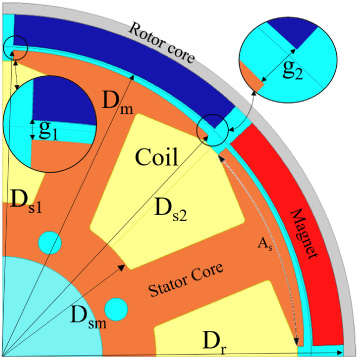
Single-Phase BLDC motor.
Parameters of the 8 pole, 8 slot SPM motor
Figure 1 depicts the model shape used during analysis, and the difference between pore lengths is depicted as g1 and g2. A surface-mounted permanent magnet (SPM)-type single-phase BLDC motor with an external rotor was used in this study. The pole-slot combinations comprised 8 poles and 8 slots. External diameter of the motor measured is 94 mm. Detail specifications of the motor are listed in Table 1.
Several papers like [11] and [12] have studied the theoretical basis of the cogging torque. The cogging torque is the amount of energy variation according to the amount of rotor rotation and can be expressed using Eq. (1).
For SPM-type BLDCs, the greatest energy change occurs within the air-gap. Therefore, only the energy within the air-gap is considered when calculating the cogging torque. This air-gap energy can be expressed as described in Eq. (2) to calculate its value from the air-gap magneto-motive force and air-gap permeance functions—

Tapered teeth and R s (θ).
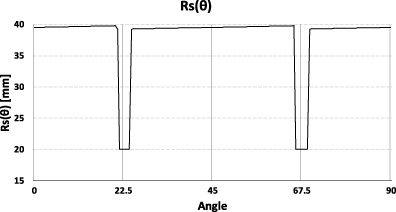
Analytical method result of R s (θ).
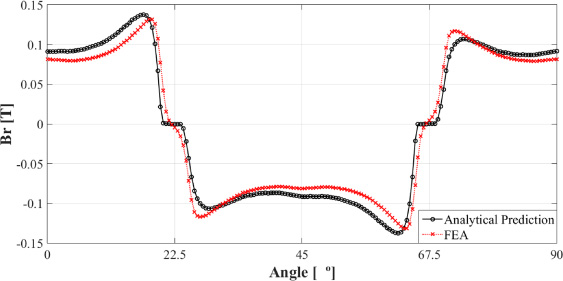
Waveform of the flux density in the middle with radial component.
In case of tapered air-gap, as Figs 2 and 3 is difference in the lengths of the stator slot length. Therefore
permeability of iron is infinite field distribution does not change in the axial direction, i.e. the end effects are neglected slot openings have rectangular shape and are infinitely deep.
To calculate
If the cogging torque is calculated according to Eq. (4), it is shows in Fig. 5. This results comparison cogging torque between the analytical method and FEA for model applied tapered air-gap. As observed, cogging torque with its corresponding peak-to-peak value obtained through use of the proposed analytical method, and FEA equaled 58.7 and 59.7 mNm, respectively.
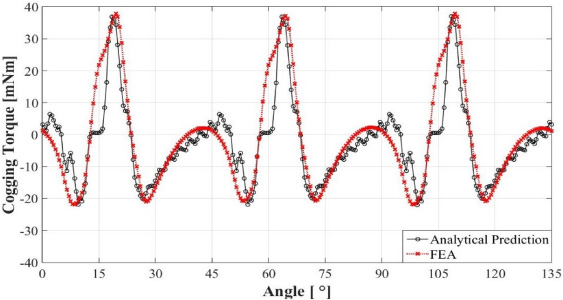
Comparision of cogging torque.
To verify the analysis results, the single-phase BLDC motor were manufactured, as shown in Fig. 6, and tested as that. Figure 6(d) depicts the experimental setup for measuring the cogging torque. A cogging-torque meter (manufactured by SUGAWARA, Japan) with 0.001% RPM accuracy was employed in this study.
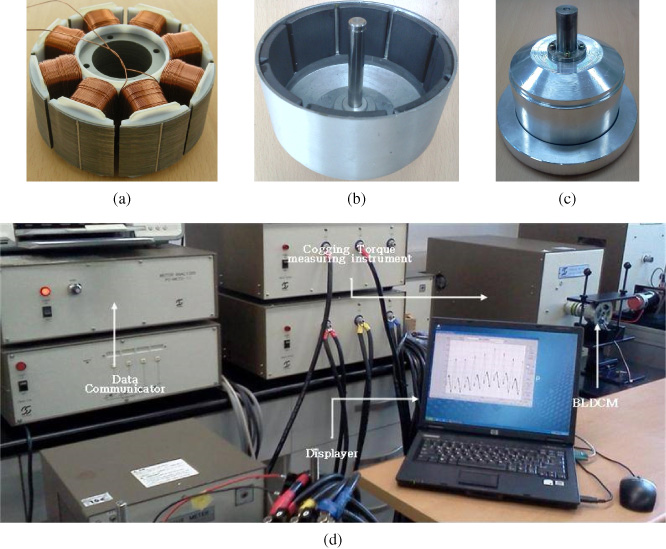
Experimental set-up for single-phase BLDC motor (a) Stator with tapered teeth (b) Rotor (c) Assembled motor (d) Set-up for experiment of cogging torque.

Experimental cogging torque of single-phase BLDC motor.
Figure 7 depicts experimental results of the cogging torque equal to 57.2 mNm. This result demonstrates that the cogging torque can be predicted because the tendency as analytical method and FEA is similar.
This paper presents an analytical method that applies a tapered air-gap to facilitate cogging-torque analysis of single-phase BLDC motors.
To calculate magnetic flux density when the tapered air-gap is varying of stator teeth distance, the stator slot function was applied followed by calculation of the spreading permeance function to be applied in the analysis of the cogging torque. Results of characteristic analysis of the cogging torque were compared against those obtained via FEA to verify the proposed analytical method. As observed, cogging torque values obtained through use of the proposed analytical method, FEA and experiment equaled 58.7, 59.7 and 57.2 mNm, respectively. The period and magnitude of the cogging torque obtained using the analytical method demonstrated good agreement with those obtained via of FEA and experiment.
Footnotes
Acknowledgements
This work was supported by NRF-2017R1A2B1009684.