



Abstract
The paper presents a solution for testing the humidity of a brick wall using electrical tomography. Different prototypes of measurement systems based on the device with hybrid tomography were prepared. Prepared constructions contain 16 electrodes in a brick wall on one side and two-sided. Electrical tomography, which is based on the measurement of potential difference, can be used to check historical buildings. The way in which we can determine the condition of a wall of moisture depends on the fact that each material has a unique conductivity. The use of modern tomographic techniques in combination with topological algorithms will allow non-destructive and non-destructive very accurate spatial assessment of the humidity level. The proposed application uses the Total Variation, Gauss–Newton and level set method to solve the inverse problem in electrical tomography.
Introduction
Moisture transfer in the walls of old buildings that are in direct contact with the soil, leads to migration of soluble salts in relation to many wall problems. Moisture can be pulled up under the influence of gravity (capillary effect). The main problem in studies on the moisture concentration in the walls is the lack of a method that ensures spatial distribution without the need to collect samples. Most of the available research methods allow only a point evaluation of moisture, thanks to which it is possible to achieve only the discrete distribution itself. Using indirect methods (thermographic camera) it is possible to determine the water concentration only on the surface of the wall or its subsurface surface. This fact is a basic problem in the case of thick barriers, because the moisture inside each wall is usually a few percent higher than at its surface [1,2,7,13]. The aim of the article is to design, implement and analyze image reconstruction algorithms and create a system for analyzing the walls of historic buildings. The article introduces information and patterns related to presented reconstructions, including the approach to topological sensitivity related to the presented algorithms. Reconstructions for two models have been carried out. In historical walls, humidity is important, which can not be examined by invasive methods, therefore it is proposed to use electrical tomography. The second element is the method of building with bricks, which makes it impossible to test using other methods, e.g. ultrasounds. The measuring system has been specially designed and made for this solution. It consists of a hybrid tomograph and measuring electrodes as well as a data transmission and analysis model. Methods were also presented, which were later used in the process of reconstruction and selection of algorithms for determining spatial humidity in walls.
Electrical impedance tomography
Electrical tomography was used to determine the unknown coefficient materials in the examined objects [1,5,6,9,14–20]. Level set methods, Total Variation and Gauss–Newton methods have been applied very successfully in many areas of the scientific modelling such as the wall dampness [5,6,11,12]. Discussed technique can be applied to the solution of inverse problems in electrical impedance tomography. The purpose of the presented method is obtaining the image reconstruction by the proposed solution. The forward problem solution in EIT consists in determining potential distribution inside the region 𝛺 under given boundary conditions and full information about region under consideration. The Laplace’s equation is governing potential distribution u:
In order to solve the inverse problem, we have to introduce the adjoint function which is helpful for efficient gradient calculation in gradient optimization methods. Reconstruction of the interior image of the object under investigation is connected with the determination of the global minimum of the objective function, which in the case under consideration is defined as follows:
Using appropriate approximations, it can be shown that the conductivity proper in the iteration denoted by k +1 is given by the following formula:
The level set function 𝜙 is also used to solve the inverse problem:
Finally, we get the following equation:
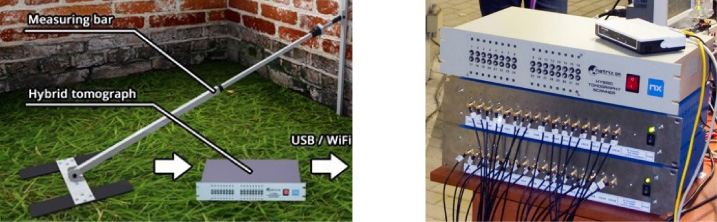
Model of the measurement system and electrical tomography device.

(a) Belt with electrodes for EIT measurements, (b) Surface electrodes on the damp brick wall.
Electrical impedance tomography (EIT) is an imaging technique for detecting the internal conductivity distribution in an object by voltage measurements taken by an exterior electrode [3,4,8,10]. In this method, the potential distribution inside the region 𝛺 under given boundary conditions and full information about the region in consideration is calculated. Most EIT works have used it as a dynamic imaging method, in which images of the impedance change compared to a baseline condition are obtained. Electrical impedance tomography is the restoration of the conductivity of the interior of the investigated object with knowledge of the currents and voltages imposed on its surface. The data acquisition system collects the measured voltage from electrode and then the data is processed. Conventional data acquisition systems require hardware to measure voltage, to filter, demodulate and convert to digital form, and a signal processing unit to transfer the data to computer. Idea of the measurement system was presented in Fig. 1. The presented measuring system allows measurements in the field of electrical tomography covering the imaging of both impedance and capacitance fields. We can measure voltage drops, capacitance as well as angle of phase shift. The type of measurement is adapted to the type of object and the efficiency of reconstruction. With wet walls, the measurement of voltage and angle of phase shift is preferred, while for wet walls, capacity can be measured.
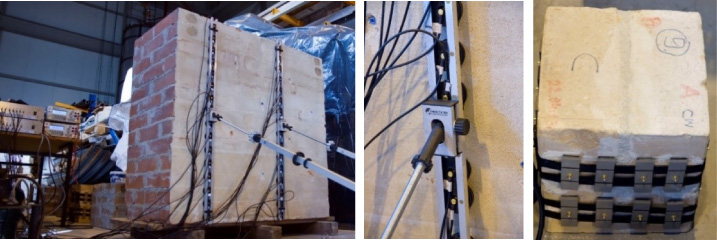
Laboratory models with measurement electrodes.
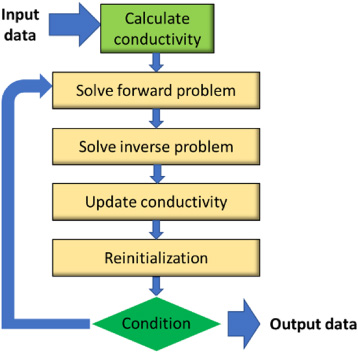
The scheme of the algorithm to minimize the objective function.

The geometrical model 3D with 16 electrodes with simulation measurements: (a) Gauss–Newton method with Laplace regularization, (b) Gauss–Newton method with Tikhonov regularization, (c) Total Variation.
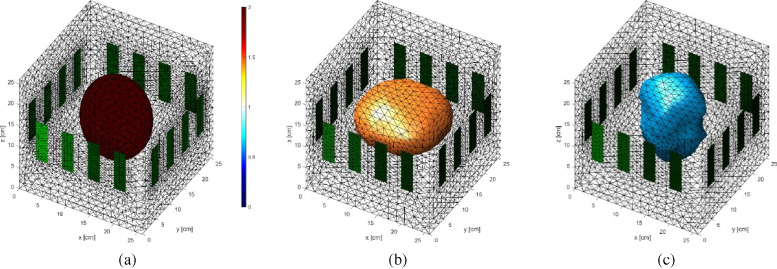
The geometrical model 3D with 16 electrodes – the image reconstruction with simulation measurements: (a) model, (b) zero level set function, (c) image recosntrucion by LSM.
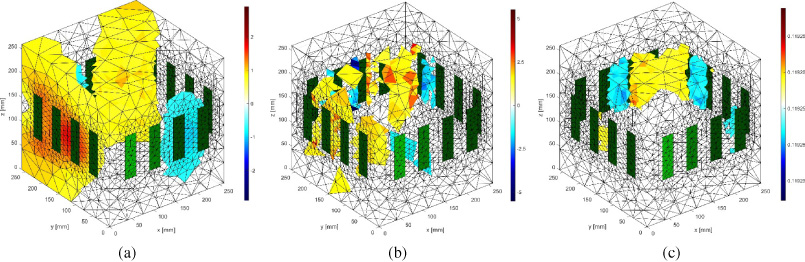
The geometrical model 3D with 16 electrodes with real measurements – the image reconstruction: (a) Gauss–Newton method with Laplace regularization, (b) Gauss–Newton method with Tikhonov regularization, (c) Total Variation.
Two model brick walls of various sizes were developed for the needs of the research, namely:
model small brick wall with dimensions in horizontal projection 250 × 250 mm and height 295 mm, model brick wall with dimensions in horizontal projection 380 × 1000 mm and height 1000 mm.
On the assumed models, appropriate simulations and reconstructions of images were performed by solving relevant inverse problems. For the presented cases, the measuring sensors were evenly distributed. They measure voltage drops. Conductivity (humidity) is calculated by solving the inverse problem. An object whose internal electrical properties are unknown is surrounded by electrodes disposed on its edge and electrically excited in various combinations. Measurements are made for all possible ways of connecting the power source to the area, to increase the number of information about the object and to improve the signal-to-noise ratio. After the first series of measurements, the excitation system switches to the neighbouring electrodes. This process is repeated sequentially for all possible power source connection systems. In this way, multiple analysis of the examined object is carried out. Figure 2 presents the belt with electrodes for EIT measurements and surface electrodes to brick wall. Figure 3 shows laboratory models and the process of immersing a wall in water and measuring such an object.
The algorithms based on gradient methods and level set function were proposed in order to solve the inverse problem in electrical impedance tomography. The conductivity values in different regions are determined by the finite element method.

The geometrical model 3D with 2 × 8 electrodes – Gauss–Newton method with Laplace regularization with simulation measurements: (a) model, (b) image reconstruction without noise, (c) SNR = 20, (d) SNR = 10.

The geometrical model 3D with 2 × 8 electrodes – the image reconstruction with simulation measurements: (a) zero level set function, (b) final reconstruction by LSM.
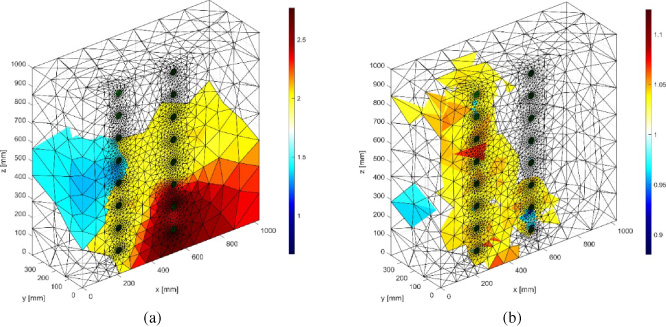
The geometrical model 3D with 2 × 8 electrodes – the image reconstruction with real measurements: (a) Gauss–Newton method with Laplace regularization, (b) Gauss–Newton method with Tikhonov regularization.
Figure 4 presents the scheme of the algorithm to minimize the objective function. Two investigated wall cases were presented. Simulation studies were carried out as reconstructions from real measurements with selected methods. The following experiments show reconstructions as imaging the conductivity map. On the outside of the wall, voltage drops are measured. In order to obtain a moisture distribution, the reverse problem is solved. Figure 5 shows the geometrical model of the investigated dumped wall with 16 electrodes and the image reconstruction obtained by Total Variation and Gauss–Newton methods. Unknown structures are marked by the solid line; simulated objects are marked the brown block Simulations of the set level method are shown in Fig. 6. Figure 7 presents the image reconstruction with real measurements. Figure 8 shows the geometrical model 3D with 2 × 8 electrodes: (a) model, (b) image reconstruction without noise, (c) SNR = 20, (d) SNR = 10, and Fig. 9 presents the level set function. The image reconstruction with real measurements was done by the Gauss–Newton method (Fig. 10).
A non-destructive method of the inspecting the walls in historical buildings system model was presented. Numerical methods were based on the Gauss–Newton method, Total Variation and the level set representation. The presented algorithms have been applied successfully in the reconstruction of measured data of the model wall. Two objects were analysed. One object was measured around, the other was a one-way survey. Two types of measurement system were evenly attached to the experimental phantoms and their numerical models were calculated. In the case of image reconstruction, depending on the nature of the object, different methods give different effects. The level set method is quite accurate, but with a wall spacing, gradient methods have a better effect. According to assumptions it is possible to build effectively the small electrical tomography system. The such solution is measurement speed and its accuracy, however, those are still high enough for practical use. The test results for prototype devices and systems were promising. The electrical tomography is a good technique of imaging the distribution moisture inside the walls and historical buildings.