



Abstract
This paper reports the experimental studies on a magneto-rheological (MR) fluid under AC magnetic fields. Magnetic clusters in the MR fluid are formed along the magnetic fields. The ultrasonic propagation velocity changes owing to the presence of clustering structures in the MR fluid. We investigated clustering structures by measuring this change in the ultrasonic propagation velocity. The results indicate that magnetic clusters in the MR fluid depend on the elapsed time, intensity, frequency, and angle of the AC magnetic fields.
Introduction
Magneto-rheological (MR) fluid is a magnetic functional fluid composed of micrometer-scale magnetic particles that are covered with surfactant and suspended in a carrier fluid such as hydrocarbon oil. The magnetic particles in the MR fluid aggregate and form clustering structures when a magnetic field is applied to the fluid. Using this property, the viscosity of the MR fluid can be changed and it can be used for various applications such as dampers and brakes. Thus, it is important to investigate the clustering structure for the development of applications using MR fluids. Since MR fluid is opaque, it is difficult to investigate the clustering structure using optical methods, and the mechanism of clustering is still not fully understood. Bramantya et al. [1] and Lopez et al. [2] measured the ultrasonic velocity and change in attenuation under a DC magnetic field and investigated the effect of the magnetic field intensity and the direction of ultrasonic wave propagation on clustering structures in the MR fluid. Motozawa et al. [3] and Isnikurniawan et al. [4] measured the change in the ultrasonic propagation velocity at different sweep rates of magnetic fields. They also investigated the effect of residual magnetization on magnetic cluster formation in an MR fluid.
Fujita et al. [5] measured the change in ultrasonic propagation velocity under AC magnetic field and estimated the effect of the frequency of magnetic field on clustering structures in the magnetic fluid. However, they were unable to detect oscillations in the velocity change corresponding to the oscillation of the AC magnetic field, presumably because of the low sampling rate. In the present study, we extended their study and improved the experimental apparatus. We measured the ultrasonic propagation velocity at a high sampling rate and precisely analyzed the clustering structures under AC magnetic fields.
Experiments
Experimental apparatus and test fluid
Figure 1 shows the experimental apparatus, and Fig. 2 shows the detailed view of the square test cell. The electromagnet applies an AC magnetic field to the test cell. The inner vessel of the test cell is filled with MR fluid, and the outer vessel is filled with circulating water supplied by the temperature control unit. An ultrasonic wave generated by the pulse generator propagates from the ceramic oscillator, attached to the test cell, to the opposite ceramic oscillator through the fluid. The ultrasonic wave form is displayed on the oscilloscope, and the ultrasonic propagation time through the fluid can be obtained. The sampling rate of the measurement is 200 Hz. The test cell can be rotated and the angle θ between the directions of the propagation of the ultrasonic wave and the magnetic field can be adjusted (θ = 0°, 15°, 30°, 45°, 60°, 75°, and 90°). The circulating water keeps the fluid temperature at 25 °C and prevents the change in ultrasonic propagation velocity caused by the temperature change. Table 1 summarizes the properties of the MR fluid.
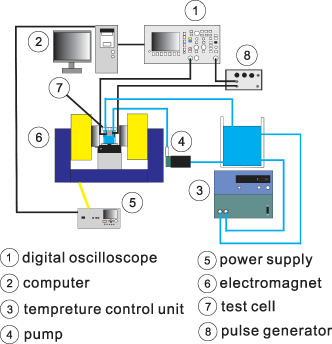
Experimental apparatus.

Test cell.
The rate of change of ultrasonic propagation velocity is expressed by the following equation [6]:
The properties of MR fluid
Frequency response of AC magnetic fields
Figure 3 shows the initial stage of ΔV∕V 0 immediately after applying magnetic fields, and Fig. 4 shows the steady stage of ΔV∕V 0 after 600 s under magnetic field. B ac and f are the effective values of the AC magnetic field and the frequency of the AC magnetic field, respectively.
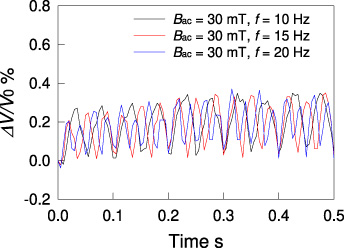
The initial stage of the rate of change of the ultrasonic propagation velocities with AC frequencies.
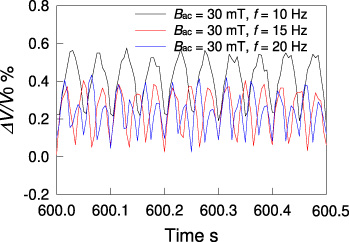
The steady stage of the rate of change of the ultrasonic propagation velocities with AC frequencies after 600 s.
As shown in Fig. 3, ΔV∕V 0 oscillates with elapsed time. It is obvious that the size of the magnetic clusters changes owing to the change in the intensity of magnetic field. The average value of ΔV∕V 0 increases gradually with the passage of time. The absolute value of the intensity of AC magnetic field oscillates. At first, when the magnetic field intensity is strong, large clusters are formed along the magnetic field momentarily. A higher value of ΔV∕V 0 is observed in the presence of a magnetic field compared with when they are absent. When the magnetic field intensity becomes weak, the large clusters collapse. However, only partial collapse occurs because a part of the clusters is held together by the residual magnetization. The value of ΔV∕V 0 is smaller in the absence of magnetic fields compared with when they are present. ΔV∕V 0 is, however, a little larger when a magnetic field is present compared with when they are absent because of the remaining small clusters. When the magnetic field intensity becomes strong again, slightly large clusters are formed. When these steps are repeated, the average size of the clusters increases gradually, and the value of ΔV∕V 0 increases. Figure 4 shows that ΔV∕V 0 oscillates with elapsed time similar to the condition shown in Fig. 3; however, the average value of ΔV∕V 0 is virtually constant. Thus, the collapse and formation of clusters reaches a steady stage when an AC magnetic field is applied for a long time.
Figure 6 shows the power spectra of ΔV∕V
0 in a steady stage for different AC frequencies (B
ac = 30 mT; f = 5, 10, 15, and 20 Hz). The number of samples is 1024. The frequency of the first Fast Fourier Transform (FFT) peak is twice that of the AC magnetic fields in all cases. Thus, the formation and collapse of clusters is repeated at twice the frequency of the AC magnetic field. The reason is that ΔV∕V
0 responds to the absolute value of the AC magnetic field intensity. The maximum of the absolute value of the AC magnetic field appears twice per one AC magnetic field cycle. This relation is also indicated by the following Fourier series expansion:
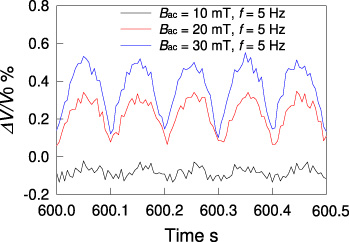
The steady stage in the rate of change of the ultrasonic propagation velocities with AC magnetic field intensity.
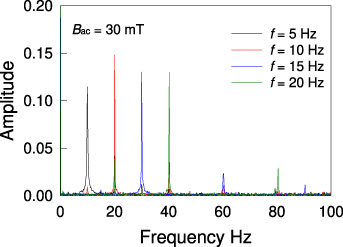
The power spectra of the rate of change of ultrasonic propagation velocities.
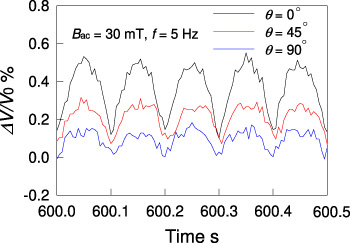
The anisotropy of the rate of change of ultrasonic propagation velocities in the steady stage.
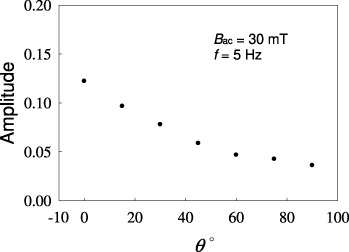
The change in the first FFT peak with θ.
When the angle θ between the directions of the magnetic field and the ultrasonic propagation is changed, ΔV∕V 0 also changes, that is, the anisotropy appears. The anisotropy of the ultrasonic propagation in a steady stage for θ = 0°, 45°, and 90° is shown in Fig. 7. The power spectra of the first FFT peak of ΔV∕V is indicated in Fig. 8. When the value of θ is high, the amplitude and average value of ΔV∕V 0 is low. Since clusters are formed along the magnetic field, the number of magnetic particles in the propagation area of the ultrasonic wave decreases with θ. As a result, the amplitude of the oscillation of ΔV∕V 0 decreases with θ, as shown in Figs 7 and 8.
Concluding remarks
We studied the ultrasonic propagation velocity in the MR fluid under AC magnetic fields. We made extensive measurements of the changes in the ultrasonic propagation velocity at a high sampling rate. When an AC magnetic field is applied to the MR fluid, magnetic clusters grow repetitively and collapse according to the oscillation of the AC magnetic field intensity. The formation and collapse of clusters is repeated at twice the frequency of the AC magnetic fields. The dependence of intensity and frequency of the AC magnetic field on ΔV∕V 0 was observed in all cases; B ac = 10, 20, and 30 mT and f = 5, 10, 15, and 20 Hz. The anisotropy was also investigated for B ac = 30 mT and f = 5 Hz.
Footnotes
Acknowledgements
This work was partially supported by JSPS KAKENHI Grant Number JP15K05806.