



Abstract
A high-performance method is developed for solving a linear system in the shielding current analysis of a high-temperature superconducting (HTS) film containing cracks. When the shielding current density is calculated in the HTS film, a linear system of special type has to be solved at each iteration cycle of the Newton method. If GMRES is applied to the solution of the linear system, its convergence property will be remarkably degraded with increasing crack size. In order to resolve this problem, other variables than corrections of the current vector potential are all eliminated from the linear system. Consequently, the residual history of GMRES is hardly affected by a crack size so that its convergence property is improved remarkably.
Introduction
Since evaluation of the shielding current density is indispensable in designing engineering applications of a high-temperature superconducting (HTS) film, several numerical methods [1–4] have been proposed to anlyze the time evolution of the shielding current density. After discretized with respect to time, an initial-boundary-value problem of the shielding current density is transformed to a nonlinear boundary-value problem at each time step. However, the solution of the nonlinear problem by the Newton method is extremely time-consuming especially for the case with a cracked HTS film. This is mainly because the convergence property of the linear-system solver, GMRES, is remarkably degraded for this case.
The purpose of the present study is to develop a high-performance method for solving a linear system in the shielding current analysis of a cracked HTS film.
Shielding current analysis
A cracked HTS film of thickness b is exposed to the time-varying magnetic field. We first assume that it contains m cracks and that it has the same cross section Ω over the thickness. By taking its thickness direction as z-direction and choosing its centroid as the origin, we use the Cartesian coordinate system 〈O :
Under the thin-plate approximation, there exists a scalar function T (
The initial and boundary conditions to (1) are assumed as follows: T = 0 at t = 0 and
The above analysis is applied to the scanning permanent magnet method (SPMM) [9] that is one of contactless methods for measuring spatial distributions of j C in HTS films. In the SPMM, a cylindrical permanent magnet of radius R and height H is moved along the surface of an HTS film and, simultaneously, an electromagnetic force F z acting on the film is monitored (see Fig. 1). During the movement of the magnet, the distance L between the magnet bottom and the film surface is kept constant. In the following, the cross section Ω of the film is assumed as a rectangle of width w and length Aw. Furthermore, the longitudinal direction of the film is taken as x-axis. Also, the symmetry axis of the magnet is denoted by (x, y) = (x A, y A), and its movement is assumed as x A = vt − Aw∕2 and y A = const. Here, v is a scanning speed. Moreover, the film is assumed to contain a single crack whose cross section is a line segment connecting two points, ( ± L c∕2, 0 mm), in the xy plane. Throughout the present study, the physical and geometrical parameters are fixed as follows: j C = 1 MA∕cm2, E C = 1 mV/m, N = 20, b = 1 μm, w = 12 mm, A = 11, m = 1, R = 0.8 mm, H = 2 mm, L = 0.5 mm, y A = 0 mm, and v = 10 cm/s.
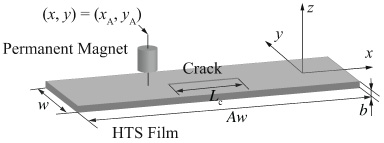
A schematic view of the scanning permanent magnet method.
The authors developed the virtual-voltage method [4–6] for accurately solving the initial-boundary-value problem of (1). In this section, the basic idea of the virtual-voltage method is explained briefly. In the following, a superscript (j) denotes a value at time t = jΔt, where Δt is the time step size. In addition, the voltage around C
i
and its numerically evaluated value are denoted by h
i
(
In the virtual-voltage method, T
(j)(
If the Newton method is applied to (3)–(6), we get the following linear boundary-value problem:
In the virtual-voltage method, both T and
The above two steps are repeated until both convergence of T and that of
Linear system at each iteration cycle of Newton method
If the linear boundary-value problem (7)–(10) is discretized with the finite element method with n nodes, the following linear system is obtained:
The linear system (11) changes depending both on an iteration cycle of the Newton method and on time. Hence, throughout this section, two linear-system solvers are applied to (11) for the 1st iteration cycle at t = Aw∕(1200v) and their performances are compared with each other. Numerical computations were carried out on FUJITSU PRIMEHPC FX100 of LHD Numerical Analysis Server in National Institute of Fusion Science.
Since both n ≫ k and n ≫ m are satisfied, most elements of the coefficient matrix in (11) are occupied by the dense submatrix A (
Let us first investigate residual histories of the conventional method. To this end, residual histories are determined for various values of k and are depicted in Fig. 2. This figure indicates that the convergence property of GMRES is degraded with an increase in k. For the purpose of quantitatively investigating this tendency, we use the number of iterations required for convergence of GMRES. In the following, it is called the convergent iteration number, N c.

Residual histories of the conventional method for the case with n = 11649.
Next, the dependence of the convergent iteration number on k is numerically determined and is shown in Fig. 3. We see from this figure that, for the conventional method, the convergent iteration number increases linearly with k. Hence, even for the case where the same node distribution is used, an increase in the number k of crack elements will raise the CPU time required for the solution of (11).

Dependences of the convergent iteration number N c on the number k of crack elements for the case with n = 11649.
As mentioned above, the computational cost of the conventional method strongly depends on the number k of crack elements. Such a strong dependence of the computational cost on k is attributable to the fact that 𝝀 is contained in (11).
Let us decompose (11) into two equations so that δ
By using projection matrices,
By solving (12) for δ
We first investigate the convergence property of the variable-reduction method. To this end, the convergent iteration number is numerically determined as a function of k and is also plotted in Fig. 3. For the variable-reduction method, the convergent iteration number is little affected by k.
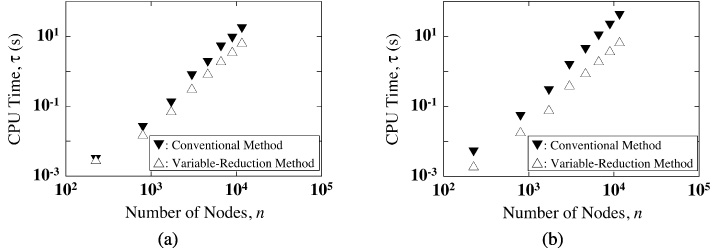
Dependences of the CPU time τ on the number n of nodes. Here, (a) L c = 15 mm and (a) L c = 45 mm.
Next, we investigate the speed of the variable-reduction method. The CPU times required for solving (11) either with the conventional method or with the variable-reduction method are measured, and they are depicted in Figs 4(a) and 4(b). These figures indicate that the variable-reduction method is always faster than the conventional method. In other words, the variable-reduction method shows the speedup effect as compared with the conventional method. Moreover, the speedup effect becomes remarkable with an increase either in the number of nodes or in a crack size.
We have developed a novel method for solving a linear system in the shielding current analysis of a cracked HTS film. After discretized with respect to time and space, the initial-boundary-value problem of the shielding current density reduces to a linear system at each iteration cycle of the Newton method. In order to solve the linear system efficiently, the variable-reduction method is proposed. Furthermore, its performance is numerically investigated. Conclusions obtained in the present study are summarized as follows:
Although the convergence property of the conventional method is significantly degraded with increasing crack size, that of the variable-reduction method is hardly influenced by a crack size. The speed of the variable-reduction method is faster than that of the conventional method. This speedup effect becomes remarkable with an increase either in the number of nodes or in a crack size.
Footnotes
Acknowledgements
This work was supported in part by Japan Society for the Promotion of Science under a Grant-in-Aid for Scientific Research (C) No. 15K05926. A part of this work was also carried out with the support and under the auspices of the NIFS Collaboration Research program (NIFS17KNTS051, NIFS16KNXN341).