



Abstract
The modeling and reduction of the iron loss is increasingly concerned in both analysis and design of large electromagnetic devices under today’s extreme excitations. This paper aims to investigate the effective and practical approaches to exactly determine the iron loss inside laminated core under ac-dc hybrid excitation in the numerical analysis, and validate the proposals based on the product-level models.
Introduction
With the development of the HVDC transmission system, the ac power transformer near the HVDC system is often affected by the dc current, which will flow into the windings through earthed neutrals. A laminated iron core under ac-dc hybrid excitation generates a distorted hysteresis loop, resulting in a higher iron loss compared with that under sinusoidal excitation [1, 2, 3].
Under ac-dc hybrid excitation, the major difficulties of the iron loss modeling are: (1) coming from magnetic property: the magnetic property data, such as B-H properties, are quite different from those under “standard” sinusoidal excitation, which are varying with both the dc excitation and the ac excitation [1], and the existing property data of the magnetic material provided by manufacturers are usually not sufficient or none; (2) coming from loss calculation method: the iron loss is not only the function of the amplitude of the ac component of flux density (
The purpose of this paper is to present a practical measurement method for the magnetic properties of laminated cores under ac-dc hybrid excitation, to investigate the effect of the variation of dc bias on iron loss, and to find an effective and practical numerical approach to confidently determine the iron loss inside GO silicon steel laminated core of large electromagnetic devices with ac-dc hybrid excitation, and validate their usefulness based on typical engineering-oriented models.
Modeling of magnetic property
In this paper, a novel measurement scheme for the magnetic properties of GO silicon steel lamination under ac-dc hybrid excitation is proposed. The newly developed system has the advantage that there is no interplay between ac and dc excitations, both ac and dc excitation applied to one and the same exciting winding, making the control easy, compared with the usual technique using a ring core or SST, having separate ac and dc exciting windings [4, 5].
Measurements of the magnetic properties under ac-dc hybrid excitation were carried out with the aid of a laminated core model (referred to as LCM), at the product level, with 45
Parameters of core and coils
Parameters of core and coils
Laminated core model of product quality. (a) Photo of laminated core model. (b) Structural dimensions (mm).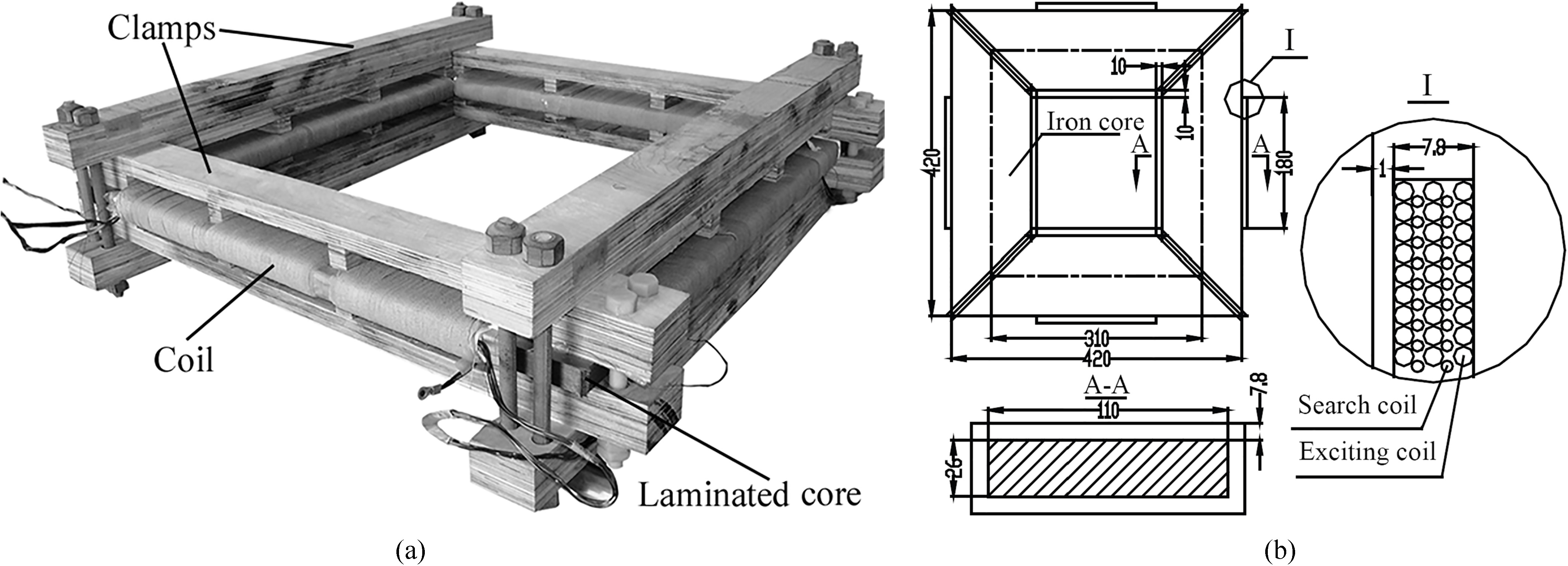
The experimental scheme based on the LCM is set up as shown in Fig. 2. The dc current passing through the exciting winding of the LCM, supplied by the dc source, is in series with the ac current.
Experimental system of dc-biased magnetic property.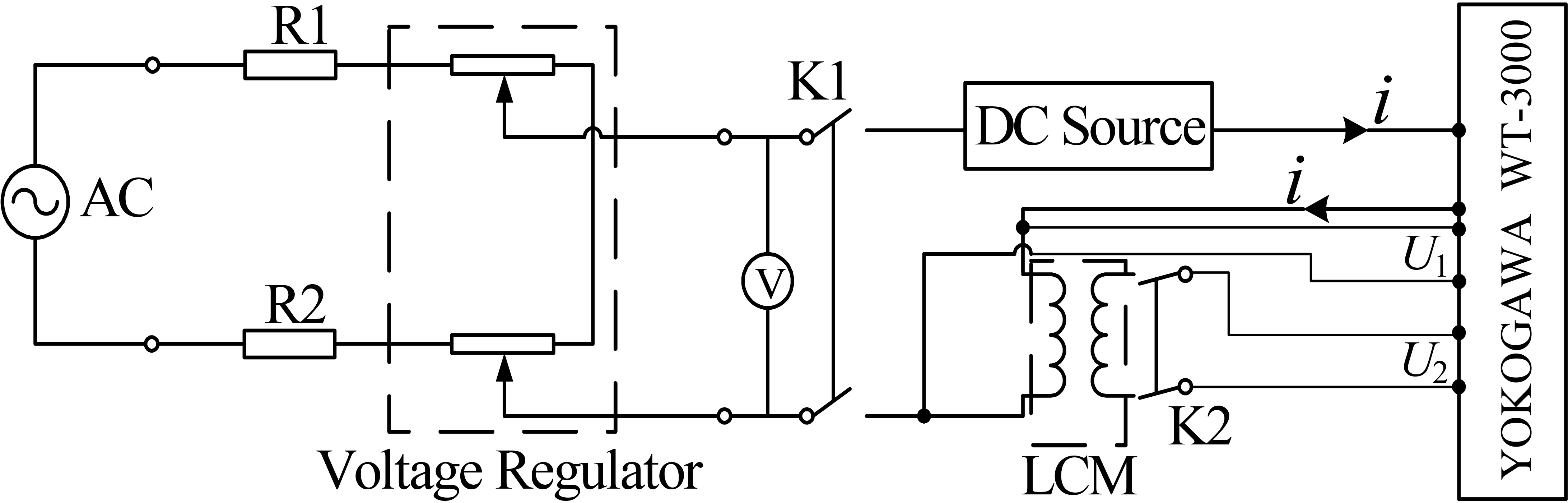
Figure 3a shows the example of hysteresis loop and the definitions of physical values under ac-dc hybrid excitation. Figure 3b and c show waveforms of flux density and magnetic field strength, respectively.
Distorted asymmetrical hysteresis loop under dc-biased magnetization. (a) Hysteresis loop under dc bias. (b) Total flux density waveform. (c) Magnetic field strength waveform.
The magnetic properties of the GO silicon steel sheet laminations are measured under dc-biased working condition, using the proposed experimental system. The ac exciting voltage
DC-biased B-H property (30Q140 silicon steel lamination, 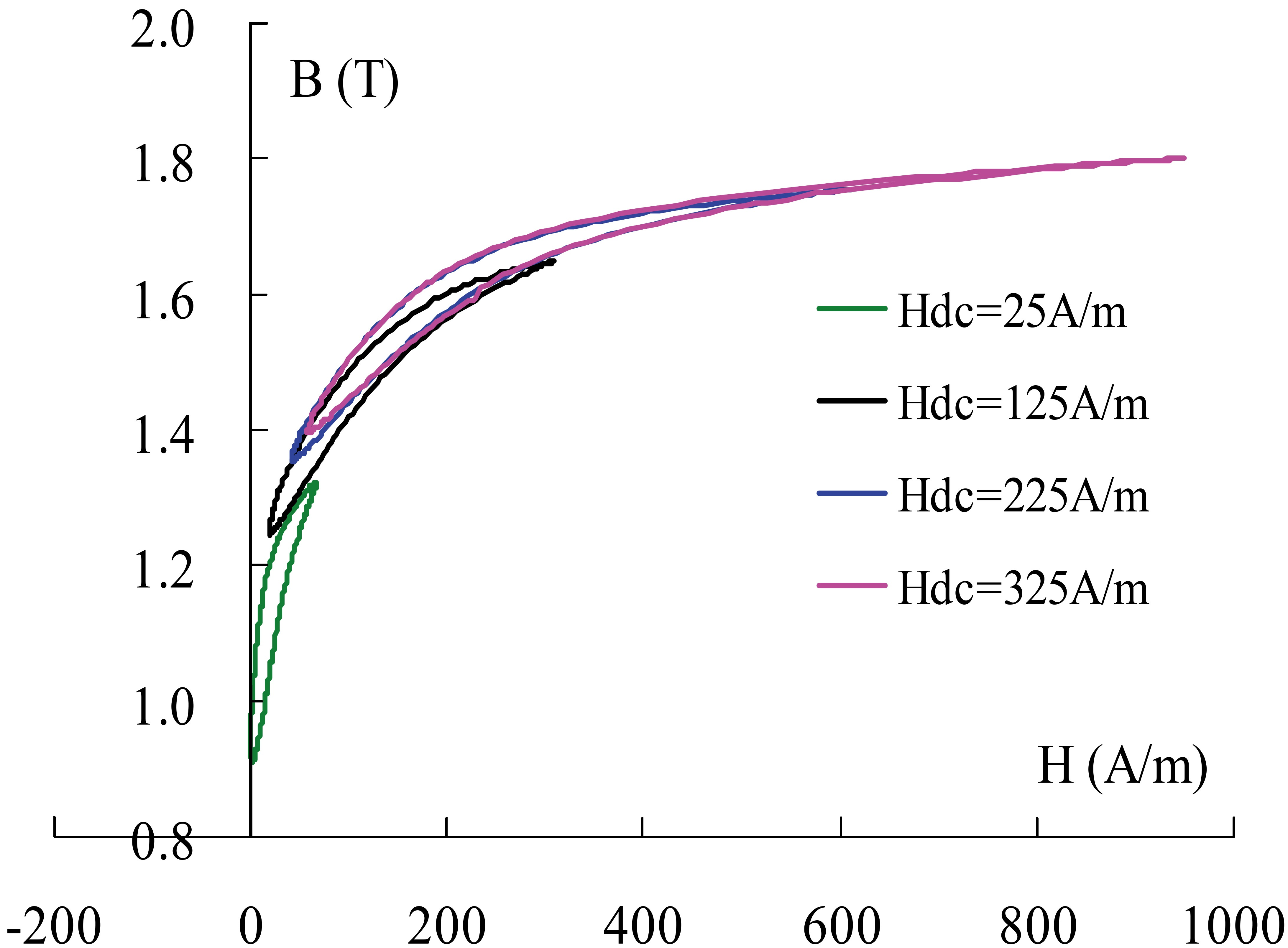
Figure 4 shows the effect of dc bias on the B-H property, demonstrating that the area of hysteresis loop increases when
DC-biased specific total loss (30Q140 silicon steel lamination, 50 Hz).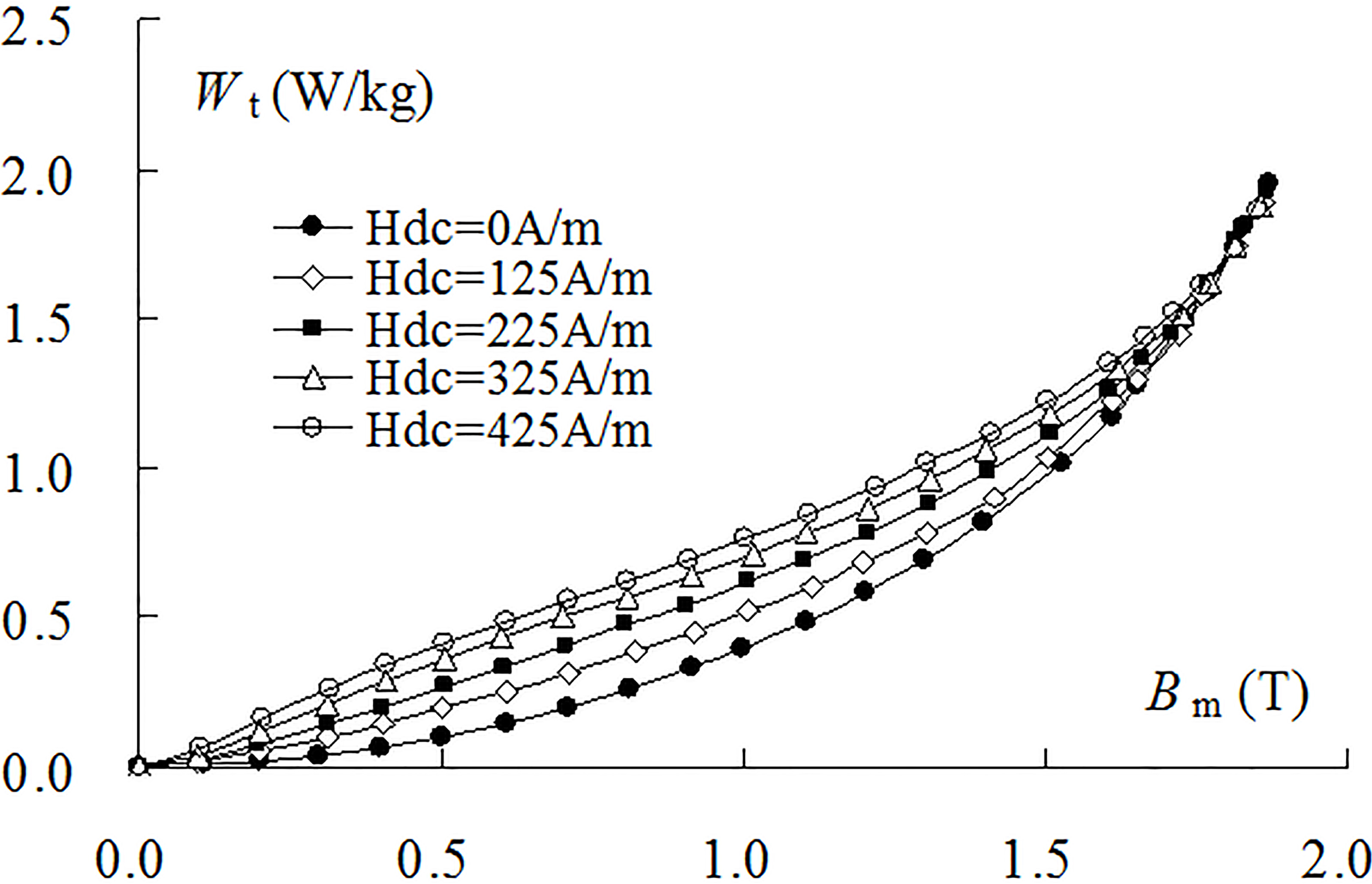
Figure 5 shows the effect of dc bias on the iron loss at 50 Hz. Figure 6 shows the comparison of total iron losses at different
For 30Q140 lamination, the total iron loss
It is clear that the total iron loss increases more slowly at higher ac working points (e.g.
In this paper, a practical approach for calculation of iron loss under ac-dc hybrid excitation is presented, and the numerical modeling results are verified by the measured data.
Effects of variation of dc-biased magnetic field intensity
Different excitation conditions
Different excitation conditions
Iron loss under dc-biased magnetization (50 Hz). (a) 
2-D magnetic field distribution in the LCM is examined, as shown in Fig. 7, where the different flux distributions caused by the different treatment of permeability, can be clearly seen.
2-D magnetic field distribution. (a) Isotropic permeability. (b) Anisotropic permeability.
The well established
The anisotropic and nonlinear permeability [
Note that in the numerical implementation the vector magnetic property of the material can be easily taken into account. The anisotropic conductivity [
where
To effectively reduce the computational cost, only the first few laminations are modeled individually as shown in Fig. 8a.
An air region is used to analyze the leakage flux in the surface layers. The inner laminated sheets are modeled as bulk and the electric conductivity (
3-D eddy current simulation model. (a) Surface layer. (b) Inner bulk.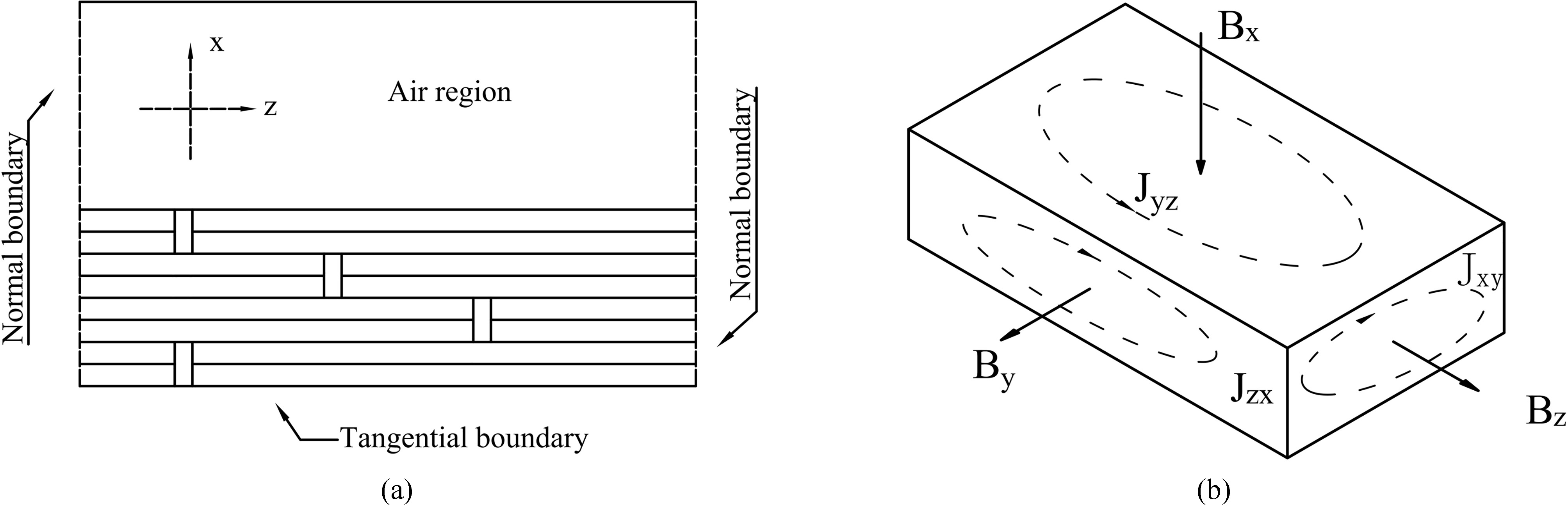
A zoned analysis method is employed in the GO silicon steel sheet’s region, i.e., a very thin mesh used in the surface layer and a coarse mesh in the remaining inner bulk region of the finite element model [7, 8, 9].
To further reduce the cost of the electromagnetic field computation in the bulk region, especially for a large-scale laminated transformer core, all the eddy currents induced in the bulk domain are neglected. So the induced eddy currents in its surface layer and then the additional eddy current loss caused by normal leakage flux into the surface layer of the laminated core have to be taken into account. The zoned conductivity [
The magnetic property of the GO silicon steel 30Q140 is certainly anisotropic, however, the applied field to LCM is almost along the rolling direction. Therefore, the working property of the LCM is, in fact, weakly anisotropic; so the measured specific total iron loss curves
The eddy current can be neglected in the electromagnetic analysis of the inner bulk because the sheet is very thin (0.3 mm thick). Of course,
When measuring dc-biased magnetic properties using the proposed measuring system, only the tangential excitation is applied; the flux sometimes enters the laminated sheets perpendicularly and that leads to an extra eddy current loss which is referred to as an additional iron loss; the eddy current reaction from such excitation condition is however much lower and can be neglected.
Therefore, the total iron loss
where
where, the relationship between
Note that, the measured
Total iron loss under different exciting cases
Measured and calculated average flux
Definition of 
The flux inside the entire lamination structure for each test case is examined. The magnetic flux
where
Note that, the average flux determined by Eq. (7) is only the ac component of flux; however, an efficient approach to calculating the dc flux in the laminated core has been proposed and presented in [10].
The measured and calculated results of total iron loss and average magnetic flux inside dc-biased LCM are shown in Tables 3 and 4 respectively. Tables 3 and 4 show good agreement between the measured and calculated results for each exciting case.
Conclusion
A new measuring system for the magnetic properties of Grain Oriented silicon steel lamination under dc-biased magnetization is proposed. The proposed method has an advantage in making the control easy since there is no interaction between ac and dc excitations.
The effect of the different dc-biased excitation patterns on both the iron loss and flux inside the laminated silicon steel sheets is investigated in detail. All the calculated and measured results of both iron loss and flux for different test cases are in good agreement. This proves that the proposed practical approach is effective in dealing with the dc-biased lamination configuration.
Footnotes
Acknowledgments
This project was supported in part by the NSFC (51107026/51677052/51237005).