



Abstract
The present paper deals with a large multidisciplinary design optimization (MDO) applied to a wind turbine permanent magnet synchronous generator (PMSG). The multidisciplinary nature of the model allows reliable results, but it demands high complexity and a large number of variables. Furthermore, to calculate the wind turbine energy production it is necessary to include several operating points in the model, increasing even more the dimension of the problem. To deal with this large optimization problem, the sequential quadratic programming (SQP) algorithm has been chosen. The results show that, besides the model complexity, the solution is obtained fast.
Keywords
Introduction
Renewable energies are expanding fast and, thanks to the development occurred in the past two decades, nowadays they represent a significant share of the energy market. Among other renewable sources, the wind power is an interesting option. Therefore, optimization is recommended in order to increase its competitiveness compared to other sources of energy, which is the purpose of several papers [1, 2, 3].
The optimal design presented in this paper aims at a wind power generation system with better cost/benefit ratio. The lifetime energy proceeds are calculated by considering the statistical annual wind profile. The net earnings are obtained subtracting the generator and power converter costs from the lifetime energy proceeds, which has been set as the objective function to be maximized. Such a method has been presented in previous papers [4, 5, 6, 7], where the PMSG and power converter optimization-oriented models have been detailed. This paper, by contrast, focuses on the optimization issues inherent of large optimization problems.
A brief description of the proposed multidisciplinary design optimization (MDO) is presented to show why a large number of variables is required. After that, the necessity of using several operating points, which increases significantly the numbers of variables and constraints, is justified as it allows estimating the wind turbine energy yield.
Global multidisciplinary design model
Seven sub-models of different disciplines have been developed to represent the wind energy conversion system (WECS): PMSG geometric sub-model, PMSG magnetic sub-model, PMSG thermal sub-model, PMSG electric sub-model, wind turbine mechanic sub-model, power converter losses (electronic) sub-model and economic sub-model. A block diagram representing the sub-models and its interactions is shown in Fig. 1. The numbers i1-i8 in Fig. 1 represent the global model inputs, whereas the numbers from o1 to o6 represent its main outputs.
Global optimization-oriented size model: connections between sub-models and optimization variables. Arrows with bold text are valid only when considering multiple operating points.
Each one of these sub-models is strongly tied to the other, e.g. the stator teeth magnetic flux density, which is given by the magnetic sub-model, depends on the machine dimensions (geometric sub-model), the voltage (electric sub-model) and the rotational speed (mechanic sub-model).
The combination of the presented sub-models provides a detailed optimization-oriented sizing model. Such a model has 37 input variables (24 are fixed and 13 are constrained) and 130 output variables (115 are free, 5 are fixed, 9 are constrained and 1 is the objective function) when only the rated operating point is taken into account.
A brief explanation of each sub-model, presented in Fig. 1, follows.
Mechanic sub-model
From wind turbine data (diameter, power coefficient, etc.) and the characteristics of the air (wind speed and air density), the mechanic sub-model provides to the electric sub-model: the wind turbine shaft power and rotation (generator speed).
Electric sub-model
Besides the PMSG data and the material characteristics (global model inputs), the electric sub-model uses information from all other sub-models: wind turbine shaft power and rotation from the mechanic sub-model; winding temperature from thermal sub-model; PMSG dimensions from geometric sub-model; maximum value of no-load linked flux, inductances and iron losses from magnetic sub-model; converter losses from electronic sub-model. The objective of the electric sub-model is to calculate some construction parameters, e.g. the number of turns per coil and the required surface of copper, and all PMSG performance parameters, including efficiency, current, voltage, etc.
This sub-model is composed of analytical equations that governs the PMSG behavior. Those equations form implicit loops involving equations of other sub-models. For instance, the copper losses are given by:
where
where
However, the generator output power is obtained from the mechanical power available in the wind turbine shaft (provided by the mechanic sub-model) and the PMSG losses:
where
As Eqs (1)–(3) show, the current
where
The thermal sub-model is responsible to compute the temperature of different parts of the PMSG. It requires as inputs the characteristics of the air and of the materials (both global model inputs), iron losses (provided by the magnetic sub-model) and copper losses (obtained from the electric sub-model).
This sub model is semi-analytic as the temperature comes from the solution of the thermal equivalent electrical circuit shown in Fig. 2, proposed by [8]. The current sources correspond to the heat sources, represented by winding and core losses. The electrical resistances represent the thermal conduction resistances of each material and the convection resistance between the PMSG frame and the surrounding air. The DC voltage source represents the ambient temperature. The solution of this equivalent electric circuit provides the voltage on each node, corresponding to the temperature of different parts of the generator. Due to symmetry of the PMSG thermal behavior, one slot pitch is enough to model it, as shown in Fig. 2.
Equivalent electric circuit of a slot pitch to model the PMSG thermal behavior.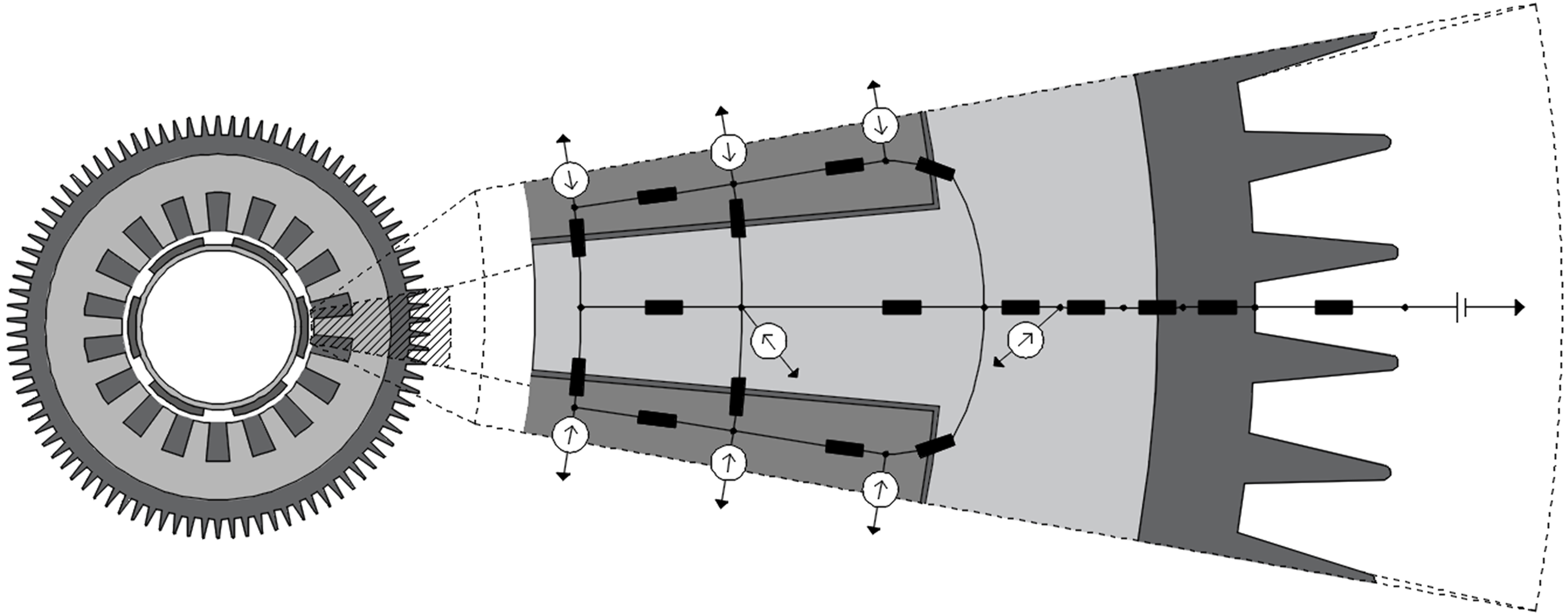
The level of discretization of this thermal sub-model influences the solution: more elements may bring a more accurate result with the cost of increasing the required computational time. The thermal sub-model has been verified through finite element analysis and they have presented good agreement, showing the accuracy to be enough to represent the PMSG thermal behavior.
Based on the PMSG data (topology, number of poles, number of slots per pole and per phase, etc.), the active materials mass densities, the surface of the conductors and the number of turns of one coil (both provided by the electric sub-model); the geometric sub-model calculates all PMSG dimensions and the masses of the active materials using analytic equations.
Magnetic sub-model
The magnetic sub-model computes iron losses, inductances and the no-load linked flux corresponding to the rotor position where the flux linked by one phase is maximum. In order to do so, the magnetic sub-model uses the electro-magnetic characteristics of the ferromagnetic materials, the dimensions and masses (obtained from the geometric sub-model), and the number of turns of one coil (provided by the electric sub-model).
The no-load linked flux is obtained from the reluctance network shown in Fig. 3. In the same manner of the thermal sub-model, this sub-model is semi-analytic.
Reluctance network of one pole section.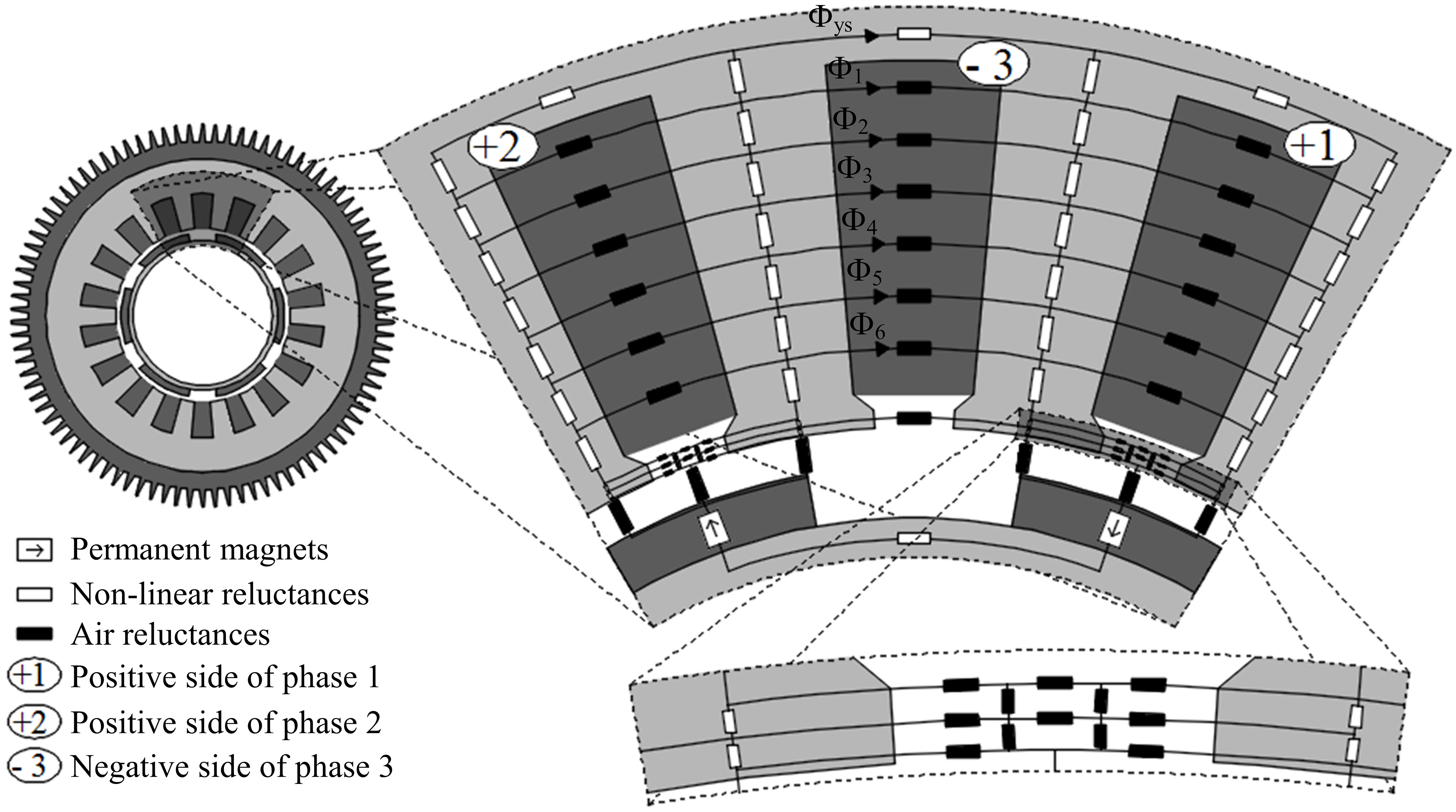
In Fig. 3, part of the flux created by the two half permanent magnets is linked by phase 3. Whereas the flux across the stator yoke above the central slot of Fig. 3 (
where
The number of reluctances used to build the reluctance network shown in Fig. 3 affects the accuracy of the no-load linked flux and the magnetic sub-model computational load. A simpler model (with less than 15 reluctances) has been tested and verified through finite element analysis, showing a quite good agreement to compute the no-load linked flux. However, the reluctance network of Fig. 3 (using 89 reluctances and 2 permanent magnets) showed to be more accurate under saturated conditions (as it considers several leakage flux paths) and it is able to provide an accurate enough value of the magnetic induction within specific regions.
The inductances and the iron losses are obtained from analytic equations and can be found in [9] and [3], respectively.
The objective of the electronic sub-model is to calculate the power converter losses. As inputs it has the power converter data, the PWM strategy and some performance parameters of the PMSG, provided by the electric sub-model.
This sub-model has been published in [7], where the development of all equations used to calculate the switching and conduction losses of the diodes and IGBTs of both generator-side and grid-side power converters is presented.
Economic sub-model
The economic sub-model provides the active material costs of the PMSG and the power converter cost. As inputs, this sub-model needs the knowledge of the power converter data, the specific costs of the active materials and the PMSG line current.
Multiple operating points
When only the rated operating point is considered in the optimum design of a variable speed generator, it is possible to minimize its cost or to maximize its rated efficiency. However, it is not possible to estimate the energy yield nor take advantage of this information to find a generator with a good balance between the energy production over the entire lifetime of the device and its cost. The best that can be done in this case is to obtain a set of Pareto optimal solutions that confronts the generator cost and efficiency. Among these optimal solutions, one that meets better the design necessities, can be chosen.
However, high efficiency in the nominal operating point does not mean high long-term energy production since the generator will operate only part of the time under rated operating conditions. A typical curve of wind speed occurrence (hours) over a year is shown in Fig. 4. The mechanical power available in the wind turbine shaft is also shown in Fig. 4 for each wind speed. This curve has been obtained considering the wind turbine operates following the maximum power tracking point (MPPT control) [10].
Wind speed occurrence and the corresponding mechanical power.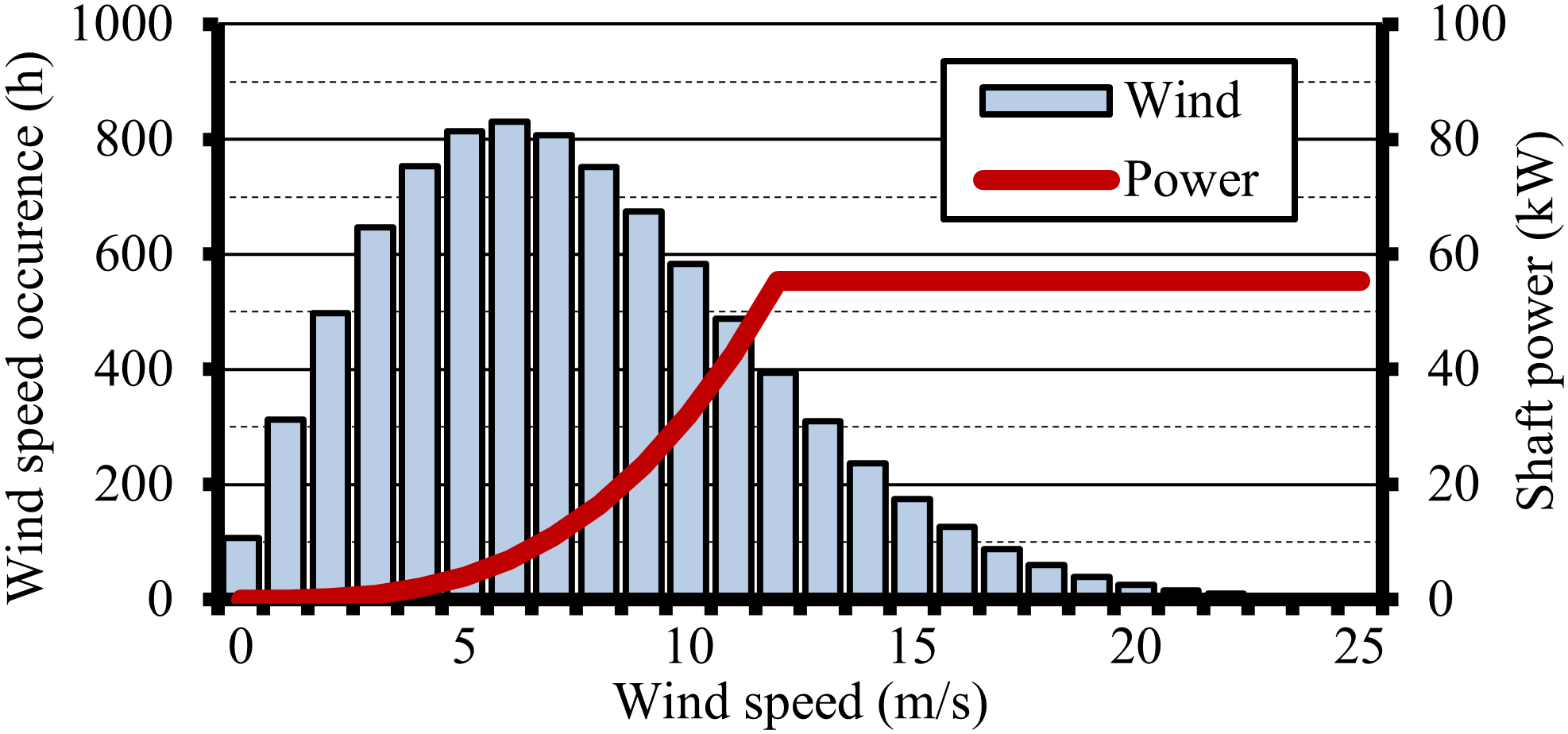
Considering the twenty-six operating points shown in Fig. 4 (one corresponding to each wind speed from 0 m/s to 25 m/s) allows to design a PMSG well adapted to the given site wind profile. Such a PMSG has better efficiencies related to the operating points corresponding to higher energy production potential (product between wind speed occurrence and mechanical power), which contributes to increase the energy yield.
Including multiple operating points, however, increases the complexity and the number of variables of the model described in the previous section. All parameter influenced by the wind turbine rotation, by the shaft power or by the wind speed needs to be calculated
where
It means that several equations should be inserted 26 times in the model, instead of once. On the other hand, the model becomes able to calculate the wind turbine produced energy over its lifetime and to use this information on the optimization objective function to design a generator with good balance between its cost and benefits.
The inclusion of multiple operating points in the MDO increases the number of variables to 140 input variables (being 35 fixed and 105 constrained) and 1792 output variables (being 1653 free, 78 fixed, 60 constrained and one objective function).
Knowing the wind turbine produced energy and the electricity price, the economic sub-model is able to calculate the wind turbine energy proceeds (
To maximize
The models have been implemented, using CADES framework [11] (see Fig. 5).
Use of CADES framework for the model description and their automatic programming.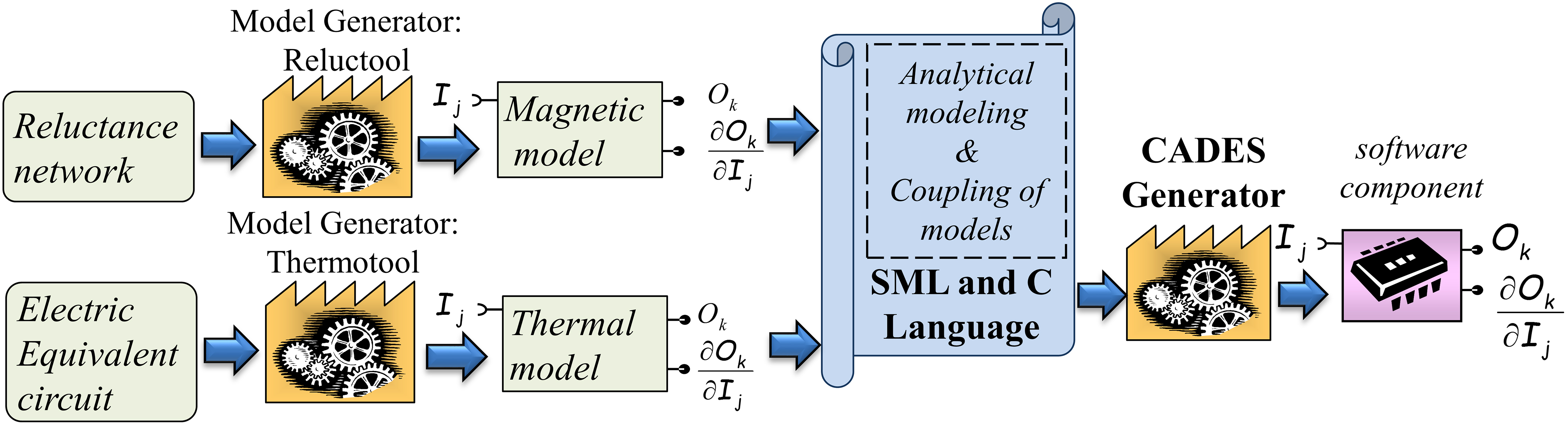
A specificity of CADES, is its possibility to generate automatically and to compute the exact jacobian of the models from several description formalism. For that, symbolic derivation, mathematic derivation properties and code derivation (for C language) are used. This allows to use the automatic generated and programmed model, in several environments using optimization algorithms that use the model jacobian.
The part of the modeling represented by simple equations is described using sml language (proposed in CADES). To create the model jacobian, symbolic derivation or code generation are proposed by CADES.
If the models contain programming instructions (e.g. if/else tests, for loops, etc.), C programming is used. Then, CADES uses ADOLC code derivation to derivate the model.
In this paper, thermal and magnetic sub-models are described using an equivalent electric circuit representation.
For thermal models, the CADES module Thermotool [12] has been developed. Resistances and sources have thermal and geometrical parameters. From the electrical circuit representation and the component characterization, Thermotool generates automatically a parametrized model including the calculation of its exact jacobian (useful for optimization using gradients). The generated models are coded in Java language. In this paper, the models generated by Thermotool use the actual dimensions of the PMSG (given by the geometric sub-model) to calculate the resistances values, and the losses in the teeth, stator yoke (provided by the magnetic sub-model) and winding (from electric sub-model) to update the values of the sources.
To describe the magnetic behavior of the machine, a reluctance network has been used to represent the magnetic flux paths. This reluctance network has been implemented in the Reluctool CADES module [13]. The reluctance network is parametric (geometrical and magnetic parameters). Like Thermotool, Reluctool creates automatically a magnetic model, in Java language, with its exact jacobian.
The connections and couplings of the sub-models are carried out in the sml language.
Note that the final model can be used in several computation framework having optimization algorithms (among them CADES and Matlab).
Large optimization problems can lead to difficulty in convergence and large computation time, making impossible to find the solution.
Heuristic optimization algorithms, like the genetic one, can be used when few design variables are considered [14]. In turn, deterministic algorithms are better suited to address problems with high number of variables [15]. Because of that, the sequential quadratic programming (SQP) optimization algorithm has been chosen to deal with this large optimization problem. Figure 6 shows the optimization flow chart, presenting the interactions among the designer, the global sizing semi-analytical model and the SQP algorithm. The SQP takes the advantage of knowing the exact gradients of the model outputs, which permits to find a solution in a considerably short period of time and manages quite easily problems with a big complexity due a high number of inputs and constraints. In this paper, the implemented version of SQP is VF13, from Harwell Library [16]. CADES integrates this SQP version, among its various optimization algorithms.
Optimization flow chart.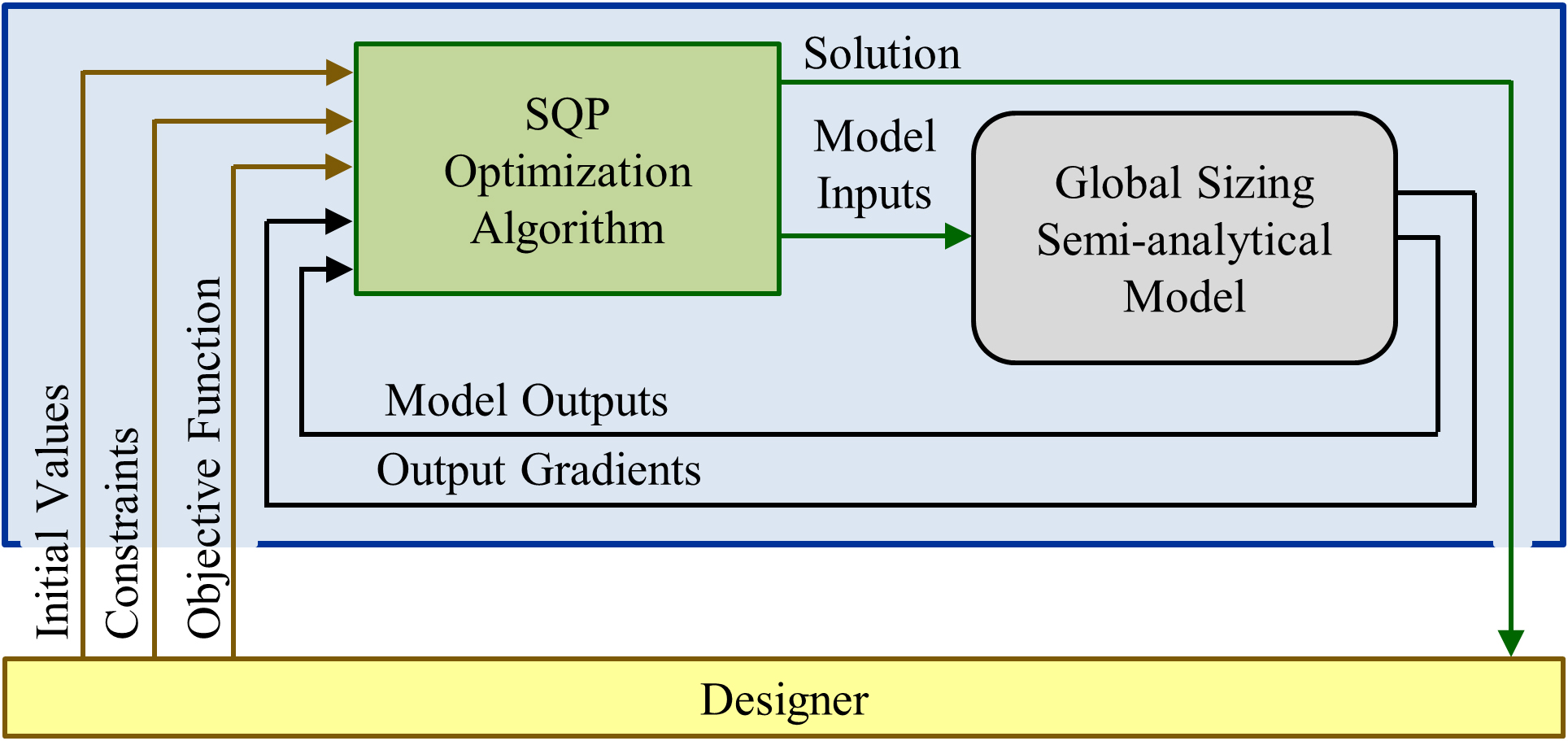
The aforementioned methodology, considering only the rated operational point, has been used to design the PMSG with minimal cost. As a result, the MDO has resulted a PMSG that costs US$ 5,512.73, with the characteristics presented in Table 1. Although this is an optimum solution that respects all design criteria and costs as low as possible, it is not possible to predict the energy produced by the WECS with this PMSG because only the rated efficiency (and so the rated output power) is known. The designer does not know if a PMSG with higher efficiency would be a better solution (even if it were more expensive).
Main characteristics of the PMSG designed considering one operating point and the PMSG designed considering 26 operating point
Main characteristics of the PMSG designed considering one operating point and the PMSG designed considering 26 operating point
A typical solution for this problem is to plot a Pareto front to see the sensitiveness of the two desired parameters, i.e. PMSG cost and efficiency. The Pareto front shown in Fig. 7 has been obtained minimizing the cost of the set formed by the PMSG and the power converter, and setting fix the system efficiency in discrete values from 90.7% to 96.9% (50 optimum results are plotted on Fig. 7).
Pareto front between cost and efficiency.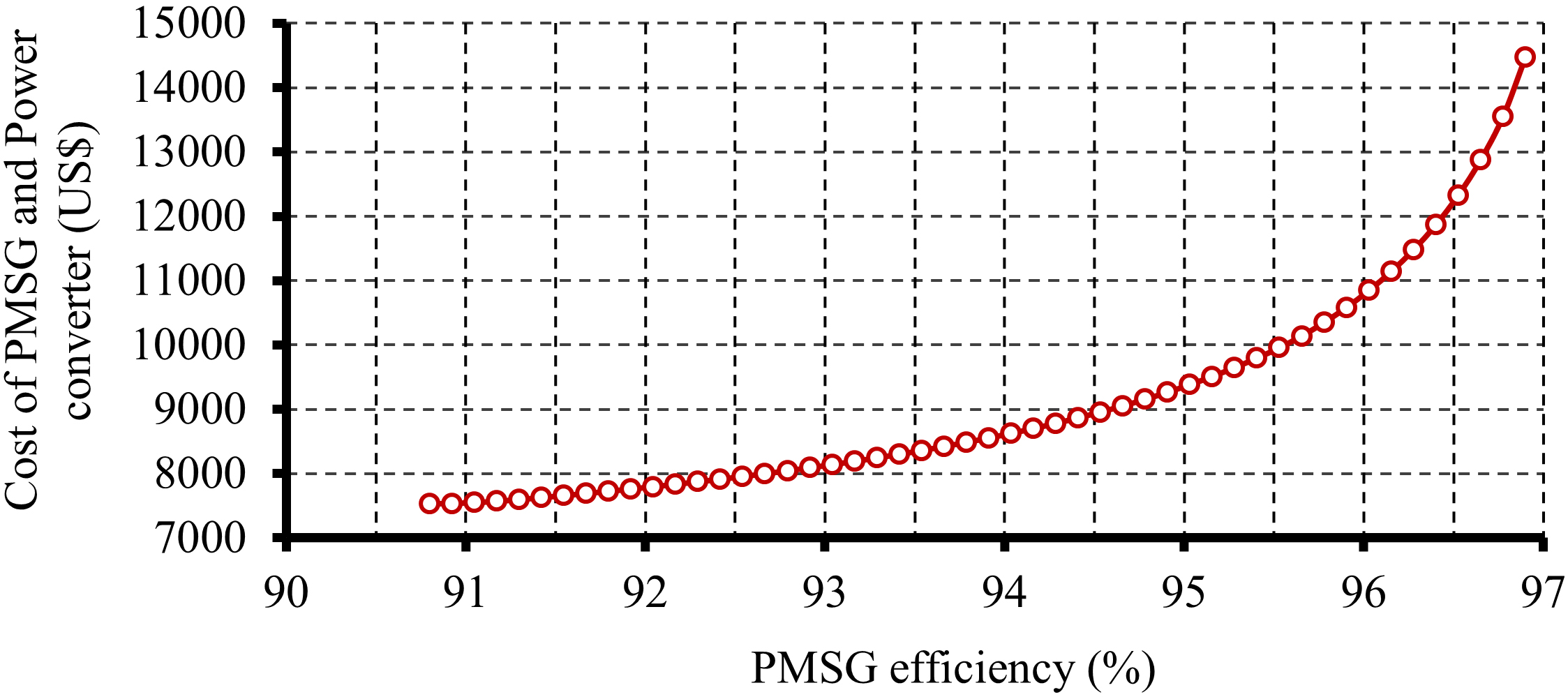
The analysis of the Pareto front allows finding out what is the cost penalty of increasing efficiency. On the other hand, it does not help very much to choose the best option: increasing the efficiency from 90.7% to 94.5% implies on increase the cost of the set from US$ 7,530.21 to US$ 9,000.00, but it is hard to compare these two options.
Including multiple operating points in the model allows to predict the energy produced by the WECS, as shown in Fig. 8.
Yearly energy yield related to each operating point.
Adopting an energy price, the produced energy can be converted into energy proceeds. To estimate the lifetime (considered as 20 years) energy proceeds, an interest rate of 6% per year has been used. By this way, Eq. (8) has been used as the objective function to be maximized. The resulted PMSG costs US$ 9,014.04 and has the characteristics presented in Table 1.
The proposed MDO applied to twenty-six operating points finds a solution representing a PMSG with a good compromise between cost and energy yield. Table 2 shows the computational time taken by the design optimization when considering one operating point and twenty-six, using a personal computer with the operational system Windows 8.1 (CPU: 1.6 GHz, RAM: 4 GB).
Computation time vs number of variables
This paper deals with a large optimization problem used to design a wind power PMSG focusing on the issues related to modeling and optimizing problems with high complexity. The results show that the model provides a reliable solution and the optimization strategy does not need excessive time to converge.
To design a variable speed machine it is very important to take into account multiple operating points, which has been done using the wind speed occurrence curve split in 26 wind speed discrete intervals from 0 m/s to 25 m/s. Such a strategy, applied to a multidisciplinary design model, enhances the number of variables and the PMSG design becomes a large optimization problem. To overcome such a problem, the employed model provides the exact jacobian, allowing the use of an optimization algorithm of order 1 that is capable of dealing with hundreds of constraints.
The proposed multidisciplinary optimization design has been used to provide a solution with the maximum net earnings from the wind turbine. Nevertheless, it can be used to seek different objective functions, as minimizing the PMSG or power converter costs (or both), to minimize the electrical losses, to maximize the energy production, to minimize the return of investment time, among others.
Some results have been presented as examples of the design methodology presented in this paper. The contributions of this paper lies mainly on the PMSG optimum design methodology, taking into account the wind occurrence curve and a multidisciplinary model. However, only the costs of the generator and power converter have been considered. The costs of blades, tower, foundation, transport, installation, maintenance and disposal, among others, are not included in the economic sub-model. These costs are very difficult to estimate, as they depend on many unpredictable factors, including distance between factory and wind farm, local policies and economic factors as inflation, for instance. Although most wind turbine manufactures consider the costs of certain components, as the blades, the other costs are not usually included in their design. All those costs could be included in the economic sub-model to obtain a solution suitable for a specific site. This would be only possible if the manufacturer disposes of reliable information on these costs.
It is intended to investigate further, how the discretization of the wind occurrence curve affects the results. It has been considered 26 wind speed intervals of 1 m/s, but a new study is being conducted to verify if different wind speed intervals (e.g. 5 intervals of 5 m/s or 100 intervals of 0.25 m/s) provide different results and how they influence the required computational time.