



Abstract
Thermophysical and rheological properties of magnetic suspensions, in which nm- and/or μm-sized magnetic particles disperse, are tunable by applying a magnetic field externally. In the present study, the influence of the size of magnetic particles on the thermophysical and rheological properties was investigated. Four types of the magnetic suspensions were prepared with varying the volume fractions of nm- and μm-sized magnetic particles. The total fraction of the magnetic particles in all samples was adjusted to be 6 vol.%. The thermal conductivity in the presence of homogeneous magnetic field was measured by the originally-designed transient hot-wire method (TPSY02, CLIMA-TEC). And the steady-state rheological behaviors were investigated by a magnetorheometer (MCR302, Anton-paar). As the obtained results, the thermal conductivity was enhanced when the magnetic field was applied parallel to the temperature gradient for all samples. On the other hand, the thermal conductivity decreased when the magnetic field was applied perpendicular to the temperature gradient in the case that both the nm- and μm-sized magnetic particles were dispersed. It was also found that the fluid only with the nm-sized magnetic particles showed a Newtonian-like behavior even in the presence of magnetic field. When the μm-sized magnetic particles were mixed and the fraction increased, the rheological behavior changed from Newtonian to viscoplastic fluid.
Keywords
Introduction
Depending on the size of magnetic particles, magnetic suspensions are classified into (a) magnetic fluid (MF), (b) magnetorheological fluid (MRF) and (c) bidisperse magnetorheological fluid (BMRF). In MFs and MRFs, nm- and μm-sized magnetic particles are dispersed in a proper carrier liquid, respectively [1]. BMRFs are a suspension in which both nm- and μm-sized magnetic particles co-exist in a carrier liquid, proposed to mitigate the settling problem in MRFs by the predominance of the thermodynamic forces of the nm-sized magnetic particles [2–4]. These fluids are very sensitive to magnetic fields. Owing to the fact that the kinetic behavior, thermophysical and rheological properties are regulated by applying magnetic fields, the magnetic suspensions are considered for various engineering applications, for examples in MF, magnetic fluid speakers [5], vacuum seals [6], temperature and pH sensors [7], in MRF, semi-active dampers [8–11], brakes [12] and clutches [13], in BMRF, polishing [14] and so on.
When a magnetic field is applied to the suspensions, the magnetic moments of the particles are oriented to the field direction. Neighboring particles interact with each other due to the magnetic moments and form chain-like structures (clusters) along the applied field [15]. These clusters induce anisotropic structure in the presence of magnetic field. An important application area utilizing such filed-induced clusters is a regulation of thermophysical and rheological properties, such as viscosity and thermal conductivity.
For the magnetorheological behaviors of the magnetic suspensions in the presence of magnetic fields, it is well known that their viscosity apparently increases when the magnetic suspensions are exposed to a magnetic field, which is termed as “magnetoviscous effect” [1]. The clusters formed perpendicular to the shear flow hinder liquid flow. There are many studies on the magnetoviscous effects in MF, MRF, and BMRF [1,16–19]. The mechanism responsible for the viscosity variation in MF depends on the fraction of nm-sized magnetic particles. At low particle fractions, where the magnetic interaction between the particles is negligible, the viscous torque is generated due to the orientation of the particle in the homogeneous magnetic field applied perpendicular to the shear flow [6]. On the other hand, at higher particle fractions where the magnetic interaction between particles plays a significant role, viscosity increases due to the formation of chain-like structures in the field direction and hinder the liquid flow, inducing the viscous stresses [15]. This magnetoviscous effect is significant in MRFs due to the size and toughness of chain-like structures. A coupling constant is the ratio of the magnetic dipole interaction energy to the thermal energy [20]. When the coupling constant exceeds one, the magnetic dipole interaction energy dominants, and the particles form the clusters along the field direction. The coupling constant of MRFs is about 106--108, 6--8 orders of magnitude larger than that of MFs. Although the MRFs are known to behave as a Newtonian fluid in the absence of a magnetic field, they behave as a Bingham fluid under external magnetic field [21]. However, the rheological behavior of MRFs is unstable due to the settling of particles. Thus, the enhancement in the static-state rheological behavior of MRF was attempted by mixing nm-sized magnetic particles [3]. Rosenfeld et al. investigated the static-state rheological behavior of MRFs mixing iron nanoparticles (BMRFs). Their results showed that the setting problem can be mitigated by the predominance of the thermodynamic forces, but the yield stress is reduced [3]. The magnetoviscous effect has been studied in the fields of MR, MRF and BMRF, individually. However, the systematical investigation of the effect of the particle size on the magnetoviscous is not well understood, crossing over the above fields.
The field-induced clusters influence the heat conduction as well. In general, the inherent thermal conductivity of magnetic particles is higher than that of carrier liquids [22,23]. Therefore, the heat conducts through the clusters, resulting in anisotropic thermal conductivity in the presence of a magnetic field. There are many studies on the effect of magnetic fields on the thermal conductivity in MFs [24–35]. For example, Li et al. [26] investigated the thermal conductivity of aqueous MFs dispersing 0.0–5.0 vol.% of 26 nm diameter Fe nanoparticles. They revealed that the thermal conductivity is enhanced when the magnetic field is applied parallel to the temperature gradient, on the other hand, the perpendicular field has no influence on the thermal conductivity. Philip et al. [36] observed a significant thermal conductivity enhancement of 300% by applying a parallel magnetic field with a magnetite MF with an average particle size of 6.7 nm and a volume fraction of 6.3%. The authors [37] have proposed a novel method to induce large anisotropic thermal conductivity by dispersing silver nanowires into MF. In MRF and BMRF, more massive clusters are formed because of the large magnetic dipole interaction energy of particles. These clusters may facilitate the thermal conductivity enhancement. However, as far as the author’s best knowledge, there is no study on the effect of magnetic fields on the thermal conductivity in MRFs and BMRFs, although there are many studies on the thermal conductivity in MFs.
Because the magnetic dipole interaction between particles depends on the particle size, the morphology of clusters varies, depending on the fraction of nm- and μm-sized magnetic particles [4]. And the different morphology of clusters influences on rheological and thermophysical properties of the magnetic suspensions. Therefore, in the present study, the influence of magnetic particle size on the thermal conductivity and the viscosity was investigated. Four types of magnetic suspensions were prepared with varying the fractions of nm- and μm-sized magnetic particles. The total volume fraction of the magnetic particles was adjusted to 6 vol.%. The thermal conductivity in the presence of homogeneous magnetic fields was measured by an originally-designed equipment using transient hot-wire method (TPSY02, CLIMA-TEC). And the steady-state rheological behavior in the presence of the homogeneous magnetic fields was investigated by a magnetorheometer (MCR302, Anton-paar).
Experimental details
Samples of magnetic suspensions
Four types of magnetic suspensions were prepared by varying volume fractions of 10 nm magnetite (APG314, Ferrotec Holdings Corporation; saturation magnetization of 27.5 mT) and 3.9 to 5.2 μm-sized iron magnetic particles (OM grade, BASF SE) in a carrier liquid of polyalphaolefin as listed in Table 1. The total volume fraction of these magnetic particles was fixed at 6 vol.%. The test fluids with nm- to μm-sized particle fraction ratios of 6:0 and 0:6 are MF (sample A) and MRF (sample D), respectively. Samples prepared under other nm- to μm-sized particle fraction ratios of 2:4 (sample B) and 4:2 (sample C) are BMRF. 5 vol.% of Smectite, which is a swellable clay, was added to the magnetic suspensions to reduce the sedimentation rate by increasing the overall viscosity of the fluids.
Compositions of samples.
Compositions of samples.
Sedimentation tests were performed to investigate the stability of particles in the gravitational field. The results are shown in Fig. 1. The thermal conductivity and viscosity measurements performed in the present study require a maximum of 30 and 15 minutes, respectively. As shown in Fig. 1, no sedimentation was visually observed within 30 minutes after the preparation of the fluids.
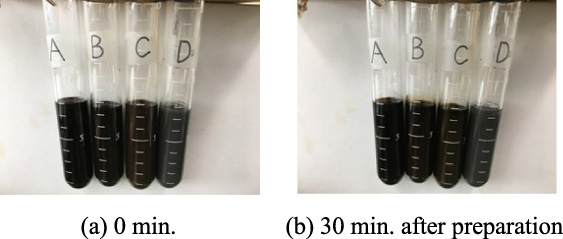
Photographs of fluids A (MF), B and C (BMRFs) and fluid D (MRF).
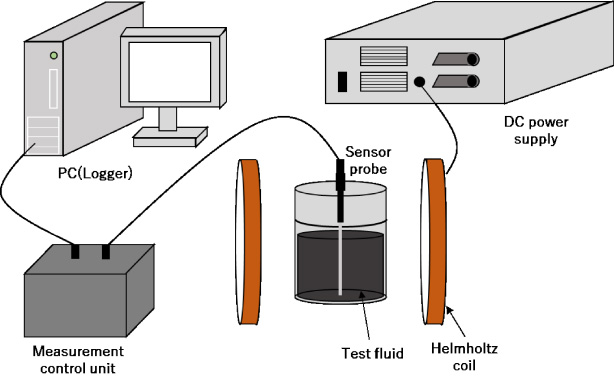
Schematic diagram of the measurement system for thermal conductivity, using transient hot-wire method.

Darkfield microscope images of magnetic suspensions. The morphology of particle structure before and after the application of magnetic field is shown on the left and right side photographs, respectively.
In this study, the thermal conductivities of samples A ∼ D were measured by the transient hot-wire method. The measuring system was mainly composed of a PC, a thermal conductivity measurement system TPSY02 produced by CLIMA-TEC and a Helmholtz coil. A platinum wire (sensor probe (TP08, CLIMA-TEC)) was immersed in the magnetic suspension in the direction of gravity. The heat conducts in the radial direction of the container (perpendicular to the gravitational field). A thermocouple is embedded in the sensor to measure the temperature rise. In this measurement system, the thermal conductivity k is determined by the following equation:
The flow curve measurement (steady-state measurement) was performed using a plate-plate type rotational rheometer (MCR 302, Anton-paar). Both the shearing plate and the lower fixed plate are made of non-magnetic materials. With considering particle structures in the presence of applied magnetic fields, Lopez-Lopez et al. [39] studied the effect of the plate-plate gap thickness, in a range of 10--400 μm, on the viscoelasticity of MRFs. Their results concluded that the thickness does not have any relevant influence on the MR properties corresponding to the flow regime (share rate >10−1 1/s). Based on their results, in our measurements, the gap thickness was set to 500 μm. The rheometer is equipped with a magnetocell capable of applying a homogeneous magnetic field perpendicular to the direction of shear flow. After applying the magnetic field on the magnetic suspensions, the morphology of the chain-like structure is known to keep varying with elapsed time [40]. Taking the influence of the morphology variation on the measurement into account, the samples were held at rest for 1 minute in the presence of the magnetic field. To quantify the operator error associated with the filling of the sample, several measurements with different fresh samples were performed. The measurement error is taken into account in reporting the results. A hot plate was also embedded in the rheometer to adjust the temperature of samples. In this study, the measurement was performed at 20
Results and discussion
Visualization of the morphology of chain-like structures in the absence and presence of the magnetic field
It is known that the morphology of structures depends on the fraction, size, material, and shape of the magnetic particles [4]. Therefore, in this study, the morphology of the clusters at different volume fractions of nm- and μm-sized magnetic particles were observed by using a commercial dark field microscope (TX73, Olympus Corporation) equipped with a custom-built electromagnet, which is capable of applying a homogeneous magnetic field of 21 mT. Here, the brightness and contrast were adjusted to sharpen the photographic images. Figure 3 shows visualized images of internal structures before and after the application of the magnetic field to each sample.
In the case of MF (Fig. 3(a)), it was impossible to observe the particles as well as the clusters in the presence and the absence of the magnetic field. On the other hand, the μm-sized magnetic particles could be visualized as shown in Fig. 3(b)--(d). When the μm-sized magnetic particles disperse, they form huge structures under the magnetic field. Furthermore, different morphologies of particle structure were observed depending on the fractions of nm- and μm-sized magnetic particles. When the fraction of the μm-sized magnetic particle increases, the morphology looks like forming network structures. And also, when the nm-sized magnetic particles were mixed (in the case of the BMRFs), longer structures were formed under the presence of the magnetic field. This is because of the nm-sized magnetic particles accumulate between the μm-sized magnetic particles [40]. In the following section, the influence of the difference in internal structures on the thermal conductivity and viscosity is described.
Thermal conductivities of magnetic suspensions in the presence and absence of external magnetic field
When a magnetic field is applied to the magnetic suspensions, magnetic particles form chain-like structures in the field direction, and consequently, the thermal conductivity is enhanced. Since the morphology of the cluster depends on the fraction of nm- and μm-sized magnetic particles as shown in Fig. 3, the difference of thermal conductivity enhancement among the samples should be expected.
Figure 4 shows the results of the thermal conductivity measurement before and after applying homogeneous magnetic fields on the samples A to D. The magnetic field was applied parallel or perpendicular to the temperature gradient. The thermal conductivities of nm- and μm-sized magnetic particles are estimated to be 9.7 W/(m K) and 80.5 W/(m K), respectively. The thermal conductivity of the polyalphaolefin was 0.16 W/(m K), and the addition of 5 vol.% of smectite did not the influence on the thermal conductivity.
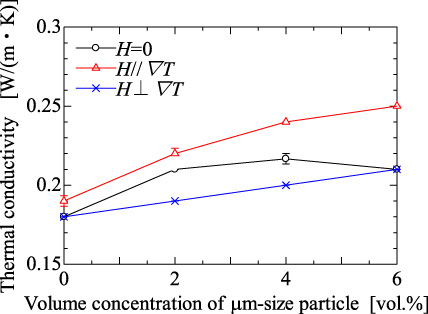
Measurement results of thermal conductivity in the presence and absence of magnetic field samples A to D. The homogeneous magnetic field was applied perpendicular and parallel to the temperature gradient.
When the volume fraction of μm-sized magnetic particles increased, an increase in the thermal conductivity even in the field-free condition could be expected for samples B, C and D than Sample A. However, the measured thermal conductivity of sample D decreased. Although the sedimentation tests did not show any visible difference over time, it is highly likely that the settling of particles progressed at a relatively higher rate in the case of the MR fluid (at 6 vol.%).
Interestingly, thermal conductivity enhancement was observed in all the samples, when the magnetic field was applied parallel to the temperature gradient. On the other hand, when the magnetic field was applied perpendicular to the temperature gradient, the thermal conductivities of samples B and C decreased. Figure 5 shows the thermal conductivity enhancement in the presence of the external magnetic field. The maximum thermal conductivity enhancement of 1.19 times was recorded for sample D. On the other hand, 0.91 times reduction in thermal conductivity was recorded for sample B.
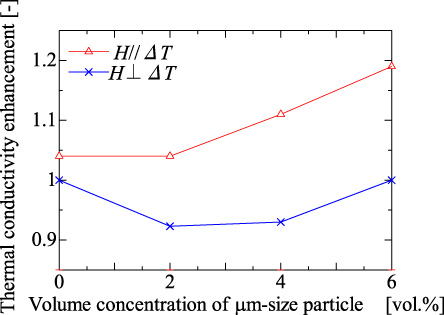
Thermal conductivity enhancement as a function of volume fraction of μm-sized magnetic particles in the presence of magnetic field applied (a) parallel and (b) perpendicular to the temperature gradient.
The variation in the thermal conductivity under the external magnetic fields could be explained using the Landau-Lifshitz relation as given by Eq. (2). This equation can be used to model the thermal conductivity of heterogeneous materials [41].
In the Landau-Lifshitz relations shown in Fig. 6, there is no significant difference in the thermal conductivity at n ≤ 0. This implies that the difference between the thermal conductivities in the series mode and the homogeneous mode is small. On the other hand, the relation shows that the thermal conductivity is dramatically enhanced with increasing n at n > 0. For magnetic suspensions, the variation in the thermal conductivity is small when a magnetic field is applied perpendicularly to the temperature gradient, whereas by applying a parallel magnetic field, a remarkable improvement in thermal conductivity can be expected. There are many studies on the influence of the magnetic field direction on the thermal conductivity of the magnetic suspensions [24–35]. Philip et al. [36] observed a significant thermal conductivity enhancement of 300% (k/k f = 4.0) by applying a parallel magnetic field with a magnetite MF with an average particle size of 6.7 nm and a volume fraction of 6.3%. On the other hand, many studies have realized that the thermal conductivity does not change when the magnetic field is applied perpendicular to the temperature gradient [26,28,30]. These results are consistent with the trend of Landau-Lifshitz relation.
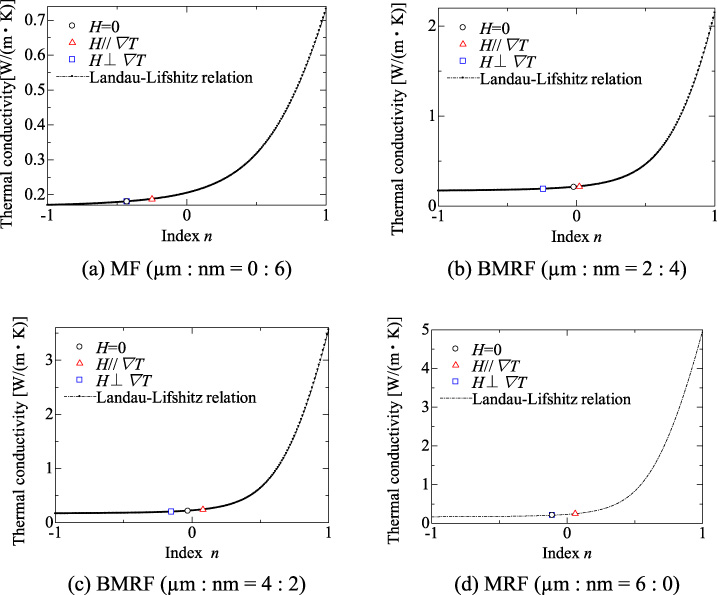
Thermal conductivity as a function of n, determined from the Landau–Lifshitz relation using the experimental conditions.
For MF employed in the present study, shown in Fig. 6(a), the thermal conductivity did not change when a magnetic field was applied perpendicularly to the temperature gradient. The index n at H = 0 and H ∥ ΔT are a negative value, meaning that the heat conduction is the series mode. This result is consistent with the results of Shima and Philip [42]. They investigated the influence of the direction and the intensity of magnetic fields on the thermal conductivity of the magnetite MFs, and showed the thermal conductivity at H = 0 and H ∥ ΔT are in the series mode. Further, they found that the thermal conductivity is enhanced and its mode is changed from the series to the parallel mode with increasing the magnetic field strength when the magnetic field is applied parallel to the temperature gradient. However, in the present study, whereas the index n somewhat shifts in the positive direction when the parallel magnetic field is applied, the index n is still a negative value, and the thermal conductivity is in the series mode. The reason for this is considered that the aspect ratio of clusters is small. When the magnetic dipolar interaction energy of particles exceeds the thermal energy, the particles aggregate to form clusters along the magnetic field direction. A coupling constant 𝜆 [20] is the ratio of the magnetic dipolar interaction energy and the thermal energy, given by Eq. (3)
In the case of MRF, the difference from MF is that the index n is larger than 0 at H ∥ΔT, showing the thermal conductivity in the parallel mode. The diameter of the magnetic particles in the MRF is about 100 times larger than that of MF. The dipole interaction energy depends on the diameter and the magnetic moment of magnetic particles. The larger dipole interaction energy occurs more extended clusters with large aspect ratio. With conducting the heat through the clusters, they facilitate to induce the large thermal conductivity [42]. The coupling constant of MRF is 3.02 × 10⁶, which is much larger than that of MF. Therefore, the magnetic dipole interaction energy is dominant over the thermal energy, and huge clusters are formed along the direction of the magnetic field. This is confirmed by the visualization results in Fig. 3(d).
Of particular interest is the behavior of the thermal conduction anisotropy in BMFR. For H = 0, the index n shows approximately 0, which means that heat conduction indicates the homogeneous mode. When the parallel and the perpendicular magnetic fields are applied, n obviously shifts to positive and negative, respectively. In the parallel magnetic field, the thermal conductivity increases and shows the parallel mode. On the other hand, in the presence of the perpendicular magnetic field, the heat conduction decreases and shows the series mode, in particular, this declination is not observed in MF and MRF. The results show that BMRF is a sensitive heat conduction media, in which the thermal conductivity is regulated with the direction of the magnetic field. The BMRF is a colloidal solution in which nm- and μm-sized magnetic particles are co-existed in a carrier liquid. The BMRF has been proposed to improve the dispersibility of μm-sized magnetic particles. The Brownian motion of nm-sized magnetic particles contributes to the dispersibility of μm-sized magnetic particles. When a magnetic field is applied to BMRF, μm-sized magnetic particles first form clusters. The nm-sized magnetic particles, then, aggregate among the μm-sized particles, resulting in longer clusters formed [40]. The nm- and μm-sized particles are spherical. When such particles approach each other due to the magnetic dipole interaction force and form a cluster, the particles are in point contact with each other. The conductance between the particles is expressed by J Q = −GΔT, where J Q is the heat flux across the interface, G is the interfacial thermal conductance and ΔT is the temperature drop across the interface [43,44]. Because the inherent thermal conductivity of the nm-sized magnetic particles is higher than that of the carrier liquid, the thermal conductance across the interface between the μm-sized magnetic particles may become increased.
As shown in Fig. 3, the morphologies of clusters in MR, BMRF, and MRF are different depending on the size and the volume fraction of the magnetic particles. These differences influence their rheological behaviors in the presence of magnetic fields. Figure 7 shows the measured shear stress with respect to the shear rate at different magnetic field intensities, which were applied perpendicular to the shear flow. As increasing the volume fraction of μm-sized magnetic particles (Fig. 7(a) → (d)) and the magnetic field strength, the shear stress is dramatically enhanced. This is because the formed clusters hinder the shear flow, resulting in viscosity increasing [15]. The chains are formed when the dipolar interaction energy of the particles overcomes the thermal energy. In the case of MF, the values of the coupling constant are 0.169, 0.678 and 1.524 at 100, 200 and 300 mT, respectively. On the other hand, the ones of MRF are 0.755 × 10⁸, 3.019 × 10⁸, 6.793 × 10⁸, which are significantly larger with approximately 108 times compared with MF. The resulting substantial magnetic dipolar interaction energy gives clusters further stiffness with large aspect ratio. For BMRF, the dispersed μm-sized magnetic particles spontaneously form the clusters, which become nuclear to lead the nm-sized magnetic particles accumulating between the μm-sized magnetic particles, and then form significant large aspect clusters [40]. Consequently, the larger magnetoviscous effect is induced with the increase of the fraction of the μm-sized magnetic particle.
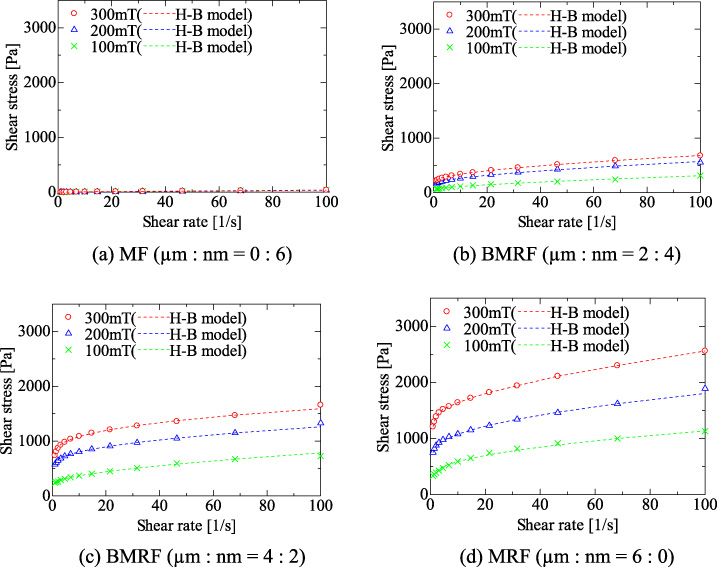
Flow curves of samples (a) A (MF), (b) B (BMRF), (c) C (BMRF) and (d) D (MRF) at different magnetic field intensities. The dot lines represent the Herschel-Burkley model fitting curves drawn using experimental data.
In the low shear rate regime, the shear thinning phenomena, where the viscosity dramatically decays, is observed. With increasing the shear rate, the Newtonian regime, where the viscosity becomes constant, is observed. For MF, the magnetic force between two aligned magnetic dipoles at a distance of d +2b is given by,
The Herschel–Bulkley model [47] is a constitutive one which is often used to represent the behavior of non-Newtonian fluid, described by Eq. (6).
The correlation with the Herschel-Bulkley Model is also plotted in Fig. 7, and is found to fit the experimental data well. Figure 8(a) and (b) shows the shear thinning exponent n and yield stress 𝜂0 with respect to the intensity of applied magnetic field in different samples. In the case of sample A, the value of shear thinning exponent n was nearly one, and the yield stress was almost zero. This result implies that MF behaves like a Newtonian fluid even in the presence of the magnetic field. On the other hand, when a small amount of μm-sized magnetic particles is introduced into MF, the fluids behave as a non-Newtonian fluid, a viscoplastic fluid, in the presence of the magnetic field as shown in Fig. 8(a), where the viscosity index n decreases with increasing the fraction of the μm-sized magnetic particles. This is because the suspensions with the μm-size magnetic particles display a significant shear thinning behavior at a low shear rate regime. As shown in Fig. 8(b), the yield stress was enhanced with increasing the fraction of μm-sized magnetic particles and the intensity of the magnetic field. This is because the magnetoviscous effect is induced by the formation of clusters composed of the μm-sized magnetic particles. Addition of the μm-size magnetic particles to magnetic suspensions (MF) significantly influences on their rheological behavior, varying from a Newtonian fluid-like to a viscoplastic fluid.
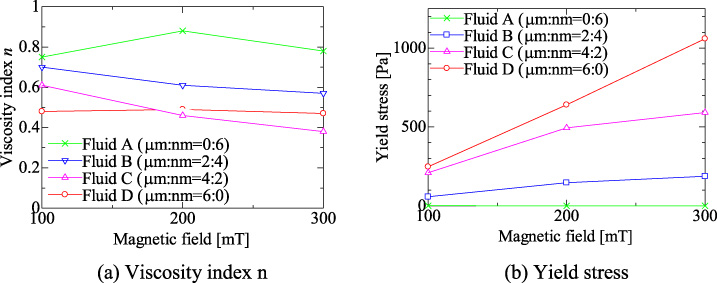
(a) Viscosity index n and (b) yield stress 𝜂0 in the Herschel–Burkley model at each sample and intensities of magnetic field.
In the present study, the influence of the size of magnetic particles, in particular – the fractions of nm- and μm-sized magnetic particles, on the thermophysical and rheological properties were investigated. From the observation results of clusters under the magnetic field, the morphology of the clusters depends on the fractions of nm- and μm-sized magnetic particles. With adding the μm-sized magnetic particles to MF, larger clusters are formed, because of the significant large magnetic dipole interaction energy of the μm-sized magnetic particles. These clusters facilitate the enhancement of the anisotropic thermal conductivity and viscosity. With increasing the volume fraction of μm-sized magnetic particle, the thermal conductivity is enhanced in the presence of the parallel magnetic field. The maximum enhancement of 20% was observed in MRF. Interestingly, the 10% decrement of thermal conductivity was also observed under the perpendicular magnetic field in BMRF, in which nm- and μm-sized magnetic particles co-exist. The nm-sized magnetic particles may accumulate between the clustered μm-sized magnetic particles, and enhance the thermal conductance of the clusters. The BMRF is found to be a highly sensitive magnetic suspension for anisotropic thermal conductivity. For the influence on the rheological properties, the magnetic fluid behaves like a Newtonian fluid even in the presence of the magnetic field. The addition of μm-sized magnetic particles to MF significantly influence on the rheological behavior, changing it from a Newtonian-like to a viscoplastic fluid. With increasing the fraction of μm-sized magnetic particle, the shear thinning in MF, MRFs, and MR is observed up to a shear rate of 10 s−1, the shear thinning regime for the shear rate was found to be not affected by the fractions of nm- and μm-sized magnetic particles.
Footnotes
Acknowledgements
This study was supported by a Grant-in-Aid for Scientific Research on Innovative Areas (B) 16H03843 from Japan Society for the Promotion of Science (JSPS), Japan.