



Abstract
This paper concerns the comparison of the performance of the Spectral Element Method (SEM) and the Finite Element Method (FEM) for modeling a magnetostatic problem. The convergence of the vector magnetic potential, the magnetic flux density, and the total stored energy in the system is compared with the results of FEM. Two simulation scenarios are examined which are distinct by a large and a small rounding radius of the corner. SEM shows comparable convergence to FEM for field computations and faster convergence for energy calculations.
Keywords
Introduction
Various modeling techniques are available for electromechanical devices, each with their advantages and limitations. Electrical Machines (EM) are extensively modeled with fast models based on the semi-analytical solutions of the Poisson’s and Laplace’s equations solved with Fourier analysis, lumped parameters or Schwarz Christoffel mapping [1, 2, 3]. The latter exhibit fast convergence to the solution and are suitable for design and optimization routines. However, these methods suffer from limited applicability when:
More complex geometries are modeled. Losses in the iron core must be computed. Noise vibration and harshness analysis are performed.
In these cases, FEM is preferred, at the price of higher computation time and a higher memory requirements [4, 5, 6, 7].
The accuracy and memory requirements of numerical methods are related to the convergence of the desired quantity to the exact value. With a slow convergence, a high number of unknowns, or degrees of freedom is necessary to achieve a good accuracy. The implementation of higher order elements in a finite element problem increases the convergence of the solution [8, 9].
One of the methods which use high order elements is the spectral element method. SEM divides the geometry into subdomains, or elements and approximates in each element the Partial Differential Equation (PDE) by patching the elements using continuous boundary condition. Therefore, in each element, the solution is approximated by a set of basis functions. The most preferred basis functions are high degree polynomials [9]. SEM is known as being very accurate for the approximation of PDEs, and with its spectral accuracy, it can achieve fast exponential convergence [9, 10, 11]. Moreover, it can also model complex geometries by implementing elements with curved boundaries by means of mapping techniques [11].
The high convergence rate of SEM will result in significant reduction of the number of degrees of freedom, for the entire geometry [12]. Nonetheless, if singularities are present in the field solution, for instance in the cases when sharp corners with different material properties exist, the convergence of the solution is limited [9]. Different configurations of SEM techniques have been used in modeling of magnetic devices [13, 4]. Recently, the implementation of SEM for more complex geometries has shown reliable results [12, 15].
In this paper the study on this method is continued with a study on convergence analysis of SEM and FEM for the modeling of magnetic devices. The convergence of both, spatial and global quantities are investigated, namely the magnetic vector potential, the magnetic flux density and the total stored energy. Two simulation scenarios are modeled to verify the convergence of high gradient magnetic flux density distributions in the corners of a magnetic core with different radii. The discussion on results and conclusions are provided.
Spectral element method
The Spectral Method approximates the solution of a PDE in a quadrilateral with a set of orthogonal basis functions. If multiple quadrilateral elements are patched together, one should choose an appropriate set of basis functions which can satisfy the continuous boundary conditions across the boundaries. Polynomial basis functions are preferred in this case. For the model in this paper, the Legendre-Gauss Lobatto (LGL) polynomial basis functions are used which are resulting from the Legendre basis. A nodal Galerkin formulation is implemented to compute the solution of the PDE at the polynomial roots.
Complex geometries are divided into multiple elements. For non-rectangular or curved boundaries, the elements are defined by the equations of the boundaries and mapped back into the unit squares with the help of the transfinite interpolation technique [11]. The implementation of the mapping in SEM results in a significant reduction of the number of spectral elements and, consequently, the number of unknowns of the final problem is also reduced.
Parameters for the simulations R1 and R2
Parameters for the simulations R1 and R2
The geometry of a magnetic circuit. Because of symmetry, only a quarter of it is modeled.
The investigated magnetic circuit is illustrated in the Fig. 1 because of the vertical and horizontal symmetry, only one corner of the core is modeled. The outer boundaries and the symmetry of the geometry are considered by imposing the following boundary conditions:
The bottom and the right side of the geometry will have Neumann boundary condition. In this way, the symmetry of the iron core and the coils is ensured. The top and left side of the geometry will have zero Dirichlet boundary conditions.
Furthermore, the iron core is assumed to be finitely permeable with a linear material characteristic. The geometrical and physical parameters of the circuit are given in Table 1.
Numerical models and results
The convergence of SEM is compared with the results from a commercial FEM software FLUX2D. The convergence of both local and global quantities is analyzed. In the case of spatial quantities, the magnetic vector potential
As a global quantity, the energy of the total system is selected. For the computation of the energy, the integration is performed on each element. Therefore, the interpolation errors are excluded.
Dimensions for the reference results
Dimensions for the reference results
a) The second order element mesh for scenario R2, generated with 2518 mesh nodes. b) The distribution of the flux lines obtained with the SEM model. The number of polynomial roots is indicated in each element.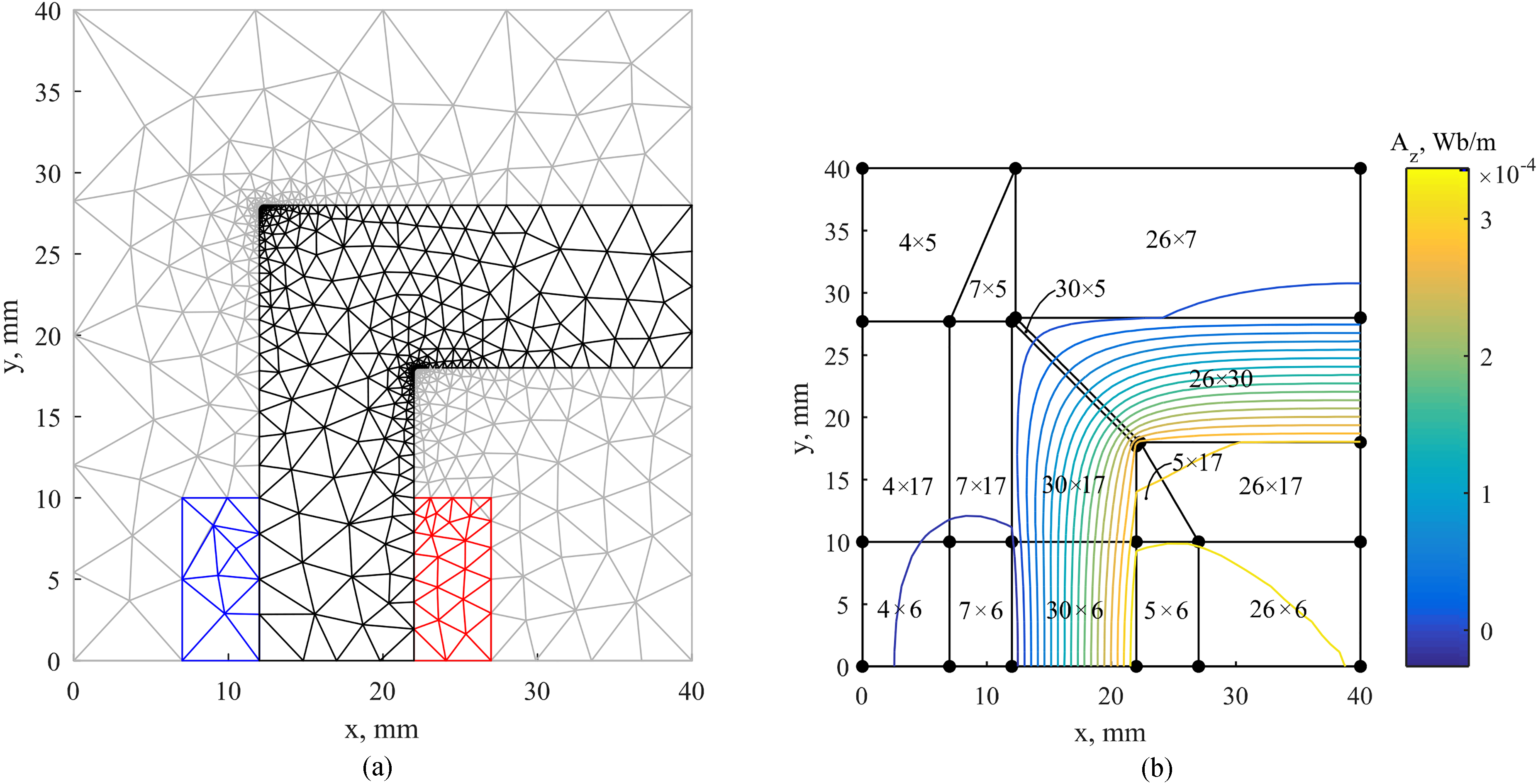
Triangular second-order mesh elements are chosen for the FEM to model the geometry from Fig. 1. A meshing technique is used which applies a relaxation on the faces and straight lines. For curved lines, the deviation of the mesh size relative to the line dimensions is considered. The mesh generated with this technique will result in a good approximation of the local fields. For each simulation scenario R1 and R2, the reference values for the convergence analysis are generated with a fine mesh, such that a discrepancy less than 10
SEM model
In SEM, each element is approximated with a set of polynomial roots. Therefore, the boundaries of shared elements must have the same number of roots on the shared line. The elements are arranged so that a minimum number of fifteen elements is used to model the given geometry. To perform the convergence analysis, for both scenarios, five simulation steps are performed. The order of polynomial basis is increased with each step. The flux lines of
a) The convergence of SEM and FEM to an exact analytical solution, b) convergence of the energy for SEM and FEM for both scenarios.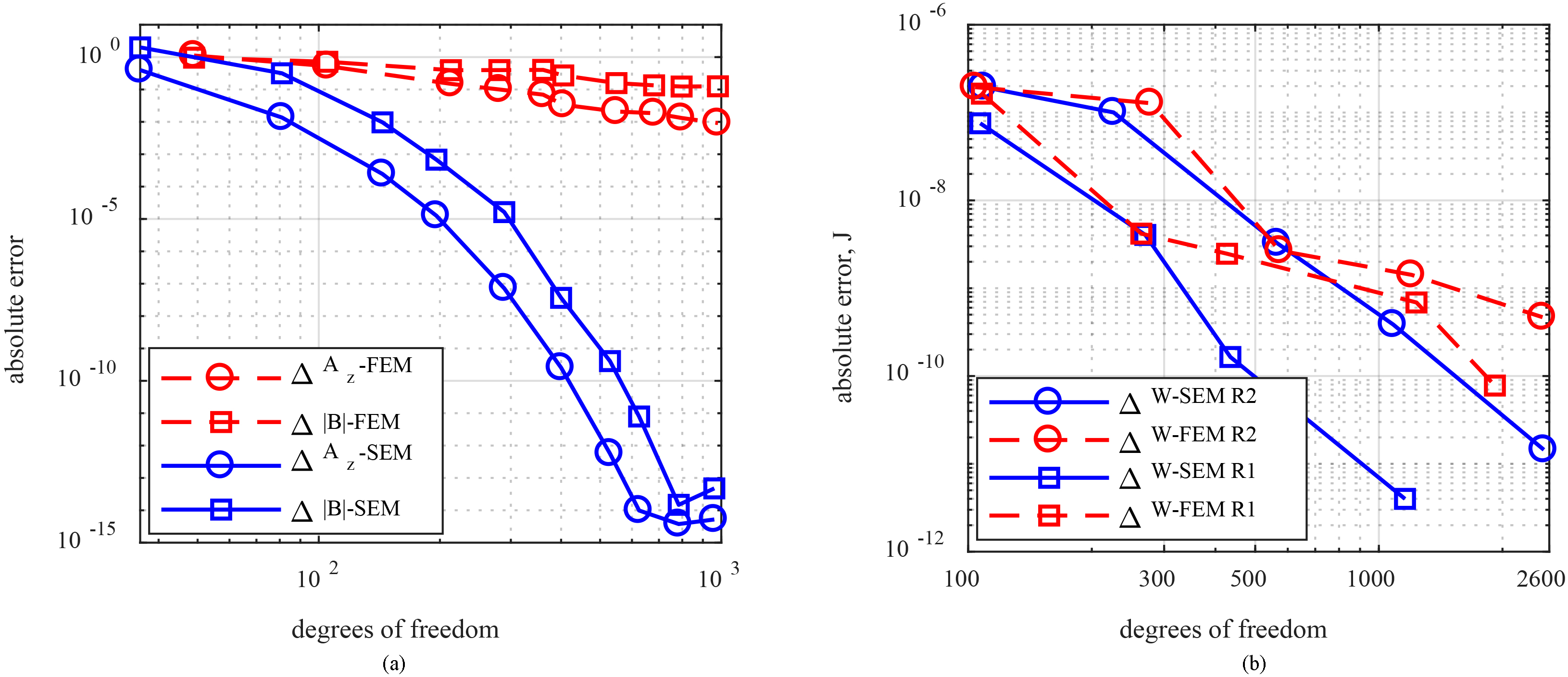
a) Convergence of 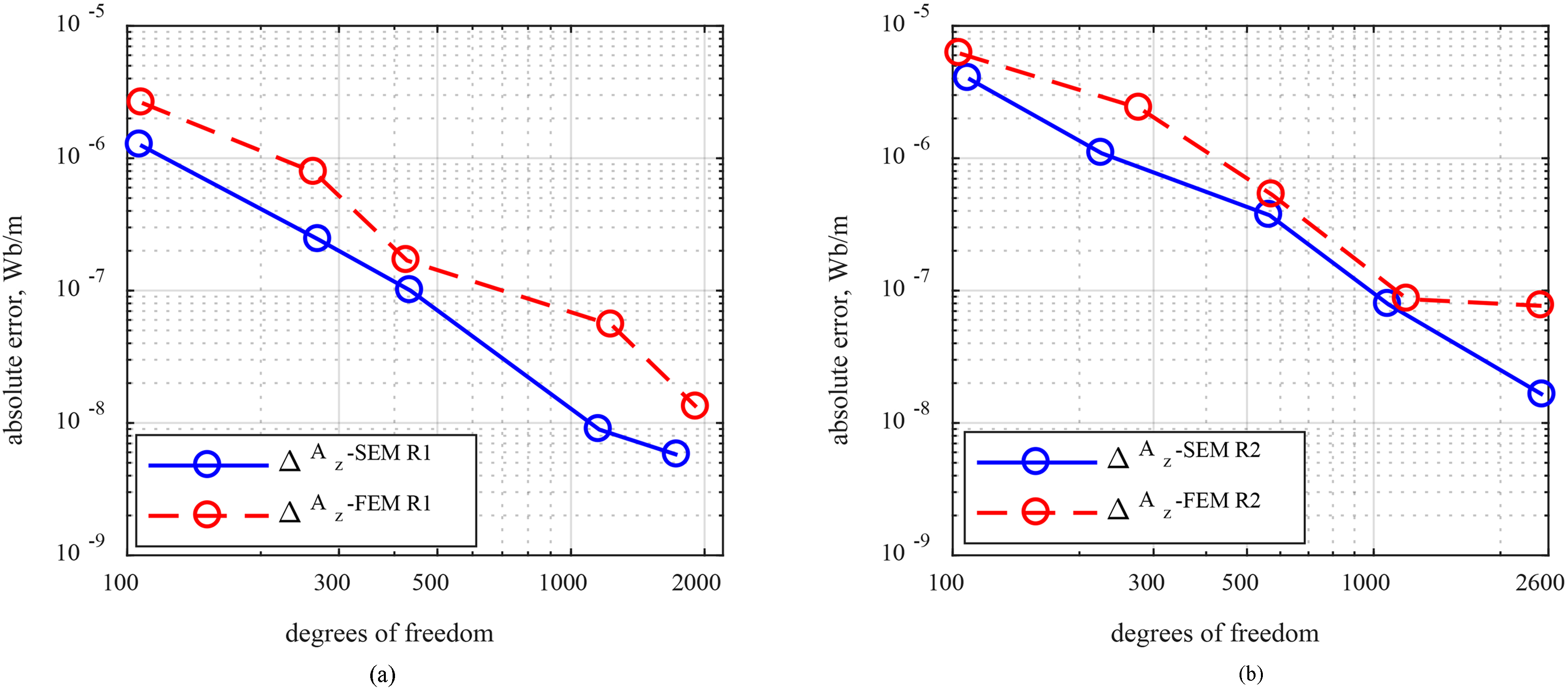
a) Convergence of B for SEM and FEM for the scenario R1, b) convergence of the magnetic flux density for SEM and FEM for the scenario R2.
The accurate convergence of a numerical PDE solver is evaluated with an exact field solution. In Fig. 3a, the convergence of both SEM and FEM towards an analytical solution of the Poisson equation in a square is shown [11]. Both
The number of unknowns for SEM can be reduced further dividing the geometry into elements optimized such that large elements, which have high order polynomials are divided into more elements which will cluster at the corners. The interpolation errors are excluded in the case of the energy calculation. The energy is computed in each spectral element, and the total energy is the sum of the energies of all elements. The FEM reference results for the energy are given in Table 2. In Fig. 3b the convergence of the energy calculation is shown for both scenarios. The energy is evaluated on the same mesh nodes for FEM and on the same roots distribution for SEM which was used to evaluate the convergence of
Conclusion
In this paper, the performance of the Spectral Element Method is investigated. The geometry of a magnetic circuit is modeled in two scenarios which are distinct by a large and small radius of the corner rounding. The convergence is evaluated for both local and global quantities. The model in the scenario R2 where smallest rounding radii are used, exhibit slower convergence than scenario R2. For the local field solution, the performance of SEM is comparable with FEM. In the same time, the convergence of a global quantity approximation-the energy in the system exhibits a faster convergence compared to FEM.
Footnotes
Acknowledgments
This paper is part of the project ADvanced Electric Powertrain Technology (ADEPT) funded by EU – Marie Curie ITN, grant number 607361.