



Abstract
Nowadays requirements for electrical motors are getting bigger due to the new energy standards. This paper presents some new version of expert system supporting automatic design of induction motors. The inference engine was used and the .NET technology was applied. Also the correction module has some new features. Due implementation of well configured knowledge bases, it is possible to create cheaper motors with better parameters.
Introduction
Induction cage motors are one of main elements in drive systems, because of simplicity of their construction, low cost of exploitation and production. Wide range of use electrical motors imposes detailed knowledge of performance characteristics in design phase [5, 9]. Modern computer aided design applications are more and more popular [6, 7]. By applying the appropriate computer programs, we get the possibility to make corrections to the object before prototyping. An expert system supporting design of low-power induction motors was introduced in the [7], where two commercial technologies were used: pc-shell [11] and Neuronix [10], as well as the Delhi language. The expert system proposed in the present article allows for the computer-aided design of induction motors of different construction in a wide range of rated power, and will be fully written in C# language [3].
Knowledge bases
To avoid the use of commercial solutions, the new proprietary software package contains inference engine, knowledge base creator and knowledge base tester created in .NET technology. It allows to open this application on any computer with installed Windows operating system, without the need to install additional libraries. The knowledge base creator allows to create or modify existing databases in user-friendly way. The creator is automatically validating facets names, range of all defined variables and logical completeness of rules [4, 13]. In the case of any mistake, the application informs which part needs to be readjusted. Each knowledge base contains 3 main sections: definition of value that can be found, list of all parameters that are necessary to found solution (with their possible ranges) and rules. The user is able to add comments in databases to help him develop files containing knowledge [14]. New base can be tested in knowledge base tester. This application needs to know each value of mandatory facets to perform inference. Each step of performed calculation is clearly described to user and then he is able to investigate quality of rules.
The 11 knowledge bases are created for expert system purpose, performing the following tasks: selection the number stator and rotor slots, selection the number of parallel branches, selection the stator inner diameter, height of airgap and stator winding wire diameter (without and with insulation), selection of air gap induction and current density in stator winding, correction of number of rotor slots and correction of all motor parameters.
Inference engine
New inference algorithm is designed and developed for expert system purpose.
Inference process algorithm.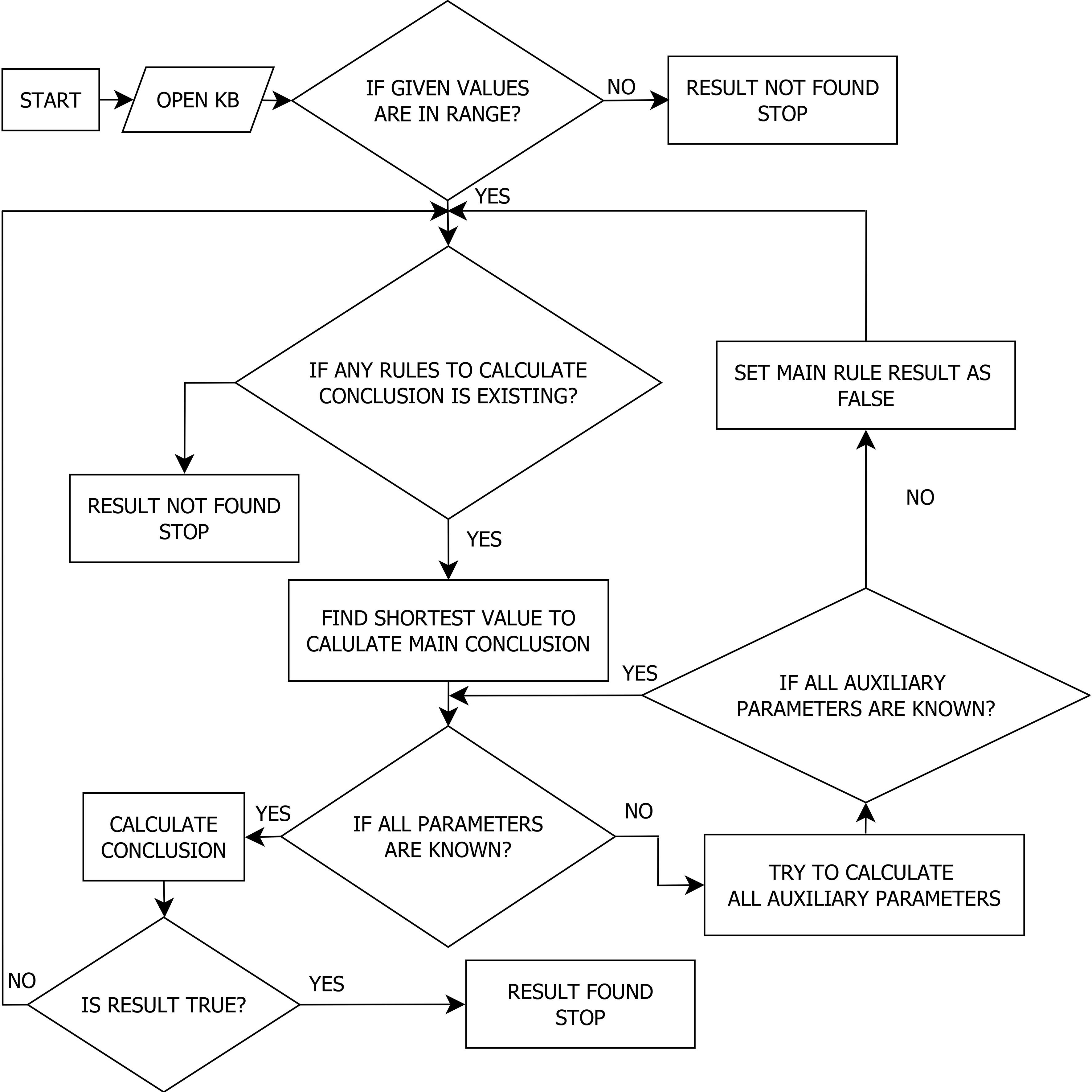
By using the algorithm in C # and internal libraries, it is possible to find the solution in a very short time, which depends of knowledge base complexity. However the calculation for big bases does not last longer than 100 ms. The algorithm of inference is shown in Fig. 1. Inference is prepared as DLL library, so it can be used in other application for any type of calculations [12].
In the presented version of expert system the same architecture as proposed earlier in [7] was used (Fig. 2). However, each module has been now expanded and equipped with new features. The biggest changes have been made to the module responsible for correcting of the parameters associated with the inference engine. The input data used in the expert system are the catalog data of the induction motor, presented in Table 1. The expert system, after checking the input data, perform preliminary calculations in order to generated the initial data file for the program calculating the motor electromagnetic parameters, which are stored in computer memory as * .dat file.
Expert system architecture [6].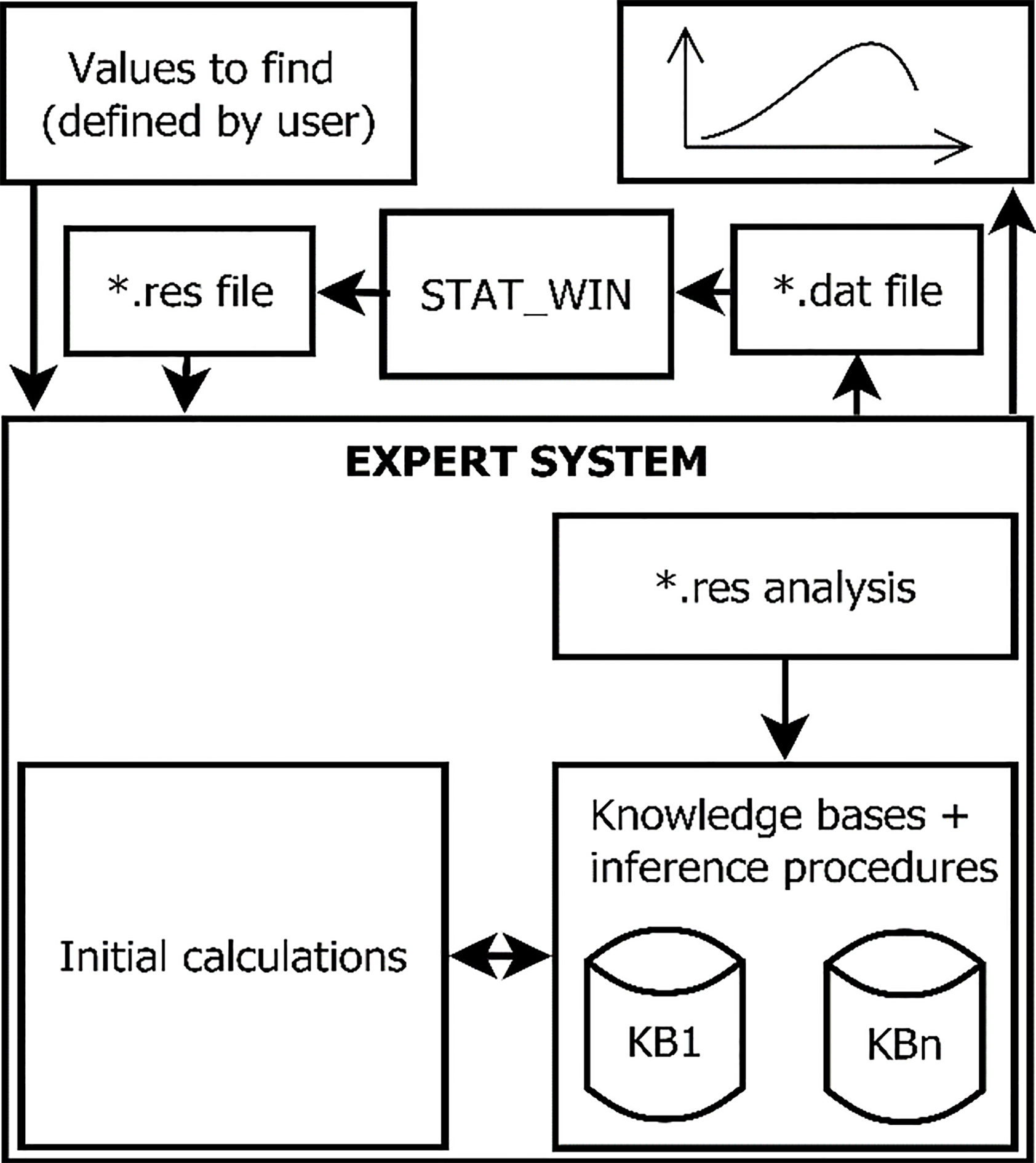
This file constitutes the input data for the existing program STAT_WIN [1, 2], which is automatically triggered of by the expert system. The program STAT_WIN requires entering 112 input data (construction dimensions, kind of sheets, winding parameters, number of slots, rotor cage type etc.) of the three-phase induction motors. Figure 3 shows the algorithm of electromagnetic calculations implemented in the STAT_WIN program.
Rated data of existing and designed induction motor
Electromagnetic parameters calculations algorithm (STAT_WIN).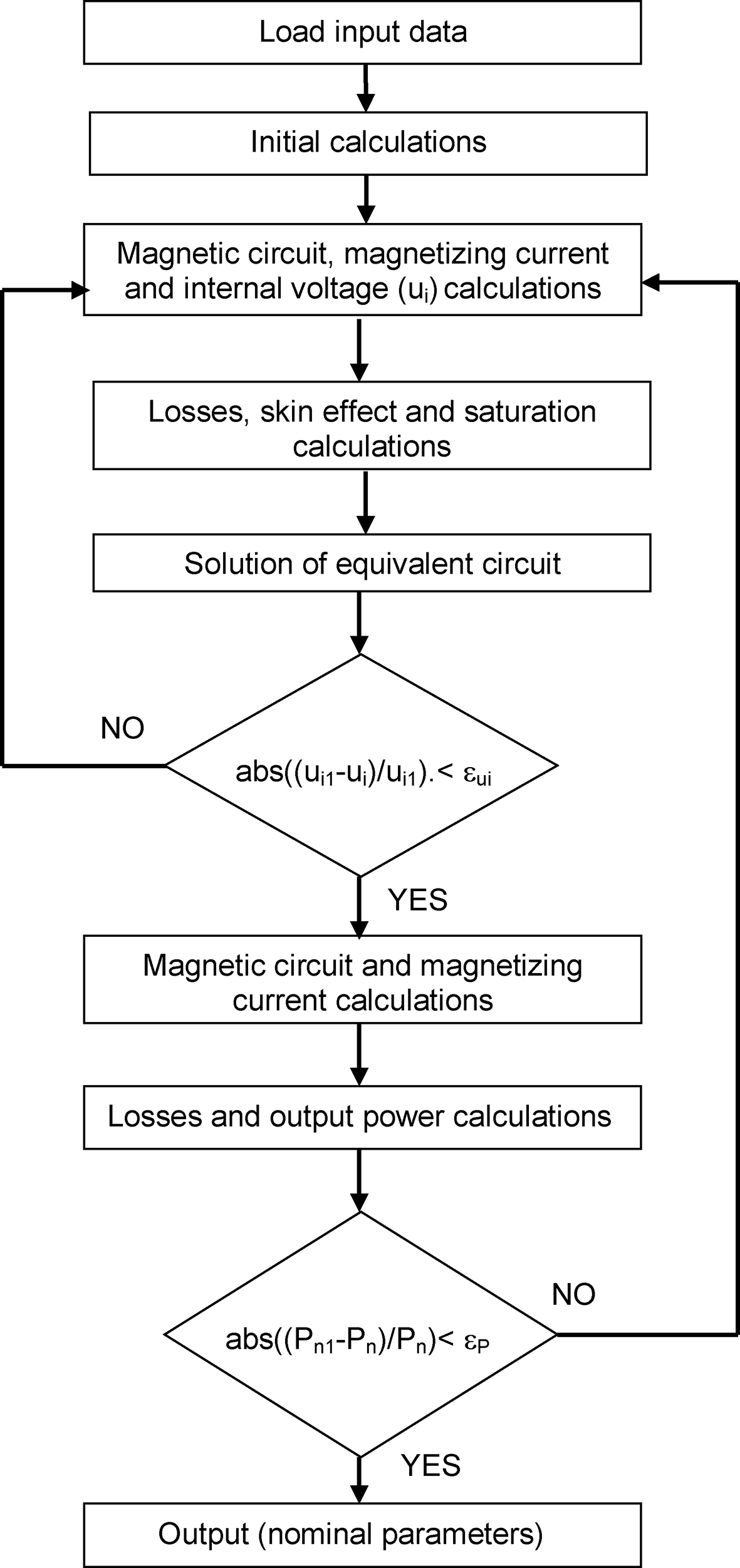
After loading all input data, the program STAT_WIN calculates the remaining geometrical dimensions, initial parameters of the equivalent circuit of induction motor (without taking into account the influence of non-linear phenomena), initial values of currents in the stator and rotor windings and rotor slip.
These values are calculating only once. Next, application is trying to find initial values of flux density in motor core, magnetizing current and internal voltage Ui. The losses in the core and windings are next calculated. After this, the parameters in equivalent circuit are updating, taking into account the non-linear phenomena, such as skin effect and saturation of magnetic circuit.
For these parameters, the equivalent circuit is calculated again and the new value of internal voltage is found, which is compared with its previous value. The algorithm is repeating until the accuracy of result is lower than assumed number. In next steps new values of magnetic flux density, magnetic current, losses and output power are calculated. The value of output power is compared with established nominal power. Rotor slip is corrected and iterative calculations of the output power are performing until its accuracy is lower than required. The program STAT_WIN generates the initial output file (as * .res file), which is next analyzed by decision-making module of the expert system, (which was built as a DLL library), and it is checked if the following inequalities are met:
where:
Expert system algorithm (a) and correction module algorithm (b).
If the actual solution, generated by STAT_WIN program satisfies the assumed motor parameters expressed by inequality (1–5), then decision – making module of expert system stops the execution of the system with the accepted solution generated in last output file *.res of STAT_WIN program. Otherwise, the input file *.dat is transferred to correction module of the system, in which the data stored in this file are corrected on the base of previous results stored in *.res file, which is closest to the derived solution defined by inequality (1–5). Nest, the new file *.dat is used as input file to program STAT_WIN. This procedure is repeated until the all inequality (1–5) are met. Figure 4a shows expert system algorithm.
The correction module, responsible for creation the new input file to program STAT_WIN constitutes the most important part of the proposed expert system. It was considerably rebuilt, when compared to the algorithm used in previous system [7].
Using the inference module and knowledge bases concerning the correction of all parameters in file *.dat, system is able to meet the expectations, expressed by inequality (1–5). Figure 4b shows algorithm of this module. In some cases, when the knowledge base contains some errors, module can be in loop, e.g. if the subsequent requests are contrary to the previous ones. In such cases the solution will not be found. The second condition that can cause the cancellation of the last correction is associated with verifying of validity of the output file from the STAT_WIN module. It can happen, for instance, if flux density in stator core calculated by STAT_WIN is too high.
To avoid the endless correction – solution loops in the case when the system tries to find the solution for very specific input, the limit number of iteration can be introduced by user. This will help to check if the system will be able to find the solution, or, if necessary, to change some input data.
The other new additional feature results from the possibility of comparison of the last output, generated during last correction loop, with newest one. Since, the algorithm tries to correct one value at a time, it can cause a situation, when one parameter is approaching a certain value, but simultaneously the difference between the calculated value and the earlier specified value for another parameter may increase.
In the case, when the system cannot find the correct solution, satisfying the inequalities (1–5), the user will receive the results selected from all results generated during calculations, which are nearest to assumed ones, specified by (1–5).
Moreover, the user has a real-time preview of the value of each factor for each calculation step during calculation process. Such information can help if solution isn’t found.
The final results are presented to user in few tab. Input data, tolerances and calculated nominal parameters are listed in tab “Main values”. The main data are listed in tab “Design data”, while all dimensions of slot are presented in tab “Slot dimensions” (Fig. 5). Also the *.res file is presented in all details in tab “STAT_WIN”.
The user has also the possibility to view load characteristic (efficiency, power factor, motor current, motor torque and rotation speed as a function of load) and starting characteristic (relative stator current, stator current, relative electromagnetic torque, electromagnetic torque versus slip and rotation speed) as the graphs for designed motor.
The proposed expert system can be adapted to wide range of induction motors by expanding the knowledge bases.
Table 1 shows the comparison of rated data of the currently produced induction motor with the lift of the shaft axis equal to 160 mm and the motor designed using the expert system. The Table 2 shows the comparison of selected machine dimensions and electromagnetic parameters of existing and designed induction motors.
Selected machine dimensions and electromagnetic parameters of existing and designed motor
Selected machine dimensions and electromagnetic parameters of existing and designed motor
“Slot dimension” window.
The last row in the Table 2 contains relative material and operating costs during the amortization period of the motor, in relation to the price of 1 kWh of electricity.
a – efficiency and power factor, b – stator current versus output power; dashed line – existing motor, solid line – designed motor.
Relative stator current and torque versus rotor slip; dashed line – existing motor, solid line – designed motor.
The characteristic for existing induction motor and designed one with the use of expert system are depicted in Figs 6 and 7.
The obtained values depend on the constraints (1–5) defined by the user and additional technological constraints
In the example above, the system designed the induction motor with the parameters as close as possible to the assumed parameters. The performance characteristics and parameters of the existing and designed induction motor are very similar to each other in the entire output power and slip range.
Both stator have the same outer diameter (which can be defined by the user) which is an advantage from the point of view of machine production.
Magnetic flux density in the designed induction motor does not reach the maximum value, which means that it will be possible to use optimization algorithms [8], as a result of which better electromagnetic parameters can be obtained than for existing motor or it will be possible to reduce further the dimensions of the motor. The lower production or operation costs of induction motor will be the effects of these activities.
This paper presents a new method of designing electrical motors. Due to using NET Framework and C# language, it is easy to develop and update the presented application in future.
The knowledge included in bases isn’t coming only from theoretical sources but also from specialists. The open architecture of the application allows to add the new rules from interface level. The system allows to design new motors in fast and efficient way. Due to implementation, well configured knowledge bases are possible to create cheaper motors with better parameters. It should be emphasized that use of an expert system allows to design motors only on the basis of catalog data and to determine all its structural and electromagnetic parameters as well as operating characteristics.
The developed algorithm has been verified for typical constructions of small and medium power cage induction motors, but it can be extended to any other constructions that can be used in both low and high voltage motors with a wide rated power range. It only requires the extension of knowledge bases. The presented expert system includes an interface that allows for easy extension of the knowledge bases by experienced designers of electrical machines.