



Abstract
Aiming at the problem of the corona discharge trigger electric filed threshold at different shapes of a metal tip, through the theoretical analysis of the electric field distribution near the surface of the conical tip and the ellipsoidal tip, and the laboratory simulation experiment, reached the following conclusion. The relationship between the value of corona current amplitude, the frequency and the tip’s radius of curvature is obtained; the corona discharge electric field threshold is relatively fixed and between 6.9382 kV/cm and 8.2824 kV/cm. The above relationship has a certain reference value in practical application and computer simulation.
Introduction
In recent years, there has been an increasing acceptance of a theory that minimizes the charge accumulation in the pre-stroke space of the lightning rod, which will enhance its ability to initiate and maintain the upward lightning leader [1–3]. Therefore, one parameter used to evaluate the tip performance of the ground high lightning receptor is its corona discharge effect under electrostatic field conditions, which corresponds to the conditions before the downward lightning leader is generated under thundercloud conditions. Corona discharge refers to a form of gas discharge in which a gas medium is locally self-sustained in a non-uniform electric field. It generally occurs near the tip electrode with a small radius of curvature. Since the local electric field strength near the tip exceeds the ionization field strength of the air, the air is ionized and excited, and corona discharge occurs. It is well known that due to the injection of space charges into the air by corona discharge at the tips of trees, buildings and other ground objects, the electric field E 0 of the thunderclouds is reduced around the ground level. And the tip on a tall building is more prone to produce corona [4,5], and the downward lightning or leader can be triggered from the tip of the ground object with E 0 large enough. Due to the downward development of the lightning leader near the target, the resulting increase in E 0 can also result in a reverse polarity leader on the tip of the grounded object. The mutual attraction between the two leaders will inevitably cause a strike on the object [6]. The strong corona discharge effect formation of a space charge layer near the tip, causing the potential to redistribute in space, and the electric field strength near the electrode is reduced. It prevents the lightning leader from reaching the electrode in the thundercloud electric field environment [7] or in the laboratory experiment gap [8–10].
So far, many scholars have done a lot of research on the physical processes of corona discharge formation and related parameters of corona discharge. Liu Min et al. measured the positive and negative corona discharges parameter at different pole spacings by needle-plate model [11]; Han Minglian et al. used artificial neural network to solve the general mathematical model of corona current [12]; F. D’Alessandro [9] measured the relationship between the peak value of corona current and the speed of wind, and Du et al. [13] have measured and analyzed the variations in corona charge intensity and corona current under different wind conditions. By using a 2D symmetrical model, Becerra [10] argued that the simulated results of Bazelyan et al. [14] overestimated the influence of the corona discharge. Zou et al. [15] have developed a 2D time-dependent model and found that the corona current increases almost linearly with the horizontal wind speed. The above scholars have obtained the related properties, parameters, and computer simulation methods of corona current in a large number of studies, but the above scholars have less research on the trigger threshold of corona currents of different shapes of metal tips.
Based on this, this paper explores electric field strength near the tip when the corona discharge occurs through the combination of theoretical calculation and laboratory tests. It is proposed to use electric field strength near the tip as the basis for judging the trigger of corona discharge, analyze the effect of height and shape of the metal tip on corona discharge and the relationship between the amplitude of the corona current and the electric field strength. It has certain reference value for studying the phenomenon of corona discharge at the tip of ground objects under the condition of the actual thunderstorm cloud electric field.
Theoretical analysis
The principle of corona formation
A corona discharge is an electrical discharge brought on by the ionization of a fluid such as air surrounding a conductor that is electrically charged. In the vicinity of the tip electrode having a small curvature radius, since the local electric field intensity exceeds the ionization electric field strength of the gas, the gas is ionized and excited, and corona discharge occurs. According to the tip polarity of the electrode where occur the corona discharge, the corona can be divided into a positive corona and a negative corona, and the corona generated by the positive electrode tip is a positive corona, and vice versa is a negative corona.
When the electrode is in a electric field and the electric field strength does not reach the air breakdown electric field strength. But the small curvature radius electrode has a distortion effect on the electric field, so that the electric field intensity near the electrode is large enough to produce corona. It leads the gas medium near the tip of the electrode to be partially broken down and to ionized produces a corona discharge phenomenon. In general, the corona discharge phenomenon of the tip with a small radius of curvature is studied. When a DC voltage is applied, the tip generates a corona phenomenon and discharges the charge into space. The accumulation and drift of the space charge will have a great influence on the original electric field, and there are also big differences in the current generated by the positive and negative corona discharge. For positive corona, as the background electric field strength of the tip increases, the first occurrence of an intermittent current pulse is called the initial streamer; the second is a very thin corona layer near the electrode, called glow corona; Continuous streamer appears, called a stream corona; finally, a bright, lightning-like spark is called a spark discharge.
Electric field distribution of grounded metal tip in the electrostatic field
Electric field strength near the surface of a conical metal tip
Analyze the electric field strength near a conical metal tip with a half top angle 𝛼. Create a coordinate system, as shown in Fig. 1. Let the potential on the conductor be zero, the potential of the external space satisfies the Laplace equation 𝛻2φ = 0, and the general solution of the Laplace equation in the axisymmetric potential problem is [16]
And P (cosθ) satisfy the Legendre equation
Since the potential at the origin is limited, and B
v
= 0, v > 0 are required in the equation, then in the interval 0 ≤ θ ≤ π−𝛼, set the potential on the conductor to 0 as required. The complete solution of the axisymmetric potential is obtained by linear superposition.
The value r which in the equation means the distance from the tip. Since the distribution of conductor charge is known by the general properties of the electrostatic field near the surface of the pointed conductor (r = 0), the main contribution of the summation formula comes from the lowest power of r . Therefore, the first term of Eq. ((3)) can be used to approximate the characteristics of the potential near r = 0, which is
Now the undetermined constants in Eq. ((3)) are A and v, and what matters is the value of v. To determine the constant A, a large curved surface must be used to surround the area where the electric field exists. The constant A is not considered here, and only the electric field near the sharp angle is analyzed by v. The metal conductor used is a tip cone, where 𝛼 ≪ 1, at this time v ≪ 1, when 𝛼 approaches zero, the potential φ around the cone is independent of the angle θ, so
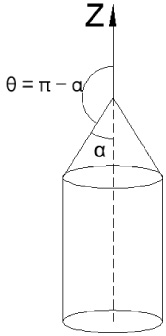
Conical tip coordinate system.

Ellipsoid tip coordinate system.
K in the above formula represents a constant, because when 𝛼 approaches zero, the external space potential of the conical tip approaches a constant, so f (θ) ≪ 1 holds. And P
v
(cosθ) satisfies Eq. ((2)), let x = cosθ, P
v
(cosθ) = K[1 + f (θ)], so Eq. ((2)) can be written as
There are also f (θ) ≪ 1, v ≪ 1, which is simplified by
Since f (θ) is no singularity in the area 0 ≤ θ ≤ π−𝛼, C
1 = −v is obtained, so that the integral constant C
2 = −vln2 may have a new physical meaning, so
Therefore, the potential near the tip of the tapered metal is
When A is consistent with the previous assumption, the surface potential is zero, then there is
𝛼 is far less than 1, so
The electric potential and the electric field strength satisfy the relationship E = −𝛻φ, and the electric field strength near the surface of the conical metal conductor can be obtained according to the potential distribution.
As shown in Fig. 2, in order to solve the electric field distribution of the ellipsoidal tip in the electrostatic field, the Laplace equation can be solved in the elliptical coordinate system to obtain the electric field analysis along the z-axis:
Among them
Establishment of the test model
Corona discharge test model in the electrostatic field
As shown in Fig. 3, the 1.5 m × 1.5 m × 5 cm metal disk used in the test, the edge is curved (more effective to reduce the edge effect) and a 1.5 m × 1.5 m × 2 mm round metal iron plate. The two metal plates are placed horizontally on the upper and lower sides with a pitch of 60 cm, and the upper plate is connected by wires to an electronic device that provides a negative high voltage. The lightning strike control platform is used in the test, which can raise the 380 V AC to −60 kV. ICGS is a device that can provide high voltage. The basic principle of ICGS is as follows: part of the test principle is shown in Fig. 3, where R 1 is the protection resistor and D is the diode. The high-voltage alternating current is converted into a pulsating direct current by the single-conductivity of the diode, and finally converted into direct current by the rectification of the capacitor C, and finally, output to the upper metal plate. In the test, the metal rod was placed at the center of the lower plate, and a thin glass mat was used under the metal bar to insulate it from the lower plate.

Model for measuring corona discharge threshold.
In the corona discharge current data acquisition process, since the amplitude of the corona current is small, the metal rod is grounded through a 1 MΩ resistor (1 μA corona discharge current is expressed as 1 V voltage), which not only increases the amplitude of the data and make the observation more significant, and convert the current data into voltage data for easy acquisition. Use an oscilloscope to collect the voltage on the 1 MΩ resistor. After the negative high voltage equipment is completed, the negative high voltage value provided by the equipment will drop at a rate of 0.1 kV/s. The principle diagram of corona current signal acquisition is shown in Fig. 4. The two metal rods with different tip shapes used in the test are shown in Fig. 5.
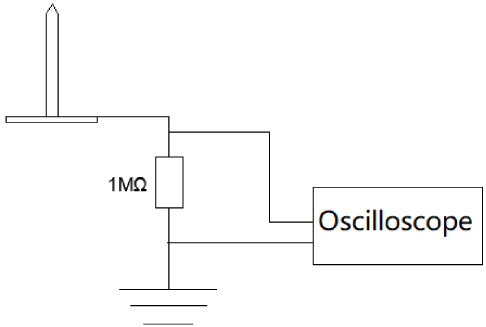
Model for measuring corona current.
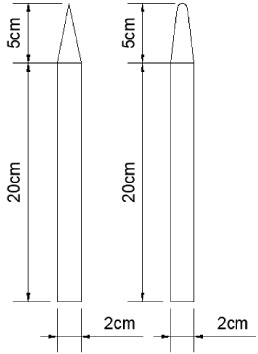
Metal rod model used in the test.
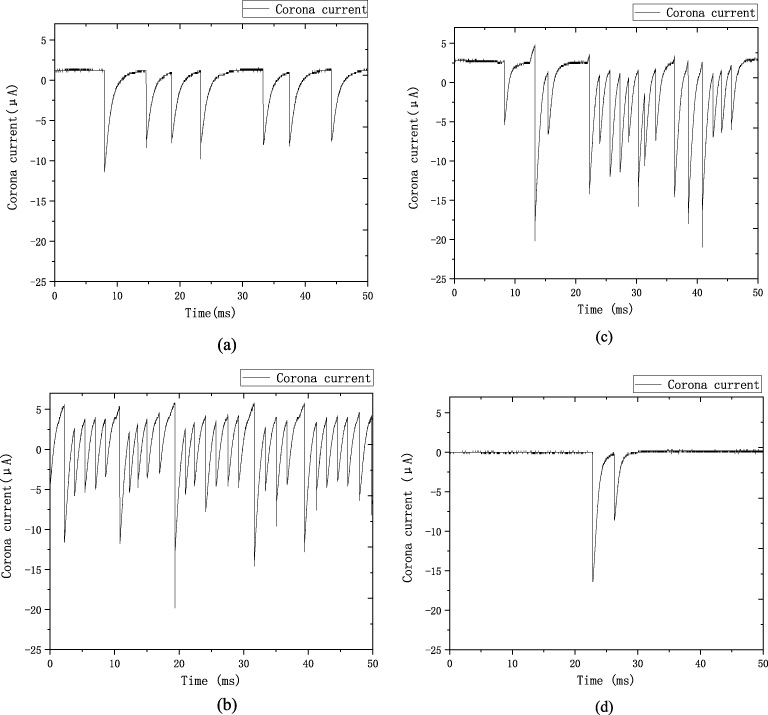
Corona current pulse diagram at different voltage moments when the upper plate voltage is gradually lowered. (a) The upper board voltage is 40.5 kV. (b) The upper board voltage is 44 kV. (c) The upper board voltage is 46 kV. (d) The upper board voltage is 47 kV.
Ellipsoid tip corona discharge current analysis
In the experiment, according to the change of the waveform displayed by the oscilloscope, a phenomenon is observed: As the background electrostatic field increases, the corona discharge current pulse will be from nothing, the number of pulses will gradually increase, the amplitude will also rise, and then the intensity will increase. Gradually become looser, and finally disappears less. This phenomenon is a good example of the evolution process of the corona current state, which is the transition state process from the “initial streamer” stage to the “glow stage”. The phase in which the corona pulse current is generated is called the “initial streamer” phase, and then as the electrostatic field strength increases, the “initial streamer” phase with a large amplitude of unstable current develops into a “glow corona” phase with a small discharge stable current amplitude. The variation of the corona pulse with the electric field strength is shown in Fig. 6. As the voltage on the upper plate increases, it means that the electric field strength between the two parallel plates is also increasing.
Ellipsoidal tip corona discharge electric field threshold analysis
After the high-voltage equipment is charged, the voltage applied to the upper metal plate will decrease at a rate of 0.1 kV/s, and the electric field strength of the background field of the metal rod will also decrease. It can be observed that the intensity of the number of corona current pulses displayed on the oscilloscope will gradually become sparse, gradually becoming a single current pulse, and finally disappearing. Record the upper plate voltage value when the last current pulse disappears, and calculate the finite element method by establishing a model with the same size in the ANSYS software to obtain the tip electric field strength. At this time, the tip electric field strength is the corona discharge electric filed threshold. The upper plate voltage values when the ellipsoidal tip corona current pulse disappeared at different heights are shown in Table 1.
Upper plate voltage value at corona discharge at the metal tip at different heights (Unit: kV)
Upper plate voltage value at corona discharge at the metal tip at different heights (Unit: kV)
In the process of electric field numerical simulation calculation, using different mesh sizes to mesh the solution space will result in different spatial resolution, which will result in certain systematic errors. Generally speaking, the smaller the mesh division is, the closer the calculated result is to the real value in the continuous space, and the smaller the error generated by the system; on the contrary, the larger the meshing selection, the more the systematic error Large, the less accurate the calculation results. In this paper, according to the voltage data applied by the tip at different heights in the test, the upper plate voltage value is converted into a uniform environment to form a uniform electrostatic field environment. Using the finite element method, the electric field strength threshold at the metal tip at different heights was calculated at a resolution of f = 0.1 cm. The ANSYS software was used to simulate the electrostatic field environment using the finite element method to calculate the electric field strength at different heights of the tip, as shown in Fig. 7 (calculated as the 49 cm height ellipsoid tip). The calculated results are shown in Table 1.
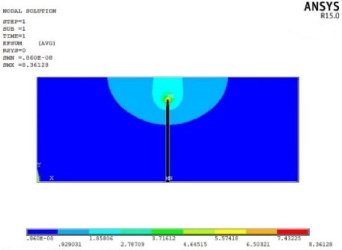
ANSYS software tip electric field simulation diagram.
From the simulation results, we can find that the corona-triggered field strength thresholds of different height tips are more concentrated and distributed in a zigzag pattern. The electric field threshold distribution around the tip is shown in Fig. 8. Therefore, the following relationship can be obtained: the corona discharge triggering near the tip under the electrostatic field is not sensitive to its height and is only related to the electric field strength at the tip. The electric field strength reaches a specific corona triggering electric field threshold, then the tip starts to discharge. The electric field threshold of corona discharge is averaged at the tip of different heights mentioned above, so the threshold value of the ellipsoidal tip corona triggering electric field is 8.2824 kV/cm.
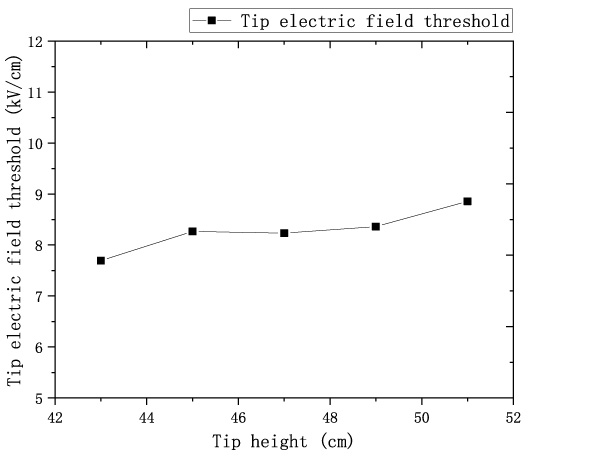
Elliptical tip electric field threshold at different heights.
Conical tip corona discharge current analysis
In the test, as the voltage of the upper plate gradually decreases, the corona current pulse image appears the same phenomenon as when the ellipsoidal tip test is used, and the corona current pulse will be from nothing when the voltage of the upper plate is increased. The number of pulses becomes denser and denser, and then gradually becomes looser, and finally becomes less and disappears. The corona pulse diagram of the conical tip is shown in Fig. 9. (At the time of (a)–(d), the tip electric field strengths are 6.6625 kV/cm, 7.8739 kV/cm, 10.0595 kV/cm, 12.14165 kV/cm, respectively.)
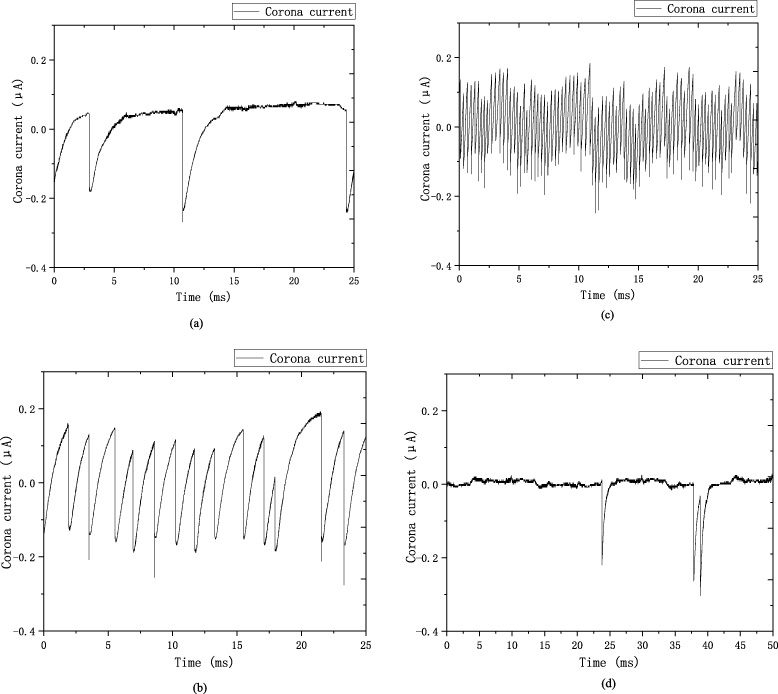
Corona current pulse diagram at different voltage moments when the upper plate voltage is gradually lowered. (a) The upper board voltage is 12 kV. (b) The upper board voltage is 13 kV. (c) The upper board voltage is 17.5 kV. (d) The upper board voltage is 20.5 kV.
After the charging is completed, the voltage applied to the upper plate by the high voltage device will decrease at a rate of 0.1 kV/s, and the corona current pulse generated on the conical tip will appear the same as the ellipsoidal tip. The phenomenon that the corona current pulse disappears from nothing, from sparse to dense, from dense to sparse, and finally disappears. When the corona pulse disappears again, the electric field strength at the tip is the threshold value of the corona discharge triggering electric field, and the voltage value of the upper plate is recorded as shown in Table 2.
Upper plate voltage threshold for corona discharge at metal tip at different heights (Unit: kV)
Upper plate voltage threshold for corona discharge at metal tip at different heights (Unit: kV)
The corresponding tip electric field strength is calculated for the tip under the above conditions, and the tip electric field thresholds at the heights of 43 cm, 45 cm, 47 cm, 49 cm, and 51 cm are respectively 7.014 kV/cm, 6.494 kV/cm, 6.977 kV/cm, 6.862 kV/cm, 7.344 kV/cm. The electric field threshold distribution is relatively concentrated, and it is distributed in a zigzag manner. The average value of the above values is the conical tip corona discharge trigger electric filed threshold.
Influence of two shape tips on electric field distortion
The distortion effects of the different tip shapes on the background electric field at the same height and the same upper plate voltage are shown in Fig. 10 and Fig. 11. From the simulation results of the horizontal electric field distribution in the figure, it can be seen that the conical tip has a small radius of curvature, and the distortion field strength at the tip is 15.1421 kV/cm, which is stronger than the field at the ellipsoid tip with a larger radius of curvature. However, the electric field distortion caused by the conical tip will attenuate more quickly. After reaching a certain distance, the degree of electric field distortion caused by the tip with a large radius of curvature will exceed the tip with a small radius of curvature. That is to say, if the downward leader reaches the vicinity of the two shapes tip under the thunderstorm cloud electric field condition, it is not necessary that the lightning rod with a small radius of curvature is more susceptible to be struck. Because the ellipsoidal tip with a large radius of curvature produces a distortion electric field strength at a farther point than the tip of the rod with a small radius curvature. The downward leader is more likely to develop toward a direction in which the electric field strength is large, that is, the potential difference is larger.
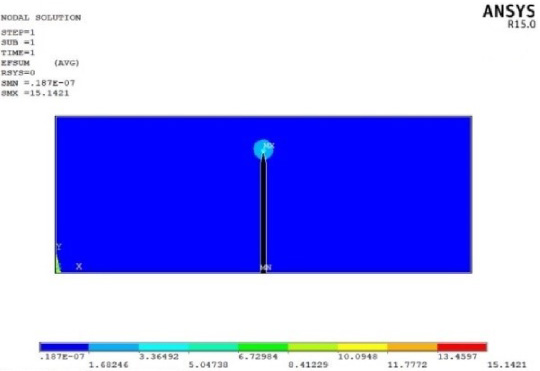
ANSYS simulation diagram with conical tip at 47 cm height and upper plate voltage of 25 kV.
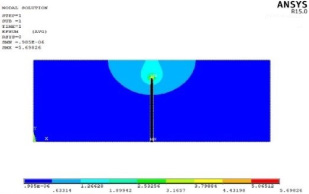
ANSYS simulation diagram with ellipsoidal tip at 47 cm height and upper plate voltage of 25 kV.
Therefore, when selecting the radius curvature of the tip as lightning rod, it is not as small as possible, but it is necessary to select an appropriate radius of curvature according to the local thunderstorm electric field environment, thereby improving the efficiency of the striking lightning rod. It can improve the efficiency of striking the lightning rod, so as to better protect the building from lightning damage.
During the experiment, it was found that the ellipsoidal tip corona discharge current pulse density was significantly smaller than the corona discharge current pulse at the conical tip at the same height and the most severe corona current generation. But the amplitude of the corona current at the ellipsoidal tip is greater than the current amplitude at the conical tip. And this rule is found at all conditions, taking the height of 47 cm as an example, as shown in Fig. 12.
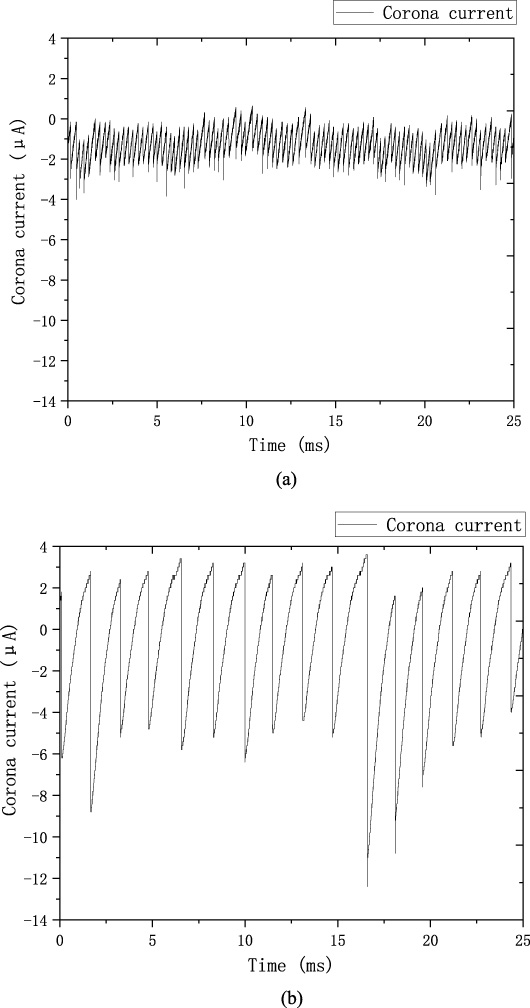
Corona current pulse diagram. (a) The conical tip. (b) The elliptical tip.
From this, it can be concluded that the corona discharge on the tip is not only related to the radius curvature of the tip but also to the surface area of the tip. From the data obtained from the test, the larger the surface area of the tip portion is, the higher the amplitude of the corona current is, but with the decrease of the discharge frequency, this is due to the essential principle of corona discharge. The essence of positive corona discharge is that after the field strength near the tip reaches the air ionization intensity, the air is ionized into pairs of electrons and positive ions. Under the action of the electric field force, the positive ions move away from the tip, and electrons accumulate near the tip surface. After the accumulated charge concentration reaches a certain level, electrons enter the tip to move toward the ground to form a corona current. The larger the tip surface area means that the larger the influence range of the electric field distortion, the more electrons adsorbed near the tip are relatively larger and the range is larger. As a result, the ellipsoidal tip of the large surface area has a relatively sparse corona current pulse, but the amplitude is relatively high.
The corona discharge trigger electric field thresholds of the two shapes at the same height are counted as shown in Table 3.
Corona electric field threshold at the same height for two shaped metal tips
Corona electric field threshold at the same height for two shaped metal tips
It can be seen from the data in the table that corona discharge electric field threshold of the ellipsoidal tip is larger than that of the conical tip, but this paper considers that the difference is due to the ANSYS simulation error and the different surface area of the tip of different shapes. In the ANSYS simulation process, it is found that different mesh size meshing has a great influence on the simulation of the tip portion. Different mesh size meshing simulation calculations have some differences in the results of the tip analysis of the same radius of curvature.
The reason is that the size of the mesh selected in the ANSYS simulation process determines the shape properties of the tip shape in the final simulation, which leads to a certain error in the simulation calculation. Therefore, this paper considers the metal tip corona discharge electric field threshold is in a range between 6.9382 kV/cm and 8.2824 kV/cm. In computer simulation experiments of corona discharge, most scholars set the electric field threshold value of corona discharge to 30 kV/cm [17], which is a certain deviation from the value calculated according to the experiments in this paper. If the threshold value calculated in this paper is applied to the simulation calculation, under the electric field environment generated by the thunderstorm cloud, the ground-tip objects will generate corona discharge earlier, which means that more corona charges will be accumulated in space. The study of the effect of the corona charge layer on the leader connection process will be very meaningful. It provides a reference for judging the corona discharge trigger electric field threshold of the lightning rod in the actual environment.
The voltage data of the corona discharge generated by the metal tip of the same material with different shapes is obtained through experiments; The electric field strength of the metal tip is calculated by the finite element method in ANSYS; The corona discharge current data collected by the oscilloscope is analyzed. The following conclusions are drawn:
(1) By simulating the electric field distortion effect produced by the conical tip and the ellipsoidal tip in the background electric field, it is found that the electric field distortion at the conical tip is greater under the same background electric field. However, the distortion effect caused by the ellipsoid tip is larger, and the intensity of the electric field distortion exceeds the influence of the conical tip after a certain distance. It is concluded that the selection of the shape parameters of the lightning rod should meet the requirements of the strike capability of the lightning rod in a given environment. For a lightning rod that requires a strong strike capability, a tip having a large radius of curvature can be selected, conversely, a tip having a small radius of curvature can be selected.
(2) Through data analysis, the magnitude and frequency of the generated corona current are not only related the electric field strength, but also to the radius of curvature and the surface area of the tip. Under the same conditions, the tip having a large radius curvature has a corona current amplitude which is generally larger than a tip having a small radius curvature, but the corona current discharge frequency is smaller than the tip having a small radius of curvature.
(3) In the test, the corona discharge trigger voltage threshold decreases as the tip height increases, but their respective tip electric field thresholds remain substantially unchanged. By analyzing the corona electric field thresholds of the two shape tips, the metal tip corona triggering electric field threshold is preliminarily obtained between 6.9382 kV/cm and 8.2824 kV/cm.
Footnotes
Acknowledgements
This work was financially supported by the National key R & D plan (Grants No. 2017YFC1501505).