



Abstract
This paper introduces a new method for fast computing of the iron and copper losses in electromagnetic systems. In the method, the finite element equation is reduced to the equivalent Cauer circuit via model order reduction. The nonlinear property due to core saturation is pre-computed and included in the Cauer circuit. While the copper loss is computed as the Jule loss in the circuit, the iron loss is computed in the post process by restoring the field distribution from the solution to the circuit equation with aid of the proper orthogonal decomposition.
Introduction
Recently, the model order reduction (MOR) techniques have attracted attentions because it can greatly reduce computational cost and memory usage. It has been shown that the MOR techniques allows us to reduce the Maxwell equations to the rational function [1] and also the continued function that is equivalently represented by the Cauer circuit [2–4]. While the copper losses obtained from the equivalent Cauer circuit have been shown very accurate, it has been difficult to accurately evaluate the iron losses in the magnetic core which include the hysteresis and eddy current losses from the circuit analysis. We here introduce a new method to restore the magnetic field from the solution to the circuit equation for computing the iron losses. In the proposed method, the Cauer circuit is built directly from the discretized Maxwell equations. The nonlinearity due to the core saturation is considered in the Cauer circuit by replacing the DC magnetic field with that obtained from the proper orthogonal decomposition (POD) [5–8]. The iron losses are here computed in the post process by applying the Steinmetz [9] equation to the restored field although other loss-evaluation methods can also be used.
Formulation
Linear problem
First, we consider a linear eddy current problem which is governed by the quasi-static Maxwell equation
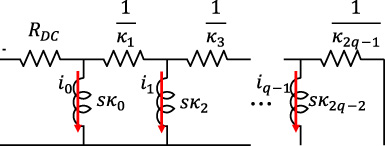
Equivalent Cauer circuit.
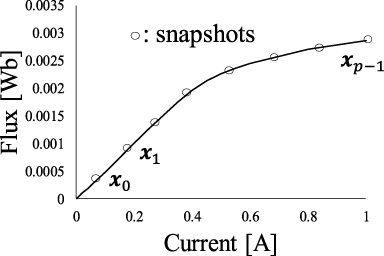
When we consider electric machines, it is important to consider the nonlinear property due to the core saturation. The nonlinearity is efficiently considered in the Cauer circuit by introducing the nonlinear current-flux characteristic which is shown in Fig. 2 to the first stage of the Cauer circuit [2,10,11]. The nonlinear characteristic is obtained by solving the FE equation derived from the static Maxwell equation for different external currents I. To evaluate the iron loss in the post process, we set up the following two hypotheses. The first hypothesis is that the magnetostatic field is dominant compared with the response fields, that is
The field restoration (2) is not valid when the core saturation becomes strong because the first term i
0
Current-flux characteristic.
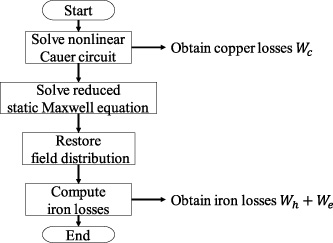
The entire process to obtain the copper and iron losses.
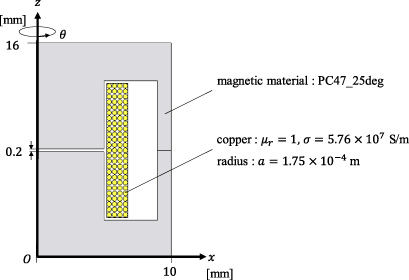
Axisymmetric reactor.
Application to reactor
To verify the proposed method, we apply the method to the analysis of an axisymmetric reactor which is shown in Fig. 4. The model is composed of a ferrite core PC47, and copper wires. The conductivity of the wire is 5.76 ×10⁷ [S/m], and the radius is 1.75 ×10⁻⁴ [m]. DC resistance of the coil winding R DC is 0.679 [Ω].
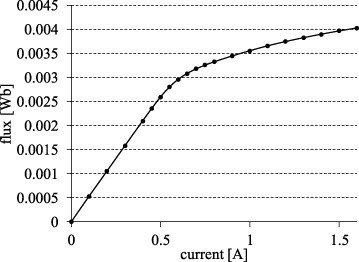
Current flux characteristic of reactor.
First, we built the equivalent Cauer circuit of the reactor. The relative permeability of the magnetic core is assumed to be 6000 which is the initial permeability of the ferrite PC47. The circuit parameters are summarized in Table 1.
Then, we compute the current flux characteristic of the reactor by solving the static Maxwell equation. The number of snapshots p is fixed at 20. The resultant current flux characteristic is shown in Fig. 5. We can see the inductance becomes small when the external current becomes large. By replacing 𝜅0 di 0∕dt with d𝛷(i 0)∕dt, we can obtain the Cauer circuit in time domain which is used in the nonlinear analysis.
Circuit parameters of reactor model
Figure 6 shows that the contour plot of the magnitude of the magnetic flux density and flux lines of the reactor when the external currents are 0.2, 0.7, 1.6 [A]. We can see that the distribution changes drastically depending on the external current due to the magnetic core saturation. This is the reason why the nonlinearity due to the saturation should be considered in the loss computation.
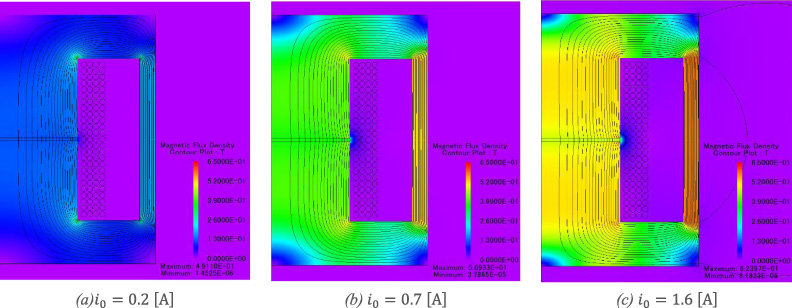
Contour plot of magnitude of magnetic flux density and flux lines of reactor.
We assume a sinusoidal input voltage, 25 kHz, 50 V, as the power supply to the reactor and to the Cauer circuit. The instantaneous power of the Cauer circuit is plotted in Fig. 7. The responses in the transient and steady states computed by FEM are also plotted in Fig. 7. We can see the results obtained by the Cauer circuit are in good agreement with those obtained by FEM. It takes about 11 minutes 25 second to build the nonlinear Cauer circuit and takes about 16 second to obtain the waveform shown in Fig. 7 (CPU: Intel Core i7-7700@3.6 GHz, RAM: 8.00 GB) whereas it would take at least 10 days to obtain the result by FEM under the same environment. The copper loss in steady state is evaluated to be
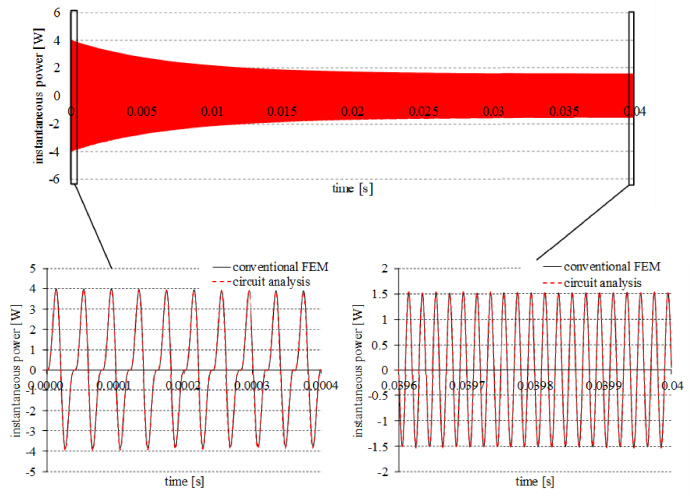
Transient analysis of Cauer circuit with power supply of 25 kHz, 50 V sinusoidal waveform.
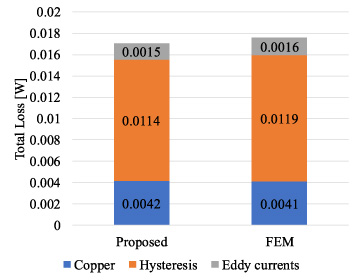
Total losses obtained by proposed method (left) and FEM (right).
In this paper, we have proposed a new method to evaluate the copper and iron losses through the analysis of the Cauer circuit which is a reduced physical model of an electric machine. In the method, the copper losses are directly evaluated from the nonlinear Cauer circuit considering the core saturation. On the other hand, to evaluate the iron losses, the magnetic field is restored from the solution to the Cauer circuit and reduced Maxwell equation obtained by POD.
We have applied the proposed method to the axisymmetric reactor model for the validation of the method. The relative errors in the obtained copper and iron losses are 1.5 and 4.1%. The accuracy of the iron losses depends on the accuracy of the MOR method.
We can perform fast transient computations for arbitrary inputs because analysis of the Cauer circuit needs much smaller computational cost compared to the original FE equation. When we consider the PWM excitation as a power supply, it is important to consider the hysteresis losses due to the minor loops. In this case, we have to employ the methods such as Preisach [12] and play [13] models which can include the losses from the minor loops. The transient loss analysis is remained for our future work.