



Abstract
This paper investigates the influence of laminating process of permendur for improvement of power density motors. A permendur has a high stress sensitivity, however the influence of manufacturing process on the magnetic properties of a permendur has not been sufficently discussed. Therefore, we discussed the influence of manufacturing process by measuring the laminated and single sheet specimen and carrying out 3D analysis of a surface permanent magnet synchronous motor (SPMSM) using the measured magnetic properties of the laminated and the single sheet specimens. As a consequence, deterioration of magnetization property by laminating process does not affect significantly motor property in motors having a wide gap.
Introduction
The use of a permendur is one of the hopeful approaches to realize further downsizing and weight reduction of a motor. A permendur is an alloy material with equal parts of iron and cobalt, and it has an advantage of higher saturation magnetic flux density compared with ordinary electrical steel sheets. However, the influence of manufacturing process on the magnetic properties of a permendur has not been sufficiently discussed [1–3].
Since a permendur has a high stress sensitivity, it is difficult to apply a manufacturing method such as caulking and welding to bind a laminated permendur core. Therefore, the laminated permendur cores are manufactured by wire-cut electrical discharge machining (EDM) after adhesive process.
In this paper, the change of magnetic properties due to laminating process is evaluated by measuring laminated and single sheet specimens of the permendur [4,5]. In addition, we perform 3-D analysis of a surface permanent magnet synchronous motor (SPMSM) using the measured magnetic properties of the laminated and the single sheet specimens and discuss the influence of manufacturing process on the motor performance.
Measurement of magnetic properties of laminated permendur core
Measurement conditions
The size of a single sheet specimen is 360 mm × 90 mm × 0.2 mm, and that of a laminated specimen is 90 mm × 16 mm × 16 mm. The density of the permendur is 8160 kg/m3. The space factor of the laminated specimen is about 96 %.
The specimen of a non-oriented electrical steel sheet of M230-35A5 whose size is 360 mm × 90 mm × 0.35 mm is prepared for comparison with the single sheet specimen of the permendur. Figure 1 shows a schematic diagram of a tester to measure a laminated specimen and a single sheet tester equipped with mechanics for stress application, respectively.
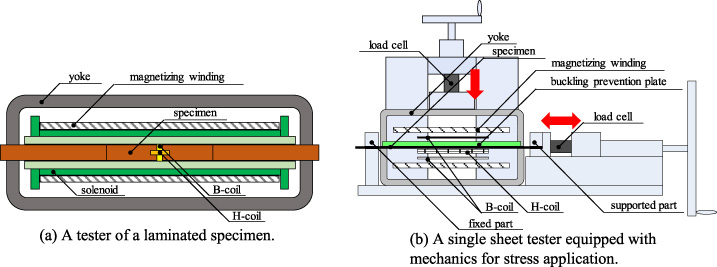
Schematic diagram.
We connected three laminated specimens in the longitudinal direction and measured magnetic properties of the combined laminated specimen. The average flux density b in the specimen is detected by a B-coil in which 40 turns of insulated wire is wound in the range of 5 mm at the center of the specimen. The magnetic field strength h is detected by a H-coil in which insulated wire is wound at a pitch of 0.08 mm in the range of 5 mm on a frame with a width of 5 mm and a thickness of 1 mm. The distance from the center of the H-coil to the specimen surface is about 1 mm.
For the single sheet specimen, the double H-coil method is adopted to accurately evaluate the magnetic field strength [6]. A thick non-magnetic plate is put on a specimen and is pressed through the yoke from the top to prevent the specimen from buckling. A B-coil detecting average flux density in the specimen is wound so as to cover the thick plate. Because the B-coil contains a large air region, a proper air-flux compensation is required at higher flux densities to realize accurate measurements. The stress applied to the single sheet specimen is ±20 MPa, ±10 MPa, ±5 MPa, and 0 MPa, where the signs of + and − mean tensile and compressive stress, respectively.
The magnetic properties of those specimens are measured at the frequencies of 50 Hz and 100 Hz to separate the iron loss into the hysteresis loss and the eddy current loss. The hysteresis loss calculated from the iron loss at 10 mHz using an electromagnet and the iron loss separation at 50 Hz and 100 Hz are almost the same. Therefore, we used hysteresis loss and an eddy current loss coefficients by iron loss separation at 50 Hz and 100 Hz [7]. The maximum flux density B m, the magnetic field strength H b and iron loss W are normalized by the respective maximum values of the laminated specimen in the following measurement results.
Figures 2 and 3 show the magnetization properties and iron loss properties of the single sheet specimen under the stress application at 50 Hz [8,9]. The measured results of the laminated specimen are also shown in Figs 2 and 3.

Magnetization property.

Iron loss property.
Figures 4 and 5 show eddy current loss coefficient k e and hysteresis loss coefficient k h of the single sheet specimen at 0 MPa and the laminated specimen. These coefficients are calculated from the iron losses measured at 50 Hz and 100 Hz. Figures 6 and 7 show the stress dependence of iron loss of the permendur and M230-35A5 at B m = 0. 5, 1.0, 1.5 and 2.0 T.
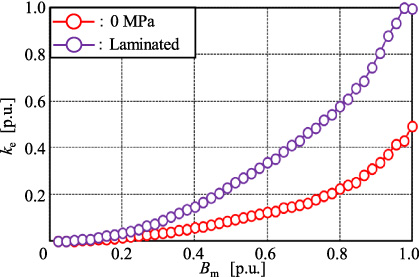
Eddy current loss coefficient.

Hysteresis loss coefficient.
Because the magnetization property of the single sheet specimen when applying −5 MPa is close to that of the laminated specimen in Fig. 2, a stress of about −5 MPa may be applied to the laminated specimen. However, from Fig. 3, the iron loss of the laminated specimen is larger than that of the single sheet specimen at −5 MPa.
From Figs 4 and 5, although the hysteresis loss coefficient of the single sheet specimen at 0 MPa is almost the same as that of the laminated specimen, the eddy current loss coefficient of the laminated specimen is significantly larger. The cause may be the short circuit on the surfaces of the laminated specimen due to wire-cut EDM after lamination.
The tendencies of the iron loss when applying tensile and compressive stress are different between the permendur shown in Fig. 2 and M230-35A5 shown in Figs 6 and 7. The iron loss of M230-35A5 increases as the compressive stress increases and does not change significantly as the tensile stress increases from 0 MPa to +20 MPa. On the other hand, the iron loss of the permendur under the compressive stress increase as well as M230-35A5, although the iron loss of the permendur decreases as the tensile stress increases. Therefore, it can be concluded that the permendur has a high stress sensitivity compared with electrical steel sheets.
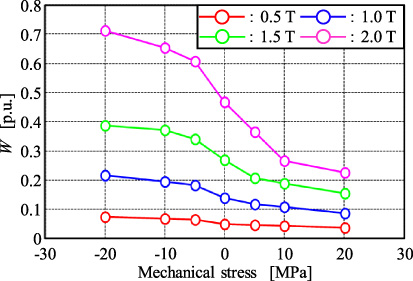
Stress dependence of iron loss of permendur at 50 Hz.

Stress dependence of iron loss of M230-35A5 at 50 Hz.
Analysis conditions
Figure 8 shows the analyzed model of a SPMSM. The motor consists of a shaft (magnetic material), permanent magnets, an armor ring (non-magnetic material), and a stator core.
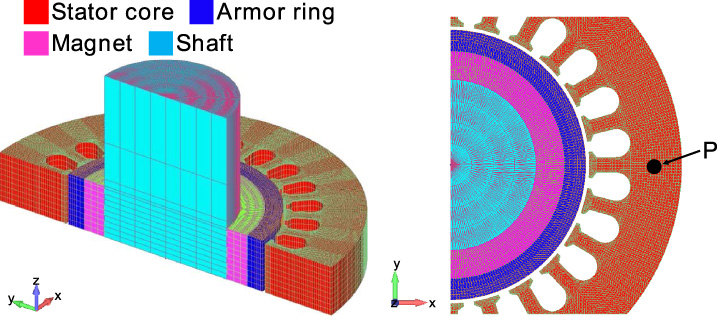
3-D model of SPM motor.
We performed a 3-D finite-element analysis of the SPMSM applying the magnetic property of the laminated specimen and the single sheet specimens under −20 MPa, −10 MPa, −5 MPa, and 0 MPa to the stator core. The frequency is over 1 kHz.
When calculating iron loss, it is necessary to consider skin effect appropriately. As an iron loss calculation method, we use 1-D finite element method in the thickness direction of a sheet as a post-processing of the main magnetic field analysis [10]. In the 1-D finite-element analysis (FEA), 1/2 of the thickness h of an electrical steel sheet is divided into 10 elements, and the classical eddy current loss is corrected by multiplying a correction coefficient 𝜅 to consider the influence of the excess eddy current loss.
The eddy current loss loss is given by
The hysteresis loss is calculated by
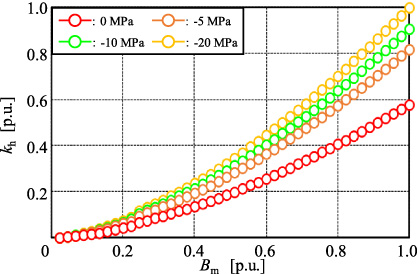
Hysteresis loss coefficient.
Figure 10 shows the circumferential components of the magnetic flux density at point P in Fig. 8 when applying magnetic properties measured with a single sheet specimen at 0 MPa to the stator core. Because the armor ring is used on the outside of the rotor core, the gap between the rotor core and stator core is large. Therefore the magnetic flux density of the back yoke has a waveform similar to a sinusoidal wave.

Waveform of magnetic flux density in back yoke.
Therefore, the excess eddy current loss correction coefficient 𝜅 is calculated based on the measured results of the single sheet specimen by using
Because the short circuit on the surfaces of the laminated specimen cannot be considered in iron loss calculation,
Figures 11 and 12 show the eddy current loss and hysteresis loss when applying the measured magnetic properties of the single sheet specimens and the laminated specimen in the SPMSM. The eddy current loss and hysteresis loss are normalized by the maximum values when using the magnetic properties of the single sheet specimen at −20 MPa. Since k e and k h of the single sheet specimen measured at 0 MPa are used as those of the laminated specimen and the magnetization property of the laminated specimen is larger than that of the single sheet specimen at 0 MPa, the eddy current loss and hysteresis loss when applying the magnetic properties of the laminated specimen to the stator core is the smallest.
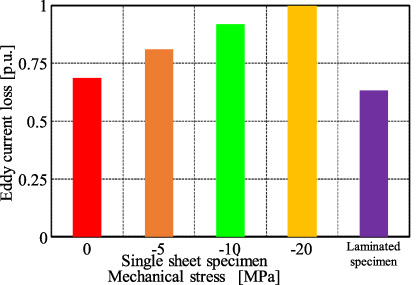
Eddy current loss.

Hysteresis loss.
Figures 13 and 14 show the efficiency and the torque when applying the measured magnetic properties of the single sheet specimens and the laminated specimen. From Fig. 13, the efficiency when applying the magnetic properties of the single sheet specimen decreases a little as the compressive stress increases. The same tendency as the efficiency is shown in Fig. 14 as for the torque, and the torques when applying the magnetic properties of the laminated specimen and the single sheet specimens are almost the same. From these results, as a manufacturing method of the permendur laminated core, it is found that wire-cut EDM after adhesive process does not affect the high power density of the motors.
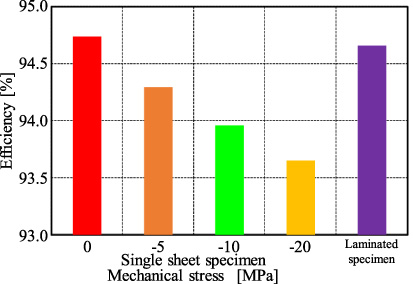
Efficiency.

Torque.
We measured laminated specimen and single sheet specimens of the permendur at ±20 MPa, ±10 MPa, ±5 MPa, 0 MPa to verify the change of magnetic properties due to laminating process. A stress of about −5 MPa may be applied to the laminated specimen judging from the deterioration of the magnetization property. However, the iron loss of the laminated specimen is larger than that of the single sheet specimen at −5 MPa. The cause may be the short circuit on the surfaces of the laminated specimen due to wire-cut EDM after lamination. By comparing the magnetic properties under stress application condition between a single sheet specimen of permendur and M230-35A5, it was clarified that a permendur has a high stress sensitivity.
We performed the 3-D analysis of the SPMSM using the measured magnetic properties of the laminated specimen and the single sheet specimens measured at −20 MPa, −10 MPa, −5 MPa, 0 MPa. As the compressive stress increases, the eddy current loss, the hysteresis loss and the efficiency decrease. Furthermore, the torque when applying the magnetic properties of the laminated specimen and the single sheet specimens are almost the same. Therefore as a manufacturing method of the laminated permendur core, wire-cut EDM after adhesive process does not significantly affect the high power density of motors.
In future, we will investigate the effect of acid etching of the surface of the laminated core manufactured by wire-cut EDM to improve its magnetic properties.