




Abstract
In this paper, the concept of body of revolution (BOR) finite-difference time-domain method time-domain (BOR-FDTD) method is applied to symplectic multi-resolution time-domain (SMRTD) algorithm to propose a BOR-SMRTD method. In order to solve the problem that the obliquely incident pulse wave cannot be directly introduced into BOR-SMRTD method, an efficient one-dimensional time-domain algorithm for propagating obliquely incident pulse plane wave in BOR-SMRTD method is also proposed. The numerical results show that the proposed algorithm runs 51 times faster than the algorithm based on fast Fourier transform (FFT) completely. Moreover, the scattering problem of a perfect electric conductor (PEC) cylinder with finite length is calculated to verify the effectiveness of the algorithm. The surface current density distribution along a generatrix of the cylinder at a giving frequency was extracted, and the results are in good agreement with that obtained with the methods of moment (MoM) and BOR-FDTD. Finally, the radar cross section (RCS) of a PEC sphere was calculated, and the results agree well with the theoretical values.
Introduction
Body of revolution finite-difference time-domain (BOR-FDTD) method [1–10] is a special numerical method for the efficient analysis of electromagnetic field with rotationally symmetric structure. This method greatly reduces the CPU time and the requirement of computer memory, and is an effective method to analyze the problem of bodies of revolution. However, due to the limitation of stability conditions, BOR-FDTD is mainly used to the analysis of rotational symmetry and enclosed cavity in the case of small electrical size and small incident angle of plane wave. Compared with the traditional FDTD and MRTD, SMRTD has higher numerical stability and better numerical dispersion characteristics [11]. Therefore, a BOR-SMRTD method is proposed in this paper.
When analyzing the electromagnetic scattering problems, pulse wave is usually used as the excitation source in order to obtain the wide frequency band data through a time domain calculation. However, the obliquely incident pulse plane wave cannot be directly introduced into BOR-SMRTD because of its non-rotational symmetry. The plane wave must first be expanded into a series of cylindrical waves in the frequency domain [12,13], then the time domain component can be obtained by FFT, and the incident wave can be introduced by total field/scattered field surface (TFSF surface). However, the FFT is needed for each time-domain incident field component at the TFSF surface, which will consume a lot of CPU time. In order to avoid a large number of Fourier transforms, an effective one-dimensional time-domain algorithm for obliquely incident plane waves in BOR-SMRTD is proposed. With the proposed algorithm, the differential equation of two-dimensional BOR is transformed into one-dimensional equation by variable substitution according to the time delay characteristic of incident plane wave in the symmetry axis direction. The numerical results show that the algorithm is 50 times faster than the algorithm using FFT. To validate the implementation of the algorithm, the scattering problem of a metal cylinder with finite length is calculated. The surface current density distribution along a generatrix of the cylinder at a certain frequency is extracted and compared with the results obtained by MoM and BOR-FDTD, and the results are in good agreement. Then, the RCS of a metal sphere is calculated, and the results are in good agreement with the theoretical values.
BOR-SMRTD method
Firstly, the electric field and magnetic field components are expanded into Fourier series.
Assuming that the medium is homogeneous isotropic, and the coordinate variables in cylindrical coordinate system are 𝜌, 𝜙 and z, then the
By substituting Eqs (1) and (2) into Maxwell’s equations in cylindrical coordinates, the following equations can be obtained
The field discretization in space domain of the BOR-SMRTD method is consistent with that of the MRTD method, taking h
𝜌 and e
𝜌 as examples, the field expansion can be expressed as follows:
The Maxwell’s equations (MEs) can be viewed as a Hamiltonian system with an infinite dimensional, and the Hamiltonian formulation can be written as
Also taking h
𝜌 and e
𝜌 as examples, the BOR-SMRTD iteration equations at the v-stage are given by
It should be noted that the components on the axis need special treatment due to singularity [14,16].
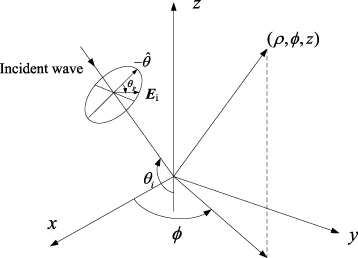
The schematic diagram of incident plane waves.
As shown in Fig. 1, the incident plane wave is assumed to propagate in the direction, θ = π −θ
i
φ = 0, and to be polarized in a direction making an angle θ
p
with the unit vector
Referring to the method in reference [13] and the transformation relationship between rectangular coordinates and cylindrical coordinates, taking E 𝜌i as example, the incident plane wave can be expanded into the following form:
Parallel polarization wave:
Taking parallel polarized wave as an example, the time-domain expressions of Eq. (21) can be obtained by inverse Fourier transform
It can be seen from Eqs (23) that the calculation of the incident field component at the TFSF surface requires a large number of FFTs, which will consume a lot of CPU time. It is noted that each component of the incident wave field has the same time term t − zcosθ i ∕c, which means that the waveform of the field component is the same at all points in the z direction, only with a time delay. Therefore, as shown in Fig. 2, as long as the incident wave at z = k 1Δz is calculated by FFT, the field components at other points can be obtained by a corresponding time delay.
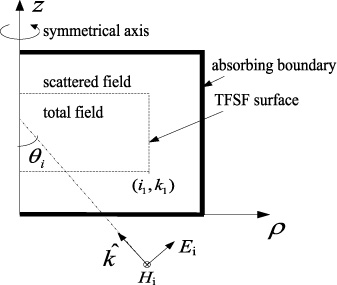
Scattering calculation diagram of BOR-FDTD.
Equations (23) can be further abbreviated as:
Following the procedure of Section 2, Eqs (27)–(31) can be discretized as
It can be seen that the Eqs (34) and (35) are implicit and cannot be calculated directly. But as long as each component is calculated in h 𝜌 → h 𝜙 → e z → e 𝜌 → e 𝜙 order, this problem can be easily solved. The whole calculation process only needs two FFTs, which greatly improves the computational efficiency.
Validation of the proposed algorithm
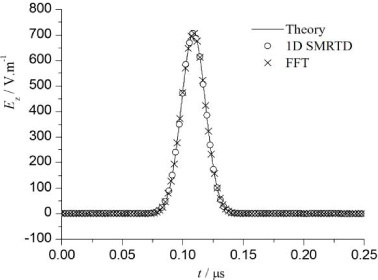
Calculation results of the pulse wave.
Firstly, in order to verify the effectiveness of the proposed one-dimensional time-domain algorithm, the incident electric field component at z = k
1Δz is calculated by using the proposed algorithm and FFT method respectively. A Gaussian pulse excitation is used here
In this case, a metal cylinder is used, and the height and radius of the metal cylinder are both 60 m. The incident wave is applied pulse form, E i (t) = E 0 exp[−4π(t − t 0)2∕τ2], which is parallel polarization, and the incident angle is θ i = 3π∕4, τ = t 0 = 1 × 10⁻⁷ s. In this section, the computation domain is discretized with a mesh Δ𝜌 × Δz = 1.5 m × 1.5 m, Δt = 0.417 ns, and M = 11.
The surface current density of the cylinder is decomposed into J t (tangential component) and J 𝜙 (𝜙-direction component), and the following surface current density formulas can be obtained according to the boundary condition:
Bottom edge:
Side:
Top edge:
Figure 4 shows the time-domain waveform of current density at the middle point of the cylinder surface. J t represents the tangential component of current density and J 𝜙 represents the 𝜙 directional component.
As shown in Fig. 5, the current density distribution of the cylindrical busbar with frequency of 10 MHz is extracted by Fourier transform and compared with the results of MoM, and the two results are also in good agreement.
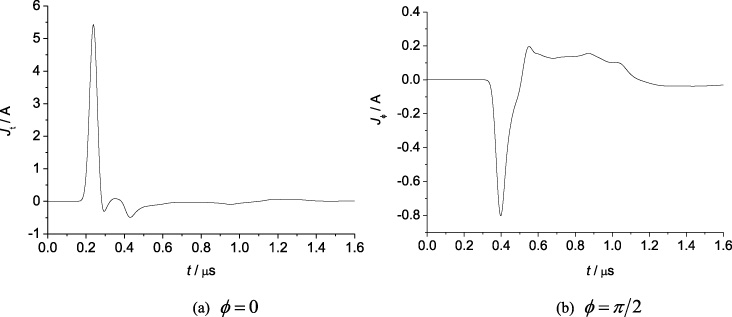
Time-domain waveform of current density on the surface of the cylinder.
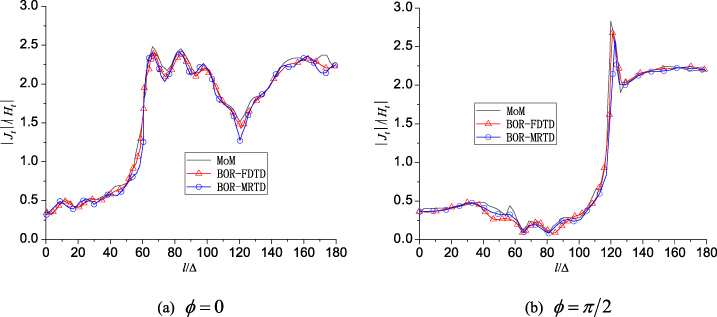
Current density distribution of cylindrical bus with 10 MHz.
Moreover, as shown in Table 1, it is obvious that the BOR-SMRTD method has an advantage over BOR-FDTD at saving the CPU time and memory. The proposed method uses 47.6% of the CPU memory and consumes 67.5% of the CPU time by the BOR-FDTD method.
CPU time and memory for different schemes
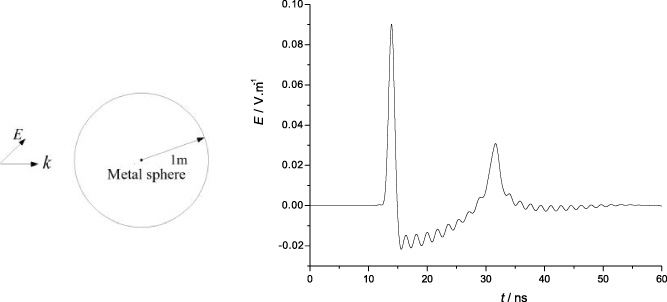
RCS of metal sphere with radius 1 m.
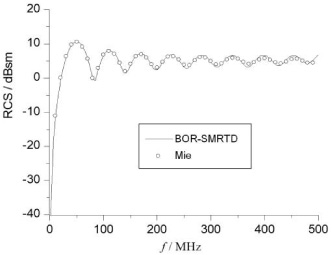
RCS of metal sphere with radius 1 m.
The radius of the metal sphere is 1 m, and the incident wave is still a Gauss pulse, τ = 3 × 10⁻⁹ s, t 0 = 3 × 10⁻⁹ s. The computation domain is discretized with a mesh Δ𝜌 ×Δz = 1.5 m × 1.5 m, Δt = 6.67 ps, and M = 9. Figure 6 shows the far-field backscattering electric field of the metal ball. As shown in Fig. 7, Fourier transform is made for the electric field and incident pulse to obtain the RCS of the metal ball. Mie series solutions are also given as a comparison. It can be seen that the results obtained by BOR-FDTD are in good agreement with Mie series solutions, which also proves the accuracy of the proposed method.
Conclusion
The obliquely incident plane wave cannot be directly introduced into BOR-SMRTD due to its non-rotational symmetry. In this paper, an efficient one-dimensional time-domain algorithm for obliquely incident plane waves in BOR-SMRTD is proposed, which is based on the characteristic that the incident wave has only time delay in the symmetrical axis direction in the cylindrical coordinate system and the cylindrical expansion of plane waves. Numerical results show that the speed of the proposed algorithm is 51 times faster than that of the algorithm using FFT. In order to verify the effectiveness of the algorithm, the scattering problem of a metal cylinder with finite length is calculated. The surface current density distribution along the cylindrical generatrix at a given frequency is extracted, and the results are consistent with those obtained by MoM and BOR-FDTD methods. Furthermore, it is shown that the proposed algorithm uses only 47.6% of the CPU memory and consumes 67.5% of the CPU time by the BOR-FDTD method. Then the RCS of a metal spheres is calculated, and the numerical result is also in good agreement with the theoretical values.
Footnotes
Acknowledgements
This work was supported by the Youth fund of National Natural Science Foundation of China (grant no. 61801511) and the Youth fund of Jiangsu Natural Science Foundation (grant no. BK20180580).