The spin Hall effect of electromagnetic wave has important application prospects in the fields of Optical-electromechanical conversion, condensed matter and high energy physics. Based on the Euler–Lagrange equations of electromagnetic field by four-dimensional covariation, a deflection model of electromagnetic wave reflecting and refracting on interface of media is established in this paper. By using Lie group analysis method, the allowable infinitesimal symmetries, conserved quantities of partial differential equations and motion equation of energy center are derived. More importantly, their detailed analytical expressions and properties are given. The content of this paper can reveal the mechanism and influencing factors for transverse shift of the electromagnetic wave energy center, and provide a powerful theoretical basis for the numerical simulation of nonlinear photoelectric wave equation and spin regulation.
The propagation properties of electromagnetic wave in inhomogeneous media have important significance in detection, location, communication and so on. In addition to the longitudinal movement, the transverse movement of total reflection beam has been predicted and confirmed [1,2]. Its internal physical mechanism is closely related to the spin-orbit of electron. The key factor of the spin hall effect of electromagnetic wave is: the coupling of spin-momentum when the reflection and refraction of electromagnetic wave occur, whose quantitative analysis has always been the basic problem of optical information mechanism, because it is directly related to the innovative design and regulation of the system. When the electromagnetic wave propagates on interface of media, the energy center moves in the direction perpendicular to the incident plane. At present, there are energy flux method [3], stationary phase method [4] and generalized variation method [5] to study the transverse shift of electromagnetic wave. Due to the existence of interface boundary conditions, the electromagnetic field is a constraint system. Mathematically, it is a kind of partial differential equation evolved from maxwell equation, so it is a very basic work to find the approximate solution or accurate solution of the equation. At present, scholars at home and abroad have done a lot of work in the calculation and experiment of various electromagnetic wave transmission models [6–10]. However, the existing calculation methods have some limitations (such as numerical error and uncontinuous quantitative factor analysis). In the 19th century, the mathematician Sophie Lie put forward the concept of symmetry of differential equation in the theory of continuous group, and gave the general integration method of equation, namely, the Lie group analysis method [11,12]. This method is equivalent to linear and nonlinear, constant coefficient and variable coefficient equations, and is applicable to both ordinary and partial differential equations. In fact, the theory of Lie group analysis has become the only general and effective method to solve differential equations today.
The Lie group theory in modern mathematics is used to the study of electromagnetic field, which has attracted more and more attention. Such as, in reference [13], the conservation law of classical Lagrange-Maxwell equations has been solved by Lie symmetry algorithm, which is the most effective method except numerical simulation. In references [14–16], the transverse displacement problem of electromagnetic wave is studied by using the properties of coordinate transformation, but there are few reports on the analytical study of electromagnetic wave model by using Lie group analysis. In this paper, we don’t need assumptions and approximations, through transformation and deduction, the Lie symmetry generators and conserved quantities of the motion equations with four-dimensional covariant form of electromagnetic wave on interface of media are given, and the transverse shift is calculated by the energy center equation.
The motion equations of electromagnetic wave on interface of media
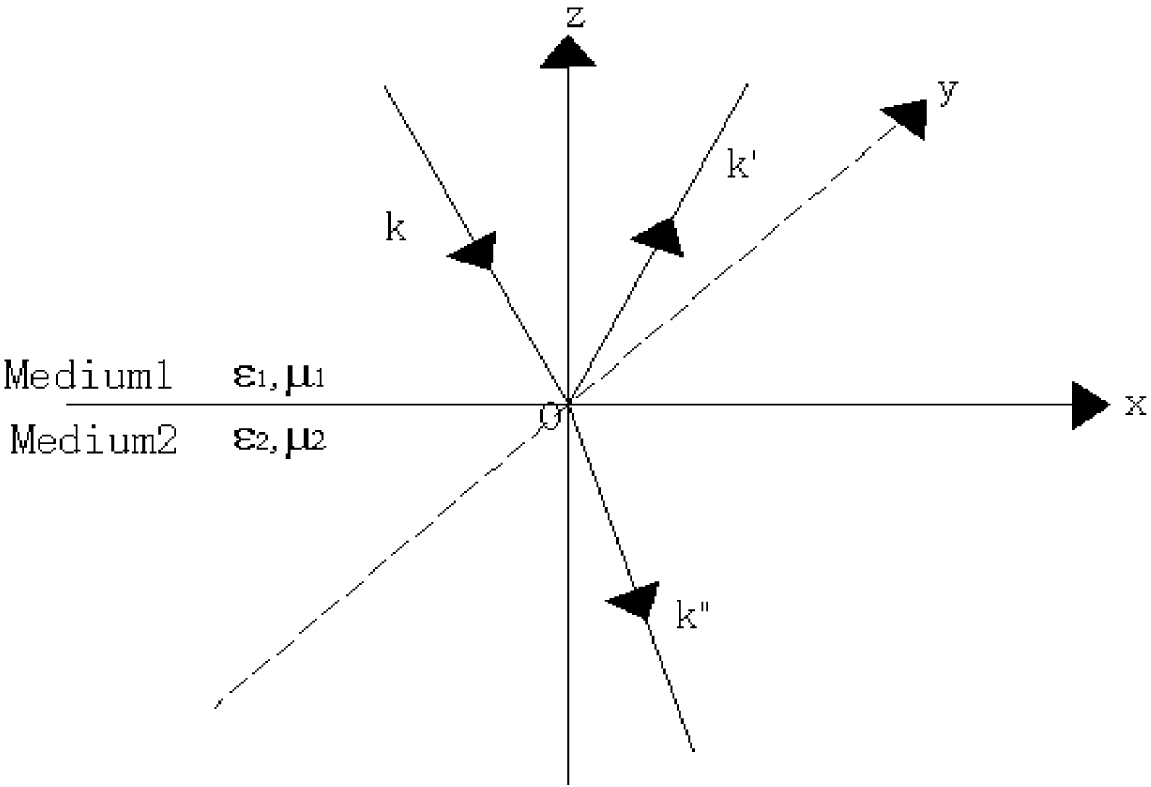
Considering the reflection and refraction of electromagnetic wave on interface of media, as shown in Fig. 1, a beam of quasi monochromatic electromagnetic wave is emitted from the insulating static isotropic homogeneous medium 1 to the insulating static isotropic homogeneous medium 2. A part of the electromagnetic wave is reflected back to the medium 1, and the other part is refracted into the medium 2. The ϵi, μi (i = 1,2) are the permittivity and permeability. The z = 0 is the interface of media, the normal unit vector is , the are followed the right-hand coordinate system.
Schematic diagram of reflection and refraction of electromagnetic wave.
Unconsidering dispersion, the are intensity of electric and magnetic field, the connection condition (constraint equation) of electromagnetic field on the boundary surface is as follows: The scalar potential and vector potential of electromagnetic field are φ, , the relationship is: Here the is a hamiltonian operator, so the four-dimensional potential of electromagnetic field is , setting the speed of light in vacuum c = 1, so the Eqs ((1)) are converted to: Here . So the tensor of electromagnetic field with four-dimensional (second-order) antisymmetric is: The Lagrangian density of free electromagnetic field is: Here F∗j, 𝛼𝛽 is the dual tensor of Fj, 𝛼𝛽, the Lagrangian density do not contain and x𝛽.
The generalized action of the system is: Here are constraint multipliers. Because δI = 0 and and are independent, so the Euler–Lagrange equations of electromagnetic field at classic level are: And the restriction of constraint equations are: Combining the (8) and (3), so are:
Lie symmetry of electromagnetic wave equations
Setting the independent variables the dependent variables A = (A1, A2, A3, A4), the total differential operator and the first and second partial derivatives are: Considering the infinitesimal transformation group with a single parameter: Here 𝜗 is an infinitesimal parameter, 𝜉i, 𝜂i are generator functions.
According to the continuation theory of Lie group, the generator, the first and second order extension vectors of (11) are as follows: The invariance of Eqs (7) under the transformation (11) can be expressed as follows: Here , the (13) are about the second-order linear partial differential equations of 𝜉i, 𝜂i: The infinitesimal generator of (14) is: It can be seen that the (15) represents the space-time translation of the system.
Conservation of electromagnetic wave equations
Proposition: For the infinitesimal generator 𝜉μ, 𝜂𝜈 satisfying the determining Eq. (13) of Lie symmetry, at the same time, a gauge function 𝛬τ can be found to make the following structural equation work: Here L∗ = L + 𝜆rGr, so there is a conservation law of electromagnetic wave equations on interface of media. Prove: Taking the partial derivative of (17): According to the (16), we have: Be aware: substituting the (19) into the (18), so: The proposition is proved.
Furthermore, the integral form of conservation law of electromagnetic wave equations can be obtained as follows: Substituting the infinitesimal generator (15) and the Lagrange density (5) into the (16) to obtain the gauge function: Setting the energy momentum tensor density of electromagnetic field is: Here gμ𝜈 = diag (1, −1, −1, −1) is the metric tensor. Substituting the (15), (5) and (22) into the (21), so: In fact, the generalized momentum and energy of the system are: The (25) is shown that the energy conservation of electromagnetic wave with reflection and refraction on interface of media can be derived from the space-time translation.
The transveral effect of electromagnetic wave equations
Setting the central coordinates of electromagnetic wave energy are: Because: Derivation of (26) and setting μ = 4, substituting (24) into (27), so the equation of transverse shift of energy center is: Here is the projection component of reflected wave vector in x2, is the refracted wave vector in x2, is the projection component of the spin of reflected wave vector in x3, the projection component of the spin of refracted wave vector in x3. Because Δ1 ≠ 0, so when the electromagnetic wave is reflected and refracted on interface of media, the coupling of spin and momentum causes the energy center to shift.
It is further assumed that the electromagnetic beam with frequency ω and incident angle θ, and the reflection angle θ′ and refraction angle θ′′, so: The forward direction of electromagnetic beam in x1 is , the direction of propagation is and . The projection linearities are Da, Dm, Db respectively, for Db ≫ Dm, so the contact time between electromagnetic wave and interface is: The total shift of energy center for reflected and refracted waves are: It can be seen from the above formula (31) that the transverse shift effect caused by the spin of electromagnetic wave is not related to the frequency, but is closely related to the polarization state, incidence angle, dielectric constant, permeability.
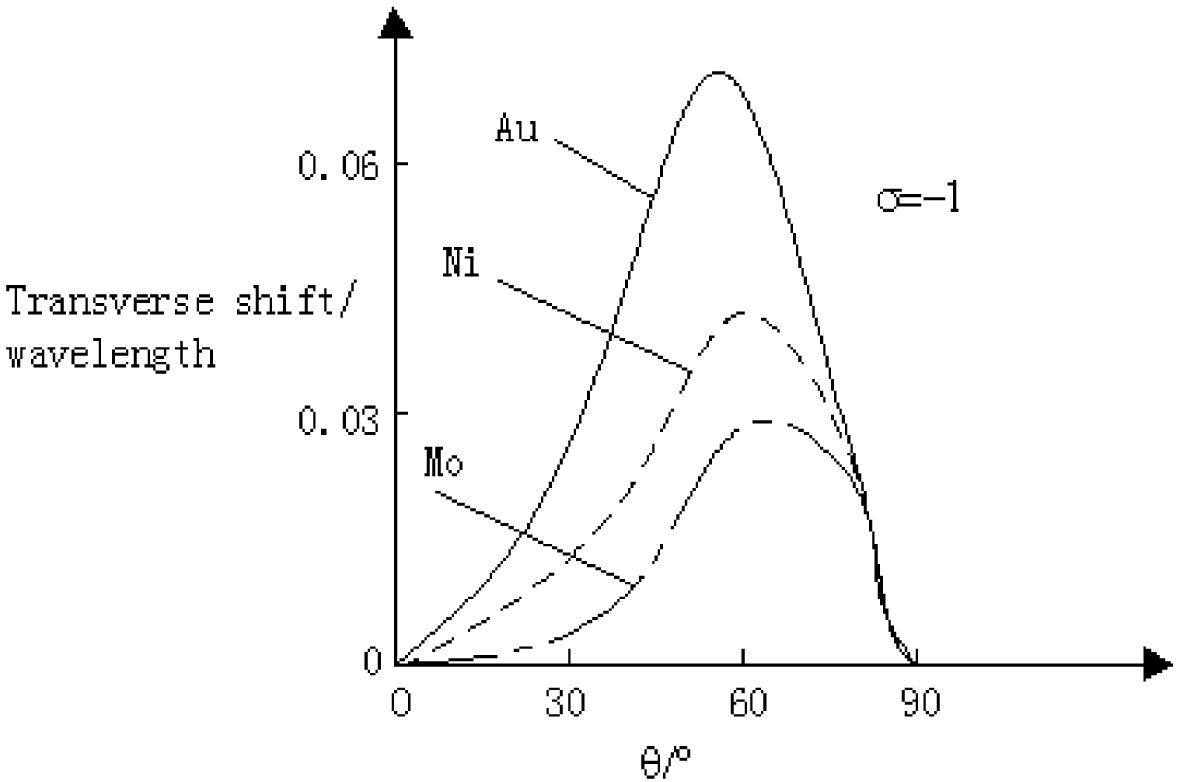
When the incident angles of each wave component in the electromagnetic beam are not much different from θ, the reflection angle and refraction angle can be approximately as follows: When the electromagnetic wave is right-handed circular polarization, the medium 1 is air and the medium 2 are metal medium Au, Ni and Mo respectively, μ1 = 1, the wavelength of Db is 𝜆, so the distribution with the incident angle for the normalization of the transverse shift of electromagnetic wave energy center and the incident wavelength is shown in Fig. 2:
Transverse shift of electromagnetic wave at different metal interfaces.
It can be seen from Fig. 2 that the electromagnetic wave is in a right-handed circular polarization state, and the transverse shift of energy centers of Au, Ni and Mo are all positive values and decrease in turn. There is an extreme point in each metal’s transverse curve, which is determined by the reflection and refraction coefficients, which are consistent with the experimental phenomenon.
In order to illustrate the correctness of Lie group method, comparing the literature [17], its results by SHEL experimental device show that the transverse shift of electromagnetic wave on interface of metal is closely related to the dielectric constant. For three metals Au, Ni, Mo (real parts of dielectric constants are negative numbers), the ratio of virtual to real parts of dielectric constants increase in turn, but the transverse shifts of electromagnetic wave decrease in turn, and when the difference between the parallel component and the horizontal component of the phase reaches the maximum value, the transverse shift of electromagnetic wave also reaches the maximum value, so the Fig. 2 just fits the regular pattern.
Conclusion
The structure of Lie group is rich. It inherits the structural properties of algebra and geometry and the differentiable properties of analysis field, which have profound internal theory. At present, the method of Lie group analysis is widely used in the field of mathematical physics equations, and has achieved rich research results. In this paper, the invariance of Euler–Lagrange equations for the transmission model of reflection and refraction of electromagnetic wave on interface of media is obtained by using the classical Lie symmetry. By using the spatiotemporal translation, the energy conservation and the equation of energy center are derived, and the specific quantitative expression of transverse shift is given. The results show that the energy center shift effect on interface of media is caused by the coupling of spin and momentum, which is closely related to polarization state, dielectric constant, refractive index gradient and incident angle. The Lie symmetry method can explain the technical characteristics and deep-seated laws of electromagnetic wave transmission and can be further extended to the study of other nonlinear photoelectric propagation systems.
References
1.
FedorovF.I., On the theory of total reflection, Dokl. Akad. Nauk.105 (1955), 465–468, doi:10.1088/2040-8978/15/1/014002.
2.
BeauregardO.C. and ImbertC., Quantized longitudinal and transverse shifts associated with total internal reflection, Phys. Rev.7 (1973), 3555–3563, doi:10.1103/PhysRevD.7.3555.
3.
FedorovF.I., Transformation and shift of a Gaussian light beam upon reflection from a resonant medium, Zh. Prikl. Spektrosk.27 (1977), 580–585, doi:10.1134/s0030400x06050195.
4.
SchillingV.H., Die strahlversetzung bei der reflexion linear oder elliptisch polarisierter ebener wellen an der trennebene zwischen absorbierenden Medien, Ann. Der. Phys.16 (1965), 122–134, doi:10.1002/andp.19654710304.
5.
LiuX.Y., Some properties of electromagnetic waves near the interface of dielectric media, J. Phys. A: Math. Gen.24 (1991), L323–L327.
6.
FedoseyevV.G., Conservation laws and transverse motion of energy on reflection and transmission of electromaenetic waves, J. Phys. A: Math. Gen.21 (1988), 2045–2059.
7.
LiuX. Y., Transverse motion of energy on reflection and refraction of electromagnetic waves, Common. Theor. Phys.24 (1995), 369–372, doi:10.1088/0253-6102/24/3/369.
8.
BakhturinM.P. and GramotnevD.K., Resonant rotation of a mirror-reflected wave in a layered structure, Phys. Lett. A162 (1992), 485–492, doi:10.1016/0375-9601(92)90011-a.
9.
LiuX.Y., Theoretical study of deflection of reflected and refracted electromagnetic waves from incident plane, Commun. Theor. Phys.25 (1996), 361–364, doi:10.1088/0253-6102/25/3/361.
10.
HosenO. and KwiatP., Observation of the spin Hall effect of light weak measurement, Science319 (2008), 787–790, doi:10.1126/science.1152697.
11.
IbragimovN.H., Differential Equations and Problems of Mathematical Physics, Higher Education Press, 2013, pp. 101–123.
12.
BlumanG.W. and AncoS.C., Symmetry and Integral Method of Differential Equations, Science Press, 2009, pp. 54–67.
13.
FuJ.L.ChenX.W. and LuoS.K., Lie symmetries and conserved quantities of Lagrange-Maxwell mechanical systems, Acta Mechanica Solida Sinica2 (2000), 157–160. doi:10.1088/1009-1963/11/1/301.
14.
LiZ.P. and WuB.C., The transverse shift of the centre of energy of the reflection and refraction of eectroamgnetic waves on the interface of dielectric media, Journal of Xinjiang University (Natural Science)10 (1993), 64–68.
15.
LiuX.Y., Tarnsveser shift of reflectde and refractde eectroamgnetic waves, Acta Optica Sinica15 (1995), 1437–1440.
16.
WuZ.M. and LiuX.Y., Deflection of reflected and refracted eectroamgnetic waves on interface of media, Journal of Nanchang University (Natural Science)25 (2001), 56–62.
17.
YinH.F., Study on the influencing factors of transverse shift in spin hall effect of light centroid, Master Dissertation, Hunan University, 2011.