




Abstract
In this work, we focused on the peristaltic unsteady flow of non-Newtonian nanofluid with heat transfer through a non-uniform vertical duct. The flow obeys Herschel Bulkley model through a non-Darcy porous medium under the effects of mixed convection and thermal diffusion. Moreover, the effects of thermal radiation, heat generation, Ohmic dissipation, chemical reaction and uniform external magnetic field are investigated. The derived equations that describe the velocity, temperature and nanoparticles concentration are simplified under the assumptions of long wave length and low Reynolds number. These equations have been solved by using a numerical technique with the help of shooting method. The obtained solutions are functions of the physical parameters entering the problem. The effects of these parameters and the obtained solutions are explained and discussed through a set of graphs. It is found that the increment in Prandtl number or Thermophoresis parameter reduces the spread of the nanoparticles (concentration increased) within the fluid along with the thermal diffusivity through the fluid layers. Also the non-Darcy effect supports the inertial forces, and in order to maintain Reynolds number, the viscous forces are motivated and the axial velocity is damped. Moreover, for the validation of the current methodology, this model is reduced to power law model (no yield stress) and compared with the work of Eldabe et al. [16].
Keywords
Introduction
The term ‘nanofluid’ refers to the fluid in which nanometer-sized particles are suspended in the base fluid that may be water, oil or ethylene glycol. Nanoparticles are made of metals such as Cu, Al and Ag or nonmetals such as Al2O3, CuO and Fe2O3 [1,2]. In fact, adding nanoparticles to the base fluid improves the thermo-physical properties of the fluid (nanofluid) such as thermal conductivity and convective heat transfer coefficients. Moreover, the stability of the suspension is enhanced. Thereby, nanofluids have several benefits in many fields such as Cooling of nuclear reactors, cooling of electronics, solar water heating, domestic refrigerator, chillers, drilling, lubrications, cancer therapy, drug delivery, photo dynamic therapy … etc. [3,4]. In view of these applications, several researchers are concerned to study the flow of nanofluids under different external effects. Zhang et al. [5] studied the entropy generation on the blood flow with suspended nanoparticles through isotropically tapered arteries, in this study the blood was considered as non-Newtonian nanofluid that obeys Jeffrey model, also the magnetic field play an important role to control the blood flow at different temperatures. Bhatti et al. [6] investigated the MHD peristaltic transport of blood with suspended tiny spherical particles through porous medium in a small annular tube, in this study the blood was considered as non-Newtonian nanofluid that obeys Prandtl model, also the effect of coagulation (i.e. a blood clot) on the blood flow was discussed. Ponalagusamy and Priyadharshini [7] discussed a mathematical model of blood flow with suspended nanoparticles through arterial stenosis, in this study the blood was considered as Herschel–Bulkley nanofluid model, the obtained velocity profiles were compared with the experimental data and it is found that blood behaves like a Herschel-Bulkley fluid rather than power law, Bingham, and Newtonian fluids. Abou-zeid [8] used homotopy perturbation method (HPM) to solve the system of equations that govern the peristaltic flow of micropolar biviscosity nanofluid under the effects of viscous dissipation and thermal radiation. On the other hand, nanoparticles may interact with each other and group together. Thereby the effect of chemical reaction has been involved in recent studies of the flow of nanofluids. The fluid flow problems with heat and mass transfer under the effect of chemical reactions have important role in metallurgy, petroleum and chemical engineering industries, such as food processing, polymer production, cooling of nuclear reactors, energy transfer in a cooling tower and the flow in a desert cooler. Moreover, possible applications can be found in processes such as drying, distribution of temperature and moisture over agricultural fields [9,10]. Arian et al. [11] used a combination of differential transform method (DTM) and Pade approximation to solve the system of equations that goven the flow of Carreau fluid with suspended nanoparticles and gyrotactic microorganisms between a pair of rotating circular plates, where the effects of chemical reaction and induced magnetic field are involved. Eldabe et al. [12] obtained numerical results (by using multi-step differential transform method (Ms-DTM)) that describe the MHD peristaltic transport of a pseudoplastic nanofluid through a porous medium in the presence of Ohmic dissipation and chemical reaction. Eldabe et al. [13] used HPM to solve the governing equations of the Magnetohydrodynamic (MHD) peristaltic transport of non-Newtonian (Eyring–Prandtl) nanofluid through a porous medium in the presence of chemical reactions and slip boundary condition. Eldabe et al. [14] solved numerically (by using explicit finite difference method) the system of equations that govern the peristaltic flow of Casson model through a porous medium in the presence of thermal diffusion and chemical reaction. Hayat et al. [15] used series to obtain a solution for the stream function and the pressure gradient corresponding to the peristaltic flow of fourth grade fluid in an inclined asymmetric channel in the presence of chemical reactions and slip boundary condition. A lot of the surrounding materials (paints, glues, inks, plastics, blood, slurries …etc.) are non-Newtonian fluids. The main feature of these fluids is that the strain rate holds a non-linear relationship with the shear stress.
Non-Newtonian fluids have numerous applications in medicine, engineering and industry such as extraction of crude oil from petroleum products, food processing, ethanol and gibberellic acid production and bio-engineering operations [16]. Consequently, many researchers have studied the flow of several models of non-Newtonian fluids under different external effects. Ellahi et al. [17] obtained exact solution for the velocity equation that describing the peristaltic flow of non-Newtonian fluid (Jeffrey model) through a porous rectangle channel with slip boundary condition. Abou-zeid [18] used HPM to solve the system of governing equations of MHD peristaltic transport of Jeffery nanofluid under the effects of couple stress, porous medium, Ohmic heating, thermal radiation and viscous dissipation. Eldabe and Abou-zeid [19] obtained exact solutions for the system equations that govern the peristaltic transport of a Jeffery model under the effects of radially varying magnetic field, thermal-diffusion, thermal radiation, Joule heating and internal heat generation. Herschel-Bulkley model is the most generalized model describing the behavior of non-Newtonian viscoplastic fluid. According to this model, the materials act as rigid solids when the applied stress is below the yield stress. Once the yield stress is covered, these materials act as shear-thinning (pseudoplastic fluid) or shear-thickening (dilatant fluids) [20]. Moreover, under different considerations, Herschel-Bulkley model can be simplified to Newtonian model, Bingham model or Power-law model [21]. Sankad and Patil [22] used cartesian coordinate system to get exact solutions for the velocity and the stream function that govern the peristaltic motion of Herschel-Bulkley fluid in a non-uniform porous pipe. It is found that the pumping of the volume flow rate of Herschel-Bulkley decreases by increasing the value of yield stress, while in the co-pumping region the effect is reversed. Selvi and Srinivas [23] used cylindrical coordinate system to get exact solutions for the velocity and the stream function that govern the peristaltic flow of Herschel-Bulkley fluid in a non-uniform channel and illustrated graphically the trapping phenomenon. It is found that the volume flow rate of Herschel-Bulkley decreases by increasing the value of yield stress. Later on, some researchers involved the effect of mixed convection on the flow of non-Newtonian fluid. In thermodynamics systems, mixed convection means that both forced and natural heat convection are involved. Heat transfer with mixed convection has many applications in industry especially in geothermal engineering such as indoor ventilation with radiators, cooling electrical components, solar collectors, solar stills, electromagnetic pumps, fuel cells, thermal insulation systems, refrigerators, and rotating-tube heat exchangers [24]. These numerous applications have attracted many researchers to study the flow of non-Newtonian fluid with mixed convection. Abou-zeid et al. [25] solved numerically the system of equations that govern the gliding movement of bacteria on power-law nanoslime in the presence of non-Darcy porous medium, where the effects of MHD, mixed convection, thermal diffusion and diffusion thermo were involved. Mansour and Abou-zeid [26] used HPM to solve the system of equations that govern the peristaltic flow of Williamson fluid through the porous medium in the presence of mixed convection. It is found that concentration and temperature have dissimilar behaviors with respect to the effects of the entering parameters.
There are rare studies that deal with Herschel Bulkley nanofluid, moreover the majority of the studies that deal with the flow Herschel Bulkley fluid neglected the effect of inertial forces (Re ≈ 0) in order to solve the system of governing equations. Thereby the main aim of the present work is to study the peristaltic flow of Herschel Bulkley nanofluid under several external effects. We extended the work of Sankad and Patil [22] to involve the effects of thermal diffusion, diffusion thermo, normal magnetic field, thermal diffusion, viscous dissipation, Ohmic dissipation, thermal radition, internal heat generation and chemical reaction on the vertical peristaltic transport of Herschel Bulkley nanofluid with mixed convection heat transfer through a non-Darcy porous medium with slip boundary condition.
Problem modeling
Physically, the model of our problem corresponds to the flow behavior through many physiological processes like swallowing through Esophagus and exerting through the ending part of the digestive system (Rectum and Anus), which are found to be peristaltic, non-uniform and vertically downwards in its normal position (see Fig. 2). It is also relevant to the technique of some medicine instruments like endoscopes surgery. Herschel-Bulkley model is found to be more suitable and applicable for the blood flow than Casson model since it contains one more additional parameter (fluid behavior index) and can be utilized for low shear rates where the Casson model fails to clarify the different physiological behaviors of blood [27].

Physical model and coordinates system.
Taking into account the cartesian coordinate system such that X-axis denotes the axis of the tube and the uniform external magnetic field is taken in the direction of transverse coordinate. Figure 1 represents the problem modeling where the solid lines represent the elastic walls of the vertical cone and the dot lines represent the sinusoidal wave train (peristaltic movement) along the walls. The mathematical equation of this wave (as mentioned in Abou-zeid and Mohamed [28]) is:
It is also noticed that the flow is unsteady in the laboratory frame (fixed frame), but under the assumptions that the channel length is an integral multiple of the wavelength
Also, our model of fluid (Herschel-Bulklely model) contributes in 3D food printing. Karyappa and Hashimoto [29] printed chocolate-based inks in its liquid phase using direct ink writing (DIW) 3D printer. The printing inks were prepared by mixing chocolate paste with high concentrations of cocoa powders. Also it is known that the inks possessed finite yield stresses at rest. Hence, the printing inks are considered as a non-Newtonian fluid (chocolate paste) that obeys Herschel Bulkley with suspended fine particles (cocoa powder). Moreover, the printing inks exhibited shear-thinning properties (n < 1). It is worth to note that our model represent a general study that may contribute in engineering, medicine and industry fields. The relation between the stress tensor and the rate of strain is given by [30] for Herschel-Bulklely model is defined as:
In the nanofluid investigation, there are two models can be considered: the single-phase model and the two phase model [32,33]. The single-phase model assumes that base fluid and nanoparticles have the same temperature and velocity field. Therefore, continuity, momentum and energy equations can be solved as if the fluid was a classical pure fluid but with using effective properties of nanofluid. Meanwhile, For two-phase nanofluid models, it is assumed that base fluid and nanoparticles can have different velocity and temperature fields. Volume of Fluid (VOF), Euleriane Mixture model (EMM), and Euleriane Eulerian model (EEM) are the three common two-phase models used in modeling of nanofluids [32]. Here, we used the mixture model, which solves the continuity, momentum and energy equations for the mixture as well as a volume fraction equation for the secondary phases.
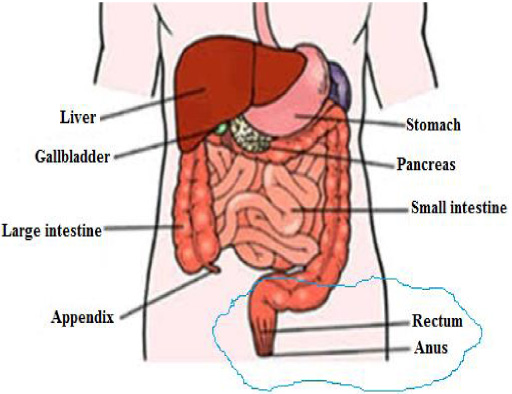
The ending part of the digestive system.
In conformity with the presence of the nanoparticles, together with thermophoresis and Brownian motion effects, the energy equation, and the volumetric nanoparticles fraction equation, following Abou-zeid [25] and El dabe et al. [16], are considered. Hence, the governing equations of the motion in the Cartesian plane can be written as follows:
The skin friction coefficient τω is considered to be:
Let u = Y 1, T = Y 3 and f = Y 5,
Hence Eqs (15), (17) and (18) can be written as follows:
The shooting technique is applied by using NAG Fortran library, namely, the subroutine D02HAF which requires the guessing of starting values of missing initial and terminal conditions. Moreover, fifth order Rung–Kutta–Merson method is used to solve the simplified governing Eqs ((21)). This method is applied in the presence of variable step size in this subroutine in order to control the local truncation error, then, we used modified Newton–Raphson technique to obtain successive corrections for the estimated boundary values. The process is repeated iteratively many times until convergence is occurs, i.e. until the absolute values of the difference between every two successive approximations of the missing conditions is less than ϵ (in our problem ϵ is taken = 10−5).
In the case of Herschel-Bulkley fluid with (n = 0.2 < 1), we obtained numerical solutions of the axial velocity, temperature distribution and nanoparticle concentration by using Mathematica software version 12.0.0.0. The effects of various parameters entering the problem are discussed through the Figs (3)–(13). These figures are depicted for a system whose particulars are the following non-dimensional numbers: M = 2, D a = 0.5, Pr = 0.1, Ec = 2, N t = 0.1, N b = 1, ∂P∕∂x = −1, n = 0.2, Re = 0.01, F s = 1.5, R = 4, 𝜆 = 2, 𝛽 = 2, B r = 0.1, G r = 0.3, Sh = 0.5, K 𝛼 = 0.5 and τ0 = 0.2.
The range of these values is in agreement with Abou-zeid [8], Sankad and Patil [22], Abou-zeid et al. [25], Abou-zeid [39] and Eldabe et al. [16]. Physically, due to the presence of nanoparticles, small value of Pr is considered to emphasize strong thermal diffusivity. Moreover, small value of G r matches with very small value of Re; as, the viscous forces are dominant.
The axial velocity u is a function of the entering parameters, since we don’t have an analytical solution for it; the understanding for the behavior of u depends on the obtained graphs. It is found that u is always negative, moreover, u decays along the path from y = 0 (axis of the tube) to y = h (wall). i.e u increases in the negative direction of Y-axis.
Figures (3) and (4) indicate that the axial velocity u decreases with increasing G r till a definite point (y ≈ 0.8) then the effect is reversed, while it increases with increasing B r till the same point (y ≈ 0.8) then the effect is reversed, respectively. Physically, in the presence of natural convection heat transfer, thermal Grashof number indicates the ratio between the buoyancy force due to spatial variation in fluid’s density (caused by temperature differences) and the viscous force acting on the fluid layers. Accordingly, the increment in G r enhances the buoyancy force. So near the axis of the tube (where ΔT = T − T 0 > 0) more fluid layers (hot layers) are forced to go towards the axis of the tube (cold medium), hence, the velocity increases in its negativity. On the other hand, near the wall of the tube (where ΔT = T 1 − T > 0) the effect is reversed, as more fluid layers (cold layers) are forced to go towards the wall of the tube (hot medium), hence, the velocity decreases in its negativity. The Dissimilar effects of G r and B r on the axial velocity u are in agreement with Asha and Sunitha [35].
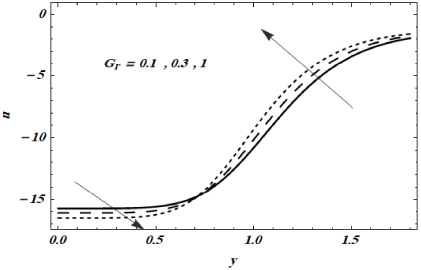
The axial velocity distribution under the effect of G r .
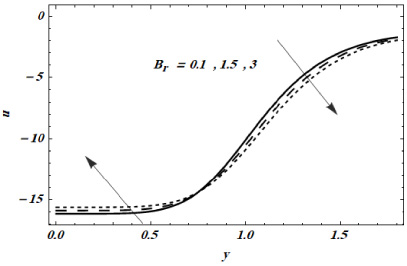
The axial velocity distribution under the effect of B r .
Figure 5 emphasizes that the axial velocity u increases as F s increases. This behavior is in agreement with Hayat et al. [36]. Physically, “F s u 2” represents an inertial force, so as F s increases the inertial forces increase. Since Re is fixed (Re = 0.01) where Re is the ratio between the inertial forces and the viscous forces in the fluid. Thereby the viscous forces must be increasing also; hence the velocity is enhanced. Also in this figure, it is clear that the gap between the velocities get cramped near the wall, this emphasizes the great effect of F s on u near the wall.
The effects of the other parameters are discussed, it is found that they have the same effects on the velocity distribution u, so that the discussions for their figures are neglected to save space and avoid repetition.
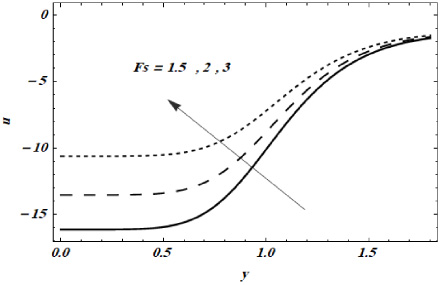
The axial velocity distribution under the effect of F s .
The graphs of temperature distribution T depict that the curve of T has a minimum point. Physically, considering (T 0 < T 1), the fluid layers near the axis of symmetry of the tube are colder than that near the wall. Therefore, the temperature of the fluid is gradually increased near the walls (T 1 > T), while it is gradually damped near the axis of the tube (T > T 0). The only way to describe this phenomenon along the path from y = 0 (axis of the tube) to y = h (wall) is to take the reverse shape of the temperature, hence the curve exhibits a minimum point, i.e T increases in the negative direction of Y-axis.
Figures (6) and (7) depict that T decreases by increasing both τ0 and Pr. Physically; Resilience is the ability of a material to absorb energy when it is elastically deformed up to yield point. So as τ0 increases the yield point increases which implies that the fluid absorbs more energy before a permanent deformation takes place. Thereby, the minimum peak of the cure goes down. This result is in agreement with Akbar and Butt [33]. As for Pr, it represents the ratio between momentum diffusivity and thermal diffusivity inside the fluid, so the increment in Prindicates that the thermal diffusivity (heat transfer through the fluid layers) decreases, hence, the fluid maintains its energy for a longer time. Thereby, the minimum peak of the cure goes down. This result is in agreement with Eldabe et al. [16–39].

Temperature distribution under the effect of τ0.
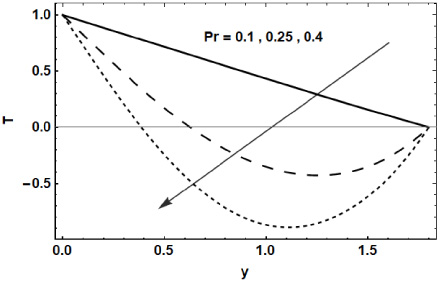
Temperature distribution under the effect of Pr.
Figure (8) shows that temperature T increases as Re increases. Physically, Re demonstrate the ratio between the inertial forces and the viscous forces in the fluid. As Re increases the flow is much easier, moreover the spread of the nanoparticles increases, hence the heat transfer increases (faster than before) and the peak of the curve goes up. This result is in agreement with Abou-zeid et al. [25], Abou-zeid [40] and Guo et al. [41].
Figure (9) shows that temperature T decreases as N b increases till a definite point (y ≈ 1) then the effect is reversed. Physically, the increment in N b implies that the diffusive mass transport (spread) of the nanoparticles (good conductors of heat) increases, hence, the thermal diffusivity increases and the curve of temperature distribution goes more flat (T decreases in its negativity). It is found that this effect appears by putting B r = 0. In case of dual effect, the amount of heat gained from the wall (hot medium)) are quickly transferred through the fluid layers (T decreases in its negativity), while near the axis of the tube it seems the effect N b is overcame by other parameters and the fluid maintains its energy (T increases in its negativity). Also it is found N b has no effect on T in the absence of that at B r and Sh, however in the work of Eldabe et al. [16] (where B r and Sh do not exist) the effect N b exists, this dissimilar behavior clarifies that in the absence of mixed convection and thermal diffusion, the effect N b on T vanishes when the tube is vertically tilted.
The effects of remaining parameters are investigated but their discussions are neglected in order to save space and avoid repetition.
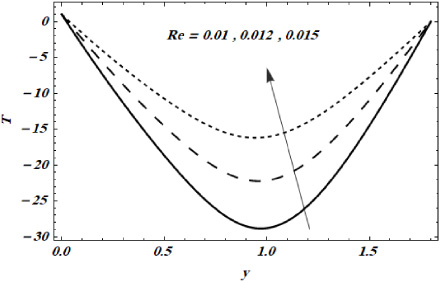
Temperature distribution under the effect of Re.
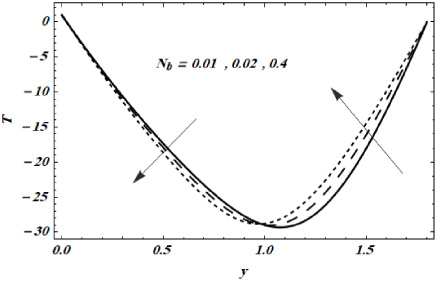
Temperature distribution under the effect of N b .
The graphs show that nanoparticles concentration f increases as y increases till a definite value y = y 0 and decreases afterwards. Physically, this phenomenon is true due the boundary conditions. From the boundary conditions we have T 1 > T 0; f 1 > f 0. According to Fick’s law; the diffusive mass transport (spread) of the nanoparticles starts from the region of higher concentration (wall) to the region of lower concentration (axis of the tube). i.e the concentration of the nanoparticles near the walls decayed to be enhanced near the axis of the tube. Hence, along the path from y = 0 (axis of the tube) to y = h ( wall), concentration increases till a maximum point then decreases afterwards.
Figures (10) and (11) depict that the nanoparticles concentration f decreases with increasing both Sh and N b . Physically, Sh represents the ratio between the rate of convective mass transport of the nanoparticles (due to their flow within the fluid) and the rate of diffusive mass transport of them (caused by their random motion). Considering that Brownian motion parameter is fixed (N b = 1), so as Sh increases the convective mass transfer of nanoparticles increases. Since the velocity of the fluid increases from the wall of the tube towards the axis of the tube, therefore the movement (spread) of the nanoparticles from the wall towards the axis of the tube increases. Hence, the concentration decreases. On the other hand, Brownian motion is the random motion of particles suspended in a fluid (a liquid or a gas) resulting from their collision with the fast-moving molecules in the fluid. This randomly motion agrees with the results that the velocity increases or decreases with the Brownian motion parameter N b , thereby, as N b increases the nanoparticles distribution (spread) increases (concentration decreases). This result is in agreement with Abou-zeid [8], Abou-zeid and Mohamed [3,28] and Eldabe et al. [16]
Figures (12) and (13) depict that the nanoparticles concentration f increases with increasing both Pr and N t . Physically, Pr represents the ratio between momentum diffusivity and thermal diffusivity inside the fluid, so the increment in Pr indicates that the thermal diffusivity (transfer of heat through the fluid layers) is damped. Thereby the movement (spread) of the nanoparticles (which are good conductors of heat) decreases through the fluid. Hence, the concentration increases. This behavior is in agreement with Abou-zeid [8], Abou-zeid and Mohamed [3,28], Eldabe et al. [16] and Ali et al. [34]. On the other hand, thermophoresis effect indicates that nanoparticles reduce the temperature gradient 𝛻T [16], in fact this is true as nanoparticles are good conductors of heat, i.e due to the presence of nanoparticles the thermal diffusivity through the fluid layers is very high (low temperature gradient). Accordingly, as the increment in N t reduces the temperature gradient [16], i.e the increment in N t increases the thermal diffusivity, hence the effect of N t matches with Pr.
The effects of remaining parameters are investigated but their discussions are neglected in order to save space and avoid repetition.

Nanoparticles concentration f distribution under the effect of Sh.
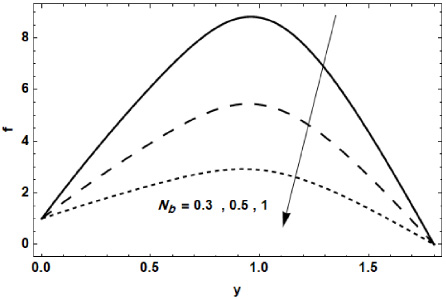
Nanoparticles concentration f distribution under the effect of N b .

Nanoparticles concentration f distribution under the effect of Pr.
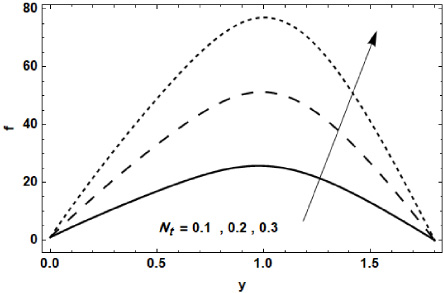
Nanoparticles concentration f distribution under the effect of N t .
Table 1 illustrates some numerical results for the skin friction coefficient τω, as obtained in Eq. (20), for several values of Re, M, F s , ∂P∕∂x. Actually, Herschel Bulkley is reduced to power-law model when the shear stress exceeds the yield point. Hence it is valid to compare between our work and the work of Eldabe et al. [16] under the following considerations:
In the present work, the boundary axial velocity is same as [16] by taking Da = 0.25 and 𝛽 = 0.25. In the present work, T
1 > T
0; f
1 > f
0 but in [16] T
1 < T
0; f
1 < f
0; This point can be covered by taking the values of Ec, Nt, Nb, G
r
and B
r
as negative values in the present study. In the present work, the channel is vertical in the presence of mixed convection, This point can be covered by adjusting the inclination angle and enlarging the gravitational force parameter in [16]. (i.e θ = Pi∕2 and F = 30 in [16]). In the present work, the effects of thermal diffusion and chemical reaction are neglected (i.e Sh = 999999 and K
𝛼 = 0). The comparison is done for the flow of pseudoplastic fluid (n = 0.2 < 1).
It is clear from Table 1 that the behavior of τω approaches it in the work of Eldabe et al. [16].
Comparison between the present work and Eldabe et al. [16]
In this chapter, the peristaltic flow of unsteady incompressible non-Newtonian (Herschel Bulkley model) nanofluid with heat transfer in a non-uniform vertical duct is studied. The flow is through a non-Darcy porous medium, under the effects of thermal radiation, heat generation, Ohmic dissipation and a uniform external magnetic field, Moreover, the effects of mixed convection, thermal diffusion and chemical reaction are taken in consideration. The governing equations that describe the velocity, temperature and nanoparticles concentration are simplified under the assumptions of long wave length and low Reynolds number. These equations are solved numerically with the help of Mathematica software program (version 12.0.0.0).
The most significant results in our study are: Pr, N
b
and N
t
have a dual effects on the axial velocity u. The effects of Pr and N
b
are similar to the effect of G
r
, while the effect of N
t
is similar to the effect of B
r
. These effects arise due to the presence of Ohimc dissipation (u enters temperature equation) and mixed convection (T and f enter the velocity equation). The effect of N
b
on the temperature distribution T is related to the effects of B
r
and Sh. It is found the effect of N
b
vanishes in the absence of B
r
and Sh. i.e in the absence of mixed convection and thermal diffusion, the effect N
b
vanishes when the tube is vertically tilted. The parameter N
b
exhibits a dual effect on the temperature distribution T. However, this dual effect vanishes at Sh > 1.5 and T increases in its negativity. While at Sh < 0.41T decreases in its negativity, i.e the dual effect of N
b
takes place in the interval Sh = ]0.41,1.5[. The increment in K
𝛼 reduces the nanoparticles concentration f. The increment in Pr or N
t
reduces the spread of the nanoparticles (concentration increased) within the fluid along with the thermal diffusivity through the fluid layers. Reynolds number Re controls the effects of inertial forces and the viscous forces and by taking a fixed value for Re, the inertial forces are directly proportional to the viscous forces, this explains the increase in the axial velocity by increasing F
s
. In case of τ0 = 0, our work tends to power-law model. In case of n = 1, our work tends to Bingham model. In case of τ0 = 0 and n = 1, our work tends to Newtonian model.
Footnotes
Acknowledgements
The authors thank the reviewers for their valuable comments, which improved and enriched their manuscript.
Nomenclature
a
Half width of the opening of the channel (m)
m
A
Chemical reaction parameter
mol/(m3 ⋅ s)
b
The amplitude of the wave
m
B
0
Uniform magnetic field
T (tesla)
B
r
local nanoparticle Grashof number
–
The wave velocity
m s−1
c
s
Forchheimer constant
–
C
s
Nanoparticle susceptibility
m3 /kg
D
a
Darcy number
–
D
B
Brownian diffusion coefficient
m2 ⋅s−1
D
T
Thermophoretic diffusion coefficient
m2 ⋅s−1
E
c
Eckert number
–
F
s
Forchheimer number
–
f
The nanoparticle concentration
mol⋅m−3
f
0
The nanoparticle concentration at y = 0
mol⋅m−3
f
1
The nanoparticle concentration at y = h
mol⋅m−3
g
The gravitational acceleration
m s−2
G
r
local temperature Grashof number
–
h (x)
transverse vibration of the wall
m
K
Permeability constant
H (Henry)/m
K
c
Thermal conductivity
W m−1 K−1
k
R
The mean absorption coefficient
m L2 T−2
K
T
Thermal diffusion ratio
W m2 /J
K
𝛼
Dimensionless Chemical reaction parameter
–
L
Dimensional slip parameter
m
M
Magnetic parameter
–
m
2m = n −1
–
n
The power-law exponent
–
N
b
Brownian motion parameter
–
N
t
Thermophoresis parameter
–
P
The fluid pressure
kg⋅m−1 ⋅s−2
Pr
Prandtl number
–
q
The radiative heat flux
–
R
Radiation parameter
–
Q
0
The volumetric rate of heat generation
m3 ⋅s−1
S
c
Schmidt number
–
Sh
Sherwood number
–
T
The fluid temperature
K (Kelvin)
T
0
Temperature at y = 0
K
T
1
Temperature at y = h
K
x
Axial coordinate
–
y
Transverse coordinate
–
Greek symbols
Units
τ0
Yield stress
kg⋅m−1 ⋅s−2
𝛼
Half the angle between the walls of channel
rad
φ
The amplitude ratio
–
τ0
Dynamic viscosity of fluid
kg⋅m−1 ⋅s−1
Shear strain
–
Wave length
m
𝜆
The volumetric rate of heat generation
kg⋅w/m3
𝛽
Dimensionless slip parameter
–
𝛽
c
Nanoparticle expansion coefficient
K−1
𝛽
t
The thermal expansion coefficient
K−1
σ
Electrical conductivity of the fluid
S⋅m−1
σ∗
Stefan Boltzmann constant
–
𝜌
f
The density of the fluid
kg⋅m−3
𝜌
P
The density of the particle
kg⋅m−3
(𝜌c)
f
Heat capacity of the fluid
J (Joule)
(𝜌c)
P
Effective heat capacity of the nanoparticles material
J
S
ij
Stress tensor components of Herschel Bulkley model
–
f
With respect to the fluid
–
P
With respect to the nanoparticle
–
0,1
With respect to the axis of symmetry of the tube and the upper wall respectively
–