



Abstract
The purpose of this paper is to investogate the ectromagnetic and micropolar properties on biviscosity fluid flow with heat and mass transfer through a non-Darcy porous medium. Morever, The heat source, viscous dissipation, thermal diffusion and chemical reaction are taken into consideration. The system of non linear equations which govern the motion is transformed into ordinary differential equations by using a suitable similarity transformations. These equations are solved by making use of Rung–Kutta–Merson method in a shooting and matching technique. The numerical solutions of the velocity, microtation velocity, temperature and concentration are obtained as a functions of the physical parameters of the problem. Moreover the effects of these parameters on these solutions are discussed numerically and depicted graphically. It is found that the microtation velocity increases or deceases as the electric parameter, Hartman parameter and the microrotation parameter increase. Morever, the temperature increases as Forschheimer number, Eckert number increase.
Introduction
Throughout the last few decades, the necessity to model the fluid which contains rotating micro-components has led to the presenting the theory of micro-polar fluid. Micro-polar fluids are fluids which make up the couple which is macroscopic velocity field and particles in the rotating motion. These fluids have been made of hard particles which are suspended in the viscous medium. Ferro-fluids, bubbly liquids and the blood flows are a few examples of micro-polar fluids. Micro-polar fluids are also being utilized in several industrial applications like polymer solutions, grease fluids, and the biological structures. Several the researchers have been investigating the theory of micro-polar fluids around the world. The concept of micro-polar fluids first created by Eringen [1–3] has been a popular field of research in recent years. By taking into consideration the thermodynamic limitations, the author has derived governing equations and boundary conditions of micro-polar fluids and solved them up for the channel flow. Micro-polar fluids may be used to model the blood flow into an artery caused by the micro-rotation vector that is involved in this kind of fluids. Beneš et al. [4] discussed the time-dependent flow of an incompressible micropolar fluid through a pipe using asymptotic analysis. Some interesting results of the micropolar fluid are studied in these articles [5–9].
Magnetohydrodynamics (MHD) is interested with the motion of Newtonian or non-Newtonian fluids and with the interaction of electrically conducting fluids in the presence of a magnetic field. At any specific point, it is identified by both magnitude and direction; hence, it is sometimes referred to as a vector field. The concept of MHD was investigated by Alfvén [10]. The MHD fluid flow has received remarkable attention by scientists and researchers due to its enormous applications in the field of geophysics, mechanical, electrical, biological, geothermal as well as many other technical and industrial processes like cooling of generators, nuclear reactors, power generators, heat exchangers, accelerators, MHD pumps and energy generators. The impact of MHD on free convection heat transfer has been reported by Sparrow and Cess [11]. The influence of thermal radiation on the MHD viscous fluid flow over a semi-infinite plate has been discussed by Raptis et al. [12]. Makinde [13] presented MHD mixed convection stagnation point flow toward a vertical plate in a porous medium with radiation and internal heat generation. Eldabe and Abouzeid [14] analyzed radially varying magnetic field effects on the Jeffery fluid peristaltic flow with heat and mass transfer in the presence of radiation and heat source. Motsa and Animasaun [15] introduced the numerical solution of thermophysical characteristics of MHD non-Darcy flow over a vertical porous surface. Sheikholeslami et al. [16] studied the flow of a nanofluid in the presence of thermal radiation and magnetic field. Abouzeid [17] analyzed the MHD non-Newtonian nanofluid flow through a porous medium with couple stresses effects. Sreenivasulu et al. [18] discussed the radiative impact on the MHD fluid flow over an exponentially stretching sheet in the presence of viscous dissipation and Joule heating. El-dabe et al. [19] have investigated the Electromagnetic steady motion of Casson fluid with heat and mass transfer through porous medium past a shrinking plate. Thermal radiation effects and the impact of nanoparticle shape, the electrical double layer thickness, and the electromagnetic fields on the flow was analyzed by Tripathi et al. [20]. Shahid et al. [21] researched the analysis the dissipative impact into an unsteady electrically conducting fluid flow embedded into a pervious medium over a shrinkable sheet. The behavior of thermal radiation and chemical reactions are also considered. Flow of mass and heat transfer due to surface stretching is important and has noteworthy interest due to its enormous applications in industry and engineering such as expulsion of plastic & rubber sheets, metal revolve, crystal growing, drawing of plastic films and paper production. Crane [22] presented a closed form analytical solution where the velocity is proportional to the distance from the fixed origin. Gupta and Gupta [23] discussed the effect of suction or blowing on the heat and mass transfer on a stretching sheet. Many authors expanded the study of Crane [24] for Newtonian as well as non-Newtonian fluids by including impacts of heat and mass transfer under different conditions [24–27].
The boundary layer flow and heat transfer over a stretching/shrinking sheet have gained considerable global interest due to its applications including glass-fiber production, plastic pieces aero-dynamic extrusion, hot rolling and paper production. Many researchers considered various non-Newtonian fluid models in their studies. Eldabe et al. [28] studied the flow of Carreau nanofluid over a stretching porous sheet in the presence of thermal diffusion and diffusion thermo effects. The effects of swimming gyrotactic microorganisms for magnetohydrodynamics nanofluid utilizing Darcy law has been researched by Shahid et al. [29]. Ellahi et al. [30] have investigated the pressure-driven flow of aluminum oxide-water based nanofluid with the combined effect of entropy generation and radiative electro-magnetohydrodynamics filled with porous media inside a symmetric wavy channel. Kamran and Wiwatanapataphee [31] reported that chemical reaction with the Newtonian heating impact is significant in the solidification process of liquid crystals and polymeric suspensions.
The main aim of this work is to extend the work of Pal and Mondal [7] in the case of non-Newtonian fluid motion with heat and mass transfer, and include the viscous dissipation, heat generation, thermal diffusion and chemical reaction effects. Then the boundary layer motion of Casson incompressible, conducting fluid with heat and mass transfer over a horizontal plate is investigated. The system is stressed by a uniform magnetic field and uniform electric field. A heat generation with radiation and chemical reaction are taken in consideration. This motion is modulated mathematically by a system of non-linear partial differential equations which transformed into non-linear ordinary differential equations by using suitable transformation. This system is solved numerically subjected to the appropriate boundary conditions to obtain the velocity, temperature and concentration fields. The influences of the physical parameters of the problem on these solutions are discussed numerically and illustrated graphically through a set of figures. The ready analysis can render as a model which may support in comprehension the mechanics of physiological flows. Physically, our model corresponds to the transmission of the gastric juice in the small intestine.
Mathematical formulations
We consider cartesian coordinates (x, y, z), where x is along the flow direction, y is perpendicular to this direction and z is normal to their plane. An electrically conducting non-fluid flows steadily over the sheet in the presence of electric and magnetic fields.
We know from ohm law that J = σ(E + V × B) and Maxwell equations 𝛻 ⋅ B = 0 and 𝛻 × E = 0. The external applied magnetic field B = (0, B 0, 0), while the electric field E = (0, 0, −E 0).
The constitutive equation of Casson fluid can be written as follows:
The governing equations which describe velocity, microrotation velocity, temperature, concentration distributions can be written as:
The appropriate boundary conditions appear under the effect of shrinking surface as
The boundary conditions in the non-dimensional form are:
Let f = Y 1, g = Y 4, θ = Y 6, φ = Y 8.
Hence, Eqs (11)–(14) can be written as follows:
We used NAG Fortran library, namely, the subroutine D02HAF, to apply shooting technique. This subroutine requires to guess missing initial and terminal conditions. The simplified governing equations (16) are solved by Rung–Kutta–Merson method of order five. In this subroutine, we used variable step size in order to control the local truncation error, then, we used modified Newton–Raphson technique to obtain successive corrections for the estimated boundary values. The process is repeated iteratively many times until convergence is occurred, i.e., until the absolute values of the difference between every two successive approximations of the missing conditions is less than ϵ (in our problem ϵ is taken = 10−6).
Here, the velocity, temperature and concentration for different values of the physical parameters involved in the problem are evaluated numerically by using ‘Mathematica package Ver. 10.1’. Furthermore, the wall shearing stress, the coefficient of heat transfer and the coefficient of mass transfer are tabulated to show the effect of these parameters in detail.
Figures 1 and 2 show the change of the velocity versus the dimensionless coordinate 𝜂 for different values of Hartmann number Ha and the dimensionless viscosity ratio 𝛽 respectively. It is seen, from these figures that the velocity increases with the increase of Ha, this is due to the fact that the effect of the magnetic field on electrically conductive fluid creates a drag force and develops the force know as Lorents force which may increase the fluid motion, whereas it decreases as 𝛽 increases. For large values of Ha, and small values of 𝛽, f ′ increases with 𝜂 till a definite value 𝜂 = 𝜂0 (represents the maximum value of f ′ ) and it decreases afterwards. This maximum value of f ′ increases by increasing Ha, while it decreases by increasing 𝛽.
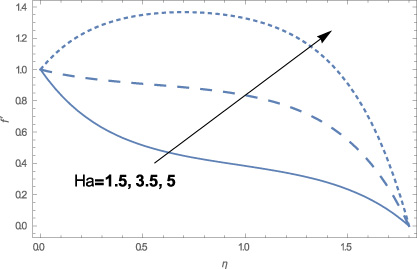
The velocity component is plotted against 𝜂 for the variation value of Ha.
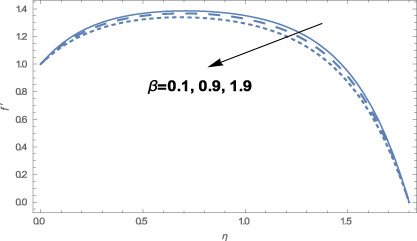
The velocity component is plotted against 𝜂 for the variation value of 𝛽.
The effects of the local electric parameter E 1 on the microrotation g which is a function of 𝜂 are shown in Fig. 3. It is found that the microrotation distribution increases by increasing E 1 in the interval 𝜂 ∈ [0, 0.73]; otherwise it decreases by increasing 𝜂. So, the behavior of g in the interval 𝜂 ∈ [0, 0.73], is an inversed manner of its behavior in the interval 𝜂 ∈ [0.73, 1.8] except that the curves are very close to each other than those obtained in the second interval. In this case, for large values of E 1, there is a minimum value of g holds at 𝜂 = 1.4. Figure 4 illustrates the effect of the microrotation parameter 𝛾 on the microrotation g as a function of 𝜂. It is found that, the behavior of g for various values of 𝛾 is an inversed manner to the behavior of g for various values of E 1 given in Fig. 3. It is also noted from Fig. 4 that the microrotation is always negative. Moreover, the relation between g and 𝜂 is a parabolic, i.e. as 𝜂 increases, g decreases till a minimum value after which it increases.
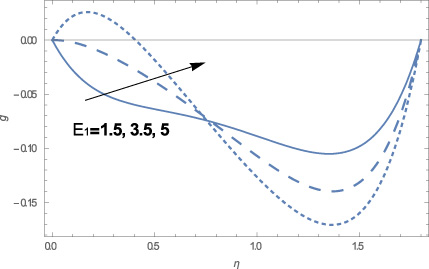
The microrotation velocity is plotted against 𝜂 for the variation value of E 1.
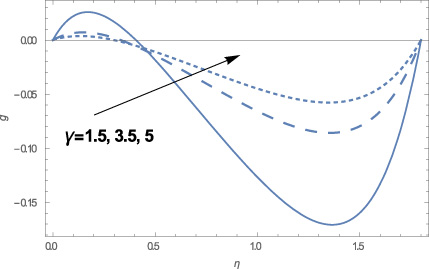
The microrotation velocity is plotted against 𝜂 for the variation value of 𝛾.
The variations of the temperature distribution T with the dimensionless coordinate 𝜂 for various values of Eckert number Ec and the upper limit of apparent viscosity coefficient 𝛼 are displayed in Figs 5 and 6, respectively, The graphical results of Figs 5 and 6, indicate that the temperature distribution T increases with increasing in the parameter Ec, since the effect of source and dissipation temperature is to increase the rate of energy transprt to the fluid and accordingly increase the temperature of the fluid, while it decreases by increasing the parameter 𝛼, respectively. It is also noted that for small values of Ec and large values of 𝛼, the relation between T and x is a parabola, i.e. T increases with 𝜂 till a definite value 𝜂 = 𝜂0 (represents the maximum value of T) and it decreases afterwards. This maximum value of T increases by increasing Ec, while it decreases by increasing 𝛼. The results which are obtained in Fig. 5, are in agreement with those which are presented by Abouzeid [6].
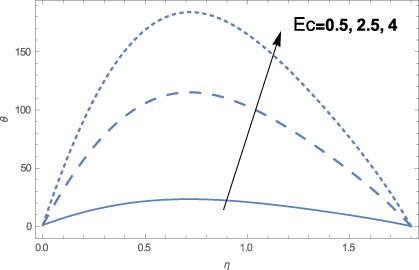
The temperature component is plotted against 𝜂 for the variation value of Ec.
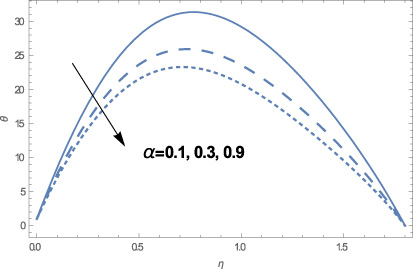
The temperature component is plotted against 𝜂 for the variation value of 𝛼.
Figures 7 and 8 show the behavior of the concentration φ with the dimensionless coordinate 𝜂 for various values of chemical reaction parameter δ and Forschheimer number Fs, respectively. It has been noticed that the concentration increases with the increases of δ, while it decreases as Fs increases. It is also noted that for each value of both δ and Fs, there exists a minimum value of C which increases by increasing δ and decreases by increasing Fs, and all minimum values occur at 𝜂 = 0.6. The result in Fig. 7 is due to the increase of chemical reaction parameter is means an increase of molecular diffusion. Hence, the concentration of the space is higher for large values of δ. The results which are obtained in Fig. 8, are in agreement with those which are presented by Pal and Mondal [7]. Table 1 presents a comparison between the numerical results of present study and those obtained by Pal and Mondal [7] for skin friction f ′′ (0), Nusselt number −θ ′ (0) and Sherwood number − f ′ (0) for various values of both E 1 and Ha. It is clear from Table 1 that an increase in the local electric parameter E 1 gives an increase in the skin-friction, but both Nusselt number and Sherwood number decreases or increases. Moreover, as Hartman number Ha increases, the values of f ′′ (0) and Sh increase but decreases the dimensionless quantity Nu. Finally, It can be concluded from Table 1 that the present results are in a good agreement with those obtained by Pal and Mondal [7].
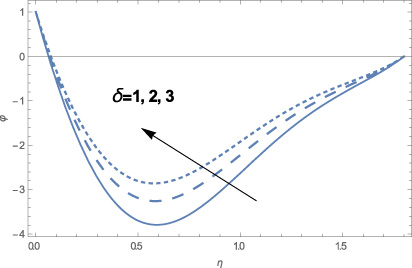
The concentration component is plotted against 𝜂 for the variation value of δ.
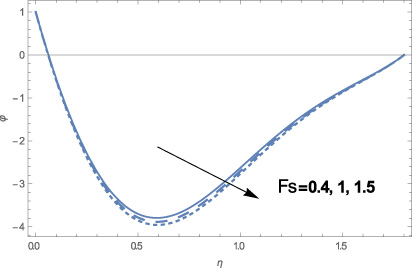
The concentration component is plotted against 𝜂 for the variation value of Fs.
Comparison between the present work and Pal and Mondal [7] for various values of
This study extends the work of of Pal and Mondal [7] to include both non-Darcian effect and micropolar property. The highly non-linear partial differential equations which govern the problem are converted into a system of ordinary differential equation by using suitable similarity transformations. Then, this is solved numerically by applying NAG Fortran library, namely, the subroutine D02HA. The obtained results can be outlined as follows. By increasing Ha, 𝛽1, E
1 and Da, the velocity increases while it decreases as Fs and 𝛽 increase. The temperature distribution increases as Q
0 increases while it decreases when R increases. Morever, it increases or decreases as other physical parameters of the problem increase. The temperature becomes greater with increasing the dimensionless coordinate 𝜂 and reaches maximum at r = 0.7, after which, it decreases. The concentration behavior is opposite with respect to the temperature behavior. Nusselt number Nu decreases, by increasing each of Ha and E
1 increase. Sherwood number Sh has an opposite behavior compared to Nusselt number Nu.
Footnotes
Acknowledgements
The authors would like to express their sincere gratitude to the anonymous referee for her useful comments.