



Abstract
Many efforts have been devoted to the improvement of metal-air batteries. Aluminum (Al) is the most abundant metal in the Earth’s crust and has high electrochemical potential. Therefore, the aluminum-air battery is one of the most attractive metal-air batteries. To overcome some disadvantages of the aluminum-air battery, some alloys of aluminum and several metals have been proposed. In this study, the performance improvement of the aluminum-air battery by doping zinc (Zn) to the aluminum anode was investigated. Zinc was doped to aluminum by a simple process. The difference in the characteristics of Zn-doped Al due to different heating temperature during the doping process was also investigated. The maximum power density of the battery was 2.5 mW/cm2.
Introduction
Recently, the development of technologies has given rise to various types of portable electronic devices, and thus the demand for portable batteries is increasing. Portable batteries are required various properties such as lightweight, low cost, high power, and long lifetime. Lithium-ion battery technology is the power source of choice for portable electronic devices because it is the most mature technology so far [1]. However, there are some problems with using Li-ion batteries for large scale applications because of the high cost and limited resources [1]. Aluminum (Al) has some advantageous characteristics, which are abundant, recyclable, cost-effective, and moderate chemical activity [2–4]. Among metal-air batteries, the aluminum-air battery has a remarkable energy density (8.1 kW/kg) and a theoretical high voltage of 2.71 V [5,6].
The zinc-air battery is another type of metal-air batteries, which has a high electrical potential. Zinc-air battery has been used as a hearing aid battery. However, zinc-air batteries also have disadvantages, as zinc (Zn) continues to oxidize after discharge, the surface is gradually oxidized [7].
Many efforts have been devoted to improving the performance of the aluminum-air battery by alloying Al with some elements such as In, Mg, Ga, Mn, In, Sn, Ti, Zn [8,9]. Zn is one of the most effective elements for combining with Al to enhance the performance of the aluminum-air battery. The addition of Zn can decrease the self-corrosion rate and shift the electrode potential to more negative values than pure aluminum anode in aqueous alkaline solution by the formation of Zn passive film [10–13].
The aluminum-air battery usually uses aqueous electrolytes, which has the disadvantage of electrolyte leakage. Polymer-based gelling agents are usually used to make gelation electrolytes. In the previous study, we used water-absorbing polymer as the gelling agent to make gelation electrolytes [14]. This water-absorbing polymer is low-cost and safe, which is usually used for making diapers. Besides, sodium chloride was also used as a convenient and safe electrolyte because it is low-cost and abundant.
The goal of this work is to study the effectiveness of doping Zn to Al by a simple method on the performance of a gelation electrolyte-based aluminum-air battery. Moreover, multiwalled carbon nanotubes (CNT) coated on carbon sheets were used as the cathode electrode due to CNT has high conductivity and large specific surface area [15]. The cathode was treated by UV-ozone treatment to improve the performance.
Experiment
Pure aluminum plate (>99.9%, AL-013421, Nilaco Corp, Japan) was cut into pieces (20 mm × 15 mm) and washed by toluene. To make Zn-doped Al, 0.5 ml 1 M zinc nitrate aqueous solution was dropped on a piece of aluminum plate. Then, the plate was heated in an electric furnace at the temperature in the range of 400–700 °C. The heating time and temperature of each sample are displayed in Fig. 1. After heating, the aluminum plate was washed by ultrasonic washer for 1 minute, followed by drying by air-pressure machine.

Heating patterns of four anode samples (c, d, e, and f).
CNT sheet (fabricated by dip-coating carbon sheet (C1- P2, Azumi Co. Ltd.) in multiwalled CNT coating liquid (N7006L, KJ Specialty Paper Co., Ltd.)) was used as the cathode. In addition, UV-ozone treatment was applied to clean and improve the hydrophilicity of the CNT sheet (treatment time was 10 hours by UV-ozone cleaner (UV253E, Filgen)).
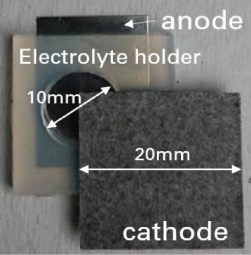
Photo image of the main components of the aluminum-air battery used in this research.
Figure 2 shows the battery design. The battery case was made of a silicone sheet (5 mm thickness) with a 10 mm diameter hole cut at the center for holding the gelation electrolyte. The electrolyte was 10 wt% sodium chloride gelatinized by a water-absorbing polymer (Super Absorbent Polymer, Newstone International Corporation) [14]. The anode and cathode were fixed to the battery case by a plastic clip. Table 1 shows a list of samples used in this study. There were seven samples, named A–G, with some different conditions.
X-ray diffraction spectroscopy (XRD) and energy dispersive X-ray spectrometer (EDS) were used to analyze the Zn-doped Al anode. The surfaces of the anodes were analyzed by SEM (SU-1500, Hitachi High Technologies), EDS (EX-250X-ACT, HORIBA), and XRD (PANalytical). The discharge capacity and stability of the Zn-doped Al anode were compared with that of the pure Al and pure Zn anodes. The power density was measured using multiple external resistors. The power density was used to compare the performance of different battery samples (Table 1).
Battery samples used in this study
Zn-doped Al anode characterization
Figure 3 shows the EDS spectrum of the Zn-doped Al anode heat-treated at 600 °C (the anode of sample E). Three elements of Al, Zn, and O were observed in the spectrum. Using the quantitative analysis of EDS, the amount of Al, Zn, and O on the surface of the anode was 71.81 wt%, 12.57 wt%, and 15.62 wt%, respectively. Figure 4 shows the SEM image and the corresponding elemental mapping of Al, O, and Zn on the surface of the anode. It can be confirmed that Al, O, and Zn were uniformly present on the surface of the anode. The presence of a significant amount of O showed that after heat-treatment, some oxides of Al and Zn were produced on the surface of the anode.
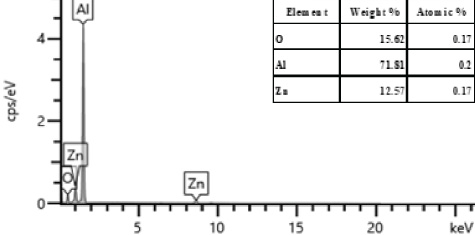
EDS spectrum of the Zn-doped Al anode.
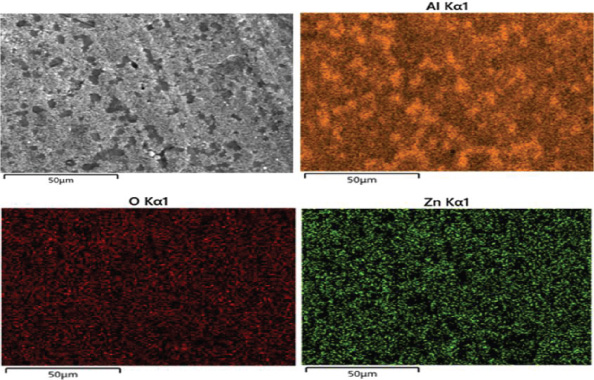
SEM image of the Zn-doped Al anode and the corresponding EDS elemental mapping of Al, O, and Zn.
The XRD diffraction pattern of the Zn-doped Al anode heat-treated at 600 °C (the anode of sample E) is presented in Fig. 5. Some diffraction peaks of the compound of Al and Zn were detected. The result confirms that Zn has been doped to the surface of the Al anode. Also, diffraction peaks of pure Al, ZnO, and Al(OH)3 were also detected on the surface of the electrode.
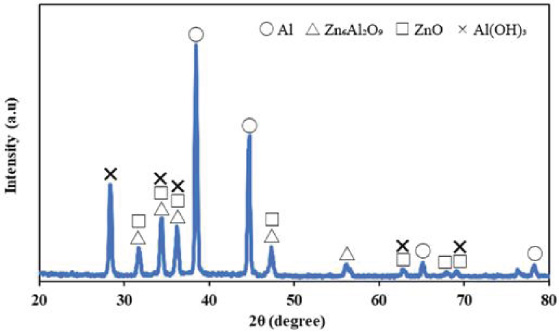
XRD diffraction pattern of the Zn-doped Al electrode.
To study the stability of the Zn-doped Al anode compared with other types of anodic materials, we conducted an experiment to measure the discharging voltage of the batteries with three different types of anodes: pure Zn (without heat treatment), pure Al (without heat treatment), and Zn-doped Al (heat-treated at 600 °C). The pure Zn anode was a Zn plate (ZN-483423, Nilaco Corp, Japan) with 99.2% Zn purity. The batteries used in this experiment had the same structure and cathodic material. To discharge the batteries, a 1 kΩ external resistor was connected between the anode and cathode.
It can be seen from Fig. 6 that the pure Zn anode showed high performance at the beginning, but it decreased quickly after that. On the other hand, the pure Al and Zn-doped Al anodes showed stable discharging voltage. Also, the Zn-doped Al anode generated about 20% higher the discharging voltage than that of the pure Al anode. From this result, Zn-doped Al anode has outperformed the pure Al and Zn anodes.
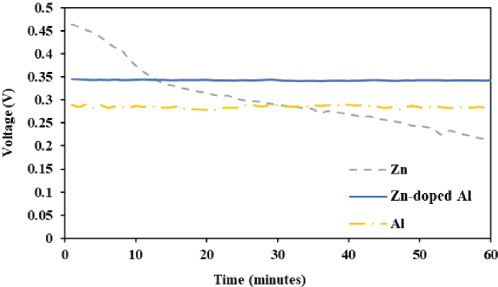
The discharging voltage of the batteries with three types of anodes: Zn, Al, and Zn-doped Al.
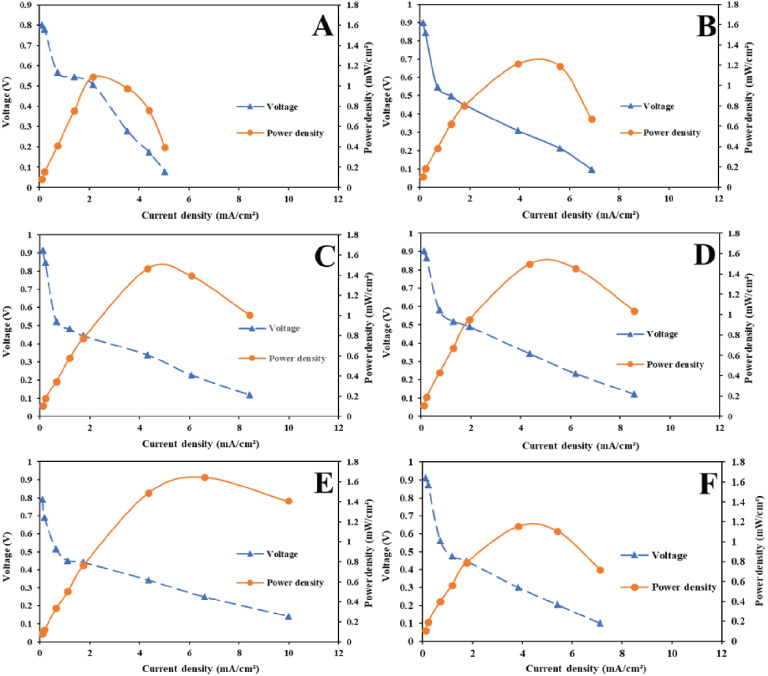
Power density and cell voltage curves generated by samples A–F (Table 1).

Power density and cell voltage curve of sample G with the 600 °C heated Zn-doped Al anode and UV-ozone treated cathode.
Moreover, the power density curves of samples A–F (Table 1) are displayed in Fig. 7. Although, both samples A and B composed of the pure aluminum anodes, the anode of sample B (Fig. 7B) was heat-treated at 600 °C and generated 12% higher power density than that of sample A (Fig. 7A). This result was attributed to the surface impurities of the anode before heat-treatment, which may have been removed by the heat treatment process. Also, the data in Fig. 7C–E showed that the power density was improved with the increase of the heating temperature from 400 °C to 600 °C. However, when the Zn-doped Al anode was heat-treated at 700 °C, which is above the melting point of aluminum, its performance got worse (Fig. 7F). Compared with undoped Al anode in sample B, the Zn-doped Al anode in sample E generated 35% higher power density (1.64 mW/cm2 compared with 1.21 mW/cm2).
Finally, Fig. 8 shows the power density curve of sample G using the optimum Zn-doped Al anode (heat-treated at 600 °C) and the UV-ozone-treated CNT cathode. Compared with sample E, although the same anodic materials were used, the power density generated by sample G was further improved by 53%. This result was attributed to the UV-ozone treatment of the cathode, which helped to clean and improve the hydrophilicity of the cathode surface [16]. Compared with our previous study [14] about the similar aluminum-air battery with pure Al anode, the battery in this study with the fabricated Zn-doped Al anode generated about 2.5-fold higher the power density.
In this paper, it has been confirmed that Zn has been doped to the surface of the Al anode by the heat-treatment method. The heating temperature had a substantial impact on the performance of the Zn-doped Al anode in the aluminum-air battery. In addition, the performance of the battery was also improved by the UV-ozone treatment of the cathode. In future studies, we will consider further optimizing the Zn-doped Al anode. Also, heat-treatment in a nitrogen atmosphere may prevent the oxidation of Al and Zn on the surface, which may improve the anode performance.
Footnotes
Acknowledgements
A part of this research was supported by Azumi Filterpaper CO., Ltd.