



Abstract
This study focused on investigating low-cost but high-performance catalyst materials used for the air cathode of the aluminum-air battery. Nickel, in the form of Ni(OH)2, was used as the catalyst because it is abundant and low-cost. The activated carbon sheet was used as the substrate to load the catalyst. The solvothermal synthesis method was used to synthesize the catalyst. The advantage of the solvothermal method is that the particle size can be reduced under high temperature and pressure conditions. The operation of some types of air-cathodes was examined. UV-ozone treatment of the air-cathode has also been investigated to enhance the performance of the battery.
Introduction
Currently, there are various power generation methods, which can be classified in nuclear electric power generation, thermal power generation, hydroelectric power generation, and power generation using recyclable energy. Electricity is essential for everyone. However, various problems associated with the current power generation methods, such as the depletion of fossil fuel and global warming. There is also the possibility that the price of electricity will rise due to the depletion of resources. Therefore, the development of fuel cells requires some properties, such as low-cost and excellent power generation efficiency.
Various studies about fuel cells have been conducting all over the world. Fuel cells have been used in a wide range of fields. Various types of metal-air batteries have been developed, such as lithium-air batteries, magnesium-air batteries, zinc-air batteries, and aluminum-air batteries [1–6]. These metal-air batteries are used in various products. One of the most important components of the metal-air battery is the air cathode. An efficient air cathode requires oxygen in the atmosphere diffused efficiently into the electrode. In other words, the large surface area of the air cathode increases the performance of the battery. The carbon sheet and activated carbon sheet are suitable for making the air cathode because these sheets can get oxygen into the electrode 3D structure [7]. The carbon sheet is based on carbon fibers, which are light and strong, and high electrical conductivity. Activated carbon is made by activating carbonaceous substances by physical or chemical activation. For example, carbonaceous substances can be sawdust, wood chips, charcoal, coconut shell charcoal, coal, phenolic resin, rayon. Activated carbon has a large surface area because of its multiporous structure. Therefore, it is suitable for use as the air cathode material. In addition, carbon nanotube (CNT) is carbon-based compounds. The structure of a CNT is a tubular shape that carbon atoms are linked in a mesh. The diameter is nanometers. There are two types of CNT that are single-walled CNT (SWCNT) and multi-walled CNT (MWCNT) [8]. CNT has high physical strength large surface area, and high conductivity [9]. Therefore, CNT is also used for the air cathode electrode of metal-air batteries.
Most of the air cathode used catalyst materials to improve the oxygen reduction reaction. The catalyst is not reacted to itself during the chemical reaction [10]. The role of the catalyst is to facilitate other reactions to happen. The most popular cathodic catalyst is Platinum (Pt). It has been reported that the performance of the battery was multifold improved when Pt was used as a catalyst [11]. However, Pt is classified in rare metals. So, Pt is a rare chemical element and high cost.
In this research, we used a Nickel-based material as a cathodic catalyst because it is a transition metal and low-cost. Nickel hydroxide (Ni(OH)2) was synthesized by the solvothermal method, which can produce various shapes, such as thin films, bulk powders, single crystals, nanocrystals [12]. The shape of the crystal can be controlled by the solvent supersaturation, the concentration of the solute, and the reaction speed. Tiny particle size can be produced by the solvothermal method under high temperature and pressure conditions. By reducing the particle size of the catalysts, the performance of the air-cathode can be significantly improved because tiny catalysts tend to penetrate to electrode better. Nickel hydroxide was loaded on the activated carbon sheet to make the air-cathode for the aluminum-air battery (AAB). Nickel ions receive electrons come from the anode electrode, so it works as the electron acceptor at the cathode [13]. UV-ozone treatment was performed to improve the performance of the air-cathode [14].
Materials and methods
The configuration of the AAB
Configuration of the gel electrolyte-based AAB.
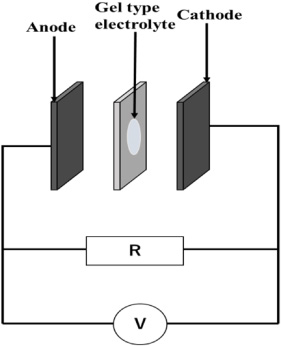
Figure 1 shows the construction of the gel electrolyte-based AAB used in this study. The gel electrolyte was placed in a circle hole on a silicone sheet, which was sandwiched by the aluminum anode and the air-cathode. The electrode size was 4 cm2 (2.0 cm × 2.0 cm). The diameter of the hole was 0.8 cm. The weight of the gelation electrolyte per one battery was 0.14 g.
The anode material was made of an aluminum alloy sheet (A1050) with the Al purity > 99.5% and thickness of 0.2 mm. The gelation electrolyte was prepared by mixing 20 ml sodium chloride aqueous solution (10 wt% concentration) with 0.5 g water-absorbing polymer (Newstone International Corporation Tokyo) [15]. The air-cathode substrate was made of activated carbon sheet (ACS). The detail of the air-cathode preparation method is described in the next subsection.
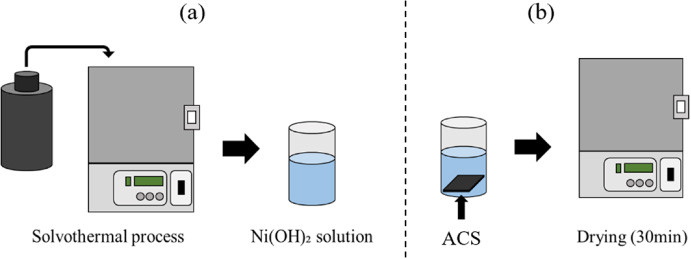
Materials used for synthesizing Ni(OH)2 were purchased from Wako Pure Chemical Industries Ltd. and used as received. First, 32 mg nickel acetylacetonate, 10 ml ammonia solution (32%) and ethanol (20 ml) were mixed. This solution was transferred to a Teflon autoclave (80 ml) for a solvothermal treatment at 180 °C for 8 h (Fig. 2(a)). The synthesized product was a dispersion solution of Ni(OH)2 particles.
(a) The synthesis of Ni(OH)2 particles and (b) the fabrication process of ACS-Ni(OH)2 cathode.
ACS was dipped in the synthesized nickel hydroxide dispersion solution for one minute, followed by the drying process with a dryer at 100 °C for 30 min (Fig. 2(b)). This electrode is called ACS-Ni(OH)2 air-cathode.
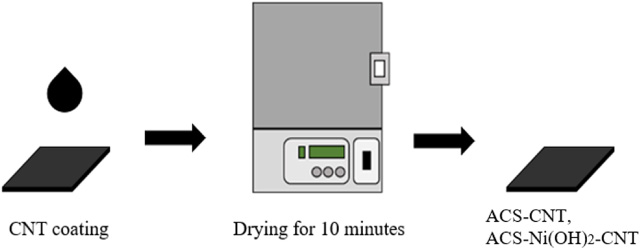
To make CNT-coated electrodes, 2 ml multiwalled CNT dispersion liquid (6 wt% MWCNT, N7006L, KJ Specialty Paper Co., Ltd.) was dropped on the ACS and ACS-Ni(OH)2 electrodes. After that they were dried at 100 °C by a dryer for 10 min as shown in Fig. 3. Those electrodes are called ACS-CNT and ACS-Ni(OH)2-CNT, respectively.
The process of coating CNT on the air-cathode.
The phenomena that occur in the electrode with UV-ozone treatment are hydrophilicity improvement, surface cleaning and surface roughening. The reason for the increase of hydrophilicity is that the ozone breaks the chemical bonds of the molecules on the surface of the object. A hydrophilic hydroxyl group (-OH), carbonyl group (-CO) and carboxyl group (-COOH) is generated from the cutting portion. The reason for surface cleaning is that the substance in ozone is very active and reacts with other molecules. Also, the reason for the surface roughening is that the ozone and contaminants on the electrode can be removed. Therefore, performing UV-ozone treatment is an effective treatment for improving the performance of the electrode.
The UV-ozone treatment was applied to the ACS-Ni(OH)2-CNT electrode. The UV-ozone treatment process was conducted three times as follows. The first ozone treatment was performed for 10 h on both sides of the ACS electrode. This electrode was immersed in a Ni(OH)2 solution and dried at 100 °C with a dryer to make the ACS-Ni(OH)2 electrode. The second UV-ozone treatment was conducted for 10 h on both sides of the ACS-Ni(OH)2 electrode. After that, the CNT coating liquid was coated on the ACS-Ni(OH)2 electrode and dried at 100 °C to make the ACS-Ni(OH)2-CNT. The third UV-ozone treatment was conducted for 10 h on both sides of the ACS-Ni(OH)2-CNT electrode. This electrode is called ACS-Ni(OH)2-CNT-ozone.
Measurement methods
Scanning electron microscopy (SEM, Hitachi SU-1500) was used to observe the surface of the air-cathodes. The sheet resistance of the air-cathodes was measured by a 4-point-probe method using a resistivity processor (NPS model sigma-5+).
In this study, we focused on investigating the catalytic activity of the fabricated air-cathodes used for the AAB. The power density was used as the main criterion for the evaluation of the performance of the air-cathode. The battery was discharged by some external resistances in the range of 25 kΩ–1.0 kΩ to measure the power density. The output voltage of the battery was monitored by a data acquisition system (National Instruments, USB-6210). From the obtained result, the power density was calculated based on Ohm’s law and the active surface area of the air-cathode in contact with the gelation electrolyte.
Results and discussion
SEM images

SEM images of the surface of (a) ACS and (b) ACS-Ni(OH)2.
Figure 4(a) and (b) show the SEM images of the surface of the ACS and ACS-Ni(OH)2 air-cathodes, respectively. It can be seen that Ni(OH)2 particles were adsorbed to the carbon fiber of the ACS electrode.
ACS and ACS-Ni(OH)2 air-cathodes were measured sheet resistance (Ω/square). The sheet resistance of ACS-Ni(OH)2 was about 6 Ω/square larger than 4.6 Ω/square of ACS. The sheet resistance increased by adsorbing the Ni(OH)2 catalyst.
Power density measurement
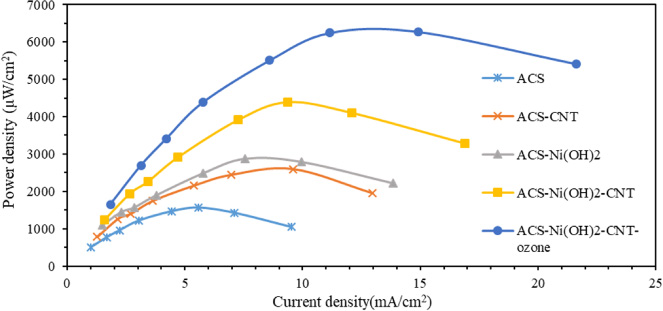
We measured the power density of the AABs with five types of air-cathodes: ACS, ACS-CNT, ACS-Ni(OH)2, ACS-Ni(OH)2-CNT, and ACS-Ni(OH)2-CNT-ozone. The experimental result is shown in Fig. 5. Ni(OH)2 shows good compatibility with ACS. Although attaching Ni(OH)2 particles to ACS increased the sheet resistance, the performance of the ACS-Ni(OH)2 air-cathode still outperformed that of the ACS air-cathode. The highest power density was obtained with the ACS-Ni(OH)2-CNT-ozone air-cathode (6,270 μ W/cm2). The lowest power density was obtained with the ACS air-cathode (1,560 μ W/cm2). The maximum power density obtained with the ACS-Ni(OH)2-CNT-ozone electrode was about 400% higher than that obtained with the ACS electrode. From this result, adsorbing Ni(OH)2 and coating CNT to the electrode could improve the performance of the air-cathode. Besides, compared with the battery with the ACS-Ni(OH)2-CNT air-cathode, the battery with the ACS-Ni(OH)2-CNT-ozone air-cathode generated 43% higher the maximum power density. Thus, the performance of the air-cathode has been improved by UV-ozone treatment because the hydrophilicity and surface area of the electrode was improved. Based on this result, it can be confirmed the positive impact of the synthesized Ni(OH)2 catalyst.
The maximum power density obtained in this study was about 6-fold higher than that of the recently reported gelation-electrolyte aluminum-air battery using the carbon nanotube-loaded carbon sheet-based air-cathode (1100 μ Wcm−2) [15].
The measured power density of the AABs using different types of air-cathodes.
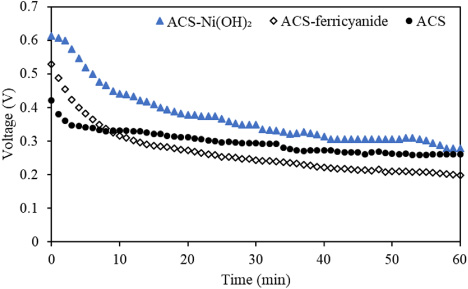
Discharging characteristics of the AABs using three types of air-cathodes.
Figure 6 shows a comparison of discharging voltage of the AABs (discharged by a 1 kΩ external resistor) using three air-cathodes of ACS, ACS-Ni(OH)2 and ACS coated ferricyanide (ACS-ferricyanide, made by dip-coating the ACS in 50 mM ferricyanide solution for 10 min and followed by the drying process at 50 °C for 30 min). The discharging voltage of the AAB using the ACS-ferricyanide electrode is higher than that of the AAb using the ACS electrode for the first 10 min. However, the performance of the ACS-ferricyanide electrode decreases quickly. On the other hand, the AAB with the ACS-Ni(OH)2 air-cathode generated the highest discharging voltage for about one hour. Both ferricyanide and ACS-Ni(OH)2 work as the electron acceptor at the cathode. Therefore, the advantage of these air-cathodes is that their performance is high at the beginning. However, after all of ions already receive electrons, the cathodic performance decreases. If the concentration of the hydroxide (Ni(OH)2) is increased, the power generation duration will be improved. Furthermore, the stability performance of Ni(OH)2 is an issue that needs to be solved in the future.