



Abstract
It is necessary to develop a high homogeneous, low power consumption, high frequency and small-size shim coil for high precision and low-cost atomic spin gyroscope (ASG). To provide the shim coil, a multi-objective optimization design method is proposed. All structural parameters including the wire diameter are optimized. In addition to the homogeneity, the size of optimized coil, especially the axial position and winding number, is restricted to develop the small-size shim coil with low power consumption. The 0-1 linear programming is adopted in the optimal model to conveniently describe winding distributions. The branch and bound algorithm is used to solve this model. Theoretical optimization results show that the homogeneity of the optimized shim coil is several orders of magnitudes better than the same-size solenoid. A simulation experiment is also conducted. Experimental results show that optimization results are verified, and power consumption of the optimized coil is about half of the solenoid when providing the same uniform magnetic field. This indicates that the proposed optimal method is feasible to develop shim coil for ASG.
Introduction
As important components of inertial measurement unit (IMU), gyroscopes play important roles in inertial navigation for kinds of carriers such as rockets, missiles and so on. Currently, short of high-performance gyroscopes has become one of the bottleneck problems [1] restricting the performance of IMU, as another important component of IMU—high performance accelerometers have been available. The precision of gyroscopes should be improved, while the size and power consumption should be restricted. It is of great importance to develop high precision gyroscope with low cost, small size, light weight and low power consumption (low-CSWaP). With the rapid development of modern physics, atomic spin gyroscope (ASG) demonstrates its potential to become next-generation gyroscope with high precision and low-CSWaP. Principle of ASG [2] is shown in Fig. 1.
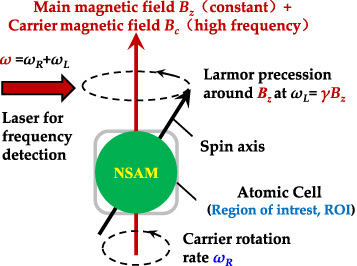
Principle of atomic spin gyroscope (ASG) based on nuclear spin angular momentum (NSAM).
Atomic nuclear spin in the atomic cell is used to detect carrier rotation. Under the main magnetic field B z , the atomic nuclear not only spins around its spin axis, but also precesses around the direction of B z in the larmor angular frequency ω L = 𝛾B z , where constant 𝛾 is the atomic nuclear gyromagnetic ratio. During the “larmor precession”, the nuclear spin can keep its spin axial direction unchanged in the inertial coordinate system. When the carrier rotates around the direction of B z in the rotation rate ω R , the angular frequency detected by the probe laser applied on the nuclear spin angular momentum (NSAM) is ω = ω R + ω L . As the value of the main magnetic field B z is known, ω L can also be calculated. Therefore, after detecting the angular frequency ω, the carrier rotation rate ω R can be easily got by ω R = ω𝛾B z .
According to the principle of ASG, the requirement for the applied magnetic field can be inferred. In the one hand, as the precession signal generated by a single atomic nuclear spin is too small to be detected, an ensemble of atoms is utilized to detect the carrier rotation [3]. The ensemble of atoms is distributed everywhere among the atomic cell. Each atomic nuclear spin contributes to the detected precession signal. To acquire the desired precession signal in narrow line width, the main magnetic B z applied on each nuclear spin should be same to ensure each nuclear spin precesses in the same frequency. Namely, the applied main magnetic B z in the atomic cell should be homogeneous. In another hand, as shown in Fig. 1, in addition to the main magnetic field B z , another high-frequency carrier magnetic field B c is also applied on the ensemble of atoms to modulate the “precession signal” to eliminate LF noise [4]. Thus, the applied magnetic field should be a high frequency uniform magnetic field with DC offset. To generate this desired magnetic field, shim coils are essential components of atomic spin gyroscope. According to the equations of magnetic field and angular random walk (ARW), bias drift (BS) of ASG [5], it can be referred that shim coils should produce ∼ 100 kHz, dozens of μT magnetic field with homogeneity better than 1/10000 in atomic cell The area of atomic cell is marked as region of interest (ROI) in the latter section. Meanwhile, to restrict the volume and power consumption, the size and inductance of shim coils should be as small as possible.
Solenoid is frequently used to be the shim coil for ASG. The solenoid proposed by E. J. Eklund [5] could provide a magnetic field with 2% homogeneity in the ROI, the volume of the solenoid wasn’t specified. Due to the low homogeneous magnetic field, the ASG made of this solenoid could not obtain the gyroscope signal. To provide the magnetic field with homogeneity better than 1/10000 in the ROI, H. F. Cheng [6] proposed a solenoid whose diameter and length are 75 mm and 80 mm, respectively. Though this coil can provide the magnetic field with desired homogeneity in the ROI, it is too large to be used to develop a micro ASG. It’s necessary to optimize the shim coil used for ASG. The winding distribution has been optimized to design a cylindrical shim coil with uneven winding distribution instead of solenoid with even winding distribution for ASG by C. E. Wang [7]. In this method, the magnetic field in the ROI produced by each single winding in the feasible region is calculated by simplifying the single winding as ring coil whose wire diameter is considered as 0. The magnetic field in the ROI produced by multi windings is obtained from linear superposition calculation. Each winding’s axial and radial position is directly optimized by choosing the homogeneity of the magnetic field in the ROI as the objective function. The diameter and length of this optimized cylindrical shim coil is 33.4 mm and 60 mm, respectively. It can provide the uniform magnetic field with the homogeneity about 8/10000 in the ROI. In this optimization model, the actual wire diameter is not considered; this may affect the homogeneity of the resulted coil. Besides, the size of the coil is not restricted in this model; especially the axial position and winding number of the coil are not restricted. This may also affect the acquisition of the best optimization results. Thus, to obtain more uniform magnetic field using a smaller coil, this paper proposes an optimization method for designing a high homogeneous and small-size shim coil for ASG based on 0-1 linear programming. All structural parameters including the wire diameter are optimized in this method. In addition to the homogeneity, the size of optimized coil, especially the axial position and winding number, is restricted The 0-1 linear programming is adopted to conveniently describe winding distributions, and the branch and bound algorithm is used to solve this model.
To optimize shim coils using 0-1 linear programming, the function of targeted magnetic field with all structural parameters of shim coil is established. Constraint conditions including the amplitude, homogeneity of magnetic field and the size of the coil are added to the optimal model.
At first, the feasible current-carrying region shown in Fig. 2(a) is initialized according to the overall size and ROI volume of ASG. The feasible region should be smaller than the overall size. The current-carrying windings in the feasible region should produce in the ROI a uniform magnetic field whose amplitude and homogeneity can meet the requirements of ASG. The relative location of the ROI with respect to the feasible current-carrying region in ASG is shown in Fig. 2(a). The ROI and feasible region shown in this figure are 1/4 axial symmetrical cross-section of actual ones. The ROI is located in the center of the feasible region; its volume is about dozens of cubic millimeters. The amplitudes of main magnetic field Bz and carrier magnetic field Bc are both at dozens of μT. Thus, a single-layer feasible region is selected, which means there is only one layer winding in the radial direction. What’s more, symmetrical coil with homogeneous features is selected to generate the uniform magnetic field. So only the “L/2” part of the feasible region needs to be optimally designed.
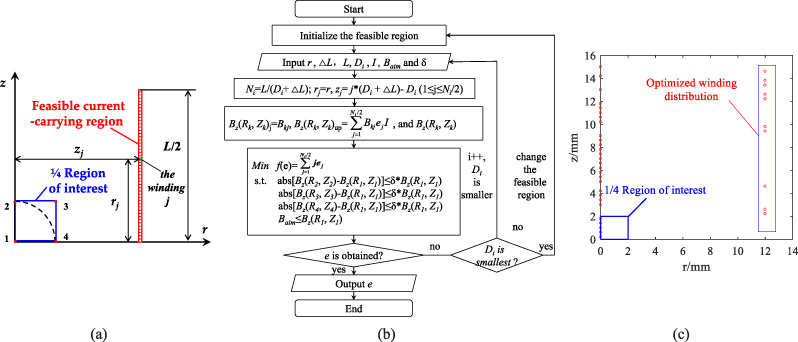
(a). The relative location of the ROI to the feasible current-carrying region, (b) the flow chart for optimally designing the cylindrical shim coil based on 0-1 linear programming, (c) the winding distribution of the optimized coil.
The optimization flow chart is shown in Fig. 2(b). Step 1, the feasible region is initialized according to the overall size and ROI volume of ASG. Step 2, the radial position r and length L of the single-layer cylindrical coil, current I, targeted magnetic field Baim, targeted homogeneity δ, initial wire diameter D
i
and minimum distance ΔL between the adjacent windings are input. Step 3, the length L is evenly divided into N
i
elements. The length of each element is D
i
+ ΔL. The radial and axial positions of each element r
j
and z
j
are calculated as shown in Fig. 2(b). Here not only axial and radial position of each winding but also the wire diameter and winding number are considered at the beginning of the optimization model. Step 4, axial magnetic flux densities B
z
(R
k
, Z
k
)
j
= B
kj
produced by the winding j at the point k in the ROI are calculated according to Eqs (1) and (2) [8]. In this optimization model, points 1 ∼ 4 in the ROI shown in the Fig. 2(a) are chosen as the targeted points as the maximum and minimum values occur at the edge of ROI. As points 1 and 2 are located in the symmetry axis of the coil, equations for calculating B1j and B2j are different from equations for B3j and B4j. K (k (R
k
, Z
k
)
j
) and E (k (R
k
, Z
k
)
j
) are first and second kind elliptic integrals, respectively. Subsequently, the axial magnetic flux density B
z
(R
k
, Z
k
)up produced by the upper coil shown in Fig. 2(a) is calculated according to Eq. (3).
The state variable e
j
in Eq. ((3)) can be 0 or 1, which represents whether there is a current-carrying winding at the place of the winding j. Also, the axial magnetic flux density B
z
(R
k
, Z
k
) produced by the whole coil is calculated according to symmetry. At last, the optimization model shown in Fig. 2(b) is established. In this model, the state variable
According to the above optimization method, an optimization design example is presented here. In this example, the initially input values of “r”, “L”, “L”, “I”, “Baim” and “δ” are 12 mm, 0.4 mm, 30 mm, 100 mA, 50 μT and 1/106, respectively. The smallest wire diameter is set to 0.15 mm, which can ensure the maximum current-carrying ability is 500 mA. According to the optimization flow chart shown in Fig. 2(b), the winding distribution in the feasible region is optimized. When 1/4 ROI is a 2 mm × 2 mm square, the optimized winding distribution of the cylindrical coil is shown in Fig. 2(c). The wire diameter and winding number of the optimized coil are 0.15 mm and 20, respectively. The calculated homogeneity of axial magnetic flux density in the ROI of the optimized cylindrical coil is shown in Fig. 3(a). What’s more, the homogeneity of axial magnetic flux density in the ROI of the equal-diameter solenoid with the length of 30 mm, 120 mm and 240 mm are calculated and shown in Figs 3(b), 3(c) and 3(d), respectively. The wire diameter of these solenoids is also 0.15 mm. The distance between the adjacent windings in these solenoids is set to 0.4 mm, too.
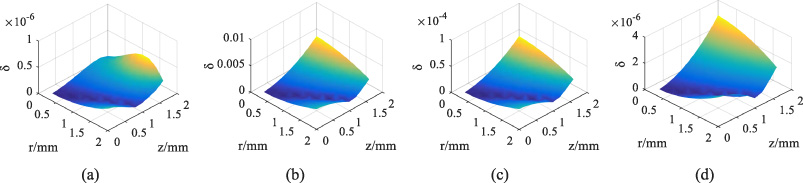
The calculated homogeneity of axial magnetic flux density in the ROI of the optimized cylindrical coil (a), the equal-diameter solenoid with the length of 30 mm (b), the equal-diameter solenoid with the length of 120 mm (c), and the equal-diameter solenoid with the length of 240 mm (d).
As shown in Fig. 3, the calculated homogeneity in the ROI of the optimized cylindrical coil is 4 orders of magnitudes higher than the solenoid at the same size, 2 orders of magnitudes higher than the solenoid with the length of 120 mm and at the same order with the solenoid with the length of 240 mm. However, it’s worth noting that the homogeneity shown in Fig. 3 is calculated under the hypothesis that the wire diameter is considered as 0 The actual wire diameter is 0.15 mm. It is necessary to research the influence of actual wire diameter on the homogeneity.
To analyze this influence, a model shown in Fig. 4 is established to conduct a simulation experiment.
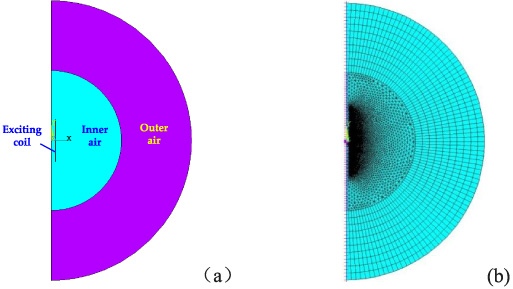
The established 2D axial symmetry entity model (a) and finite element model (b) for simulation experiment.
This model is a 2D axial symmetry finite element model created by use of the soft “Ansys 16.0”. Each circle winding is simplified to a circular cross-section. The radii of “inner air” and “outer air” are set to 0.25 m and 0.5 m, respectively. The winding wire cross-section of the exciting coil is set to the actual size “0.15 mm”. Thus, the distribution of magnetic field generated by the exciting coil can simulate the actual situation. In this model, the element “plane53” is used to mesh the domain of “exciting coil”, “inner air” and “outer air”. After meshing the entity model subtly, 860404 elements are formed in the finite element model shown in Fig. 4(b).
To simplify the whole experiment, the winding number of the established exciting coil is 600, the total length of the coil is 240 mm, and the distance between adjacent windings is same with the actual ones. During this experiment, the material property of each winding is reset every time to simulate the “optimized coil”, “30 mm-length solenoid”, “120 mm-length solenoid” and “240 mm-length solenoid”, respectively. The sparse direct equation solver is utilized to solve the distribution of the magnetic field, and the “LMATRIX macro” is used to calculate each coil’s inductances The simulated homogeneity of axial magnetic flux density in the ROI of the optimized cylindrical coil the equal-diameter solenoid with the length of 30 mm, 120 mm and 240 mm are calculated and shown in Fig. 5(a), (b), (c) and (d), respectively.
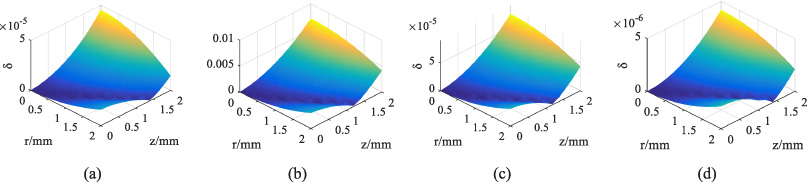
The simulated homogeneity of axial magnetic flux density in the ROI of the optimized cylindrical coil (a), the equal-diameter solenoid with the length of 30 mm (b), the equal-diameter solenoid with the length of 120 mm (c), and the equal-diameter solenoid with the length of 240 mm (d).
Comparing Figs 5 with 3, it can be found that simulated distribution of magnetic field coincides with theoretical calculation results, and the influence of the actual wire diameter on the homogeneity indeed exists. This indicates that the FEM model is correct and suitable for testing the optimization results. The influences of the actual wire diameter on the homogeneity of different coils are different from each other. The basic law is that with the decreasing of the winding number, the influence is increasing. The homogeneity of axial magnetic flux density in the ROI of solenoid decreases 1 ∼ 2 times, while the homogeneity of the optimized coil decreases almost 2 order of magnitudes. However, with consideration of the actual wire diameter, the homogeneity of optimized coil is still 2 order of magnitudes higher than the solenoid at the same size, and at the same order with the homogeneity of the solenoid with the length of 120 mm. What’s more, the simulated homogeneity of axial magnetic flux density in the ROI of the optimized cylindrical coil is better than 1/10000. This indicates that the optimized cylindrical coil shown in Fig. 2(c) can be used to provide the appropriate magnetic field required by ASG.
Furthermore, the power consumption of the Φ24 × 30 optimized coil and the Φ24 × 120 solenoid with the homogeneity at the same order are compared. If the optimized coil and solenoid are both used to generate the f = 100 kHz and B = 50 μT magnetic field, the power consumption W = 2πfL∗(B∕𝜂)2, where L is the inductance and 𝜂 is the ratio of magnetic field and current. The resistance and capacitance are ignored in this situation. The inductance, ratio and power of the Φ24 ×30 optimized coil and the Φ24 ×120 solenoid are listed in Table 1.
The power consumption comparison of the Φ24 × 30 optimized coil and the Φ24 ×120 solenoid with the homogeneity at the same order
As shown in Table 1, the power consumption of the Φ24 × 30 optimized coil and the Φ24 × 120 solenoid with the homogeneity at the same order are 34.0 mW and 67.4 mW, respectively. The power consumption of the optimized coil is about half of the solenoid. This indicates that the size and power consumption of the optimized coil is smaller than the solenoid when providing the same high frequency uniform magnetic field. The optimization method proposed in this paper is feasible to design a high homogeneous and small-size shim coil for ASG.
In this paper, an optimization method based on 0-1 linear programming is proposed to design the high homogeneous and small-size shim coil for atomic spin gyroscope. In the optimization model, the function of targeted magnetic field with all structural parameters of shim coils is established. The targeted function ensuring the shim coil smallest is set. Constraint conditions including the amplitude, homogeneity of magnetic field are added to the optimal model. Especially the axial position and winding number of the coil are restricted. Thus, this model can ensure that the shim coil with the smallest size can be obtained. The branch and bound algorithm is used to solve the optimal model. Theoretical optimization results show that the optimized cylindrical coil can generate the magnetic field whose homogeneity is several orders of magnitudes better than the homogeneity of the same-size solenoid. A simulation experiment considering the influence of wire diameter on the performance of the coil is also conducted. The experimental results show that the influence of the actual wire diameter on the magnetic field homogeneity indeed exists. However, the size and power consumption of the optimized coil is still smaller than the solenoid when providing the same high frequency uniform magnetic field. This indicates that the optimization method proposed in this paper is feasible to design an appropriate shim coil for ASG This work can promote the development of high-performance ASG In the future work, an actual shim coil will be produced according to the work of this paper. Also, the performance of the shim coil such as amplitude, homogeneity and power consumption will be tested and compared with the corresponding solenoid.
Footnotes
Acknowledgements
This work is supported by the Military-civil Integration Industrial Development Foundation of Sichuan under Grant No. zyf-2018-113.
Conflict of interest
The authors declare no conflict of interest.