



Abstract
This paper presents a novel method for solving multi-objective optimization problems based on single-objective cellular genetic algorithm. In the proposed multi-objective cellular genetic algorithm, the objectives are divided into the primary objective and the secondary objective according to the preferences of a decision maker. The primary objective is used as the driving force for individual updating, while the secondary objective is employed as the bias force to select neighbors. The proposed approach has ensured that the secondary objective is also evolving in the optimal direction, as evidenced by the numerical results on both a mathematical test function and a prototype metamaterial unit as reported in this paper.
Introduction
Metamaterial (MM) is an unnatural material and has some extraordinary physical properties which are not presented in a natural medium, such as permittivity, permeability, and refractive index with negative values. It is constructed by embedding some micro structures, commonly metals, into a traditional material to assemble into a unit. Due to its superior material characteristics, MMs have broad application scenarios and have made a promising breakthrough in microwave engineering and optics in the last score years. Inspired by the application of metamaterials at high frequencies, it is believed that many bottlenecks of power storage and conversion at low frequencies can be removed given the implementation of metamaterials at frequencies ranged from DC to RF frequency band. When conventional metamaterials are scaled to the low frequencies, the period of array is impractically large, and extreme parameters and losses of the corresponding material restrict the direct application of these scaled metamaterials. A large negative permeability MM at the resonance frequency has a strong potential, and is competitive in engineering application to reduce the dimension of a high frequency transformer. Consequently, one of the bottleneck problems that must be solved in a MM is to increase its permeability. Moreover, the losses of existing MMs are too high for long duty engineering applications. Hence another topic in low frequency MM developments is to minimize the copper usage for an indirect losses reduction. Consequently, the design optimization of a metamaterial involves generally at least two objectives, and a multi-objective optimizer is required for its optimizations.
Hitherto, a wealth of optimal methods for structural optimizations have been reported in the literature. A genetic algorithm is used to optimize the effective material parameters of an acoustic metamaterial in [1], while the genetic algorithm optimization is implemented to decide the geometry of a N-sided regular polygon split ring resonator to optimize it for a particular resonance frequency in [2]. Also, a technique based on the combination of the genetic algorithm with simulation software is presented to perform optimization designs in [3]. Consequently, the genetic algorithm is widely used in design optimizations of different disciplines.
Genetic algorithm is inspired from the process of natural selection and uses commonly the bioinspired operators such as mutation, crossover and selection to generate high quality candidate solutions to drive the iterative procedure toward promising solution spaces. To improve the performance of a genetic algorithm, different variants, such as the hierarchical genetic algorithm, the adaptive genetic algorithm, genetic algorithm based on niche technology, have been proposed [4–6]. Among these variants, the cellular genetic algorithm combining the cellular automata model with simple genetic algorithm is deserved further studies [7]. This algorithm limits the acting region of each individual’s genetic operation to not only reduce the inefficient search and premature convergence but also to increase the global searching ability of the algorithm. However, the application of the cellular genetic algorithm to multi-objective design optimization has attracted relatively low efforts. Moreover, either an aggregation technique to transform a multi-objective optimization problem to a single one or a vector optimal algorithm is commonly used in engineering multi-objective designs [8,9]. However, a different optimization methodology, using the cellular genetic algorithm, and differentiating primary and secondary optimization objectives according to the preferences of a decision maker, is proposed for the multi-objective design optimization of a MM unit in this paper.
The proposed optimization methodology
Single-objective cellular genetic algorithm
In order to eliminate the deficiencies in existing genetic algorithm, such as an insufficient local search ability, the premature phenomena, the oscillation near the optimal solution, an improved genetic algorithm called cellular genetic algorithm is proposed [7]. The iterative procedure of a single-objective cellular genetic algorithm is given in Fig. 1. In the iterative process of the algorithm, each individual is assigned to a grid topology, in which the individual and its neighbors are defined. And genetic operations, such as crossover and mutation, can only be conducted between the individuals and their neighbors. Consequently, the genetic operation is limited to the cell in cellular genetic algorithm, making the diffusion of the solution more smoothly in the evolutionary process. Individuals in different subspaces converge to different regions of the search space, thus increasing the diversity of the population and the searching ability of the algorithm.

Iterative procedure of a single-objective cellular genetic algorithm.
There are different selection mechanisms in the whole evolutionary process of a cellular genetic algorithm; for example, the mechanism to select neighbors for the crossover and mutation, and the mechanism to decide whether the evolutionary individual replaces the current one. However, such mechanisms are not completely suitable for a multi-objective problem. Nevertheless, both the theoretical analysis and numerical results have revealed that the individuals updating in a cellular genetic algorithm has more influence on the performance of the algorithm as compared to the selection of the neighbors. In this point of view, a simple and efficient multi-objective cellular genetic algorithm is proposed. In the proposed multi-objective cellular genetic algorithm, the objectives are divided into the primary objective and the secondary objective according to the preferences of a decision maker. The primary objective is used as the driving force for individual updating, while the second objective is employed as the bias force to select neighbors. The proposed approach will ensure that the secondary objective is also evolving in the optimal direction.
Numerical examples
To validate the effectiveness of the proposed methodology, the standard ZDT1-3 mathematical test functions are first solved. The objective f2 is chosen as the primary objective while f1 is the secondary objective. Figures 2–4 give the optimized results of the proposed algorithm in 500 iterations. For all of 3 tested problems, all the secondary objectives achieve their global optimum under the condition that the primary objectives reach their global optimal value. Taking ZDT1 as an example, after 200 iterations, the primary objective function f2 has reached its optimum value 0 and the secondary objective function f1 has also reached its global optimal value 1 under the premise of the main objective reached. Obviously, the proposed new methodology has a good searching ability for multi-objective optimization problems with preferences of a decision maker.
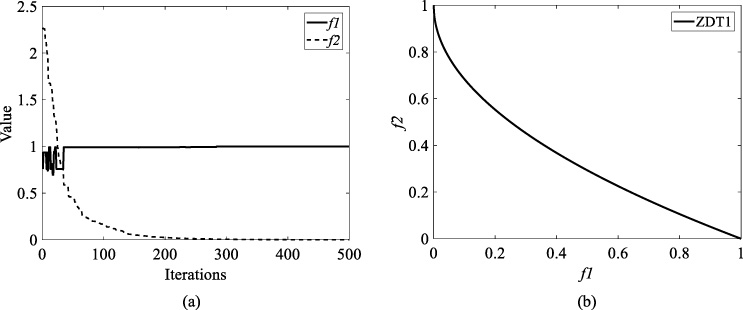
(a) The final solution of the proposed methodology for ZDT1, (b) The exact Pareto front of ZDT1.
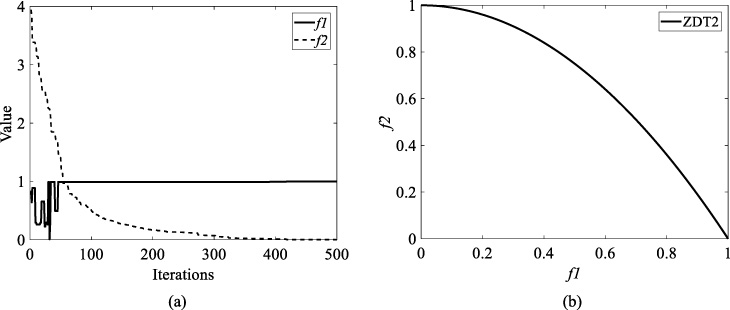
(a) The final solution of the proposed methodology for ZDT2, (b) the exact Pareto front of ZDT2.
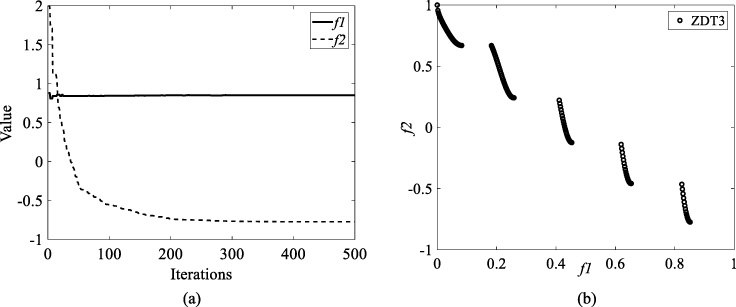
(a) The final solution of the proposed methodology for ZDT3, (b) the exact Pareto front of ZDT3.
Optimizing objectives and variables
To validate the feasibility of the proposed optimal methodology in solving an engineering design problem, it is used to optimize a metamaterial unit. The MM unit is a double helical quadrilateral layer coil [10], having 6 turns in each layer. The upper coils are mirror symmetrical to the lower. The outermost coil of each layer is connected through a hole. The innermost coil extends and is connected to a lumped capacitance of 100 pF. The intermediate insulating medium is FR4.
The optimal objectives are the minimization of the usage of the copper and the maximization of MM’s permeability. The usage of copper is directly expressed by using the volume of the copper. The MM’s permeability is derived from S-parameters using Eqs ((1))–((3))[11], where z is the wave impedance, n is the refractive index, k is the wave vector, d is the thickness of the unit. The S-parameters are computed using the finite element analysis [12]. Moreover,
In the optimization process, the area of the copper should not be too small. Otherwise the current would be too small, which would affect the performance of the metamaterials. Therefore, the upper and lower limits of the variables are decided accordingly. The four design variables, as shown in Fig. 5, are: a the width of the copper per turn with limits from 0.2 mm to 0.5 mm, b the spacing of the two adjacent turns of the copper with limits from 0.05 mm to 0.15 mm, c the width of the middle copper strip with limits from 0.1 mm to 0.3 mm, d the inner side length of the most inner copper with limits from 8 mm to 13 mm.
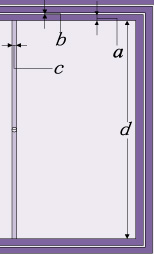
The schematic description of the MM unit.

The optimized result of the proposed algorithm.
The maximization of the MM unit’s permeability is treated as the primary objective, and the volume of the copper as the second objective. As explained previously, the primary objective is used in the individual renewal, and the second objective is used to select parent neighborhood individuals. The finally optimized results of the proposed algorithm are shown in Fig. 6. The relative permeability of the MM unit is increased by 37%, from 8.93 to 12.23, after just 10 generations optimizations. Also the volume of copper is always decreasing, which is not shown in the figure and decreased by 12.2%, from 30.16 mm3 to 26.48 mm3.
Under the new selection mechanism, a point in the Pareto front of this multi-objective optimization problem always reaches the optimal values of the primary objective. The advantage of this distinction between primary and the secondary optimization objectives is that, on the premise of optimizing the main objectives, the secondary objectives are also optimum. That is, for a multi-objective optimization problem with minimum values, the solutions obtained by the new methodology are that the objectives will not be above the Pareto front, and the objectives with different priorities will be optimized directly according to the actual preferences of the decision makers. By differentiating the objectives, the desired solution in Pareto front can be obtained without a calculation of the whole Pareto optimal solution set.
Conclusion
A novel multi-objective optimization methodology, considering the preference of a decision maker, based on the cellular genetic algorithm, is proposed and validated by numerical results of different case studies. The numerical results have demonstrated the salient advantage of the proposed new method is that on the premise of optimizing the main objectives according the preference of a decision maker, the secondary objectives are also optimum. Also, the computational efficiency of the proposed multi-objective optimal methodology is not very high since a whole Pareto front is not required in the proposed algorithm.
Footnotes
Acknowledgements
This work is supported by the National Natural Science Foundation of China under grant No. 51677163.