



Abstract
The influence of strong magnetic field on stress intensity factor of an interface crack is studied in this paper. The nonlinear piezomagnetic property and magnetostriction effect have been taken into consideration in the theoretical analyses. This multi-field coupled problem is solved through a sequential coupling approach. The perturbed magnetization caused by the deformation around the crack is solved under magnetic boundary conditions. After modified by the perturbed magnetization, the initial loads are updated with magnetic forces for iterative calculation. With this strategy, the distributions of the stress and displacement at the crack region approach to the real solution gradually. Numerical results show that the influence of the external magnetic field on fracture behaviors is not ignorable. For structures with interface crack serving in a strong magnetic field, e.g., the multi-layer welded structures in the Tokamak device, the magneto-elastic coupling effects have to be considered to deal with its fracture problem.
Introduction
The influence of magneto-elastic coupling effect can be remarkable in case of strong environmental magnetic field [9]. For structures serving in strong magnetic field, the fracture problems will be far more complicated for ferromagnetic, e.g., RAFM steel in the Tokamak device. The Tokamak is one of the most possible ways to achieve the controllable fusion energy. There is a huge magnetic field to restrain the fusion plasma inside the Tokamak vacuum vessel to realize the thermal nuclear reaction. The maximum strength of this confinement magnetic field in Tokamak may be as large as 14 T. The structures inside the confinement magnetic field will sustain great influence of magnetic field, but the influence of magneto-elastic coupling effect, e.g., the magnetostriction property and the relative magnetic permeability, on fracture toughness has not been quantitatively evaluated in the design and safety evaluation of the Tokamak structures.
The material of TBM is considered as the Reduced Activation Ferritic & Martensitic steel (RAFM steel), a ferromagnetic steel can withstand fusion neutron radiation. A layer of copper with heat sinks is bounded to the RAFM steel wall to cool down the TBM structure. Delamination between the interface of the copper and RARM material is critical for the safety and function of the TBMs. Up to now, however, there is no suitable method valid yet to quantitatively evaluate the influence of strong external magnetic field on the interface fracture behaviors between two different materials.
Brown and Pao-Yeh [1] particularly studied the interaction between magnetic field and mechanical deformation. There are theoretical models to describe the magneto-elastic coupling effects, e.g., PaoYeh’s model, Maugin’s model and Zhou–Zheng’s model [2]. The magnetic properties are usually considered as constants in these theoretical models. According to experiments on the RAFM steel in our previous work, their magnetostriction effect and piezomagnetic effect are sensitive to the stress [7,8], i.e., it is not suitable to treat them as constant during analysis. A theoretical model for treating single crack in infinite plate is proposed by authors [9] and the stress intensity factor at the crack tip was solved with consideration of the nonlinear magnetic properties. In this paper, the interface fracture problem is studied further for the layered TBM first wall.
Magneto-elastic coupling model for interface fracture problem
With consideration of the nonlinear magnetic properties, a semi-analytical solution was adopted for the interface crack problem in strong magnetic field. The each step of iteration to solve this magneto-elastic coupled problem consists of four parts. First, the analytical or numerical solution of the stress and displacement without magnetic field is solved. Second, with initial solution of displacement and solving with the magneto-elastic boundary conditions, the solutions of the magnetic field perturbation due to deformation is obtained to consider the influence of deformation on the magnetization state. Third, based on the perturbed magnetic field and the solution of stress solved in the last step, the magnetostriction strain and magnetic permeability in nonlinear form are calculated. Finally, the magnetostriction strain and Maxwell stress are transformed to an additional load to update the load in first part. The iteration of these 4 parts is continued until convergent condition is reached.
The interface crack model build in this paper is as that depicted in Fig. 1. The origin point of the coordinate is set on the middle point of the crack of length 2a and the y axis is set perpendicular to the crack length. The crack in this model is of Griffith crack type, i.e., a through crack of zero width in a 2 layer plate of infinite side length and thickness. The effect of reverse magnetic field will be ignored in this model. Uniform internal pressure p is applied on the crack surface as the initial mechanical load. The direction of the applied magnetic field is along the positive direction of y axis. In the region S+(y > 0) is RAFM steel, while copper in the region S (y < 0). The materials in these two regions are considered of isotropic and homogeneous. In Fig. 1, μ and 𝜅 refers to the Lame constant, the relative magnetic permeability is write as μ r to make a distinction.

The interface crack model.
The iterative calculation began with the solutions of displacement and stress around the crack region due to inner pressure. Based on the theory of elastic mechanics [3,4], for crack model depicted in Fig. 1, the stress boundary condition at the crack surface can be written as
By introducing complex functions φ and 𝜓, the solution of displacement and stress in region S+ and S− can be expressed as
With Eqs (1) and (2), the holomorphic function 𝜂 and θ can be solved as
In Eqs (9) and (10), the forms of 𝛼 and ϵ are
The solution of Eq. (10) is a kind of Reimann–Hilbert problem (R-H problem). It can be transformed into a typical R-H form and solved:
The magnetic field constitutive law for a ferromagnetic material can be written as
In Eq. (25), e ijk is the permutation symbol and (,) in subscript is the partial differential with respect to the spatial variables. In this model, we assume that |b|∕|B|≪1, |h|∕|H|≪1.
Crossing a surface of discontinuity of a deformed body, the boundary conditions of B and H for this problem are the same as the usual ones in magnetostatics [5,6], i.e.,
With Eq. ((32)), the theoretical solution of the perturbed magnetic field due to the crack is obtained. With this perturbed magnetic field, the distribution of the magnetic field and the corresponding magnetic forces in the model can be solved. Furtherly, The stress intensity factor of the crack can be calculated through the iteration strategy developed in our previous study [9]. The nonlinear magnetic constitutive model of magnetic permeability and magnetostriciton strain of RAFM steel need to be adopted in this procedure. From the calculated magnetic permeability and magnetostriction strain, the Maxwell stress and magnetostriction stress along the crack surface can be obtained. These magnetic loads will be added on the load to considered the influence of magnetic force on the mechanical deformation. By doing these iterative calculations recursively, the converged results will give a good approximation of the true stress intensity factor values. The terminating condition of the iterative computation is Δp∕p ≤ 10−4. The calculation of the stress intensity factor at the crack tip can be carried out through a linear extrapolation on a line from the crack tip. The details of the nonlinear constitutive models of RAFM steel and the extrapolation scheme to obtain the stress intensity factor can be found in paper [9].
Through iterative calculations, the solutions of perturbed magnetic field, stress and stress intensity factor were obtained and depicted from Figs 2 to 5. In the follows, numerical results are illustrated to show the influence of magneto-mechanical coupling effects. In practical computation, the material properties and load conditions as follows: E1 = 200 GPa, v1 = 0.27, μr1 = 1500, E2 = 119 GPa, v2 =0.27, μr2 =1, B0 = 2 T, p = 100 MPa.

Perturbed magnetic field h y .

Distribution of initial stress.
Figure 2 shows the solution of perturbed magnetic field h y along the line parallel to the crack surface. As the results concentrated at the x axis (y =0), the distance y of the line is set as 0.01 for this result to make the pick up points away a little from the x axis. The results of this distance are close to the actual situation and also can reflect the singularity. Fig. 3 shows the solution of stress along the crack surface under initial uniform pressure. From Fig. 2, it can be found that the perturbed magnetic field is concentrated at the crack tip and has the same singularity distribution as the initial stress. After iterative calculation, the results of the initial stress and the modified results are depicted in Fig. 4. It is obvious that the stress along the crack get larger after being influenced by an external magnetic field. This variation is mainly caused by the magnetostriction effect, as the influence of Maxwell force on this phenomenon is smaller than 0.1%. For materials with huge magnetostriction effect, this variation may become even much more remarkable. The solutions of the stress intensity factor are illustrated in Fig. 5. Under the influence of magnetic field up to 2 T, the stress intensity factor of the interface crack model increased about 4.3%. The external magnetic field makes the interface crack easier to be propagated. This result reveals that the influence of external magnetic field on the TBM interface crack problem cannot be ignored. The magneto-elastic coupling effect should be considered during the design and weld strength on the interface region should be reinforced.
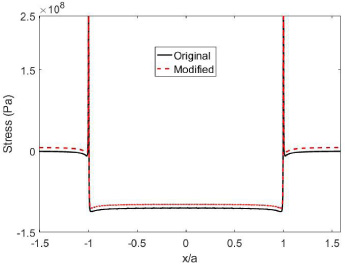
Distribution of stress (Modified versus initial).
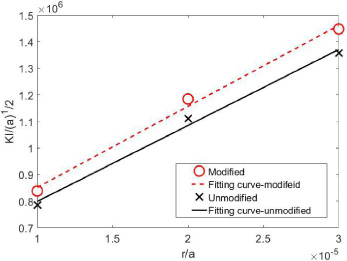
Stress intensity factor (Modified versus initial).
The coupled magneto-elastic problem on fracture of problem of an interface crack was studied in this paper through a semi-analytical method proposed by authors. Based on the proposed method, the interface crack problem of the first wall in TBM structure was studied. The nonlinear magnetostriction effect and piezomagnetic effect have been taken into consideration to deal with the coupled problem. Results show that the perturbed magnetic field centralized nearby the crack tip and the singularity of the perturbed magnetic field is remarkable. For interface crack between RAFM steel and copper layer, the stress intensity factor increased obviously after an external magnetic field was applied. The influence of the magnetostriction effect on the fracture behaviors of the interface crack is remarkable. These results reveal the magneto-elastic coupling is not ignorable when considering the fracture of ferromagnetic material in strong magnetic field.
Footnotes
Acknowledgements
This work was supported in part by the National Key Research and Development Program of China under Grant 2017YFF0209703 and the National Science Foundation of China under Grant 51577139.