



Abstract
In this paper, a new electromagnetic acoustic resonance (EMAR) transducer is proposed for precise thickness measurement in specimen. The new EMAR is composed of a mirror symmetric coil (MSC) and a pair of Nd-Fe-B permanent magnets with the different polarity for enhancing the generation and detection of resonant signals. Firstly, a finite element model was established to simulate the distributions of Lorentz force produced by new EMAR and the resonant process of shear waves. Furthermore, the relationship between the frequency response characteristic of the new EMAR and the common EMAR were explored. Finally, to verify the performance of the EMAR, several experiments were performed. Compared with the common EMAR transducer, the resonant amplitude of the new EMAR transducer was increased by 121.74% and the signal-to-noise ratio was increased by 28.35%, and the resonance frequency interval of the new EMAR was twice that of the common mode in the frequency domain simulation experiment, this advantage effectively reduced the error rate of measurement. The results show that the new EMAR transducer with mirror coil structure has higher accuracy in thickness detection of specimens.
Keywords
Introduction
In the harsh production environment, the performance of metal materials will inevitably degrade, and the change of metal thickness caused by corrosion and abrasion will easily lead to serious production safety problems. Therefore, accurate evaluation of sheet metal thickness is of great practical significance to ensure the safety and reliability in use. At present, piezoelectric transducer (PZT) technology has been widely applied to the thickness measurement. PZT is mainly used to excite P wave, and coupling agent is needed on metal. When PZT is used to detect the specimen, PZT will change the acoustic impedance characteristics of the metal surface. In addition, the movement of PZT and the measurement of high temperature objects have great constraints, so a non-destructive evaluation method with high energy conversion efficiency, simple measurement method and no coupling agent limitation is still needed [1]. Electromagnetic acoustic transducer (EMAT) technology is a non-contact ultrasonic testing. However, the drawback of EMAT is its low conversion efficiency. Electromagnetic acoustic resonance (EMAR) can overcome the above shortcomings very well, so it is suitable for the measurement of metal plate thickness in engineering practice.
EMAR has been used in metal thickness measurement because it can obtain resonance voltage signal in metal plate and improve signal-to-noise ratio of echo signal in the process of nondestructive testing [2–5]. In the transmitting process of EMAR, the coil is fed with multi-period high-power exciting alternating current. At this time, the exciting shear wave and the reflected shear wave (S wave) at the bottom of the transducer are superimposed on each other, which make the ultrasonic wave resonated in the specimen, so as to enhance the intensity of the detection signal [6–8]. A corrected method with EMAR has put forward to detect the mean grain size of dual phase steel [9] and the thickness of pipes evaluating in a nuclear power plant during its shutdown [10]. The free vibration resonance frequency and attenuation coefficient of Cr-Mo-V steel (JIS-SNB16) after creep also can be measured by EMAR [11]. It’s worth noting that, the longer of the thickness, the longer propagation time of acoustic wave is, the more serious the energy attenuation of waveform signal is, which will bring disadvantage influence to signal amplitude.
In order to design the sensor with higher performance (shorter resonance interval, higher resonant amplitude), the mirror symmetric coil (MSC) structure is proposed in this paper. The new EMAR is intensively investigated via simulations and experiments. The rest of the paper is organized as follows. Section 2 provides details regarding to the principle of EMAT. The simulation and the validation works are demonstrated at Section 3 and 4, followed by the discussion in Section 5.
New EMAR structure and working principle
Figure 1 is the structure and working principle of the new EMAR. They are made up of MSC, a pair of Nd-Fe-B permanent magnets with the different polarity. MSC is located on the surface of specimen, and the coil is of mirror symmetry. When the current J C passed into the coil, the eddy current J E opposite to the direction of exciting current is induced in the skin depth of the aluminum plate surface. Nd-Fe-B permanent magnets is placed above MSC to provide strong static magnetic field B0. Lorentz force F L is induced under the action of eddy current J E and static magnetic field B0, and shifts the crystal particle to produce S wave.
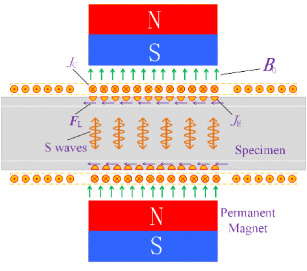
Diagram of the EMAR.

Mirror symmetric coil structure.
Expansion diagram of MSC of new EMAR is shown in Fig. 2. The high frequency excitation current into MSC will induce eddy current opposite to the direction of excitation current on the upper and lower surfaces of the specimen. Simultaneously, S wave is generated in the interior of the specimen. When S wave propagates to the surface of the specimen, static magnetic field is cut in the coil of the other layer. The field changes the magnetic flux in the coil, and the voltage signal is induced by Faraday’s law of electromagnetic induction. Increasing the number of excitation pulse current cycles makes the S wave propagating distance in the specimen be an integral multiple of the wavelength. At this time, the phase of the incident wave matches the phase of the reflected wave, and the acoustic waveform resonate. The advantages of the new EMAR are: (1) reducing signal attenuation; (2) shortening the echo propagation time; (3) increasing resonance amplitude.
EMAR processes the received resonant signal through the super-heterodyne system and scans the frequency bandwidth to obtain the resonant frequencies in multiple frequency bands.
Resonance satisfies condition:
If the resonance frequency is f
m
, when resonance occur, then the formula is satisfied:
The adjacent interval resonant frequency Δf can be obtained from the mth and m +1th order resonant frequency:
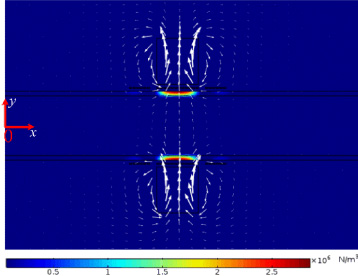
To investigate the performance of new EMAR, a set of FE analysis are conducted via COMSOL Multiphysics software. The simulation process generally includes the coupling of electric field, magnetic field and structure field. In this simulation process, the static magnetic field strength and the Lorentz force are discussed in detail. As shown in Fig. 3, the maximum horizontal Lorentz force density occurs below the coil.
Distribution of Lorentz force at t = 4.25 T.
Propagation process of body wave in common EMAR.
Due to the uneven distribution of the static magnetic field, magnetic flux density perpendicular to the specimen at the edge of the permanent magnet is larger than that at the gap of the permanent magnet pair, so the Lorentz force near the edge of the permanent magnet tends to be horizontal. According to Fig. 3, the vertical magnetic field in the direction of B y is dominant inside the specimen, while the vertical magnetic circuit along the direction of B y is formed between the upper and lower polarities of the permanent magnet, which is conducive to generating the same Lorentz force in the same direction. Based on the above design, EMAR mainly generates S wave in the body of the specimens with vertical incidence.
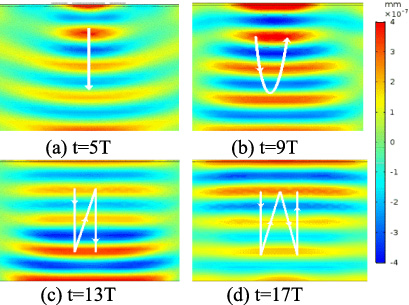
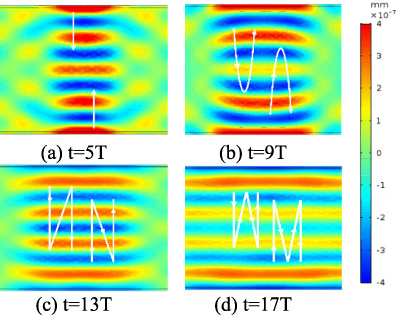
The difference between the two transducers in the signal strength of induced voltage is further explained, and the acoustic field propagation process of S wave is analyzed. The displacement of acoustic is shown in Fig. 4 and Fig. 5.
Propagation process of body wave in new EMAR.

Frequency resonance spectrum of two coils.
From the above conclusion, it can be seen that the new EMAR transducer has acoustic resonance at t = 5 T, t = 9 T, t = 11 T and t = 17 T, while the common EMAR transducer only has acoustic resonance at t = 9 T and t = 17 T, and the acoustic resonance amplitude is lower than the corresponding amplitude of the new EMAR transducer.
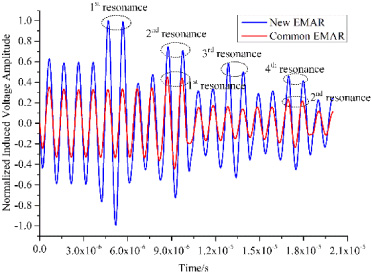
The normalized induced voltage waveform.
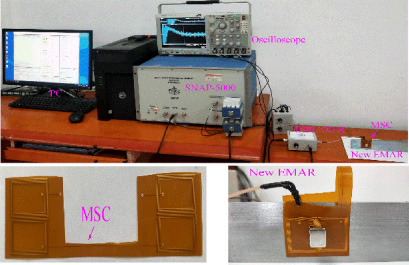
EMAR experiment.
When resonance occurs in common EMAR, the propagation distance of ultrasonic wave is twice the thickness of specimen D, the adjacent interval resonant frequency Δf can be obtained from the nth and n +1th order resonant frequency: Δf = fn+1 − f n = c∕2D, n represents a positive integer. The results are shown in Fig. 6. Under the same condition, the resonant frequency interval of the new EMAR transducer is twice that of the common EMAR transducer.
In order to compare the efficiency and signal-to-noise ratio of the new EMAR transducer, a simulation comparison is made: the S wave generated by the common EMAR transducer propagates at the specimen. When it reaches the surface of the specimen, the S wave reflects and propagates along the original path until it reaches another surface of the specimen plate. Because the thickness of the specimen is 4 times the wavelength of S wave, the exciting impulse current period is 10 cycles, so the first S wave resonance occurs between 9 T and 10 T, as shown in Fig. 7. The MSC structure is used in the new EMAR transducer. S wave is excited on both surfaces of the specimen and propagates in opposite direction at the same time. The exciting impulse current period is 6 cycles, and the first resonance occurs between 5T and 6T. According to Fig. 7, compared with common EMAR transducer, the amplitude of induced voltage waveform is increased by 121.74% and the signal-to-noise ratio is increased by 28.53%.
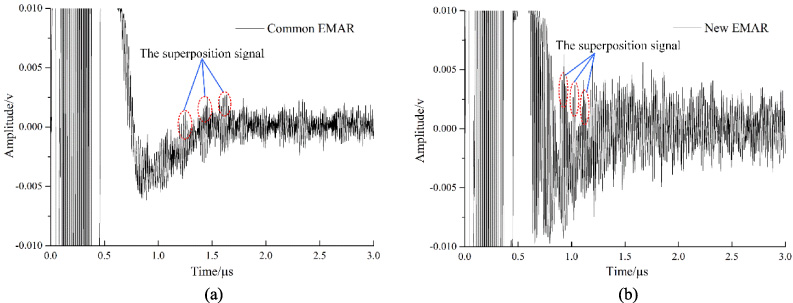
Time domain diagram of EMAR (a) Common EMAR (b) New EMAR.
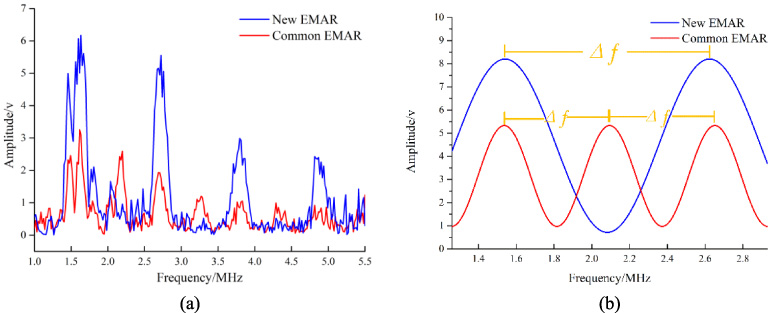
Spectrum analysis of EMAR. (a) Frequency resonance spectrum, (b) signal processing by DWSC.
On the basis of SNAP-5000 produced by Ritec Company, the resonance spectrum of the specimen is obtained by sweeping frequency measurement with an acoustic measuring system. The platform of the new EMAR experiment is shown in Fig. 8. Here the specimen thickness is 3 mm.
Usually, when utilizing EMAR transducer to measure thickness, high power and long period alternating current should be put into the coil. Fig. 9(a) and (b) are the time domain diagrams of the induced voltage signal under the condition that both ends of the coil are loaded with the same excitation current. In the process of experimental verification, the duration of excitation pulse of common EMAR transducer is 4.6625 μs. Because of the short propagation distance, the cycle of excitation pulse of new EMAR transducer needs to be loaded is relatively reduced. Therefore, when the pulse time is 2.3375 μs, the echo signal is superimposed. Compared with common EMAR, the amplitude of induced voltage received by new EMAR is increased by 80.79%, and the overlapping time of echo signal is shorter. Then, the echo signals of the same integration interval are selected for frequency sweep analysis, and the spectrum of the original echo signal is drawn, as shown in Fig. 10(a). The frequency spectrum of the original echo signal is processed by double wave superposition of nth compression (DWSC) [12]. The results are shown in Fig. 10(b). According to Fig. 10, under the same excitation current, the amplitude of resonance spectrum of new EMAR is 1.539 times that of common EMAR, and the interval of resonance frequency is also 1.91 times, which is consistent with the analysis in Section 3.
The formulas are used to calculate the thickness of specimen plate: under the condition of common and new EMAR thickness measurement, the thickness of the specimen is respectively 2.975 mm and 2.993 mm.
In order to judge which transducer has higher measurement accuracy, the experimental results are compared with the standard thickness of 3 mm specimen plate. The results show that the relative error of the thickness of specimen sheet obtained by common EMAR is 0.83%, which is 0.23% under the new EMAR. Therefore, it is concluded that the new EMAR proposed in this paper has higher accuracy in measuring the thickness of specimen sheet.
Conclusions
In this paper, a new type of EMAR transducer with MSC structure and the different polarity is proposed, and it was used to measure the thickness of specimen. Firstly, compared with common transducer, the induced voltage and signal-to-noise ratio of new EMAR transducer were increased respectively by 121.74% and 28.53%. Secondly, the resonant interval frequency of new EMAR transducer is twice that of common transducer. Finally, the results show that compared with common EMAR, new EMAR with mirror symmetric coil structure has higher thickness detection accuracy. In the future, Mirror symmetric coil will be optimized to improve energy conversion efficiency.
Footnotes
Acknowledgements
This work was supported by National Natural Science Foundation of China under Grant 51807065.