



Abstract
In this paper, the magnetic field and temperature field of transformer are analyzed, and the influence of temperature on electrical steel sheet is considered. Experiment are supplied to obtain the magnetic properties curves (B-H curves, B-P curves, and magnetic permeability curves of 30QG120), which are required for the accurate FEM (finite element method) simulation setup. Finally, the magnetizing characteristics and temperature distribution of the transformer under different temperatures and loads are studied experimentally. The simulation results of a singlephase transformer are verified by the experimental results.
Keywords
Introduction
In recent years, The UHV and long-distance transmission projects have developed rapidly, so electrical equipment such as transformer has become an indispensable electrical appliance for our daily life and industrial production, as shown in Fig. 1. As a main core material of electrical equipment such as transformers and motors, electrical steel sheets are affected by the ambient temperature, and then affects the working performance of electrical equipment. Under normal circumstances, the analysis of the transformer mainly focuses on the magnetic induction curve and the loss curve at room temperature. Usually, the influence of the actual working temperature on the transformer is not considered. Therefore, it is possible to amplify the error when designing and analyzing transformers [1].
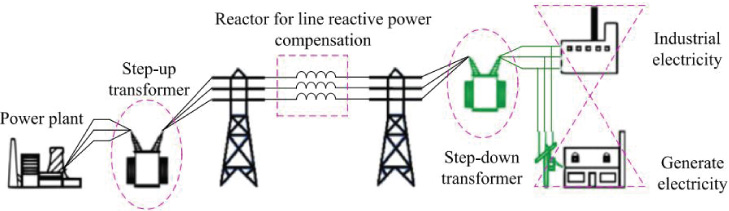
The UHV and long-distance transmission line.
At present, domestic and foreign scholars have carried out extensive research work on electrical steel sheets for electromagnetic devices. In [2], the magnetic properties of oriented silicon steel sheets under different temperature and harmonic conditions were tested. The magnetic properties of electrical steel sheet for transformer are studied in [3,4]; The magnetic properties of electrical steel sheet under different working conditions are studied in references [5,6]. In [7], the electromagnetic characteristics of electrical steel sheet under magneto-thermal coupling are studied.
The analysis methods for transformers mainly include empirical methods, analytical methods and finite element methods. At present, the finite element method is commonly used to analyze the electromagnetic-thermal characteristics of transformers. In [8], the two-dimensional finite element method is applied to study the magnetic field of a converter transformer, but the temperature rise is not considered. The three-dimensional finite element method is used to improve the magnetic field, loss and temperature of high-frequency transformer in [9]. The study did not consider the changes in the magnetic properties of electrical steel sheets at different temperatures. The leakage magnetic field and temperature field of an 800 kVA transformer were analyzed [10], but also did not consider the magnetic properties of electrical steel sheets at different temperatures.
Foreign scholars have studied the electrical steel sheets earlier. In [11], the iron loss characteristics of non-oriented electrical steel sheet under high temperature harmonic environment are measured and analyzed. In [12], the electromagnetic properties of oriented electrical steel sheet under tension and compression stress are studied. The loss of non-oriented electrical steel sheet at liquid nitrogen temperature was measured in reference [13]. In [14], the core loss of the motor under harmonic action is analyzed, but the temperature factor is not considered. In [15], the loss and noise of transformer are studied, but the influence of temperature on the loss and noise is also not considered.
This paper investigated the temperature effect on the electrical steel sheet by theory analysis and experiment verification. Experiment are conducted to obtain the magnetizing characteristics at different temperature. The FEM model considering different temperature magnetic properties curves and modified for better performance. In addition, the test setup and experimental result of temperature distribution in a single-phase transformer are also presented to verify the simulation result.
The measuring coil system consists of a primary winding to create magnetic field which then creates magnetic flux in the steel. The magnetic field is defined by the current, the winding and the number of windings as well as the magnetic length of the coil. The computer converts the measured voltage into magnetic field strength.
The electrical sheet steel working under different temperature is achieved by the temperature control system, and the excitation can provide the AC voltage with different DC bias and controlled harmonic. The data collection system is based on a computer. The measurement instrument system of single sheet is shown in Fig. 2. The main performances of measurement instrument are shown in Table 1. Electrical steel measuring gauge for the determination of magnetic characteristics of all types of soft magnetically sheets, especially to measure electromagnetic properties of non-crystal orientation silicon sheet and crystal orientation silicon sheet. The system meets the IEC (IEC60404 and IEC 60205) and ASTM Standards.

Magnetic properties test device of electrical sheet steel.
Measuring instrument performance
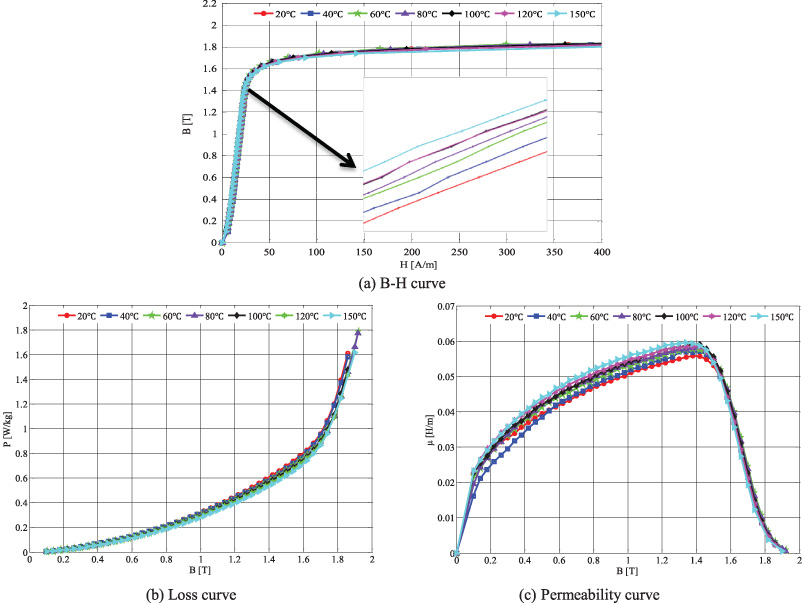
Magnetic properties of 30QG120 at different temperatures.
It can be seen from Fig. 3(a) that as the temperature increases, the working point of the 30QG120 electrical steel sheet shifts to the right, and the saturation magnetic induction intensity decreases. From Fig. 3(b), shows that under the same magnetic induction intensity, the loss of 30QG120 electrical steel sheet decreases with the increase of temperature. From Fig. 3(c), the magnetic permeability of 30QG120 electrical steel sheet increases with the increase of temperature.
The results of Fig. 3 show that the increase in temperature causes the magnetic domain change of the electrical steel sheet to be more active, and the hysteresis characteristic is lowered, thereby lowering the magnetic induction strength, reducing the loss, and increasing the magnetic permeability. It indicates that the temperature has certain influence on the magnetic properties of 30QG120 electrical steel sheet. When applying 30QG120 electrical steel sheet for electromagnetic product design, the influence of working temperature should be considered.
The simulation analysis of the electromagnetic characteristics of a single-phase transformer at different temperatures was carried out based on COMSOL finite element analysis software. Table 2 shows the basic parameters of the transformer.
Main parameters of the single-phase transformer
Main parameters of the single-phase transformer
Figure 4 shows the electromagnetic and thermal simulation flow chart of the transformer.
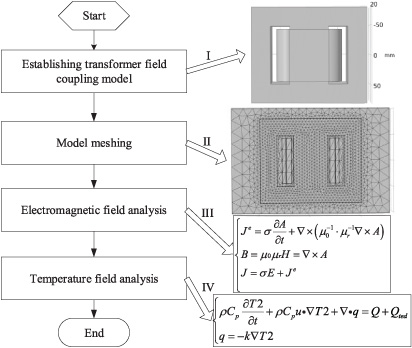
Calculation process of the FEM.
Calculation can be conducted by substituting the B-H curve in Fig. 3(a) and B-P curve in Fig. 3(b) obtained by experiment into step III and step IV.
Figure 5 shows the flux density of the transformer under different temperature. As shown in Fig. 5, the flux density of the transformer decreases as temperature decreases.
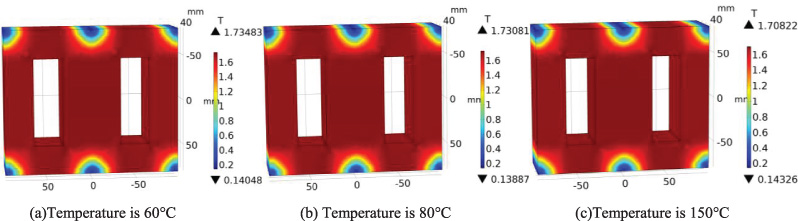
Magnetic induction intensity of transformer under different temperature.
The temperature field of transformer is obtained by considering the influence of temperature on electrical steel sheet. Figure 6 shows the temperature distribution of transformer core.
As shown in Fig. 6, the maximum temperature of transformer core is 40.5 °C and the maximum temperature of winding is 60 °C.

Transformer temperature field simulation.
An experiment is conducted to verify the effectiveness of simulation, and experimental system is shown in Fig. 7.

Experimental system.
The Fig. 7(a) shows the experimental system used to measure the magnetic characteristic of transformers at different environment temperatures. Figure 8 shows the magnetization curves of the transformer at 20 °C, 80 °C and 150 °C, respectively. Obviously, the magnetic induction strength of the transformer decreases with the increase of temperature.
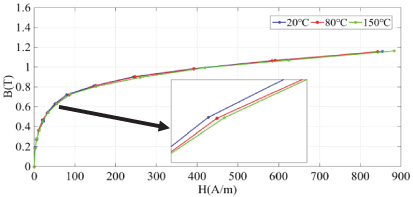
B-H curve of the transformer at different temperatures.
The Fig. 7(b) shows the experimental system for measuring temperature of the transformer. Figure 9 shows that the maximum temperature of the transformer core is 42.2 °C at full load operation. The comparison between simulation results and experimental results are shown in Table 3.

Transformer temperature photograph.
Comparison of simulation and experiment
In this paper, the magnetic properties of electrical steel sheet at different temperatures were studied. The magnetic field and temperature field of the transformer made of electrical steel sheet are simulated and experimentally studied.
(1) The magnetic properties of electrical steel sheets at different temperatures were measured. The test results showed that when the magnetic induction intensity is 1.6 T, the magnetic field intensity was 37 A/m at 60 °C, 38 A/m at 80 °C, and 60 A/m at 150 °C; The permeability is 37181 at 60 °C, 36874 at 80 °C, 34290 at 150 °C; The unit iron loss is 0.74 W/kg at 60 °C, 0.73 W/kg at 80 °C and 0.69 W/kg at 150 °C. It shows that temperature has a certain influence on the magnetic properties of oriented electrical steel sheets. In the process of analysis and design of electromagnetic devices, the influence of temperature should be considered.
(2) An experimental platform for electromagnetic characteristics and temperature rise of 3 kW transformer is built and studied. The experimental results show that the error of simulation and experiment is less than 5%. The theoretical analysis can guide the design of transformer, and each index can meet the actual needs of the project.
Footnotes
Acknowledgements
This research was jointly supported by the Project of Liaoning Education Department (no. 201634090) and Project Support of Liaoning Science and Technology Department (no. 20180550037).