



Abstract
Nickel and nickel-based composites are of vital importance in many fields, while temperature loading can greatly influence the strength and performance of the materials. Nondestructive evaluation and characterization of such thermal damage can be used to predict the failure of metallic structures, thermal barrier coatings and so on, especially in a non-contact way under certain strict circumstances, such as testing at high temperature or in radiative environment. Herein, a contactless ultrasonic technique employing electromagnetic acoustic transducers (EMATs) combined with the resonance ultrasound spectroscopy is applied to make up the low energy transition efficiency of EMATs and enhance the signal-to-noise ratio of ultrasonic testing signals. The method is adopted to assess the thermal damages of different levels in artificially heat loaded nickel plates. The damage sensitivity of third order harmonics generated from shear waves is discussed, along with linear ultrasonic features including wave velocity and attenuation. Experimental results show that the proposed nonlinear electromagnetic acoustic resonance (EMAR) technique can be used to evaluate the thermal damage in ferromagnetic material with improved reliability and sensitivity over linear ones.
Introduction
Nickel is an important metallic material as has been widely used in many fields. For instance, the production of ferronickel for stainless steel and non-ferrous alloys has dominated most of the applications of nickel. In addition, nickel has been used as catalyst in synthesis processes, electrode material in electrochemical reactions and batteries, and thermal barrier coatings (TBC) for blades of turbocharger and aeroengines [1,2]. However, thermal fatigue in nickel-based structures and protective coatings can cause serious damages, degrading the performances of mechanical components and even causing failure of the whole system [2]. Kocks et al. investigated the effects of temperature and strain rate on the dislocation glide at constant structure in nickel and nickel alloys [3]. Koeberl et al. studied the failure mechanism of pure nickel under thermo-mechanical loading [2]. The thermal neutron irradiations of nickel-bearing materials concerning the displacement damage was researched by Greenwood [4]. The production and microstructural evaluation of coatings based on nickel or nickel composites have been conducted by many researchers [1,5,6]. Therefore, for one thing, rapid online quality inspections of nickel products in a nondestructive way are demanded under certain circumstances to detect damages and prevent future failures of structures or components. For another, reliable material characterization of high sensitivity is needed to provide more information on the material properties.
Ultrasonic testing, as one of the nondestructive testing and evaluation technique, has been developed as a well-established tool for flaw detection and material characterization. In addition, nonlinear acoustics based on higher harmonic generation has been accepted as a promising technique for material characterization due to its higher sensitivity to micro-changes in material structures than linear ultrasonic features [7,8]. Nevertheless, the coupling condition between specimens and ultrasonic transducers can greatly affect the accuracy of contact ultrasonic techniques. Besides, piezoelectric transducers may not be applied in certain cases such as testing under high temperature environments [9].
Among the non-contacting ultrasonic measurements, electromagnetic acoustic transducers (EMATs) have drawn increasing concern, for their capacity to conduct rapid and reliable in-situ continuous material characterization and online monitoring through a relatively easy and low-cost way. However, the energy conversion efficiency of EMATs is quite low compared with piezoelectric transducers, which results in a low signal to noise ratio (SNR) during the measurement of ultrasonic signals. Moreover, it is extremely difficult to receive the higher harmonics generated in the specimens since the vibration amplitudes of particles are very small with regard to the ultrasonic signal excitation of EMATs [10].
To overcome this drawback of EMATs and make use of ultrasonic higher harmonic generations, we have proposed a nonlinear electromagnetic acoustic resonance (EMAR) technique based on the measure of third order harmonics of ultrasonic shear waves [11]. In this paper, we further implement experiments to confirm the effectiveness and feasibility of the nonlinear EMAR method in the ferromagnetic plates with long-time thermal fatigue damage. The resonance ultrasound spectroscopy (RUS) method involving EMATs greatly enhances the received signal by superimposing multi-echoes of ultrasonic waves coherently, which has been investigated by many researchers [10–13]. The use of EMATs can isolate the material non-linearity and minimize the coupling effect on the measurements, and EMAR method makes the higher harmonics measurable. Thus, this combination of EMATs and nonlinear acoustics provides promising prospect for material characterization and meanwhile possibility for rapid online monitoring of metals. The proposed technique is applied to evaluate the thermal loading damage in nickel plates. Linear ultrasonic features based on acoustic attenuation is also measured and discussed for comparison.
Theoretical fundamentals
Resonance frequency spectrum
The phase matching condition is supposed to be met regarding the resonance of continuous ultrasonic pulse echoes reflected from the boundaries of a metallic sample plate [10]. When a series of pulse-echo signals denoted by F1(t), F2(t), …, F
n
(t) propagate through the plate, the sinusoidal burst waves will overlap with each other, resulting in a superposition of many echoes. The amplitude of the final composite waves received by the transducer can be significantly affected by the phases of each pulse waves, i.e. the constructive or destructive interferences of each other. The received signal resulted from the superposition of the ultrasonic pulse echoes can be expressed as
If the whole echoes of a continuous ultrasonic pulse signal excited from the EMAT are in phase of each other, the time domain signal received from the transducer will reach the maximum magnitude. In other words, the signal F
i
(t) satisfies the following equation
Based on the above analysis, the resonance frequencies of a metallic plate can be obtained by sweeping the frequency of the input signal and implement the frequency domain analysis with a long-time window which accommodates multi echoes of the ultrasound.
As has been demonstrated above, the magnitude of the received signal in a resonant plate will be greater than that in a non-resonant one. Therefore, the vibration amplitude of substance is much larger, which importantly contributes to the higher harmonic generation of ultrasonic shear waves. The unique characteristic of nonlinearity in shear waves is that it is primarily cubic rather than quadratic [14].
Thus, the third-order self-interaction of primary shear wave will induce the third-harmonic generation in the tested plate, and finally results in the corresponding shear waves of triple frequency of the primary wave.
For linear EMAR measurement, one can investigate the frequency changes of a tested specimen, since the wave velocity relating to the material property can be calculated from the resonance frequency spectrum of the specimen. With the EMAR method adopted, however, the nonlinear acoustic parameter is calculated by a two-step measurement. First, the primary wave amplitude in the resonance frequency spectrum at a resonance frequency (f r ) is adopted as A1, then an input signal of one third of the resonance frequency (f r ∕3) is brought into the plate, and the magnitude at frequency of f r is determined as A3. Normalization of A3 versus A1 will remove the influence of lifting off, frequency dependence of the transfer efficiency and other anomalies. Consequently, the constructed nonlinear acoustic parameter can be used to indicate the material nonlinearity induced by micro-changes occurred in the specimens.
Experiments
Specimens
The samples are commercially provided pure nickel plates (weight% ≥ 99.5). Different thermal loadings at temperature of 660° were applied to the specimens, as shown in Table 1. Measurements were implemented when the specimens were cooled down to room temperature. On one hand, the segregation behavior of other elements (e.g. Si, Al, C, Cr, Mn) is known to occur during heating process at high temperature [15]. The segregation and concentration of all impurities often combine with the migration of those elements to the grain boundary, resulting in a change of ultrasonic attenuation in the sample. Secondly, the thermal loading on the specimens will introduce micro- voids/cracks due to thermal stress and embrittlement [2]. Thus, ultrasonic scattering could also change the ultrasonic propagation path, and cause the variation of attenuation. Same reasons could apply to the increase of the material nonlinearity. The increase of normalized A3∕A1 can be explained as the more micro-damage including micro-discontinuities (grain boundaries) generated by the thermal loadings.
Thickness and thermal loading information of the nickel plates
Thickness and thermal loading information of the nickel plates
Two electromagnetic transducers of which the bandwidths are from 1.0 MHz to 10 MHz are employed in this investigation. The cylindrical EMATs are of 20 mm diameter, and the copper coils of 1 mm diameter bind 11 circles beneath the permanent magnets. The effective area to generate and measure the ultrasonic shear waves is the region in which the coils overlap the magnets. The nickel plates are placed between the ultrasonic transmitter and receiver. The ultrasonic RAM-5000-SNAP system is capable of high-power ultrasonic signal excitations. Figure 1(a) shows the schematic of shear wave generation/reception by the EMATs and the experimental setup. Figure 1(b) presents the received time domain signal while a 1-cycle pulse at 6.14 MHz was introduced to the EMAT transmitter. The shear wave velocity was then calculated as 3077 m/s, which verified the detection accuracy.
With the spiral coils and permanent magnets designed for the EMATs, eddy currents are introduced into the metal surface through the biasing and dynamic magnetic fields, and finally the radial ultrasonic shear waves propagating in the specimen can be generated by varying Lorenz force and magnetostrictive force. Since the low signal to noise ratio of the received signals, a pre-amplifier was connected in the measurement system. The RF pulse voltage level and the gated amplifier can be adjusted to change the magnitude of the ultrasonic synthesizer source, and the integrator gate delay of the superheterodyne phase sensitive detector was used to control the width of measured signals in the time domain.
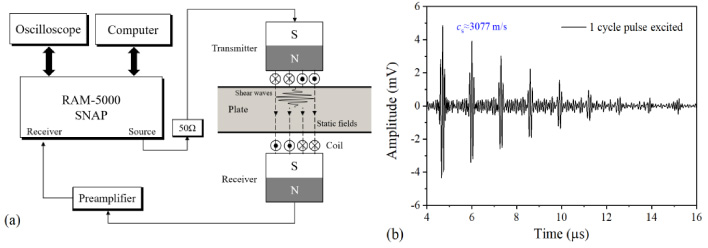
Schematic of the EMAR measurement system, (b) measured time domain signal in #0 with 1 cycle pulse at 6.14 MHz excited.
Resonance ultrasound spectroscopy
Based on the theoretical analysis in Section 2, it is believed that the resonance spectrum of a plate is supposed to be measured in the case where the burst width of the excited signal is longer than the round-trip time (2d∕c s ). The gain of the receiver was set to be 40 dB, and the integrator gate width was set to be 30 μs. By sweeping the frequency of the input signal from 1.0 MHz to 10 MHz with exact the same instrument parameters, the resonance spectra were obtained. Figure 2(a) shows the resonance frequency spectrum measured in the intact nickel specimen.
According to Eq. (4), the shear wave velocities can be calculated as linear acoustic parameters for material characterization. Due to that the measured resonance frequency spectrum barely changes with the heating time, it is believed that the wave velocity is insensitive for evaluating the thermal damages in the specimens. On the other hand, the ultrasonic attenuation in different nickel plates can be measured by the relaxation time coefficient (Referencing Ogi et al. [10]). First, an input signal at the resonance frequency was excited to drive the EMAT, and then the ring-down curves were obtained by scanning a short integrator gate along the time axis. Finally, the relaxation time coefficients are defined as the exponential decay constants of the fitted ring-down curves as shown in Fig. 2(b), which satisfied the following mathematical model
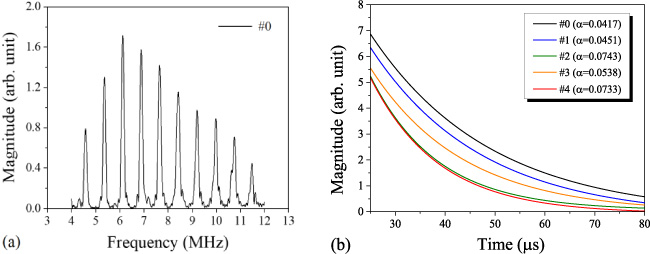
Measured linear ultrasonic features, (a) resonance frequency spectrum measured in the intact nickel plate, (b) measured ring-down curves in the specimens.
The measured attenuation coefficient from the ring-down curves includes mainly the material’s attenuation, and it was proved to be independent of amplitude [10]. As seen in Fig. 2(b), the attenuation coefficient in nickel plate increases with the heat loading time except for the sample plate #2. However, it was noted during experiments that the measurement error of attenuation is significant. Thus, the results of this attenuation measurement is to some extent consistent with the theoretical prediction regarding the influence of thermal loading on the materials, but not a reliable method to assess the thermal damage.
According to the measured resonance frequency spectra of nickel specimens, an applicable frequency at 2.05 MHz was adopted as the aforementioned f r ∕3 for the nonlinear EMAR measurements. Figure 3(a) shows the measured amplitudes A1 and A3 in the intact nickel sample plate. To verify the reliability of the proposed nonlinear acoustic parameter based on the measure of third-order harmonics of shear waves, the relationship between the A1 and A3 was measured as presented in Fig. 3(b). As seen, the linear trend of A3 regarding to A1 confirms the viability of the constructed parameter. As regards the thermal damage evaluation, the measurements were conducted in the different heat-loaded nickel plates. Figure 4 shows the measured A3∕A1 in the specimens. As one can see, the proposed nonlinear ultrasonic parameter increases steadily with the heating time, suggesting an increase of the material nonlinearity in the nickel plates.
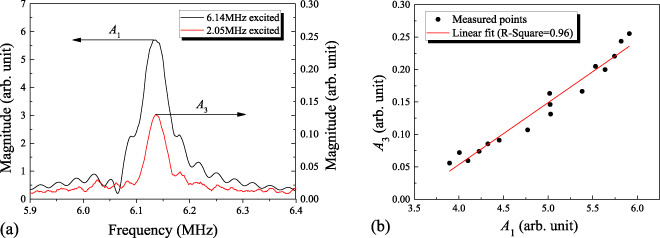
Measurements in the intact nickel plate, (a) measured A1 and A3 by nonlinear EMAR method, (b) measured correlation between A3 and A1 by adjusting the input ultrasonic power.
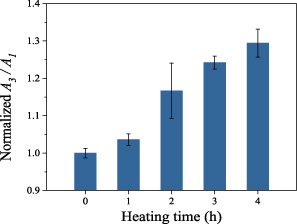
Measured nonlinear ultrasonic parameters in different heat-loaded specimens, normalized by the reference raw nickel plate with (A3∕A1 = 0.014).
It should be noted that both the primary wave amplitude (A1) and third harmonic wave amplitude (A3) decrease as the wave propagation increases for the reason of attenuation. The third harmonic amplitude at higher frequency should decrease more. However, as shown in Fig. 4, the significant increase of measured A3∕A1 versus heating time can be attributed to the higher value of A3 in the specimen with more heating time. The increase of normalized A3∕A1 can be explained as the more micro-damage including micro-discontinuities (grain boundaries) generated by the thermal loadings. Thus, the constructed nonlinear parameter is effective to characterize thermal damage with more sensitivity than wave velocity and relatively smaller measurement error than attenuation.
Nickel-containing products, which play an important role in many fields for better corrosion resistance, greater toughness and special magnetic/electronic properties, can subject to thermal damages. In this investigation, a nonlinear EMAR technique is validated to evaluate the heat loading damages in pure nickel plates. Experimental results show that the constructed parameter based on the measure of cubic harmonic generation of shear waves can well indicate the material nonlinearity in the specimens. With the advantages of non-contact feature of EMATs and high sensitivity of nonlinear ultrasonic response to early micro-damages in materials integrated, the proposed nonlinear EMAR technique could be a promising tool to rapidly characterize thermal damage in materials. Comparison of linear and nonlinear ultrasonic parameters to thermal loadings is also discussed in this work. It is found that nonlinear acoustic parameters are more promising and stable indicators to heating time than linear ones.
Footnotes
Acknowledgements
This research was funded by the National Natural Science Foundation of China, grant number 11774295, 11974295, 11834008 and 11632004.
Conflicts of interest
The authors declared that there are no conflicts of interest to this work.