



Abstract
The new analytical theory is developed describing propagation of plasmon polariton localized at the interface between a dielectric uniaxial crystal and an isotropic metal. The theory relates to the crystal cut choice corresponding to the sagittal plane parallel to the optical axis. For this geometry the compact dispersion equation is derived admitting exact explicit solutions for all physical parameters of the plasmon polariton for an arbitrary slope of the optical axis to the interface plane. Results are illustrated for a series of uniaxial crystals with gold coatings.
Introduction
Plasmon polaritons – electromagnetic eigenwaves localized at the dielectric-metal interfaces – now became important elements in various modern devices [1–3]. Such waves have some new useful properties when dielectric is a crystal [4] due to their possible coupling with special reflections of bulk electromagnetic waves in a crystal providing a resonance excitations of plasmon polaritons [5–7]. The development of theoretical description of plasmon polaritons in such media is not yet very advanced being basically limited to numerical methods [8,9].
The most of previous considerations were based on the so-called Dyakonov [10] wave geometry, when the interface was chosen to be parallel to the optical axis of the uniaxial crystal. For such a cut the dispersion equation took a rather compact form which however did not admit analytical solution and was analysed numerically. In this paper we shall choose, instead of Dyakonov’s geometry, an alternative cut when the optical axis
Statement of the problem
Consider the combined bi-medium (Fig. 1) consisting of an uniaxial dielectric crystal (at y < 0) with permittivity components, ϵ
o
(ordinary) and ϵ
e
(extraordinary), and an isotropic metal (at y < 0) with negative permittivity ϵ
m
< 0 and permeability μ = 1. We shall use the Cartesian system where the coordinate planes xz and xy respectively coincide with the interface and sagittal planes. The y axis perpendicular to the interface is directed inside the crystal. The optical axis directed along the unit vector
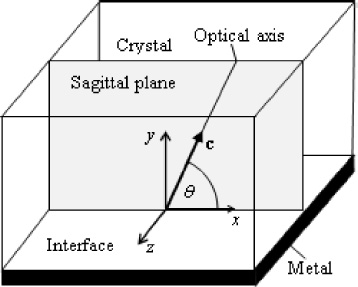
Geometric features of the problem.
The scalar amplitudes C
e
and C
m
in (1) are determined by the boundary conditions requiring the continuity of tangential components of electric and magnetic fields at the interface (y = 0). This continuity is reduced to the system of equations with respect to the unknown amplitudes C
e
and C
m
:
The system of Eqs (7) being as usual homogeneous has nontrivial (nonvanishing) solutions with respect to the coefficients Ce, m when the both Eqs in (7) give the same ratio
The formulae (10)–(12) represent the exact explicit solutions for basic parameters of the discussed hybridized wave localized at the interface of the considered crystal – metal structure. They describe both positive (ϵ e > ϵ o ) and negative (ϵ e < ϵ o ) crystals. Figure 2 demonstrate the functions n (θ) (10), q e (θ) (11) and q m (θ) (12) for the four uniaxial crystals, two positive (rutile and calomel) and two negative (calcite and saltpetre), coated by a gold. The material parameters, ϵ o and ϵ e , for these crystals (and for the two other crystals discussed below) are taken from the book [11] and presented in Table 1. For the gold electric permittivity ϵ m we use the real part of the magnitude −20.15 + i1.25 [12] related to the vacuum wavelength 𝜆 v = 0. 75 μm.
Permittivities ϵ o and ϵ e for the series of uniaxial crystals

The curves n (θ), q e (θ) and q m (θ) for the four uniaxial crystals from the Table 1.
One can see from Fig. 2 that for positive crystals the function n (θ) monotonically increases with the growth of the optical axis slope θ while for negative crystals it decreases with θ. And for the localization parameters q e (θ) and q m (θ) everything is vice versa: they decrease for positive crystals and increase for negative. It is essential that in all cases the parameter q e is substantially bigger than q m , i.e. the plasmon in metal is localized in much narrower layer than the polariton in crystal.
The above conclusion that there are no limitation for the existence of the considered plasmon polariton was concerned only geometry of propagation. In fact, physical limitations for its existence unfortunately still do occur. They arise due to energy dissipation, mainly in metal, which can substantially reduce the length of a mean free path of our wave superposition. Such processes are usually described in terms of imaginary additions to permittivities. In our case the prevailing contribution to the dissipation is obviously provided by the electric currents accompanying to the plasmon propagation in the metal. So, we can limit ourselves to the estimation based on the only replacement:
Let us introduce the mean free path of the plasmon polariton as the distance L = 1∕δ where the wave amplitude decreases e times:
Relative mean free path of plasmon polariton for six crystals coated by the gold (𝜆 v = 1 μm)
As is seen from Table 2, the mean free path of plasmon polariton in positive crystals is several times less than in negative crystals. However even in the latter case the typical magnitude of L remains rather small being only of the order of 102 μm. On the other hand, in many cases it is quite sufficient length bearing in mind the tendencies of modern nanoscale technique.
Summarizing, we can state that the analytical theory is developed of the plasmon polariton localized at the crystal-metal interface for the cut relating to the optical axis belonging to the sagittal plane. The compact dispersion equation (9) determines the two-partial plasmon polariton consisting of the extraordinary polariton in a crystal and TM-polarized plasmon in a metal. The unique solution exists for any slope θ of the optical axis in the sagittal plane of propagation. And for any θ the localization parameters q
e
(θ) (11) and q
m
(θ) (12) of the partial waves remain finite. The found parameters n, q
e
and q
m
are plotted in Fig. 2 as functions of θ for the four concrete uniaxial crystals, both positive and negative, coated by the gold. The developed theory provided exact explicit solutions which do not need a comparison with numerical solutions. It would be interesting to compare them with data of experiments, but as far as we know they do not exist yet. The dissipation of the plasmon in the metal is taken into account: the damping coefficient δ (16) and the mean free path L (17) of the plasmon polariton are expressed in terms of the found parameters with the numerical illustration for the six crystals (Table 2). The analysis shows that the path L is the bigger the larger is the metal permittivity ϵ
m
and the less is its imaginary part
Footnotes
Acknowledgements
V.I. Alshits and V.N. Lyubimov were supported by the Ministry of Science and Higher Education within the State assignment FSRC “Crystallography and Photonics” RAS.