



Abstract
Washing machines are used very frequently in everyday life. There have been many related studies on the vibration and noise of washing machines. The suspension system is an important vibration isolation component of the washing machine. Based on the Lagrangian equation, the dynamic model of the suspension system was established. The reliability of the model was verified by finite element simulation and experimental methods. Finally, this paper used a multi-objective optimization method to obtain optimal parameters of the washing machine and further to reduce the vibration level of washing machines.
Introduction
Washing machines are frequently used in daily life. For washing machines, the smaller the vibration and noise means better performance. Many scholars and companies have conducted researches on this issue.
O.S. Turkay [1] established the dynamic equation of the suspension system of a certain type of the washing machine, which was optimized from two aspects: the damping coefficient of the damper and the stiffness coefficient of the spring; W. Soedel and D.C. Conrad [2] established the vibration models of two types of washing machines after abstracting and simplifying the pulsator and drum type washing machines, and mathematically solved the models under high-speed dehydration conditions. F. Mentes et al. [3] analyzed the vibration signal of the washing machine under the working condition, and found the vibration source of the washing machine through spectrum analysis. Jing Qian and Zhiwei Wang [4] used the Lagrangian equation to establish the dynamic model of the barrel parts of the washing machine from the energy point of view, and applied the Runge–Kutta method to simulate the vibration of the barrel parts under the dehydration condition. Ying Lin, Zhenchang Huang et al. [5] took a certain type of drum washing machine as the research object, took the minimum force of the washing machine under the dehydration condition as the objective function, adopted the optimization design method to obtain the vibration system parameters, and passed the prototype test. Qingliang Liu [6] abstracted the internal structure of the drum washing machine. Using the three-degree-of-freedom research method under plane motion, the six-degree-of-freedom mathematical model of the suspension system of the drum washing machine was established, and then the mathematical model was numerically simulated. Yanyan Zuo, Xiumin Shen, and Haibo Liu [7] combined the modern testing technology with the finite element modal analysis theory to perform a modal test on a drum washing machine box, and obtained its mode shape and natural frequency through analysis. According to the vibration characteristics of the box, the structural optimization design was proposed, which significantly improved the vibration characteristics.
This paper focuses on the suspension system of the washing machine. The suspension system is an important vibration isolation component of the washing machine. The dynamic model of the suspension system is established based on the Lagrangian equation. The reliability of the model is verified by both finite element simulation and experimental methods. Finally, the multi-objective optimization algorithm is used to obtain the suspension system parameters, which effectively reduces vibration amplitude of the washing machine.
Mathematical modeling
The following assumptions are made: (1) the outer barrel and the inner barrel are considered to be rigid bodies; (2) the connection point of the spring and the box body is considered to be a fixed point; (3) the quality of the spring hanger is ignored, and it is considered to be an ideal component; (4) the laundry is regarded as a mass point, which is closely attached to the inner wall of the dewatering bucket during the dehydration process and remains relatively stationary; (5) in the dehydration process, the reduction of moisture in the laundry is ignored, and the system is regarded as a constant mass system.
Establishing vibration differential equations based on Lagrange equation
Where T, U and D represent the kinetic energy, potential energy and dissipative energy of the system, respectively, q
i
and
In this paper, outer barrel mass is denoted as M with moment of inertia J1x, J1y, J1z, while inner barrel mass is denoted as m with moment of inertia J2x, J2y, J2z, and m0 represents clothing mass.
Assuming that the displacement coordinate of the system centroid is
Outer barrel kinetic energy:
Inner barrel kinetic energy:
The kinetic energy of washing clothes:
The kinetic energy of the whole system is the sum of the kinetic energy of the outer tub, inner tub and washing clothes, namely:
The gravitational potential energy and the initial elastic potential energy of the spring are offset, so only the potential energy caused by the spring change is considered.
The spring stiffness is the linear stiffness k, and the approximate stiffness in all directions of the spring is expressed as: k
x
, k
y
, k
z
.
The energy dissipation in the system is mainly caused by damping.
Assuming that the damping is linear and the damping coefficient of the suspension system is c, the approximate damping in each direction is: c x , c y , c z .
System dissipation energy:
Choose a special state: counterweight m0 = 0; washing machine rotating speed ω = 0. According to the Lagrange equation, the solution can be obtained:
That is:
The accuracy of the suspension system dynamic model is verified by both finite element simulation and experiment.
The suspension system of the washing machine is mainly composed of the outer barrel (the tub), the inner barrel (the basket), the balance ring, the barrel cover, the spring hanger and the motor. The finite element models of the various components are built separately and combined to form the finite element model of the entire suspension system.
The finite element model of the suspension system is as follows:
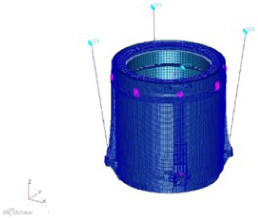
FE model.
The simulated natural frequencies are as follows:
Simulation results
In order to obtain the frequency of the suspension system, a modal test is performed. The modal test procedure: Firstly, take the suspension system out of the washing machine and suspend them with a boom to give the bucket an initial disturbance, then release the barrel components, let them oscillate freely, and collect acceleration response. There are three cases: (1) initial displacement in the X direction, (2) initial displacement in the Y direction, and (3) initial torsion in the Z direction.
The instruments used are as follows:
Instruments for vibration test
This paper uses the software Signal Express for data collection and analysis.
The test schematic diagram is as follows:

The test schematic.
The filtered typical acceleration signal curves are as follows:

Acceleration response in the X direction.
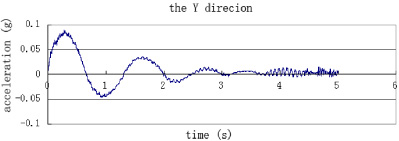
Acceleration response in the Y direction.
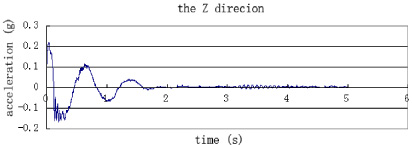
Acceleration response in the Z direction.
Test results
Modal result comparison
As can be seen from the above table, the frequency of theoretical calculations, test and simulation results are very close. The results obtained by the three methods are basically consistent, which also proves the validity and reliability of the theoretical derivation.
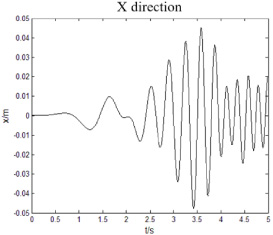
Displacement in the X direction.
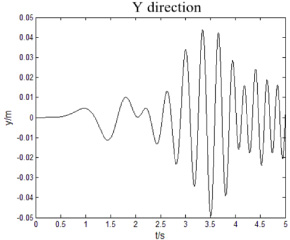
Displacement in the Y direction.
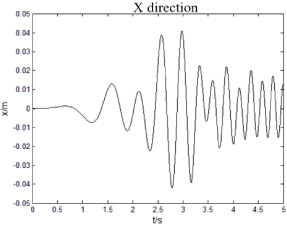
Displacement after optimization in the X direction.
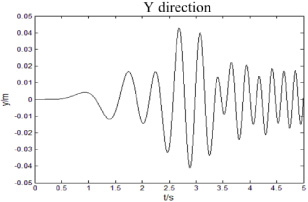
Displacement after optimization in the Y direction.
In order to reduce vibration, some parameters of the suspension system are optimized. In this paper, the maximum displacements of the top of the bucket component in the x and y directions are used as the optimization target. According to the factor effect analysis, the optimization variables are: the stiffness of the spring K, the x coordinate of the spring hanger and the suspension point of the box lx, the y coordinate ly and the length of the spring boom l. The design intervals are set as:
Using the Runge–Kutta method, the equation is solved by MATLAB programming, and the curve of the displacement of the top of the tub component with time is shown in the following figures. The x-direction displacement maximum value max_x is 0.0488 m, and the y-direction displacement maximum value max_y is 0.0473 m.
The optimization results are: k = 2036.6 N/m, l = 0.57098 m, lx = 0.32876 m, ly = 0.33418 m. The maximum values of the displacements in the x and y directions at this time are: 0.041585 m, and 0.041521 m. The x and y displacement curves after optimization are shown below.
By comparison, it is obvious that the maximum displacement after optimization is decreased, which means the vibration response is effectively reduced and the optimization results improve the vibration performance of the machine.
Conclusion
The work of this paper is as follows:
(1) The article establishes the dynamic model of the washing machine suspension system based on the Lagrange equation;
(2) The accuracy of the proposed model is verified by two methods: finite element simulation and experiment.
(3) Four optimization variables are selected, then the maximum displacement of the top of the barrel component is optimized. The optimization results show that the vibration response of the barrel is reduced.
The research in this paper has certain reference significance for the vibration reduction work of washing machine, and also lays a foundation for the subsequent noise reduction.
Footnotes
Acknowledgements
The authors would like to acknowledge the support provided by National Natural Science Foundation of China, No. 51775270.