



Abstract
The winding design of an electrical machine is an important task in the whole design process. This leads, for a part, to the magneto motive force which is one of the main quantities to manage for electrical machine performances. Indeed, the latter is directly linked to that of the air gap magnetic flux density and thus to the torque ripples, vibration and then noise. This paper proposes to reduce the MMF harmonic content by means of optimization process using mono-objective or multi-objective algorithms with discrete and continuous variables. For this aim, optimization algorithm is coupled with an analytical tool which enables calculating quickly the MMF harmonic content from winding parameters. A winding optimization of three different windings with the same number of pole pairs is proposed to show the suitability of this process.
Keywords
Introduction
The stator winding is an important part of an electrical machine. To obtain its optimal design, several parameters have to be taken into account such as the structure, the number of pole pairs, the number of stator slot... [1,2]. Usually, the study of the Magento Motive Force (MMF) is required.
Magneto motive force due to polyphase windings supplied by balanced polyphase currents is the main source providing the magnetic flux density in the air gap of alternative electrical machines. The MMF harmonics are due to a combination of spatial harmonics of the windings and temporal harmonics of the currents. The harmonic content has a great importance to convert the electromechanical energy but it also has an effect on iron losses, torque ripples and noise [3].
Classical Distributed Windings (DW) are known to have low MMF spatial harmonic content. Indeed, they are made up of a principal harmonic, linked to the number of pole pairs, and some spatial harmonics whose amplitudes are not significant. Nevertheless, their end winding length constitutes their main drawback as it leads to more copper amount [4]. Therefore, since last decades, Fractional Slot Concentrated Windings (FSCW) are more and more studied and used especially in permanent magnet synchronous machines (PMSM). These windings reduce the end parts and then the amount of copper but they have a drawback by means of a MMF spatial harmonic content which is quite important. The MMF of a FSCW is constituted of a main harmonic linked to the number of pole pairs (as for DW), but also of many other harmonics whose amplitudes are not negligible by comparison to the main harmonic. Whatever the chosen winding, spatial harmonics can be reduced through the analysis of the winding function that describes the winding spatial distribution of coils. For high-power machine, the spatial harmonic content of a distributed winding (especially the 11th and 13th or the 17th and 19th) can be reduced by changing the coil span and doubling the number of layers [4]. Different works have also tackled the subject for concentrated windings [5–9] studied the use of multi-layers windings [6,8,10], focused on the use of flux barriers and [8,11–13], propose to increase the number of stator slots using two stator windings shifted by a specific angle with a delta star connection. Finally [14], suggests the utilization of windings with no constant coil pitch.
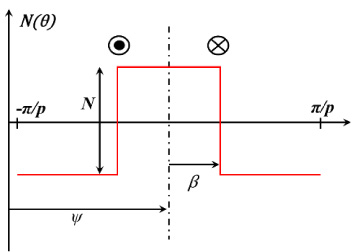
Elementary pattern of one coil.
In this paper, we propose to reduce the MMF spatial harmonic content by an optimization process. From the latter, many different optimization problems can be defined. Indeed, two different optimization problems; i.e. mono-objective and multi-objective; are based on a dedicated analytical tool [15] to get different winding designs. This tool enables obtaining quickly the harmonic content of a polyphase winding from an elementary pattern whose Fast Fourier Transform (FFT) is well known. Thus, it can be coupled with any optimization algorithm using discrete or continuous variables and hence obtain new windings with MMF harmonic content meeting a given need. Hence, new multi-layer and non-constant coil pitch windings with lower MMF spatial harmonic content are proposed.

Harmonic amplitude calculation of the winding function of one phase.
The paper is organized as follows. The second part is devoted to explain the analytical tool with its inputs and outputs which constitute the variables, objectives and constrains of the optimization problem. In the third part, the structure of the process using different algorithms coupled with the analytical tool is presented. Furthermore, the description of different optimization problems to obtain either mutli-layers or non-constant coil pitch is reported. In the last part, optimization results in terms of new winding topologies are proposed.
To obtain the MMF harmonic content of a winding, an analytical tool is used [15]. This tool is based on an elementary pattern which represents the winding function of one coil defined by 𝜓, which is its magnetic axis position and 𝛽, its half coil pitch as shown in Fig. 1. Note that if the sign of beta is negative, the elementary pattern is the opposite of the one shown in Fig. 1.
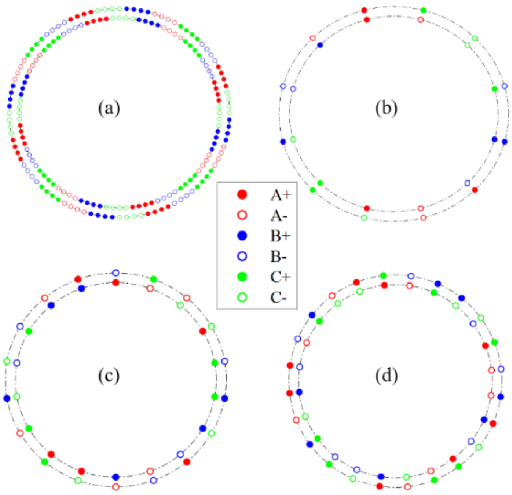
Winding representation. (a) DW 96-slot 8-pole, (b) FSCW 12-slot 10-pole, (c) FSCW 18-slot 10-pole, (d) FSCW 24-slot 10-pole machines.

Comparison of the two MMF spatial harmonic contents.
The analytical FFT of this elementary pattern is well known and is given by Eq. (1).
Each phase being made of several coils, the total amplitude of the jth spatial harmonic of one phase, A j , is calculated just by adding the contribution of the jth spatial harmonic of each coil as shown in Fig. 2.
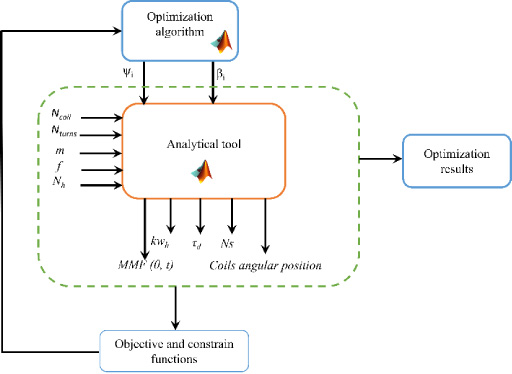
MMF optimization process.
Thus, assuming that A
k
is the current harmonic amplitude of rank k, Eq. (2) gives the resulting amplitude of each spatiotemporal MMF harmonic A
h
. The spatiotemporal stator MMF expression is then given by (3).
Where m is the number of phases, j the spatial harmonic order, k the time harmonic order, ω the electrical pulsation, p the number of pole pairs, θ the spatial angle and t the time.

MMF spatial harmonic content of the studied windings, blue 12-slot 10-pole winding, red 14-slot 10-pole winding, black 24-slot 10-pole winding.
This method enables doing any numerical FFT and leads to get the results very quickly. Hence, this model is very relevant for the use of an optimization process.
The example of two different windings is considered. The first one is a three-phase DW with 96 slots and 8 poles made up of 32 coils per phase. There are 16 coils wound in one direction (𝛽 > 0) and 16 coils wound in the opposite direction (𝛽 < 0). The second one is a three-phase FSCW with 12-slots and 10-pole made up of four coils per phase, 2 coils wound in one direction (𝛽 > 0) and two coils wound in the opposite direction (𝛽 < 0). Winding representation and their MMF spatial harmonic contents are presented in Figs 3.a, 3.b and 4 respectively. Regarding the latter, we observe in both cases that the higher magnitude harmonic, which is also called main harmonic or working harmonic, is linked to the number of pole pairs (the fourth for the DW and the fifth for the FSCW). Note that positive and negative harmonics are separated to show the rotating field direction. Then, the harmonic content of the FSCW is more important than the one of the DW.

Variable criteria to obtain a FSCW.
The model presented above can be used in a generic way, with any procedure, in order to get a given winding that respects criteria and constraints. To do that, the optimization process given in Fig. 5 can be achieved. The variables are then the magnetic axis position of the coils (𝜓 i ) and its half coil pitch (𝛽 i ). The optimization objective, which can be increase the winding factor or reduce the harmonic content, is chosen among the outputs of the model. Moreover, some constraints must be added such as the control of the slot number or the number of layers.
To this aim, mono-objective optimization to reach a unique solution or multi-objective optimization to have a compromise between objectives can be selected in this design process. Moreover, discrete or continuous variables can be used according to the problems definition and the optimization algorithm chosen.
Thus, this process enables obtaining automatically the winding distribution from a defined optimization problem.
With this approach, many optimizations can be performed to obtain a reduced spatial MMF harmonic content for example. In the present works, we propose to optimize and compare three different FSCW structures with the same number of pole pairs, 12-slot 10-pole, 18-slot 10-pole, 24-slot 10-pole whose MMF spatial harmonic contents is given in Figs 6. Figures 3b, 3c and 3d give also the winding design. For each structure, two distinct optimization problems are proposed. The first one aims at obtaining a regular slot pitch with a fixed slot number like classical windings but with a multi-layer one. The aim of second one is to obtain new windings with non-regular slot pitch.
Optimization problem with a regular slot pitch
Usually, FSCW are studied thanks to star of slot method [16] with the aim to maximize the main harmonic. Depending on the winding, the number of slots (12, 18 or 24) and the number of coils per phase are then fixed. In our case, while keeping the same number of slots, the objective is to find the best winding configuration that meets some criteria such as maximization of the main harmonic linked to the number of the pole pairs and also the minimization of other harmonics. Coils can be placed in any slot and the number of the coils per phase can be increased in order to have an additional degree of freedom. Hence, the obtained windings are multi-layer ones with more or less layers provided automatically by the optimization problem. In the latter, a constraint is applied to obtain a spatial harmonic content with only odd harmonics as classical windings. The half coil pitch, 𝛽
i
, and the magnetic axis position, 𝜓
i
, of each coil of the first phase constitute the optimization variables. The coil locations of the two other phases are deducted by electric shift angles of 120° and 240° with respect to the first one. Whatever the number of slots considered, 𝜓
i
and 𝛽
i
have to respect the criteria given by Eq. ((4)) which enables defining the total number of combinations in order to obtain a FSCW. An illustration is given in Fig. 7.
where N s is the number of stator slot.
According to the variable definition, a mono-objective optimization with discrete variables using the genetic algorithm of Matlab® is conducted to maximize the main harmonic (the fifth harmonic in our case) and minimize the others. To limit computation time while reaching a good accuracy, only the first hundred spatial harmonics and the first time harmonic are considered. The algorithm chosen cannot take into account the equality constraint when using discrete variables. Then, an inequality constraint is adopted and the optimization problem is thus defined by Eq. (5).
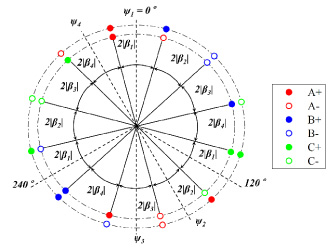
12-slot 10-pole winding configuration.
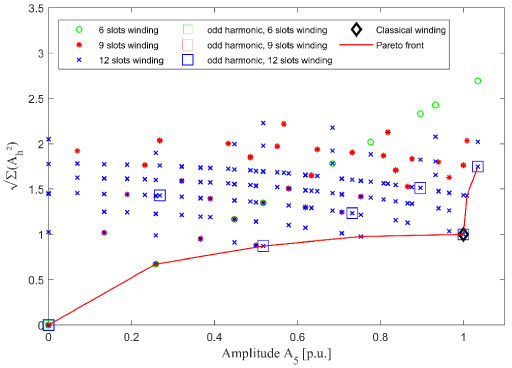
Amplitude of the fifth harmonic versus the others for all the possibilities of coil winding locations for 12-slot 10-pole winding (exhaustive solution).
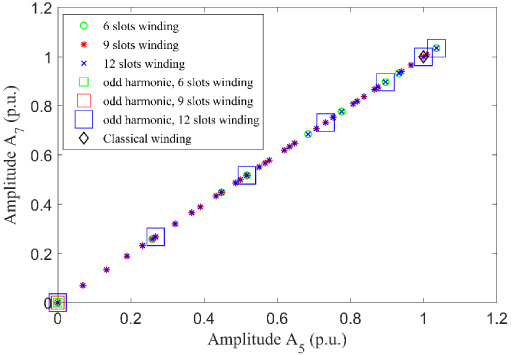
Amplitude of the fifth harmonic versus amplitude of the seventh harmonic for all the possibilities of coil winding locations for 12-slot 10-pole winding.
The aim of this optimization is to obtain a winding with the same number of stator slots and the same number of coils per phase as the classical winding. Moreover, each coil stay at the same slot but have a non-constant coil pitch all around the stator. Each winding studied have to be configured with the parameters 𝛽
i
and 𝜓
i
which define coil winding. The example of the 12-slot 10-pole winding is given Fig. 8. Thanks to a three-phase balanced winding property, the total winding can be configured only by parameters 𝛽
i
and 𝜓
i
defining the 4 coils that constitute one phase. The equation system is then given by Eq. (6).
According to Eq. (6), only three variables, 𝛽1, 𝛽2 and 𝛽3 are needed. In the studied case, they can be continuous so that the optimization is carried out as a bi-objective optimization using multi-objective genetic algorithm of Matlab®. The first one is the maximization of the fifth harmonic and the second one is the minimization of the others. Thanks to winding properties, the spatial MMF harmonic content cannot have even harmonics so no optimization constrain is needed. The optimization problem is then defined by Eq. (7).
For the two other windings, the same procedure is carried out. The 18 slots/10 pole winding is composed of 6 coils per phase. According to the equation system given by Eq. (8), the number of the variables considered is equal to five, 𝛽1, 𝛽2, 𝛽3, 𝛽4 and 𝛽5. In the case of the 24 slots/10 pole winding, one phase is made up of eight coils per phase. So, according to the equation system given by Eq. (9), seven variables are needed for the optimization problem, 𝛽1, 𝛽2, 𝛽3, 𝛽4, 𝛽5, 𝛽6 and 𝛽7. The objectives are the same as presented by Eq. (7).
Regular slot pitch
The 12-slot 10-pole winding made up four coils per phase is the first case studied. First, the same approach as described in section III.A is performed with bi-objective representation, i.e. the amplitude of the fifth harmonic versus the amplitude of others. In the present work, the 331 776 (= 24 ×124) winding possibilities are computed using the fast analytical model taking about 4h on a classical personal computer. In this example all possibilities are exhaustively tested. The results are given in Fig. 9.
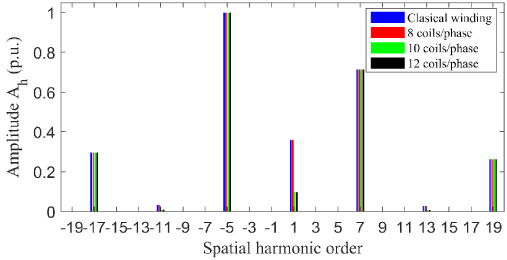
Spatial MMF harmonic content comparison for 12-slot 10-pole winding.
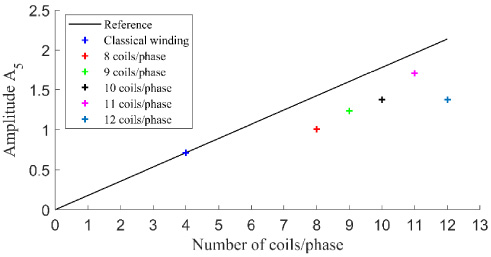
Amplitude of the fifth harmonic according to the number of coils per phase for 12-slot 10-pole winding.
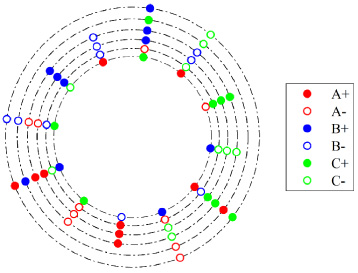
Winding obtained by optimization with 10 coils/phase for the 12-slot 10-pole winding.
Depending of the coil distribution, the number of slots can be different when compared with the classical winding. Indeed, results show 3 kinds of windings, with 6 or 9 slots in addition to the classical one with 12 slots. Among these windings, those whose spatial harmonic contents of the stator MMF contain only odd harmonic are highlighted by a square. Moreover, either the fifth harmonic amplitude (horizontal axis) is significantly reduced or the quantity of other harmonic amplitude (vertical axis) is significantly increased when compared to the classical winding. So, according to the Pareto front in red continuous line, the best solution seems to be the classical winding represented by a black diamond since most of the other solutions present even spatial harmonics.
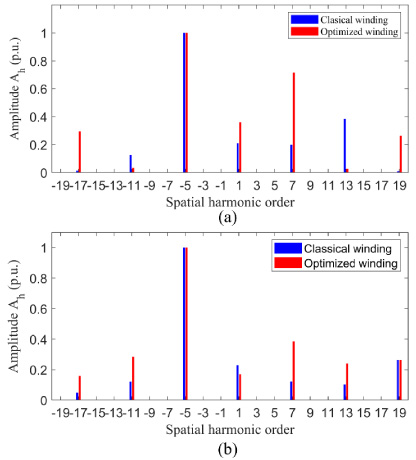
Spatial MMF harmonic content comparison, (a) 18-slot 10-pole, (b) 24-slot 10-pole windings.
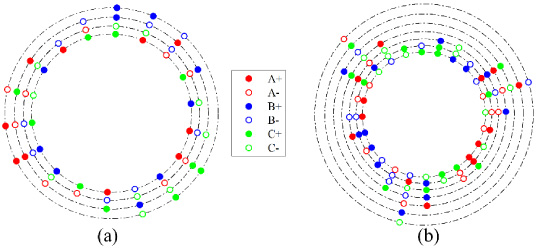
Windings obtain by optimization, (a) 18-slot 10-pole, (b) 24-slot 10-pole.
In the case of the 12-slot 10-pole winding, the fifth and the seventh harmonics have higher magnitudes than the others. The first one is the working harmonic but the second one is an undesirable harmonic because of its high amplitude but also its spatial proximity. Figure 10 shows the amplitude of these two harmonics. We observe that the both harmonics progress in the same direction. Thus, with the same number of coils per phase, the amplitude of the seventh harmonic cannot be reduced without the same effect on the fifth. For this problem definition, no solution exists to decouple the 5th harmonic from the 7th.
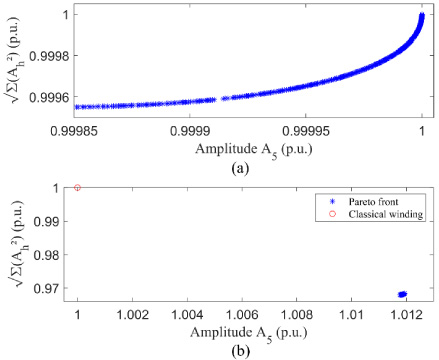
Multi-objective optimization results for 18 slots/10 pole winding, (a) Pareto front only, (b) comparison with classical winding.
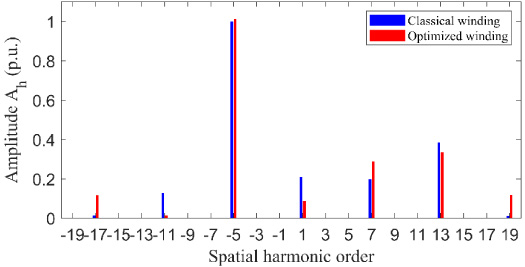
Harmonic content comparison for the 18 slots/10 pole winding multi-objective optimization.
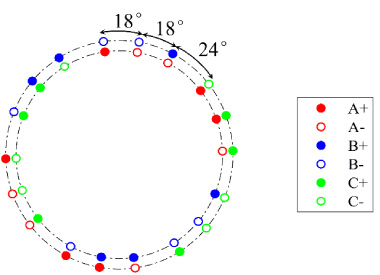
Winding result for the 18-slot 10-pole winding multi-objectives optimization.
In a second time, the optimization process described in part III.A is used. As expected, the results are similar but they are obtained by a computation time approximately divided by sixteen. All the results presented below are then obtained by optimization process presented in part III.A and III.B.
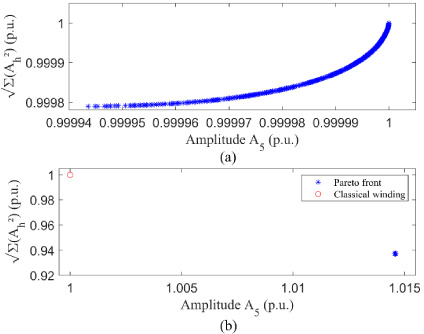
Multi-objective optimization results for 24-slot 10-pole winding, (a) Pareto front only, (b) comparison with classical winding.
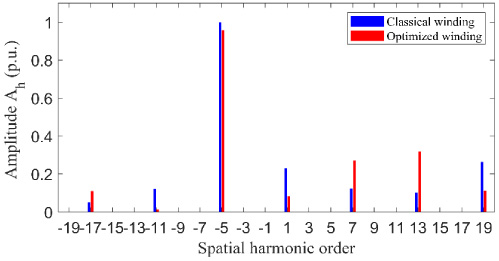
Harmonic content comparison for the 24-slot 10-pole winding multi-objective optimization.
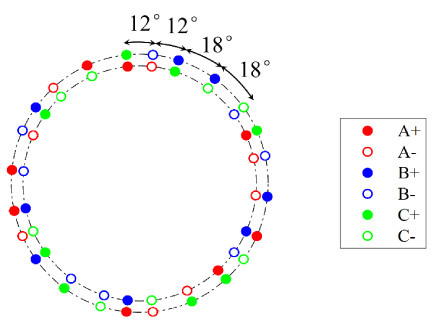
Winding result for the 24-slot 10-pole winding multi-objectives optimization.
The optimization problem defined in part III.A is run with different number of coils per phase (4, 8, 9, 10, 11, 12). The comparison of the MMF spatial harmonic content of the windings is given in Fig. 11. For sake of clarity, only three results are shown. It can be noted that increasing the number of coils per phase does not guarantee better harmonic content. Indeed, until 9 coils per phase the latter is not improved whereas with 10 coils per phase the first harmonic amplitude is mitigated by 66%. The magnitude of the eleventh and thirteenth harmonics are also reduced. Adding coils per phase increases the total Ampere-turn as shown in Fig. 12 in the case of the fifth harmonic amplitude versus the number of coils per phase. The black line represents the theoretical amplitude of A5 by adding coils. Lower amplitude is observed for each case which means that the winding factor is lower than the case of the classical winding. Solution with 10 coils per phase, presented in Fig. 13, seems to be the best one. As expected, a multi-layer winding is obtained but the number of coils per slots is different for each slot. We also note the two identical coils belonging to the same phase wound around the same teeth. This is identical to one coil with a double number of turns.
The same work is carried out for 18-slot 10-pole and 24-slot 10-pole windings with better results. For the first one, the optimal result is obtained for 10 coils per phase and the second one for 14 coils per phase. Their harmonic contents compared to classical windings and their winding design are shown in Figs 14 and 15 respectively. For the 18-slot 10-pole winding, the optimization allowed to mitigate the seventh harmonic magnitude but increases the first one whereas for the 24-slot 10-pole winding, the first harmonic amplitude is reduced and the one of the seventh is higher. The same conclusions as for 12-slot 10-pole winding machine can be made for the winding design.
The results given in this part are obtained with process described in part III.B. For the 12 slots/10 pole winding, the optimization does not enable to find a better winding than the classical one. In the case of the results obtained for the 18-slot 10-pole winding shown in Fig. 16, the Pareto front (Fig. 16a) presents several solutions. However, regarding the axis rank, the solutions are very close and can be assumed as one. When comparing the Pareto front to classical winding results, an improvement of 1.2% for the A5 amplitude and 3.2% for the other amplitudes can be noted. The harmonic content comparison is given Fig. 17 and the optimized winding is given Fig. 18. Despite of a non-constant slot pitch, a winding periodicity is present, 18°–18°–24° as already found in [12].
For the 24-slot 10-pole winding, the optimization result, Fig. 19, shows numerous solutions in the Pareto front. However, as in the case of the previous winding, a unique solution can be assumed. The spatial harmonic content of this solution compared to the classical winding is made in Fig. 20. An improvement of 1.5% for the harmonic A5 and 6.3% for the other amplitudes is noted. A winding periodicity of 12°–12°–18°–18° is noticed Fig. 21 which presents the design of the optimized winding.
Conclusion
In this paper, a method to obtain a winding with reduced spatial MMF harmonic content is proposed using an analytical tool coupled with an optimization process. Mono-objective and bi-objectives optimizations are carried out in order to obtain either multi-layers windings or non-constant slot pitch windings with the aim to have a mitigated harmonic content compared to the classical winding. The comparison between three different winding structures with the same number of pole pairs is proposed, 12-slot 10-pole, 18-slot 10-pole and 24-slot 10-pole windings.
Increasing the number of coils per phase enables to mainly mitigate the first or seventh harmonic while keeping the amplitude of the others at almost the same level in comparison with the classical winding. However, the winding factor can be impacted with this approach and has to be taken into account for future optimization problems.
Pareto fronts obtained by the second optimization process show no real compromised but only a unique solution. The latter enables reducing many harmonic amplitudes while slightly increasing the main one.
Mitigating a spatial harmonic content using an optimization process enables to obtain new windings according to the objective desired. Other objectives will lead to different results and then other winding designs. The winding design by optimization can then be used as a flexible tool for the design of specific new electric machines.