



Abstract
The influence of permanent magnet excitation on HTS coil in transverse-flux linear motor is analyzed. Numerical analysis using finite-element method is carried for two commonly used magnet arrays - alternating and Halbach. The influence of magnet arrangements on critical current density of HTS winding operating in temperature of liquid nitogen of 77 K is examined. The goal is to find optimal air gap size and magnet span to assure the best performance of the motor where anisotropy of superconductor is taken into account.
Keywords
Introduction
In recent years, the research on superconducting materials is focused on achieving superconducting state at highest possible temperature (critical temperature). The high-temperature superconductors (HTS) is a group of materials which critical temperature is above 30 K, and most widely used materials are YBCO and BSCCO which appear in form of superconducting tapes and could operate in liquid nitrogen with temperature of 77 K at ambient pressure. Superconductors may replace conventional conductors like copper or aluminium if it is economically justified, because of the capability of conducting high current with little to no losses. So far the cost of 1 meter of second-generation HTS tape is at least 20 euro, which is significant compared to conventional materials like copper. Since HTS materials are crystals, handling them is challenging due to ease of damage.
High-temperature superconductors tapes are characterized by several times higher current density than traditional conductors (10 kAcm−2). Typical tapes have cross-sectional dimensions of 4 mm × 0.1 mm and can conduct a current of about 100 A. Nevertheless, HTS has several significant disadvantages [1]. One of them is anisotropy and reduction of the critical current in the external magnetic field, related to the crystalline structure of superconductors [2–4], therefore estimating value of critical current is necessary in the design process of superconductor devices.
One area of application of HTS is electric machines [5,6], where coils can be made out of superconducting materials. This will lead to higher values of higher than normal values of specific current loading. So far very few superconducting machines had been build, and tested by research groups. One type of electric machine which can benefit from the application of superconductors is the transverse flux linear motor with permanent magnet (PM) excitation (HTS-TLPM). The advantage of the transverse motor is that coils can be wounded using HTS tape without twisting, therefore reducing mechanical stress in tape and should not affect critical current. The number of coils is small and is generally equal to the number of phases [7,8]. The only thing that has to be considered is bending radius of the tape which may lead to break of superconducting structure inside.
The analyzed motor is shown in Fig. 1 comprises two stator coils which conduct alternating current depending on actuator position. The actuator, also called mover is a moving part consists of permanent magnets, here double-sided, and the ferromagnetic actuator core is optional. The transverse flux motors are simple in construction and parts of the magnetic circuit can be made outof blocks of ferromagnetic material. Such motors have a high number of poles which lead to high output force ((1)). When designing a motor, one of the equations used for estimating the performance of the motor is an equation for force generated by the actuator. This force is proportional by some constant C which value depends on geometry and dimensions of a given machine, number of poles (2p), average magnetic field B
avg
in the air gap g and peak current flowing through coil I
max
. When dealing with superconductors it is not obvious how presence of magnetic field in a given configuration will affect the current through superconducting coil [9,10].
In the following paper, we present the influence of permanent magnets arranged as in analyzed transverse linear motor on HTS coils using finite-element method (FEM).
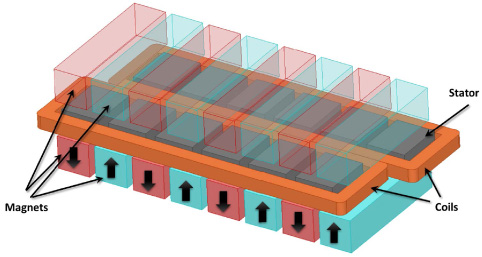
Geometry of HTS transverse flux PM motor.
HTS materials are compounds or ceramic materials which form a crystalline structure. In materials such as YBCO or BSCCO which are cuprates (copper-oxides) there are copper-oxide planes (ab-planes) which are favorable directions for current to flow. When an external magnetic field is applied perpendicularly to those planes, it limits critical current significantly compared to field applied parallel to the plane. The HTS tape is constructed in such a way, that copper-oxide planes are aligned along the tapes length. When HTS tape is placed in a uniform magnetic field, the dependence between angle and critical current for different values of magnetic field is presented in Fig. 2. It is worth noticing that peaks of critical current are not the same in value for field acting parallel to the tape due to ferromagnetic substrate on one of the sides [11].
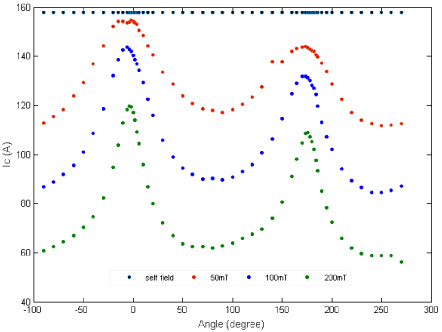
Measured angular dependence of the critical current of a single YBCO tape placed in external magnetic field for different value of magnetic field: 0 mT, 50 mT, 100 mT and 200 mT.
The influence of magnetic field is captured in empirically derived Kim’s equation ((2)) which reflects the anisotropy of HTS tapes with value of parameter k.
For different HTS materials the influence of magnetic field differs, and the effect is described by b power in the Eq. (2) and the example measurement results are presented in Fig. 3 [2,3].
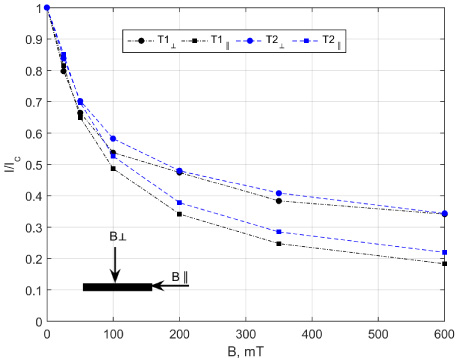
Measured relative critical current value for two types: T1–4 mm, T2–12 mm without airtificial pinning produced by SuperPower as a function of external magnetic field. Examples for perpendicular and parallel direction of the HTS tape.
When designing any superconducting device it is necessary to pick an adequate operating point within safety margins and limits (critical parameters) - critical temperature, critical current density and critical magnetic flux which are interdependent. If one of these values are exceeded the superconductor experiences a rapid change of state - from superconducting to normal state. Depending on cryogenic system, the superconductor may return to superconducting state or quench, resulting in dissipation of energy in the superconductor which may lead to destruction of the device. The analyzed motor presented in Fig. 1 is double-sided, meaning that actuator consists of two mechanically connected parts with mounted PMs. This increases motor torque twofold compared to single-sided motor [12]. The coils are placed between magnets with alternating polarity. Permanent magnets can also be arranged in Halbach array which increases the magnetic field, but at a cost of an increasing number of PMs for the same number of poles. This also leads to increased length of the machine, assuming that dimensions of used magnets stays the same.
Obtaining distribution of magnetic field in the air gap of any electric machine is a difficult task due to complex geometry resulting from slots, slot openings, magnet arrangement and presence of ferromagnetic material. Although it is possible to calculate distribution in particular geometries, especially in presence of symmetry [12]. There are also other ways to calculate distribution of magnetic flux like lumped magnetic circuit models [13]. The numerical analysis was carried in Ansys Electronics software where partial differential equations (PDE) are solved using finite-element method. The problem is described by A-φ formulation ((3)).
The resistivity of HTS material is derived from E-J power law (4), from which the formula for calculating resistivity can be derived ((5)). The resistivity of HTS material depends on current density and it is assumed, that critical current density J
c
is reached for critical electric field intensity E
c
= 100 V/m, which is a common practice and an upper bound for defining critical current density.
The geometry of motor presented in Fig. 1 was simplified to analyze 2D geometry of specific cross-sections of the motor as presented in Fig. 4. When designing the electric motor parameter to be taken into account is magnet span C𝜙 (6) which is a value between 0 and 1. Magnets with span equal to 1 are usually avoided due to high flux leakage, since magnets are close to each other, thus lowering the performance. On the other hand, having magnet span below 0.5 is not favorable since less than half of the space is filled with magnets. Therefore, in practical applications magnets with a span from 0.6 to 0.9 are used [8,14,15].
Except for the high-volume manufacturers, magnets are commercially available in a givendimensions. In this case, authors have decided to use 10 × 10 × 10 mm NdFeB-N35 neodymium magnets due to symmetrical shape. In this way, same magnets can be arranged in either alternating or in Halbach array. Since the magnets dimensions are fixed, change of magnet span leads to an increase of length of the motor.
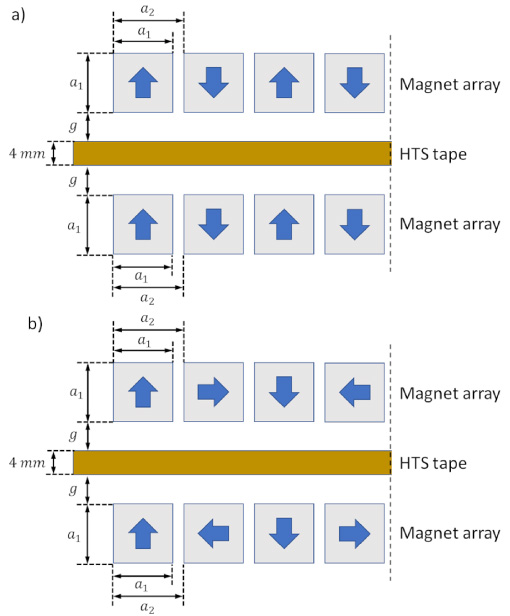
Cross-section of half of analyzed linear transverse-flux permanent magnet motor (a) alternating magnet array; (b) Halbach array.
The total number of magnets is assumed to be the same in both configurations, to have the same length for both. This will result in two times higher number of poles in alternating array compared to Halbach array. In the Fig. 5 the results of FEM simulation are shown for both arrays. To clearly present the results, it was decided to show distribution of magnetic flux
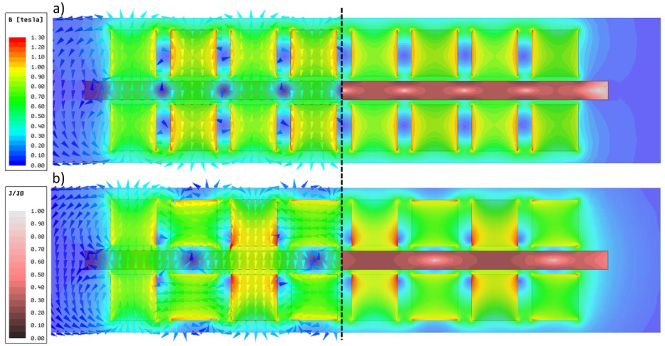
Distribution of magnetic flux and normalized critical current density for C𝜙 = 0.85 and air gap of 1 mm: (a) alternating array; (b) Halbach array.
It can be seen in Fig. 5a, that alternating array results in a lower magnitude of magnetic flux in the air gap compared to Halbach array as in Fig. 5b. The performance of HTS tapeis limited by places where total critical current density J is the lowest along the cross-section of the tape. These places behave as a bottleneck for current and may become hotspots when quench occurs. Increase of critical current in these places (hotspots) can cause local damage of the tape. In this case, to get an idea on how HTS winding performs in the given structure, the value of peak current in ((1)) can be replaced with averaged normalized critical current integrated over the cross-section of HTS tape S
HTS
.
We introduce the reference pole number P
ref
= p
alter
∕p
Halbach
which is a ration of a number of pole pairs between machine utilizing alternating p
alter
and Halbach arrays p
Halbach
assuming the motor has the same length and the same total number of magnets.
To further grasp the influence of a magnetic field on HTS tape the average value of magnetic flux in the air gap and normalized critical currentis presented for change of an air gap size and magnet span C𝜙.
For a given magnet span, the average magnetic flux in the air gap is higher for Halbach array than for alternating array. With a decrease of magnet span, the average flux decreases as well for both arrays in Fig. 6a. Regardless of magnet array, for air gaps smaller than 1 mm, the normalized critical current is similar for different magnets spans of both arrays and is around 22%. The value of
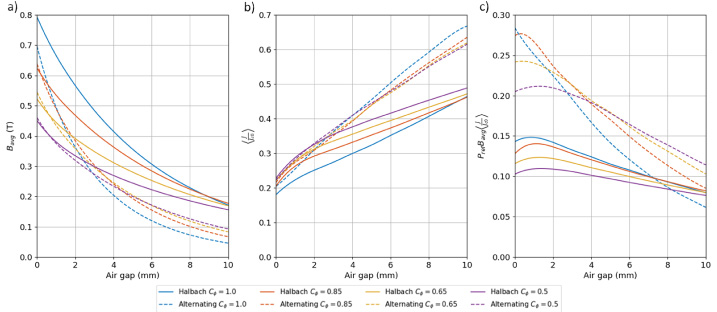
Results of FEM simulation (a) average magnetic flux B
avg
; (b) average normalized critical current
The aim of this paper was to present guidelines for designing a transverse-flux linear motor utilizing superconductors as coils in presence of external magnetic field. For that purpose a generalized equations for estimating output force were introduced with regards to some reference values for both types of analyzed magnet arrays. The analysis was carried for two types of double-sided actuators with with alternating and Halbach arrays. The former results in twice the number of poles for the same length of motor than latter but the downside is lower average magnetic flux in the air gap of the machine. The research was focused on influence of both arrangements on performance of HTS winding in such a motor. A parametric numerical simulation for different air gap sizes and magnet spans was created to evaluate distribution of magnetic field and its effects on critical current of HTS tape using finite-element method in Ansys software. The results of simulation showed that although Halbach array creates higher average magnetic flux in the air gap of the motor, but significantly decreases critical current of HTS. It was shown that alternating PM array is superior to Halbach array in terms of output force which depends on product of number of poles, average magnetic flux in the air gap and current flowing through the coil.