



Abstract
Inclined uniform magnetic field and mixed convention effects on micropolar non-Newtonian nanofluid Al2O3 flow with heat transfer are studied. The heat source, both viscous and ohmic dissipation and temperature micropolarity properties are considered. We transformed our system of non-linear partial differential equations into ordinary equations by using suitable similarity transformations. These equations are solved by making use of Rung–Kutta–Merson method in a shooting and matching technique. The numerical solutions of the tangential velocity, microtation velocity, temperature and nanoparticle concentration are obtained as functions of the physical parameters of the problem. Moreover, we discussed the effects of these parameters on the numerical solutions and depicted graphically. It is obvious that these parameters control the fluid flow. It is noticed that the tangential velocity magnifies with an increase in the value of Darcy number. Meanwhile, the value of the tangential velocity reduces with the elevation in the value of the magnetic field parameter. On the other hand, the elevation in the value of Brownian motion parameter leads to a reduction in the value of fluid temperature. Furthermore, increasing in the value of heat source parameter makes an enhancement in the value of nanoparticles concentration. The current study has many accomplishments in several scientific areas like medical industry, medicine, and others. Therefore, it represents the depiction of gas or liquid motion over a surface. When particles are moving from areas of high concentration to areas of low concentration.
Introduction
Magnetohydrodynamics (MHD) is the study of the magnetic properties and behavior of electrically conducting fluids. It builds up a coupling between the Navier–Stokes equations for fluid elements and Maxwell’s equations for electromagnetism. The micropolar fluids are non-Newtonian fluids consisting of a suspension of small body fluids and colloidal fluid elements. This model is derived from the Navier–Stokes model and takes into account the rotation of particles. In the area where the flow regulate from zero velocity at the wall to extreme velocity within the main stream of the flow is called the boundary layer. The concept of boundary layers is of significance in all of viscous fluid dynamics within the hypothesis of heat transfer. Nanofluid may be a fluid suspension containing very little particles with diameter less than 100 nm. Convection is one of the mods of heat transfer and, unlike conduction heat transfer in convection involves molecular diffusion along with bulk motion.
Many researchers studied MHD influences on viscous, incompressible and electrically conducting fluids because of its applications in different fluid engineering devices such as: viz plasma confinement and liquid metal cooling of nuclear reactors. The fluid pump for producing a continuous flow through a non-Darcy porous medium taking into consideration: viscous dissipation, the heat source, thermal diffusion and chemical reaction. The ectro-magnetic and micropolar characteristics on biviscosity fluid flow with heat and mass transfer have been discussed by Ouaf and Abouzeid [1]. Eldabe et al. [2] investigated the peristaltic flow of Jeffery nanofluid inside an asymmetric channel. Hall currents, Joule heat and viscous dissipation are taken into their consideration. The influence of buoyancy parameters beside radiation on MHD micro-polar nano-fluid flow over a stretching/shrinking sheet is examined by Rehman [3]. Eldabe et al. [4] studied MHD peristaltic flow of steady non-Newtonian nanofluid with heat transfer through a non-uniform vertical duct. A numerical solution for the problem of unsteady space fractional MHD free convective flow and heat transfer influences with Hall is discussed by Xiaoqing [5]. Abouzeid [6] explained MHD flow for a non-Newtonian nanofluid with Cattaneo–Christov heat flux through a porous media. Inside a square enclosure the thermal characteristics and the flow pattern of free convection of a Newtonian MHD fluid flow against two different non-Newtonian power-law fluids are compared by Rostami [7]. Recently, there are many researches related to MHD over different surfaces [8–10].
Animal blood liquid crystals, polymeric fluids, paints, Ferro liquids, and colloidal fluids are considered examples of fluids with microstructures. Bég [11] discussed, theoretically and numerically unsteady MHD micropolar flow as viscous two-dimensional, heat and mass transfer with Hall and Ion-slip currents from an infinite vertical surface. MHD peristaltic flow of a micropolar non-Newtonian Casson nanofluid through a porous medium is examined by Mohamed and Abou-zeid [12]. Jingrui [13] examined the appropriate weak arrange to the compressible micropolar non-Newtonian Casson model. A theoretical study for MHD peristaltic flow of micropolar non-Newtonian biviscosity fluid is developed by Eldabe and Abouzeid [14]. A mathematical model for bacterial growth in the heart valve with numerical simulation is examined. The nanoparticles have used for antibacterial activities and antibodies properties. And due to dispersion homogeneously antibiotics through the blood the non-Newtonian fluid of Casson micropolar blood flow in the heart valve for two dimensional with variable properties is studied by Elelamy et al. [15].
The boundary layer flow and heat transfer over a stretching/shrinking sheet have been deemed trusted because of their applications including glass-fiber production, plastic pieces aero-dynamic extrusion, hot rolling and paper production. El-Dabe et al. [16] discussed the motion of non-Newtonian fluid with heat and mass transfer through porous medium past a shrinking plate. The boundary layer flow with heat and mass transfer properties are achieved analytically in the presence of viscous dissipation and heat source by Abouzeid [17]. Eldabe et al. [18] investigated the effects of thermal diffusion and diffusion thermo on the motion of a non-Newtonian Eyring Powell nanofluid with gyrotactic microorganisms in the boundary layer. The viscous fluid for flow over a curved surface stretching with nonlinear power-law velocity is studied by Nadeem et al. [19]. Recently, there have been different studies that discuss the boundary layer flow [20–23].
Nanofluid has numerous applications in heat transfer such as microelectronics, fuel cells and pharmaceutical industry, and in powered engines such as engine cooling, vehicle thermal management, refrigerator, heat exchanger and boiler flue gas temperature reduction. Recently, nanofluids have been used to treat cancer. Nanotechnology is an important field in science and engineering. The nanotechnology sustainability for biomedical applications are studied by Falsini et al. [24]. Dharmalingam et al. [25] being developed different nano materials in the field of engineering. Riaz et al. [26] has discussed computational research on the peristaltic propulsion of nanofluid flow through a porous rectangular duct. Rasool et al. [27] analyzed the characteristic of MHD Darcy–Forchheimer nanofluid flow over a nonlinear stretching sheet. An analytical study is explained for couple stresses influences on MHD peristaltic transport of a non-Newtonian Jeffery nanofluid by Abou-zeid [28]. In the presence of small particles moving in the sinusoidal form in a Darcy–Brinkman–Forchheimer medium the electro-osmotic flow of non-Newtonian fluid is studied. A transverse magnetic field considered by ignoring the influence of an induced magnetic field with taking a small magnetic Reynolds number. To examine the non-Newtonian effects, Jeffrey fluid model is considered by Bhatti et al. [29]. Many results of the nanofluid are studied in these articles [30–33].
Our aim in this work is to extend the work of Ouaf and Abouzeid [1] to include mixed convection, inclined uniform magnetic field, heat source and both thermophoresis and Brownian effects. Then, the boundary layer flow of non-Newtonian nanofluid Al2O3, conducting fluid with heat transfer over a verical plate is studied. The system is stressed by a uniform inclined magnetic field. A heat generation with thermal micropolar properties are taken in consideration. This fluid motion is modulated by a system of non-linear partial differential equations which are transformed into non-linear ordinary differential equations by using the suitable transformations. This system is solved numerically and is subjected to the appropriate boundary conditions to obtain the velocity, temperature and concentration fields. The influences of the physical parameters of the problem on these solutions are discussed numerically and illustrated graphically through a set of figures. Physically, the present work is very substantial in an important industrial implementation like the depiction of the liquid or gas in the boundary layer tends to cling to the surface. Moreover, the location the separation point itself can be determined by theory of boundary layer. So, this analysis can serve as a model which may support in comprehension the mechanics of physiological flows.
Mathematical formulations
In this work, we cosidered a two-demensional micropolar Casson fluid past a stretching surface along with the characteristics of convective heat. A magnetic field is applied with the magnitude B 0 to the inclination angle.
The constitutive equation of Casson fluid can be written as follows:
The governing equations which describe velocity, microrotation velocity, temperature, nano-particles concentration distributions can be written as [34]:
The appropriate boundary conditions appear under the effect of shrinking surface as
Substitution of Eqs ((8)) in Eqs ((3))--((6)) we get
The boundary conditions in the non-dimensional form are:
The governing equations become more complex to handle as supplemental nonlinear terms appear in the equations of motion because of the flow behavior of non-Newtonian nanofluids. So the exact solutions of such problems are practically impossible.
Method of solution
In order to solve the above equations, let
Hence, equations ((9))–((12)) can be written as follows:
The system of equations (9)–(12) with the boundary conditions (13), are more complex to handle as supplemental nonlinear terms appear in the equations of motion. So, we apply shooting technique by using NAG Fortran library, namely, the subroutine D02HAF which requires the guessing of starting values of missing initial and terminal conditions. Rung–Kutta–Merson method with variable step size is used in this subroutine in order to control the local truncation error, then modified Newton-Raphson technique is applied to make successive corrections to the estimated boundary values. The process is repeated iteratively until convergence is obtained i.e. until the absolute values of the difference between every two successive approximations of the missing conditions is less than ϵ (in our spacingϵ =10−7).
Here, the tangential velocity, micro-rotation velocity, temperature and nano-particles concentration for different values of the physical parameters contained in the problem are discussed graphically. These numerical values are obtained by using “Mathematica package Ver.10.1”. We calculated the coefficients of both heat transfer and mass transfer to obtain the effect of these parameters in detail.
The variations of the tangential velocity with the dimensionless coordinate 𝜂 for different values of magnetic parameter M and the Darcy number Da individually are shown in Figs 1 and 2. It is seen from these figures that the velocity decreases with the increase of M, while it increases as Da increases. The result in Fig. 1 is due to the Lorentz force retards the flow i.e. This force causes reduction in the fluid velocity within the boundary layer as the magnetic field opposes the transport phenomena. Moreover, for small values of M and large values of Da, there is a semi-linear relation between the velocity and the dimensionless coordinate 𝜂. The result in Fig. 2 is due to increase the Darcy number which leads to more porous in medium, in the porous layer the fluid permeability increases, so the velocity increases. Also, the result in Fig. 2 agrees with those obtained by [35]. The effects of both Q and Br on the velocity (figures are removed) are found to be exactly like the effect of Da on the velocity given in Fig. 2, with the only difference that the obtained curves are very close to those obtained in Fig. 2. Similar result to that shown in Fig. 1 can be obtained if M is replaced by Fs or Nt.
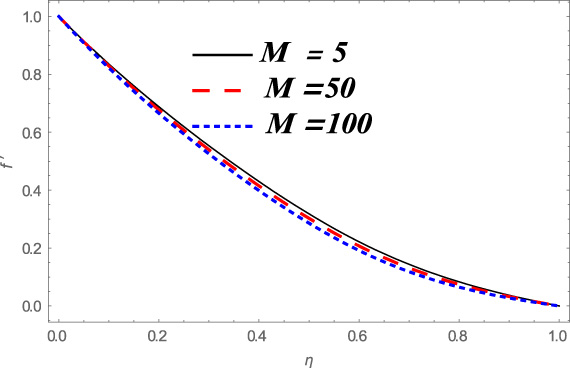
The tangential velocity is plotted versus for different values of M and for k 1 = 0.01, Fs = 2.6, β = 0.1, Da = 0.05, γ = 0.5, Pr = 2.5, Q = 10, Sc = 1.5, Br = 0.01, Gr = 1, Γ = 50, Ec = 0.5, Pr = 1.5, Nt = 1, Nb = 1.
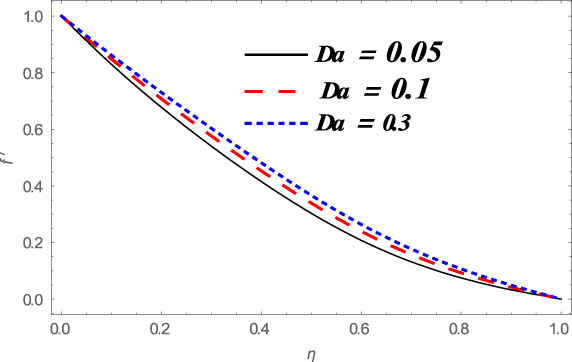
The tangential velocity is plotted versus
Figures 3 and 4 represent the effects of Grashorf number Gr and Darcy number Da on the micro-rotation velocity g which is a function of 𝜂. It is found that the microrotation distribution increases by increasing Gr, while the behavior of g for different values of Da is an inversed way to the behavior of g for different values of Gr given in Fig. 3, i.e. it decreases by increasing Da. Also, not all curves intersect at 𝜂 = 0, due to the boundary conditions (13). The behavior of g with both Nt and Fs is found to be like the curves in Fig. 3, with the only difference being that the obtained curves are very close to those obtained in Fig. 3.
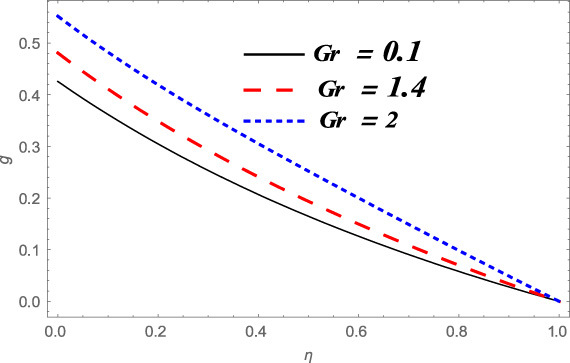
The micro-rotation velocity is plotted versus
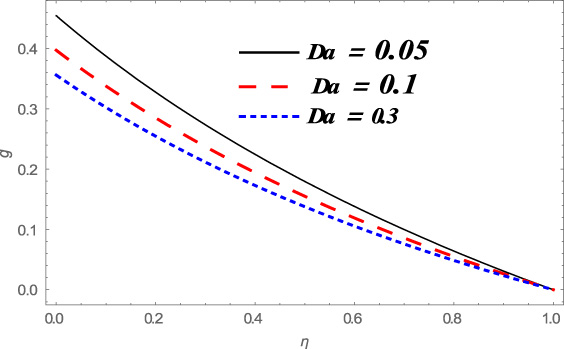
The micro-rotation velocity is plotted versus
The temperature is plotted versus
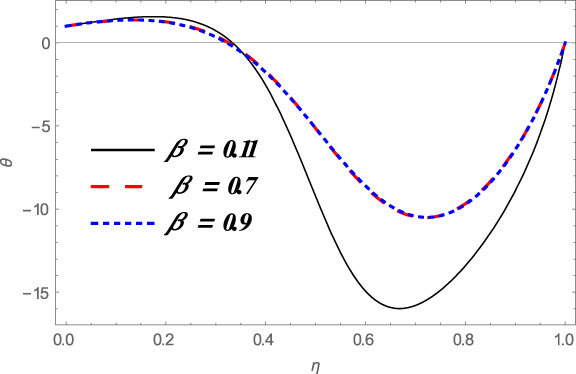
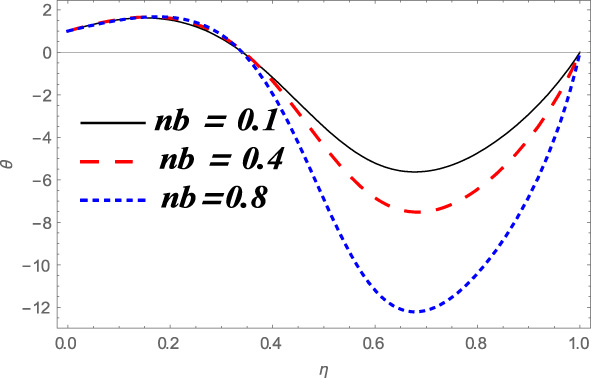
The alters of the temperature distribution θ with the dimensionless coordinate 𝜂 for different values of the the upper limit of apparent viscosity coefficient 𝛽 and Brownian motion parameter Nb appear in Figs 5 and 6, respectively. The graphical outcomes of Figs 5 and 6, indicate that the temperature distribution θ increases with an increase in the parameter 𝛽 while it decreases with the increase of Nb. It is also noted that for each value of both 𝛽 and Nb, the temperature distribution has a minimum value, i.e. θ decreases as 𝜂 increases till a minimum value, which increases by increasing 𝛽 and decreases by increasing Nb, and all minimum values occur at 𝜂 = 0.67. The result in Fig. 6 is due to the their collision with fast-moving molecules within the fluid. Hence, the nanoparticles temperature in the space is lower for large values of Nb. The results which are obtained in Fig. 6, are in agreement with those which are presented by Eldabe et al. [14]. The result in Fig. 5 is due the following; the temperature increases as viscosity of gases increases and the viscosity is approximately proportional to the square of root of temperature. This is because of the increase in the frequency of intermolecular collisions at high vales temperatures. The effect of the Eckert number Ec on the temperature distribution T is similar to the effect of Nb on T which appeared in Fig. 6, with the only difference that there is an inverse behavior near the wall, namely 0 < 𝜂 < 0.39. This figure is excluded here to save space.
The temperature is plotted versus
The nanoparticles concentration is plotted versus
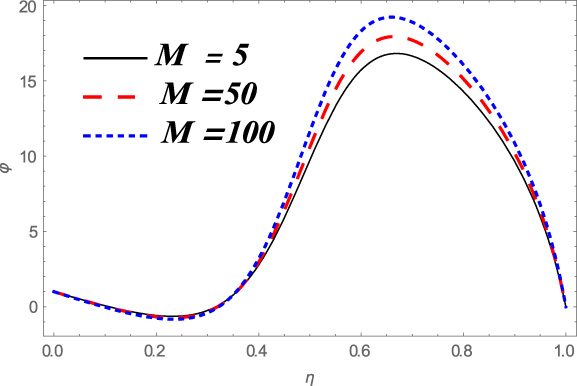
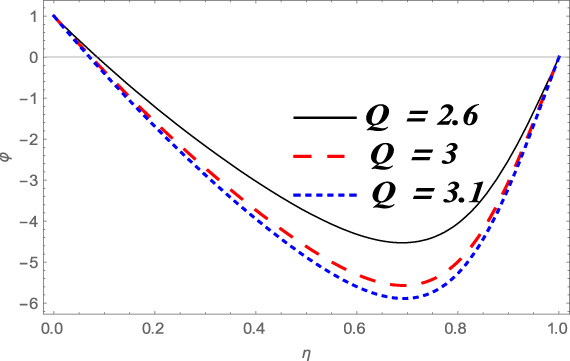
The variations of the nanoparticles concentration φ with the dimensionless coordinate 𝜂 for different values of magnetic parameter M and the heat source Q, respectively are shown in Figs 7 and 8. It is seen from these figures that the nano-particles concentration increases with the increase of M, while it decreases as Q increases. It is also noted that for large values of M, the relation between φ and 𝜂 is a parabola, i.e. φ increases with 𝜂 till a definite value 𝜂 = 𝜂0 (represents the maximum value of φ) and it decreases afterwards. This maximum value of φ increases by increasing M. The results which are obtained in Figs 7 and 8, are in agreement with those which are presented by Abouzeid [1] and Eldabe and Abouzeid [36], respectively. The behavior of other parameters is similar to behavior of M in Fig. 7, except that the obtained curves are closer to each other than those obtained in Fig. 7.
The nanoparticles concentration is plotted versus
The purpose of the current analysis is to display the influence of heat transfer on MHD boundary layer flow of a micropolar non-Newtonian alumina Al2O3 nanofluid. The incompressible biviscosity model flow over a verical plate is considered. Our system is influenced by a inclined magnetic field, including non-Darcy porous medium, mixed convection, Ohmic and viscous dissipation and heat source effects. So, this problem is an extension the problem of Ouaf and Abouzeid [1]. The governing equations of motion are displayed in a non-dimensional form, and are very complicated to solve. Therefore, to relax the complexity of the mathematical procedure, asuitable similarity transformations are followed. This system of equations is solved numerically by applying Rung–Kutta–Merson method with shooting and matching technique. A group of figures are drawn to describe the impacts of the various non-dimensional parameters on the tangential velocity u, microrotation velocity g, temperature θ and nanoparticles concentration φ distributions. The numerical results are found to be in a great complying with other studies. The obtained results can be outlined as follows. The tangential velocity increases by increasing Br, Q, k and Da, while it decreases as M, Gr, Nb, Nt, Ec, Fs and 𝛾 increase. By increasing Ec, Fs, M and Nb, the microrotation velocity increases while it decreases as Da and Br increase. The temperature distribution increases as Da, and Q increase, while it decreases when Fs and M increases. Moreover, it increases or decreases as other physical parameters of the problem increase. The temperature becomes lower with increasing the dimensionless coordinate 𝜂 and reaches minimum at 𝜂 = 0.7, after which, it increases. The nanoparticlers concentration behavior is contrary with respect to the temperature behavior except that it decreases as Q, Da and Nb increase.
Applications
The results of this paper may have many importance applications in several fields concerned with boundary-layer flow of non-Newtonian nanofluids problems. Furthermore, from the physical point of view, this investigation has several applications such as The drag forces examination. Gas or liquid flow over a surface. Analysis of fluctuation motion. Airfoils flow with low or high Reynolds number.
Footnotes
Acknowledgement
The authors thank the reviewers for their valuable remarks which improved and enriched our manuscript.