




Abstract
In this work, a novel superconducting (SC) inductor topology for an axial flux synchronous machine is presented and tested. The proposed device combines HTS YBaCuO bulks and coils supplied with DC current to create a variable air gap flux density distribution. In fact, the two SC bulks modulate and redirect the flux lines produced by the coil thanks to their magnetic field shielding property. This results in a periodic space variation of the axial component of the flux density. A 3D electromagnetic modeling based on a finite element solution is developed to demonstrate the relevance of using the magnetic shielding properties of SC bulks. In order to verify the screening properties of the SC bulk, a prototype of the proposed inductor was constructed and tested in the laboratory.
Introduction
Advances in the technology of superconducting materials and cryogenic systems have led to a new generation of electrical actuators. Indeed, the use of superconductors allows the generation of very intense magnetic fields and the transmission of energy without losses [1].
One of the main challenges of using superconductors in electric machines is to increase the magnetic flux density in the air gap and thus reduce the volume of the electric machine [2]. The majority of the superconducting rotating machines studied and realized are radial flux synchronous machines with a dominant structure of salient pole synchronous motors. In this kind of machines, it is a question of taking a classical copper motor and replacing the direct current winding part of the inductor by superconducting coils [2–4].
In axial flux synchronous machines, the magnetic field is directed along the axis with “flower petal” windings. Several structures have been realized, distinguishing three categories, machines with superconducting coils, others with passive superconducting materials (bulks) and machines with both types of materials [5–7].
In this work, a novel topology of the inductor of an axial field synchronous machine is presented and constructed in laboratory. The principle of flux concentration is adopted by combining high-temperature superconducting (HTS) bulks and a superconducting coil.
Machine design
Structure of the studied machine
In electric motors, the torque is mainly proportional to two parameters: the tangential magnetic field created by the armature winding and the normal flux density generated by the inductor winding in the air gap. To increase the motor torque, two solutions are possible: the first is to increase the magnetic field in the armature, which means using a high armature current that depends on the size of the slots.
The second solution is to increase the flux density generated by the inductor. The last solution, which is limited by the saturation of the materials used, can be achieved by the principle of flux concentration [8].
The structure of the proposed inductor, presented in Fig. 1, consists of a superconducting coil stuck in a non-magnetic disk supplied with DC current and two superconducting YBaCuO bulks. Thanks to their magnetic field screening property, two HTS bulks modulate and redirect the flux density lines produced by the coil [9]. Thus, we can generate a periodic spatial variation of the axial component of the flux density which varies between Bmin and Bmax (Fig. 2).

Topology of the axial field concentration machine.
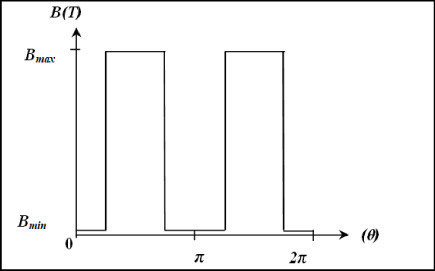
Spatial variation of the flux density.
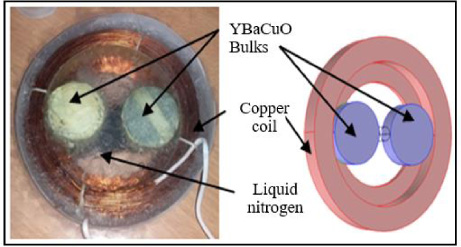
Realized prototype of new inductor.
Obviously, the HTS bulks also placed on the non-magnetic disk of the inductor are cooled with liquid nitrogen to operate as a barrier to the flux density lines created by the superconducting coil [10].
In order to study the feasibility of this new topology of the inductor, a 3D finite element magneto-static model is developed. A magnetic vector potential formulation, noted A, is adopted so the flux density B is determined by:
In the air and the superconducting bulks In the coil
In this model the superconducting coil is supplied with a uniform current density over its cross-section area. A very low relative permeability (μ r = 10−4) is considered for the HTS bulks to account for its screening property.
The external boundary condition (A = 0) is set on the surface of an infinite box surrounding the studied structure.
The prototype of the proposed inductor was constructed in the laboratory. As shown in Fig. 3, it consists of a copper coil and two circular shaped YBaCuO HTS bulks. The critical temperature of this superconductor is 93 K. This inductor is cooled with liquid nitrogen at 77 K. The test is performed by supplying the coil with a DC current of I = 10.24 A which results in a current density of 11.3 (A∕mm2) in the copper conductor.
It can be seen in Fig. 4 that the flux density waveform predicted by the 3D FE model is in good agreement with the experiments. It presents a periodic spatial variation and its amplitude varies between the positive values Bmin and Bmax. The measured maximum value of the flux density in the air gap is about 40.8 mT. As we can see in Fig. 4, the flux density is concentrated between the two HTS bulks at 90° and 270°.
In Fig. 5, we can clearly see the screening effect of the two YBaCuO bulks.
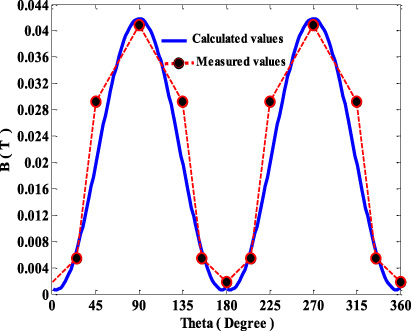
Flux density in the air gap: comparison between experimental and 3D FE for (I = 10.24 A).
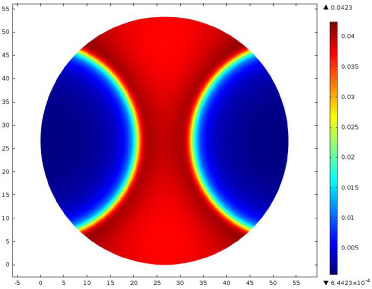
Flux density distribution in the air gap.
For the considered inductor, the HTS coil is made from BSCCO tapes. The geometric parameters of the BSCCO tape are shown in Table 1.
The parameters of the Kim model (Jc0, k, Bj0, 𝛽), at a working temperature of 30 K, are given in Table 2 [11]. Hence, one can determine the critical current J cr (B) of the coil.
BSCCO HTS tape specifications [11]
BSCCO HTS tape specifications [11]
The parameters of the Kim model at 30 K [11]
This section is devoted to the analysis of the HTS bulk behavior which has a nonlinear relationship between the electric field E and the current density J.
This relationship is well described by the power law [12]
J c : is the critical current density; n: Exponent of the power law. B and T are respectively the local flux density and the cooling temperature. E c : is the critical electric field corresponding to the critical current.
Using a magnetic field
The magnetic field has two components:
The use of this vector formulation makes it easy to simulate problems containing materials with nonlinear properties. A finite element modeling requires the use of edge elements that ensure the continuity of the magnetic field at the interface of adjacent elements.
To avoid convergence problems in the resolution method, it is much recommended to modify the power law (Eq. (5)) by adding an arbitrary residual resistivity, as follows:
In this study, a homogeneous magnetic field is imposed in the form of a ramp. So the flux density applied on the surface of the superconducting bulk (YBaCuO) is expressed by:
Figure 6 shows the normal flux density distribution in the YBaCuO bulk material at different times t = 0, 15, 30, 45 and 60 s. Note that, for the time t = 60 s, the applied flux density is B app = 4 T on the superconducting bulk.
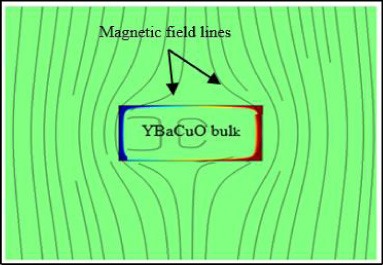
This study illustrates the influence of the flux density on the screening capacity of the superconducting bulk. Indeed, the induced currents develop mainly on the outer edge of the YBaCuO bulk (HTS) in order to oppose the applied external field (Lenz law).

Normal flux density as function of B app of bulk (YBaCuO).
Screening of the superconducting bulk (YBaCuO) in 2D.
Characteristics of a YBaCuO bulk superconductor [13]
Figures 6 and 7 show that if Bapp increases, this high current density region moves towards the center of the HTS bulk. Thus, the screening width of the SC bulk decreases. However, the flux density remains mainly deflected around the YBaCuO bulk whose properties are given in Table 3.
With the edge condition (A = 0), the flux density remains totally expelled from the superconductor whatever the imposed amplitude.
The normal flux density distribution at the surface of the superconductor, as well as in the middle, remains close for B app below 2 Tesla. Beyond that, the penetration width of the flux density in the superconducting material can no longer be neglected and must therefore be considered.

Structure of the studied superconducting axial machine.
B = f (J). Critical current density J c = 448 (A∕mm2).
The proposed three-phase axial synchronous machine operates in generator mode. The rotating armature is an ordinary non-magnetic disk with six concentric copper coils placed side by side with an offset angle of 60° (Fig. 8). Two successive coils connected in series represent one phase. The machine parameters are indicated in Table 4.
The induced electromotive force e
i
(t) of phase i is expressed as:
Each phase contains two successive coils in series. Then the flux ∅
i
(t) is expressed as:
(θ s , r s ): are the coordinates of the point located in the middle of the coil and R s the radius of the coil.
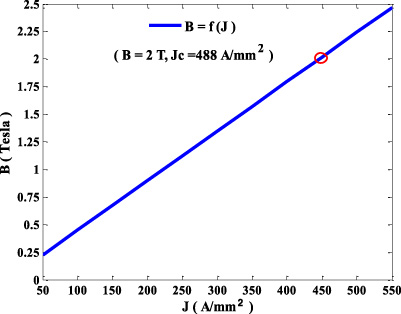
In order to analyze the screening ability of the HTS bulks when varying the coil’s current density J, we have plotted on Fig. 9 the flux density norm vs. current density curve at the middle surface of the bulks. Obviously, this modulus increases with the current density. It is clear that it should not exceed a current density of 448 (A/mm2) to maintain the shielding capacity of the YBaCuO HTS bulks.
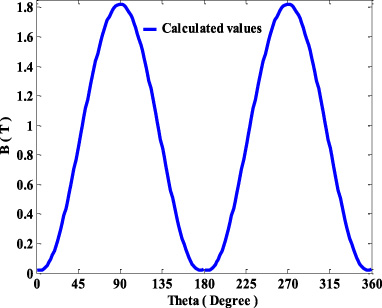
The waveform of the axial component of the flux density as a function of angular position is shown in Fig. 10. The curve is plotted along an arc (in the θ direction) located in the middle of the air gap. It can be seen that the flux density waveform has a periodic spatial variation with two pole pairs and its amplitude reaches 1.82 T.
Axial flux density waveform in the air gap (J = 448 A∕mm2) of the inductor alone.

Flux under one pole of the machine.

Electromotive force (EMF phase voltage).
Machine parameters
As shown in Fig. 11, the flux linkage of one phase of the armature reaches 𝜙 = 0.44 Wb.
We observe on Fig. 12 that the phase EMF has an alternating time variation. With a maximum value of 165 V for a rotational speed 𝛺 = 1500 rpm. The number of turns of the phase armature coil is N s = 250 turns.
A novel topology of an axial flux synchronous machine inductor is presented in this work. It consists of a superconducting coil supplied with Dc current whose flux density is modulated using two superconducting YBaCuO bulks. This results in a periodic spatial variation of the axial component of the flux density.
To validate the proposed concept, a prototype of the inductor made from a copper coil and two superconducting YBaCuO bulks has been constructed and successfully tested in the laboratory.
The experimental results have also been checked by 3D finite element computations. A good agreement is obtained which shows the feasibility of the proposed inductor. Furthermore, the use of a superconducting coil and the two YBaCuO bulks allows a considerable increase the flux density in the air gap thus reducing the volume of the electrical machine.
In the future, a prototype of the proposed inductor with superconducting coil will be tested.