




Abstract
A microbicidal Protecting Breathing Device using an Ultraviolet Germicidal Irradiation (UVGI) air-sterilization unit, is designed and analyzed. The system is producing short-wave UV light which inactivates bacteria, viruses, and protozoa and it is connected to a full-face mask supplying sterilized inhaled air to the user and in a unique way, also sterilizes the exhaled air back to the ambient environment so covering the case of an asymptomatic transmitter. A dedicated control system is developed and built in the device for a full surveillance of the system.
Keywords
Introduction and device description
The idea of using UVC radiation for sterilization purposes is very old. In 1879, Arthur Downes and Thomas P. Blunt [1] published a paper describing the sterilization of bacteria exposed to short-wavelength light. The 1903 Nobel Prize for Medicine was awarded to Niels Finsen [2], for his use of UV against lupus vulgaris, tuberculosis of the skin. Dr. Edward A. Nardell [3], professor of global health and social medicine at Harvard Medical School is stated that UVC radiation is a highly effective, very safe technology for airborne infections and they have done studies, proving that it works. Newest research [4,5] have clearly proved the effectiveness of UVC radiation, against SARS-COV-2. On the other hand, breathing devices have been used at the lethal Spanish flew pandemic, almost a century ago and they are still used in the modern era. Our aim was to build an integrated system combining the aforementioned practices, using state of the art technologies creating a novel device with a unique feature of disinfected both inhale and exhale air of any given user. A step-by-step analysis of the various components has been performed and thoroughly examined before each one became a part of the integrated device.
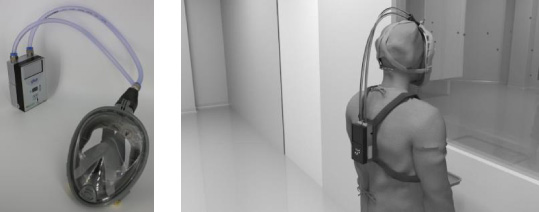
The breathing device called VITER (Virus TERminator).
The system (Fig. 1) consists of a modified snorkeling mask, an adaptor, air pipes and the main unit. The aim of the adaptor design Fig. 2 was to create a 3D printed connector that hermetically adapts to the existing mask outlet and inlet, and guide the inhale and exhale air, through the air tubes, to the main device for sterilization. Among the challenges of the design process was to create a smooth transition from a rectangular cross-section to a circular cross-section of specific dimensions. The geometric complexity lies in the fact that the transitions from one section to another must be made gradually, through curved surfaces that display curvature continuity, so as not to obstruct the flow of air. The internal form was therefore created by blending double-curved surfaces, considering wall thicknesses that can be successfully 3D printed without compromising the object’s robustness. The inlet and outlet connect through the respective tubes to the air disinfection unit.
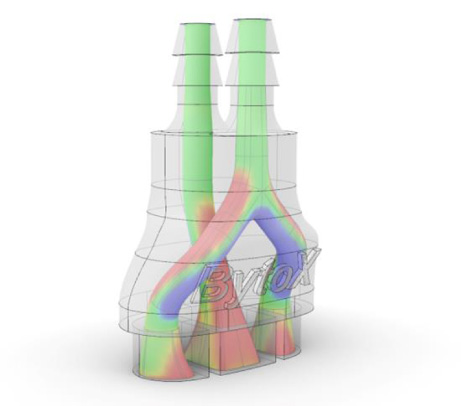
The 3D adaptor displaying curvature continuity.
At main unit two individual paths sterilize the inhaled and exhaled air by illuminating with a proper UVC [4,5] radiation away from the dangerous Ozon producing zone. The system is based on four UV-LEDs and a blower to disinfect and provide the necessary air flow to the protected individuals. All the LEDs as well as the blower are fed through independent current sources, each controlled by a separate DC–DC switching regulator (PWM). This ensures the proper polarization current for each LED to ensure radiation peaks at the exact disinfecting wavelength and strength. Similarly, the blower adjusts the air flow to assure the user’s breathing comfort, through a local and wireless remote user interface. A Li-ion battery feeds the system for several working hours under usual field constrains. Sensors, monitor continuously the temperature of the provided air flow to prevent any harm and discomfort of the user. An SD memory card is included in the system to log continuously the operating conditions with exact time stamps and the working hours of the UV sources, to assure their effectiveness. Visual and variable audible warnings are generated to inform the user for any extreme functioning conditions and the system sleeps or shuts down if necessary. The system is driven (Fig. 3) by a low power, arm controller having a local graphics display, a wifi interface, real time clock, user buttons, battery charger and a battery management system. The controller has been customized for the specific device and the relevant dedicated software was written to ensure the proper functionality of the system and to protect the user from potential malfunctions, like low battery level conditions, high breathing temperatures, LEDs working out of the limits and others. The built-in sensors provide additional real time safety.
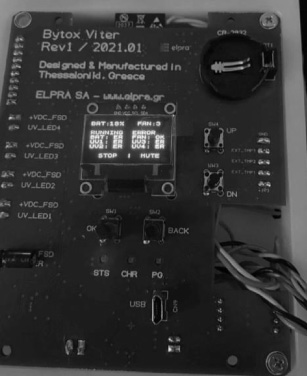
The control device.
Bio-aerosols are an airborne collection of biological materials. Bio-aerosols in suspended, aerosolized liquid droplets typically contain microbes and cell fragments combined with byproducts of cellular metabolism [8]. In addition, they may carry viruses, bacteria and fungi that float on dust particles along with cells and parts of cells.
Microbial aerosols are generated in outdoor and indoor environments because of a variety of natural and anthropogenic activities [7]. Inhalation of microbial aerosols can elicit adverse human health effects including infection, allergic reaction, inflammation and respiratory disease [6] Airborne viruses, bacteria, and fungi, known as bioaerosols, are of interest, especially from public health points of view because some can lead to plain or sever human diseases. Due to the recent SARS-CoV-2 pandemic, the necessity of creating means to minimize the spread of airborne microbes is as urgent as ever. Studies have proven that SARS-CoV-2 forms aggregates with airborne bio-aerosols. A SARS-CoV-2 transmitter person while talking, sneezing, or coughing can still provide a pathogenic bio-aerosol load with submicron particles that remain viable in air for up to 3 h thus exposing healthy persons near and far from the source in a stagnant environment [6]. According to literature [9], there are several validated methods for reducing airborne microbial bio-aerosols, the most commonly and effectively used techniques are Air Filtration and UVC (𝜆 = 253,7 nm) irradiation.
Experiments and procedures for microbial air bioburden
An experiment was conducted at Microbiological laboratory of Quality Control’s Department, of Hellenic Pasteur Institute, to visualize the microbial reduction using the VITER (VIrus TERminator) device. The room volume was approximately 50 m3 and the sampling procedure included air samples of 1 m3 volume per plate. All experiments were carried out based on the common principle of measuring the initial microbial count and to compare it with its corresponding, after the application the mechanical air sterilization system Viter, at standard time points of use with two different air sampling technics, with passive air sampling (4-hour precipitation/dish) [11] and active air sampling using a precise compliant air sampler MAS-100 (Fig. 4). Antimicrobial air sampling devices, certified according to ISO 14698-1 [10], are widely used in the pharmaceutical and personal care industries. Microbial load measurements with air samplers are performed in accordance with the EU GMP for proper manufacturing principles for microbial monitoring of ambient air in controlled environments up to clean rooms. A specified amount of air is aspirated through a perforated lid and impacted onto the surface of growth media in standard 90-100 mm Petri dishes. The system measures the airflow and regulates it to a constant value of 100 standard liters/min.
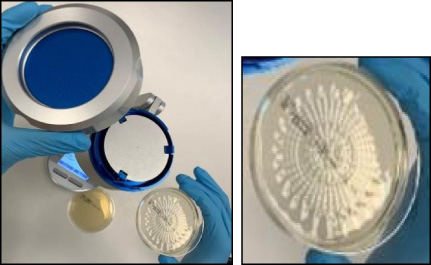
Microbial air sampler, MAS-100, used for the experiment (left). Visible imprint of forced air on petri dish (right).
The measurement of microbial air bioburden was calculated before (passive & active air sampling), as well as after the use of the prototype air sterilization system (active air sampling) at 5, 10, 15, 30 minutes. Petri dishes with Tryptic Soy Agar (TSA) nutrient medium were used and the mechanical system was running on 2 modes FAN2 (medium) and FAN3 (high). Microorganisms were impacted onto agar plates and after an appropriate incubation period, the colonies were counted, while the results were expressed in cfu/m3. (colony-forming units per cubic meter).
An elevated reduction of the total microbial air bioburden of up to 99.25% at FAN3 mode was observed, after the application of the Viter device (Table 1).
Results from Petri dishes (TSA) expressed in cfu/m3, after air sterilization system Viter at 2 modes: FAN2 & FAN3
Summary of results with % reduction, after air sterilization system Viter at 2 modes: FAN2 & FAN3
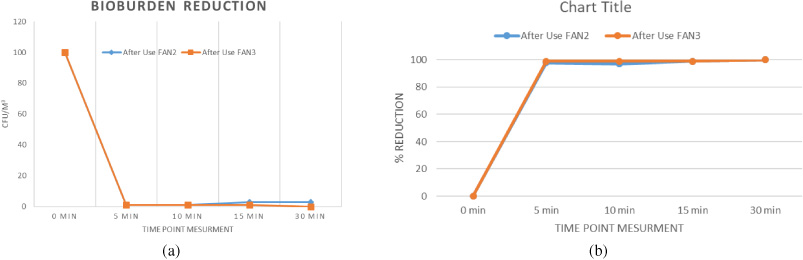
Schematical presentation of Table 2, expressed in cfu/m3 (a) and % Reduction (b).
A new device (VITER) is designed, analyzed, studied, and tested. The main task of Viter is to provide disinfected air to individuals working in high-risk environments or treating virus infected patients, such as by the recent covid-19 pandemic. Viter is transforming passive to active safety. A reduction of the total microbial air bioburden was observed, after the application of the Viter, device, 98.40%, at FAN2 mode and 99, 25%.at FAN3 mode. The performance of the device proved to be very high and warrant the security and confidence to the first liners to continue to serve and help everyone in need.
Footnotes
Acknowledgements
The authors like to express their gratitude to Bytox S.A., for financing and leading the program, and G. Samaras S.A., ELPRA S.A. for their help at design and final construction.