



Abstract
A metamaterial (MM) generally works on a resonance mode, and its permeability will vary sharply around this resonance frequency. Consequently, the performance of a MM will be largely degraded if it is designed using a traditional optimization technique without considering these inevitable imperfections in fabrications. In this regard, the robustness of a solution must be included in the design optimization of a MM, exacerbating additional computational burdens to the already costly design procedure arising from the application of a high-fidelity model. Consequently, it is demanding to reduce the function calls for a high-fidelity model in the robust design of a MM. In this point of view, an optimization methodology by combining the genetic algorithm (GA) and a local search surrogate model is proposed for efficiently robust optimizations of a MM unit.
Introduction
A metamaterial (MM) is a man-made structured material by embedding inclusions in a host media. Electromagnetic MM has diverse applications, including wireless power transmission [1], transformer [2], and eddy current testing [3], in electrical engineering since it has some extraordinary physical properties that do not exist in natural media. Nevertheless, a MM with a large negative permeability and a small size and resonance frequency in low frequency regime is still being developed. For example, the size and dimension of a MM are in the range of a subwavelength, and become impractically large, which will be unacceptable for real-world applications when applied to low frequency electronic and electrical systems and devices. Also, the resonance frequency of existing low frequency MMs is still very high. The design optimization has thus become a vital approach in the quest to enhance MM performance such as a larger permeability and a lower resonance frequency.
However, the complex electromagnetic mechanisms of a MM and the high nonlinearity between the design variables and the performance parameters lend a metamaterial design optimization not an easy task. Moreover, the permeability of a MM will vary sharply at its working frequency. In this point of view, the performance of a MM will be significantly degraded due to the imperfections in fabrications and fluctuations in working and environmental conditions. In this regard, it is equally important to consider the robustness of a solution in design optimizations of a MM. In this direction, the worst-case solution to measure the robustness of a solution is used in a realistic active metamaterial design [4]. To seek the worst case solution of a specific design, an inner optimization loop is generally required and implemented. Although the expected (mean) value of the performance parameter can also be used to quantify the robustness of a solution [5], the evaluation of this expected value will incur the sampling of at least tens of points in a small neighbor of the solution in question, and the corresponding computation of function values at these sampling points. Consequently, the computing resources required by a robust optimization will be far heavier than that by a global optimization. The application of a high fidelity model in the MM design further exacerbates the contradiction between the solution speed and the quality. Although approaches such as the polynomial chaos approximation as proposed in [5] have been introduced to eliminate the high computational cost of a robust design, it is still demanding to reduce the function calls for a high fidelity model in the robust design of a MM. In this point of view, an optimization methodology by combining the genetic algorithm (GA) and a local surrogate model is proposed for efficiently robust optimizations of a MM unit.
An efficient robust optimization methodology
A local surrogate model
To reduce the number of function calls for a high-fidelity model, a local surrogate model is proposed and used. To construct a polynomial surrogate model of the objective function, f(
To improve the accuracy of ((1)), a local search mechanism to explore better performance solutions (exploring hunts) after LHS sampling is proposed. To guarantee the diversity of the exploring hunts, first, a direction vector,
The 2
n
direction-exploring hunts are then produced from:
As shown in Fig. 1, the black circle presents the current solution; the color circles are hunted solutions and are ranked. If the best one among the 2 n direction exploring hunts is better than the current solution, the latter will be replaced by the former. For example, the black solution will be replaced by the blue-colored one in Fig. 1.
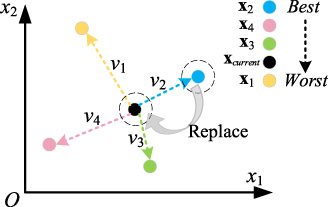
Intuitive description of the proposed local search mechanism for two design variables.
Finally, the LHS points updated by the proposed local search are utilized to construct the surrogate model of (1). The number of local searches can be decided by a decision maker.
To measure the robustness of a solution, the mean value of the objective functions in a small neighbor of the solution in question is used:
Consequently, the robust performance evaluation of all interminate solutions will require an extremely large computational resource. To address this issue, a partition of the whole decision space is proposed. In the proposed methodology, the whole decision space is equally partitioned into m n subregions by equally dividing each direction into m segments. As shown in Fig. 2, a three demissional decision space under m = 2 is partitioned into 8 subregions.
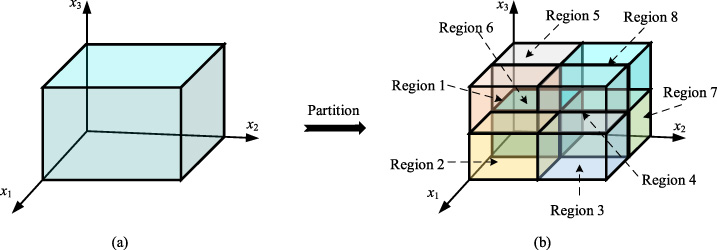
Partition of the whole decision space, (a) the whole decision region, (b) the 8 partition sub-regions.
After the crossover, mutation, and evaluation operations of GA, each individual will be assigned to the closest sub-region according to the Euclidean distance of the individual in question to the center of the sub-region. The robust performance evaluation procedure is activated to only the best solution in each sub-region. Consequently, the requirement for robust performance computations will be reduced significantly. The robust optimization procedure of the proposed methodology is shown in Fig. 3.
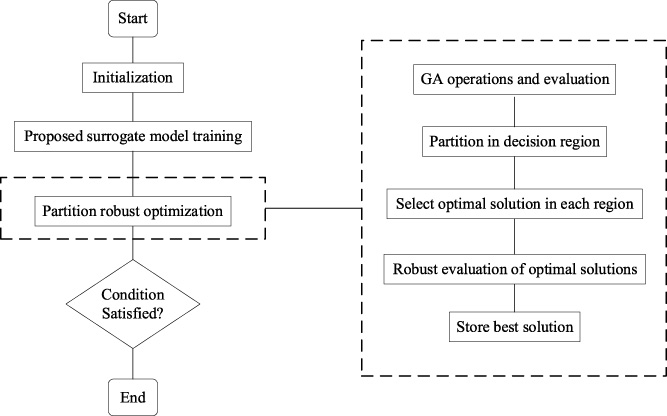
The robust optimization procedure of the proposed methodology.
Function test
A test function consisting of a series of Gaussian functions in [7] is chosen to verify the effectiveness of the proposed methodology. Moreover,
The robust and global optimal solutions of this function are, respectively, (3,1) and (3,4). In the numerical implementation of the proposed robust optimization methodology, the number of the maximum generations is 100, and the population size is 100, the crossover probability and the mutation probability are 0.7 and 0.2 respectively. The decision space is partitioned into 22 subregions and N r = 5. Under such conditions, the performances of the proposed GA-based robust methodology and a mere GA approach are compared in Table 1.
Performances comparison of different methods
From these performance comparison results, it is found that by using the proposed partition mechanism, the function calls are reduced from 111100 of the mere GA to only 14544; while the optimized results by the two methods are nearly the same.
Second, to demonstrate the high accuracy of the proposed surrogate model, the function values constructed by different surrogate models using 121 sampling points are tabulated in Table 2. The errors between the results of surrogate models and the exact function values are given in brackets. Obviously, with enough number of implementations of the proposed local search mechanism, the error of the reconstructed function using the proposed surrogate model will be small enough.
Errors comparisons of different models using 121 sampling points
Note: (a) the exact value, (b) constructed by the original surrogate model, (c)∼(e) constructed by the proposed model with 1, 5, and 10 times local searches.
A dual-layer square metamaterial unit with an interlayer via and a capacitor pad as reported in [8] is optimized. Three design variables, the line width,
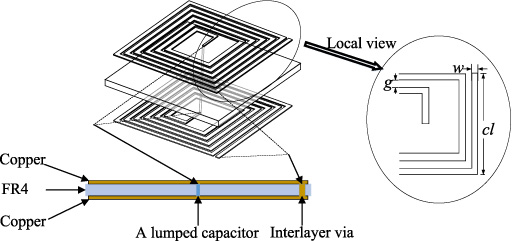
The geometry of the MM unit and three design variables.
Table 3 tabulates the final results of the global optimization design by GA, and the final results of the robust optimizations by GA and the proposed methodology. It should be noted that although the solutions in Table 3 are optimized by using the surrogate model, the real permeability is computed by FEM. In the 100 generations of evolutions, the original GA needs 20201 surrogate model calls, while the proposed robustness optimization methodology requires only 11717 ones. Also, the final robust optimization results for the two methodologies are nearly the same. Again, the proposed partition mechanism reduces significantly the computational cost for the robustness performances and enhances the solution speed of the whole optimization procedure.
Global and robust optimized results of different optimization methodologies
Moreover, to demonstrate the necessity to conduct a robust design on the MM unit to model the inevitable fabrication tolerances, 27 random perturbations are applied to the optimized solutions obtained, respectively, by traditional performance-based and the proposed robustness-based optimization methodologies. The limit for the disturbance on a dimension is smaller than 5% of the dimension size. The computed real permeability by the FEM of the whole 27 perturbations for the two differently optimized solutions is given in Fig. 5, and the averaged ones of the 27 perturbations for the robustness based and the traditional performance-based optimization results are −2.898 and −2.785. Obviously, if an imperfection or fabrication tolerance occurs, the performance of the manufactured MM from the design using the proposed methodology will not be degraded seriously while that from the design using a traditional performance-based methodology will be degraded significantly.
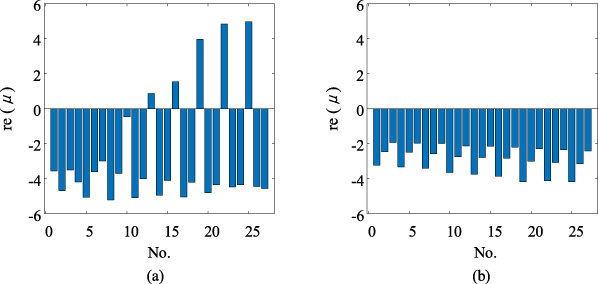
The computed real permeability of the 27 perturbations, (a) on the traditionally performance-based optimal designs, (b) on the proposed robustness-based optimal design.
An optimization methodology by combining the genetic algorithm (GA) and a local surrogate model is proposed for efficiently robust optimizations of a MM unit. A local surrogate model is proposed to both reduce the number of function calls of a high-fidelity model and enhance the accuracy of the reconstructed model. A mechanism for the partition of the decision space is proposed to reduce the robust performance evaluation costs to conserve computational resources. The numerical results on a test function consisting of lots of Gaussian functions and a MM unit demonstrate the advantages and merits of the proposed method in efficiently finding high quality/accuracy solutions.