




Abstract
The performance of soil microbial fuel cells (SMFCs) is greatly affected by the material of the anode. In this study, a low-cost material was fabricated based on rice husk charcoal (RHC) and cheaply available Bokuju (Japanese black drawing ink). Using the fabricated material to make the anode, the SMFC obtained a maximum power density of 9.52 μW/cm2. RHC showed a significant impact on the performance of the anode electrodes. Also, the ratio of RHC to Bokuju affected the output of the SMFC.
Introduction
Soil microbial fuel cells (SMFCs) are microbial fuel cells (MFCs) that use soil as a substrate medium. Bacteria decompose organic matter in soil and generate electricity for SMFCs. The anode of SMFCs supports the formation of biofilm and collects electrons generated by bacterial cells [1]. Therefore, the anode performance depends on microbial affinity and conductivity [2]. Carbon-based materials with high microbial affinity are usually used as the anode in MFCs [3]. However, carbon-based materials have disadvantages such as low durability and low conductivity [4]. Therefore, it has been proposed to use stainless steel mesh (SSM), which has excellent strength and conductivity, for MFC [5]. In addition, coating SSM with carbon-based materials has been studied [6]. This method takes advantage of the high strength of SSM and high microbial affinity of carbon-based materials.
This study used rice husk charcoal (RHC) as a carbon-based material for the electrodes. Rice is produced as a staple food crop in the world, especially in Asia [7]. Rice husks are a byproduct of rice harvesting (Fig. 1(a)). In recent years, the amount of rice grown in the world has reached about 800 million tons, of which about 20–25% is rice husk [8,9]. However, rice husks are generally disposed of by open-pit mining or incineration, which raises environmental and carcinogenic health issues. Rice husks, after carbonization, as shown in Fig. 1(b), are considered to have a high affinity with bacteria in terms of their surface structure and the nutrients they contain [10]. Therefore, it is possible to be used as a low-cost carbon-based material for the electrodes of MFCs.
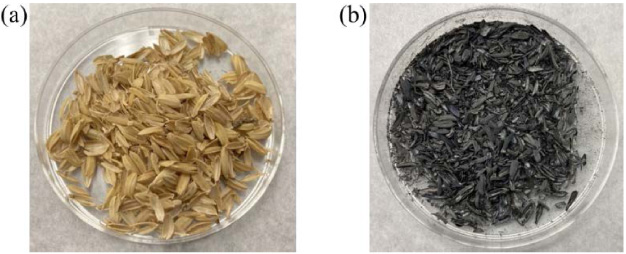
Pictures of rice husks (a) before and (b) after carbonization.
Moreover, the Japanese black drawing ink, named “Bokuju”, was used as a binder. Bokuju is commercially available and costs as low as $1 for 180 ml. Bokuju is a popular ink used in Japan for calligraphy (Fig. 2(a)). Bokuju is cheap and readily available in the market in Japan because calligraphy is widely practiced in various settings, such as elementary school classes and traditional events. Generally, Bokuju is a colloidal solution of soot (carbon black) uniformly dispersed in water with polyvinyl alcohol [11]. Since it is a black carbon-based material, Bokuju is a well-conductive material. In addition, polyvinyl alcohol has been confirmed to improve output when used as an anode in MFC [12]. Therefore, the use of Bokuju in MFCs is expected to improve MFC performance. Furthermore, Bokuju solidifies when it dries, as shown in Fig. 2(b), so it can be expected to function as a binder between the RHC and the SSM.
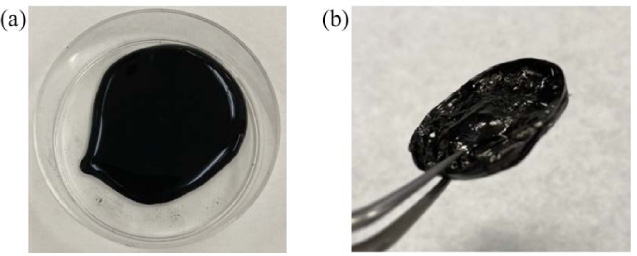
Pictures of Bokuju (a) before and (b) after drying.
The use of RHC and Bokuju is expected to reduce the cost of SMFCs and solve the problem of disposal of rice husks.
RHC and Bokuju electrode fabrication method
RHC (Tokorozawa Ueki Bachi Center, Ltd., Japan), which had already been carbonized by the contractor using the smoking method, was used for the electrodes. RHC was treated in alkaline NaOH solution (0.6 M). After alkali treatment, RHC was washed with tap water, dried, and ground to powder with a pestle. The coating solutions were created by blending RHC and Bokuju (Daiso Industries Co., Ltd., Japan). Then, the SSMs (#321 Hikari Co., Ltd., Japan) were dip-coated with the coating solutions. To adsorb the coating solution on SSM, coated SSM was dried at 200 °C for 2 h.
SMFC setup
Figure 3 shows the schematic of the SMFC setup. The anode was plugged into the soil, and the cathode was placed on the soil surface. Activated carbon sheets were used as the cathodes. The soil was collected from rice paddies in Japan (34° 59 ′ 42. 7986 ′′ N, 135° 57 ′ 16. 1892 ′′ E (34.9995222, 135.954497)). Tap water was added to the SMFC as appropriate to prevent the soil from drying out through evaporation. The SMFC was connected to a 10 kΩ external resistance. The SSM (#304 Hikari Co., Ltd., Japan) connected the electrode to the external circuit. SMFC fabrication, operation, and measurements were performed in an indoor environment (25 ± 1 °C).
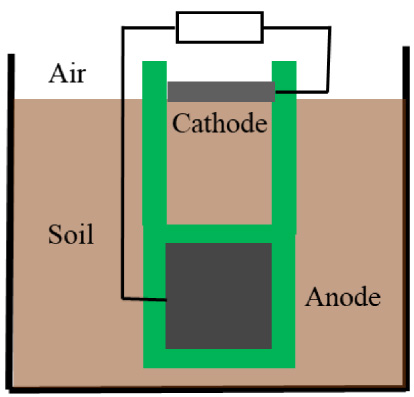
Schematic of the SMFC setup.
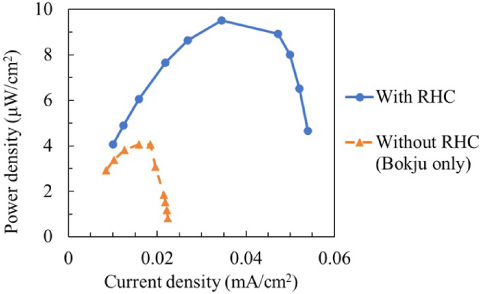
To study the impact of RHC, electrodes with RHC and electrodes without RHC (Bokuju only) were fabricated. Electrodes with RHC were prepared with an 8:2 mass ratio of Bokuju to RHC. The voltage across the external resistance (10 kΩ) of the SMFC was monitored by a data acquisition system (NI USB-6210, National Instruments Corp., USA). The power density curves were calculated based on the steady-state discharge voltage measured by varying the external resistance (10–0.4 kΩ) on the fourth day after the SMFC was activated.
Examination of the amount of RHC to Bokuju
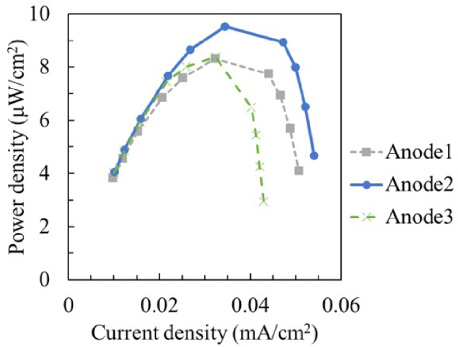
The effect of the amount of RHC in the anodes on the performance of SMFCs was studied. As shown in Table 1, different ratios of Bokuju and RHC were used to make each anode. Using the same method described above, the power density curves were measured on the fourth day after the activation of the SMFCs, and four types of SMFCs using electrodes with different RHC content were compared.
Anodic material composition
Anodic material composition
The electrode surface was cleaned by UV ozone treatment to reduce impurities on the surface and improve the wettability and affinity of biofilms [13,14]. Compared with other cleaning methods (such as using a brush or ultrasonic sink), this method can clean the surface without damaging the substrate surface.
Anode 2 (shown in Table 1) was treated in this experiment. UV ozone treatment was performed for 12.5 h using a UV ozone cleaning device (UV253E, Filgen, Inc., Japan), as illustrated in Fig. 4. The power density was measured using the same method as above and compared to SMFCs using anodes without UV ozone treatment.
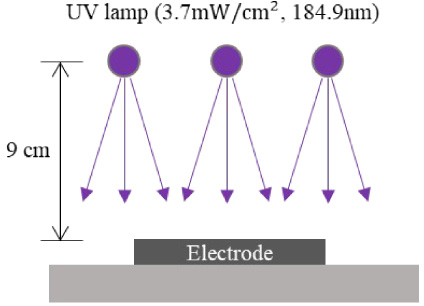
Illustration of UV-ozone treatment.
Bokuju and RHC electrode
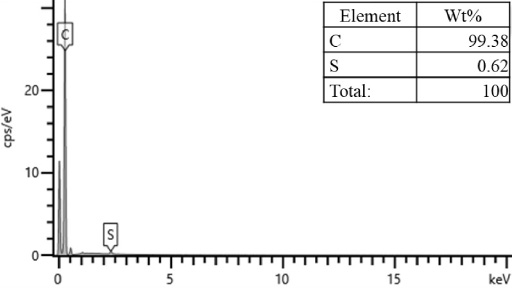
The result of the Energy Dispersive X-ray Spectroscopy (EDS) (SU-1500, Hitachi, Ltd., Japan) analysis of Bokuju is shown in Fig. 5. There were two diffraction peaks identified as carbon (C) and sulfur (S). Quantitative estimation by EDS showed that Bokuju contained 99.4 wt% of C and 0.6 wt% of S. This result reaffirmed that Bokuju is made mainly of carbon black.
Elemental analysis of Bokuju by EDS.
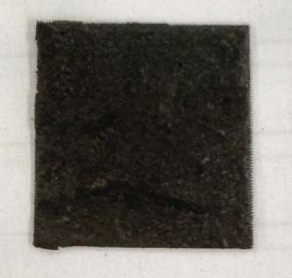
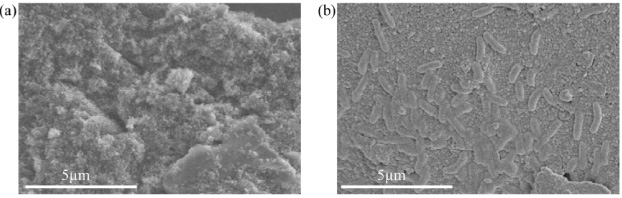
The electrode made of Bokuju and RHC is shown in Fig. 6. Figure 7(a) is a photograph taken by a scanning electron microscope (SEM) (S-4300, Hitachi, Ltd., Japan) of the electrode surface. The SEM photograph shows that the electrode surface is uneven. This unevenness is thought to be due to RHC. Therefore, it is expected that RHC increases the surface area of the electrode.
Picture of electrode created with RHC and Bokuju.
SEM photographs of Bokuju and RHC electrodes (a) before and (b) after the experiment.
The surfaces of the RHC and Bokuju electrodes were observed by SEM after the SMFC was operated. For SEM observation, the anodes were removed from the SMFC, dehydrated with ethanol, and coated with gold in a sputtering system (SC-701Mk II ADVANCE, Sanyu Electron Co., Ltd., Japan). Bacteria were observed on the anode surface after SMFC operation (Fig. 7(b)). This observation suggests that electrical energy could be obtained from bacteria.
Effectiveness of RHC
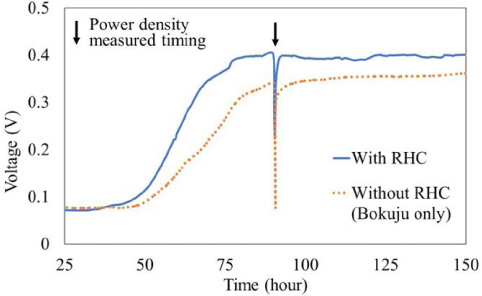
The time evolution of the voltage of SMFCs with electrodes using only Bokuju as material and electrodes using Bokuju and RHC as material were compared, as shown in Fig. 8. The SMFC, which uses the electrode without RHC, obtained a maximum voltage of 361 mV. The addition of RHCs increased the maximum voltage by 11.1% (401 mV). Furthermore, the time required for the voltage to reach at least 80% of its maximum value was 77.5 h without the RHC, compared to 66.5 h with the RHC. The reduction in start-up time is attributed to the improved affinity of the bacteria by the RHC.
Comparison of voltage change over time with and without RHC at anodes.
Figure 9 compares the power density with and without RHC. When the anodes were prepared using only Bokuju, the power density of SMFC was 4.07 μW/cm2, but by adding RHC to the electrode material, the power density was 9.52 μW/cm2, which is a 134% increase. These results suggest that the use of Bokuju and RHC electrodes as anodes in SMFCs is effective.
Comparison of power density with and without RHC at anodes.
The effect of the amount of RHC in Bokuju on the power density of the SMFC is shown in Fig. 10. The power density curves show that the power density varies with the RHC content of the coating solution. Among the three electrodes created in this experiment, the electrode with 20% RHC content (Anode 2) had the highest power density. There would be room for further optimization of RHC content.
Comparison of power density in RHC and Bokuju ratio.
Cleaning the electrode surfaces with UV ozone treatment increased the maximum power density by 29% (Anode 2 compared with Anode 1 and 2). This may be due to the fact that impurities on the electrode surface were removed by the UV ozone treatment [13,14], making it easier to receive electrons from bacteria cells. Therefore, the use of UV ozone-treated anode electrodes is expected to improve the performance of SMFCs.
Conclusion
In this experiment, the use of waste rice husks and Bokuju to make the anodes of the SMFC was investigated. A power density of 4.07 μW/cm2 was obtained even when only Bokuju was used as the anode, but the addition of RHC helped increase the power density by 134% to 9.52 μW/cm2. Furthermore, the RHC also improved the start-up time. These results suggest that RHC and Bokuju have the potential for use as anodes in SMFCs and would warrant further investigation. For future research, one thing to consider is optimizing the ratio of Bokuju to RHC because the amount of RHC in the anode was found to affect the performance of SMFCs.