



Abstract
In order to increase the torque performance of the conventional surface-inset Halbach machines, a surface-inset Halbach machine with trapezoidal mixed grade magnets is proposed and investigated. Based on a layered and linear superposition method, the air-gap magnetic fields are analytically obtained from solution of matrix equations. In addition, the dimensions of mid-magnet and the remanences of Halbach magnets are analytically optimized. In order to show its advantages, the optimized performances of the proposed machine model are compared with those of the conventional Halbach and trapezoidal equal grade Halbach machines. The prediction shows that the proposed optimized machine model has the largest electromagnetic torque and the lowest torque ripple. The demagnetization performance is also investigated. Finally, the finite element analysis (FEA) results verify the analytical predictions.
Keywords
Introduction
Permanent magnet (PM) machines with segmented Halbach array can make the air-gap magnetic field closer to the sinusoidal distribution, thus having many high requirement applications [1–3].
Surface-mounted Halbach machines have the advantages of easy manufacture and high efficiency. They are ideal for analytical modeling because of their relatively simple structure. General analytical model for surface-mounted segmented Halbach machines is proposed [4]. The influences of the design parameters [5] and the air-gap between the segmented Halbach magnets [6] on the electromagnetic performances are analyzed.
The parameter optimization of segmented Halbach machines can improve their performance. The magnet-arc to pole-pitch ratio of Halbach magnets is analyzed and optimized [7]. The unequal arc/height of magnets and unequal magnetization direction for Halbach array are investigated [8] and [9]. The surface-mounted mixed magnets with unequal height are utilized for Halbach machines [10]. In order to increase the torque density of surface-mounted Halbach machines, a multi-objective optimization method [11] and a genetic algorithm [12] are employed. The optimal split ratio of Halbach machines is analytically derived so as to obtain the maximum torque density [13]. Besides, two-segment trapezoidal Halbach array magnets used for surface-mounted machines [14] and linear motor [15] are investigated. A trapezoidal Halbach array is used to decrease the torque ripple for a PM machine [16], an axial flux PM machine adopts trapezoidal Halbach to optimize the electromagnetic performance [17] and an arc-edged trapezoidal Halbach PM linear actuator is proposed for precision engineering [18].
Different from surface-mounted PM machines, surface-inset PM machines have reluctance torque. The analysis of surface-inset machines with relatively complex structure is difficult. A two-dimensional subdomain model method is used to solve the magnetic fields in surface-inset machines [19–21]. General analytical optimization model is presented for surface-inset segmented Halbach machines [22]. In addition, the asymmetric rotor [23] and the eccentric Halbach array [24] arrangements for surface-inset machines are adopted to increase the torque performance.
Hence, since the analytical modeling has the advantage of quick solution and optimization, it can be used for the surface-inset Halbach machines with trapezoidal and/or mixed grade magnets.
This paper is organized as follows. In Sections 2 and 3, the proposed physical model and the equivalent method are analyzed. In Sections 4–6, the air-gap magnetic field generated by the magnets in different regions and layers is analyzed. In Section 7, the analytical expressions of the air-gap magnetic field, the back-EMF and the electromagnetic torque are presented. In Section 8, the analytical results and FEA verification are given. In Section 9, the demagnetization of the novel machine model is analyzed.
Trapezoidal Halbach physical model
Figure 1 shows three types of magnets in surface-inset three-segment Halbach machines. The conventional three-segment Halbach array is shown in Fig. 1(a). The trapezoidal three-segment Halbach magnets with identical/mixed grade are shown in Fig. 1(b) and (c), respectively.

Three types of surface-inset three-segment Halbach magnets. (a) Conventional. (b) Trapezoidal with identical grade. (c) Trapezoidal with mixed grade.
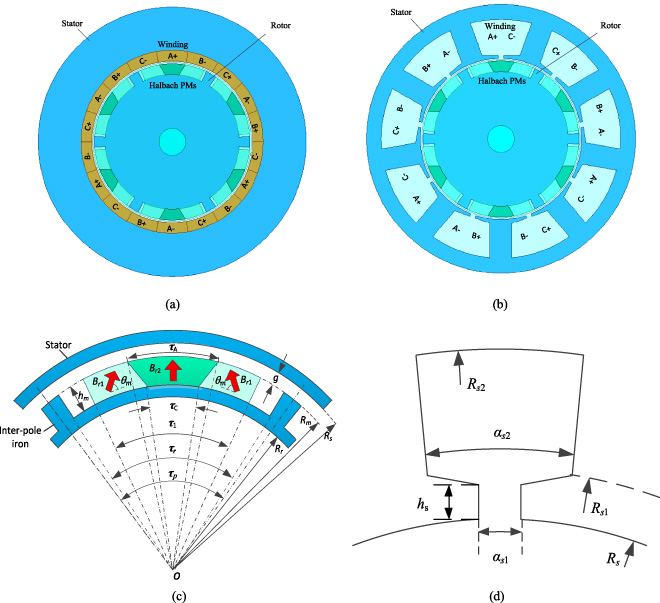
Physical models and design parameters of slotless/slotted surface-inset Halbach machine with trapezoidal mixed grade magnets. (a) Slotless model. (b) Slotted model. (c) Slotless parameters. (d) Slotted parameters.
Figure 2(a) and 2(b) shows the physical models of slotless/slotted surface-inset trapezoidal Halbach machine with mixed grade magnets. Figure 2(c) and 2(d) shows the slotless/slotted design parameters. The remanence of each side-magnet is B
r1 and that of the mid-magnet is B
r2. τ
p
is the pole pitch and equal to π∕p, where p is the pole-pair number. τ1 is the pole-arc length, τ
r
is the arc length of rotor slot, τA and τC are the outer/inner arc lengths of the mid-magnet, respectively. θ
m
is the magnetization angle of each side-magnet. The ratio coefficients 𝛼
r
, 𝛼1, 𝛼C and 𝛼A are defined as
Figure 3 shows the equivalently layered schematic diagram for the trapezoidal Halbach magnets in polar coordinates. The magnets are radially divided into w layers evenly. Each layer includes the equivalent regular Halbach magnets.
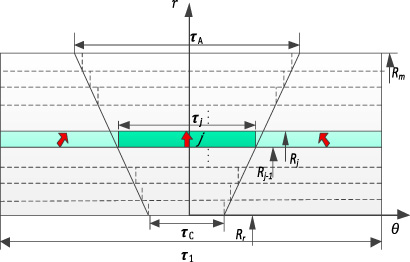
Equivalently layered method for trapezoidal Halbach magnets.
Then, the parameters are defined as
In order to analyze the magnetic field, general assumptions need to be made: the linear demagnetization characteristics of magnets, the infinite permeability of iron and neglected end effects.
Figure 4 shows the radial/tangential magnetization component waveforms of the j-th layer magnets.
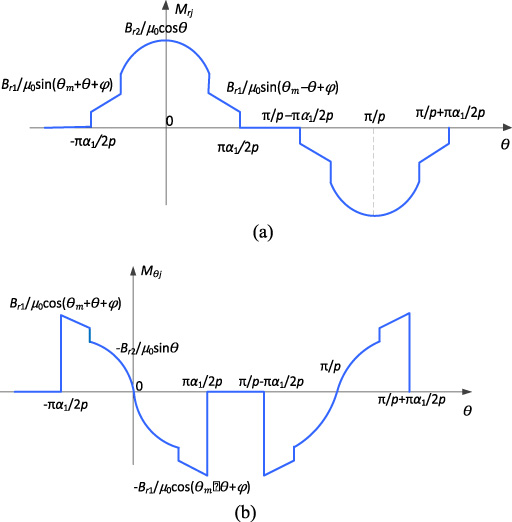
Radial/tangential magnetization waveforms of the j-th layer magnets. (a) Radial magnetization component. (b) Tangential magnetization component.
The magnetization components can be expressed as Fourier series, i.e.,
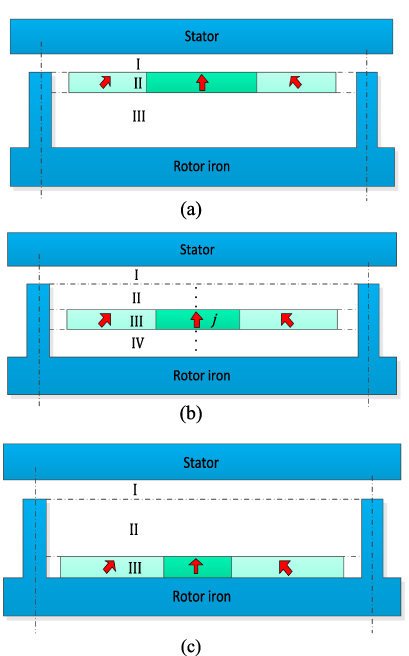
Solution regions for the outermost, middle and innermost layer Halbach magnets.
Then
Different from surface-mounted machines with trapezoidal magnets in [14], the solution of the model equations for surface-inset machines with trapezoidal magnets is more complex. The outermost, middle and innermost layer magnets need to be analyzed separately for different solution regions and boundary conditions, as shown in Fig. 5.
As shown in Fig. 5(a), there are three solution regions for the outermost layer Halbach magnets. Regions I and III are the air-gap and region II is the magnet. According to Laplacian equation, the magnetic scalar potentials φAI and φAIII for the air-gap regions are given as
According to the quasi-Poissonian equation, the magnetic scalar potential for the magnet region can be obtained as
From (10), the magnetic field intensity component H
θAII and the flux density component B
rAII in region II can be obtained as
The boundary conditions of regions I and III are written as
According to (13), the magnetic field intensity component H
θAI and the flux density component B
rAI in region I are given as
Similarly, according to (14), the two components H
θAIII and B
rAIII in region III are given as
The interface conditions between regions II and III are
According to (13), (14), and (17)–(19), H
θAII and B
rAII are given as
The structured column matrices X
mAI and X
nAII can be written as
At r = R
m
, the following equations are satisfied:
Based on (25) and (26), the constructed matrix equation is expressed by
Thus, all the coefficients for the outermost layer magnets can be obtained. The air-gap flux density B rA-slotless produced by the outermost layer magnets can be obtained.
Except the outermost and innermost layers, there are w − 2 layers for the middle layer magnets. The j-th layer magnets are taken for analysis. As shown in Fig. 5(b), there are four solution regions. Region III is the magnet and the other three regions are the air-gap. The magnetic scalar potential functions in four regions can be obtained as
The boundary conditions of regions I and IV are
The interface conditions between regions II and III are
The interface conditions between regions III and IV are
According to ((32))–((35)), the two components H
jθBII and B
jrBII in region II are given as
The constructed matrix equation is given as
Thus, all the coefficients for the middle layer magnets can be obtained. The air-gap flux density B rB-slotless produced by the middle layer magnets can be obtained.
As shown in Fig. 5(c), there are three regions for the innermost layer magnets. The magnetic scalar potential functions in three regions can be obtained as
The boundary and interface conditions are as follows:
According to (40)–(45), the magnetic field intensity component H
θCII and the flux density component B
rCII in region II are given as
The constructed matrix equation is given by
Therefore, all the coefficients can be derived and the air-gap flux density B rC-slotless produced by the innermost layer magnets can be obtained.
In Sections 3–6, the slotless air-gap magnetic field is analyzed. It is necessary to consider the slotted air-gap magnetic field. The expression of the slotted air-gap flux density is given as
According to [8], the flux linkage of the k-th phase winding with N
p
series turns can be expressed as
Parameters of analyzed Halbach machines
Then, the phase EMF and electromagnetic torque can be written as
Through the foregoing analysis, the slotless/slotted surface-inset machines with proposed trapezoidal mixed grade Halbach magnets are investigated. The slotted stator has tooth-tips. Table 1 lists the main design parameters of 6-pole/9-slot surface-inset Halbach machines. It should be noted that the average remanence per unit volume B r is also the remanence of three-segment Halbach magnets shown in Fig. 1(a) and (b) and its value is set as 1.2 T.
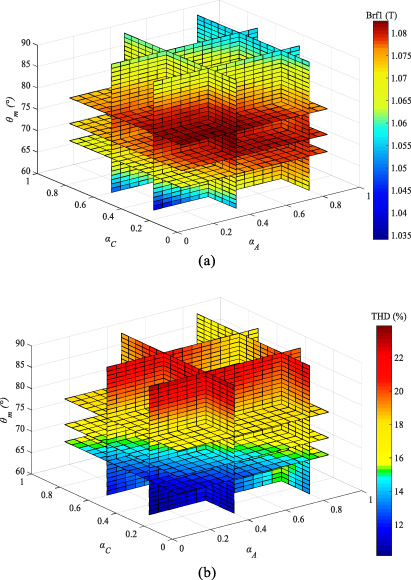
Influence of three variables on fundamental amplitude and THD of slotless air-gap field. (a) Fundamental amplitude. (b) THD.
For the trapezoidal Halbach magnets with identical grade, the fundamental amplitude and total harmonic distortion (THD) of the slotless air-gap flux density are affected by the inner-/outer-arc ratios of mid-magnet and the magnetization angle of the side-magnet, which can be written as
Figure 6 shows the influence of the inner-/outer-arc ratios of mid-magnet and magnetization angle on the fundamental amplitude and THD. According to this figure, when 0.35 < 𝛼A < 0.60, 0.12 < 𝛼C < 0.45 and 69° < θ m < 72°, the fundamental amplitude is relatively large and THD is relatively low.
Since it is very difficult to analytically optimize both the fundamental amplitude and THD, it is necessary to choose a relatively optimal combination of 𝛼A, 𝛼C and θ
m
. Then, these three variables are optimized as follows:
The air-gap field varies with different remanences of the mid-magnet and side-magnet. It is assumed that the consumed magnet volume is equal for three different surface-inset machines. Thus, the relationship equation is as follows:
Then, the fundamental amplitude and THD of the slotless air-gap flux density can be given as
According to (60) and (61), both the fundamental amplitude and THD of the air-gap field are influenced by B r2, as shown in Fig. 7. It can be seen that when B r2 = 1.35 T, a relatively large fundamental amplitude and the lowest THD are derived. At this point, B r1 = 1.09 T can be obtained from obtained from (56). Thus, for the proposed model with trapezoidal mixed grade magnets, this point is taken as the optimization result.
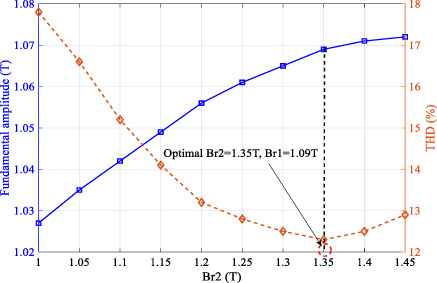
Influence of B r2 on fundamental amplitude and THD of slotless air-gap flux density.
Table 2 shows the comparison of optimized magnet parameters for three machines with the same magnet consumption. These parameters include the remanences, the ratio coefficients, the magnet areas and the magnetization angle. For the latter two machines, only the remanences are different.
Figure 8 shows the air-gap flux density comparison in three optimized slotless surface-inset Halbach machines.
Comparison between three optimized magnet parameters
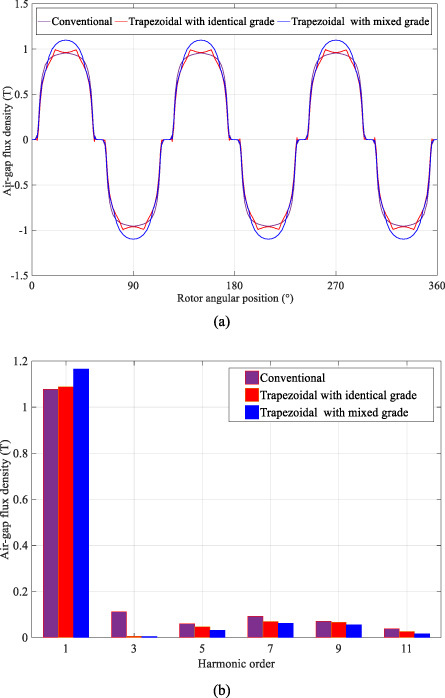
Comparison of waveforms/harmonics of optimized air-gap flux density. (a) Comparison of waveforms. (b) Comparison of harmonics.
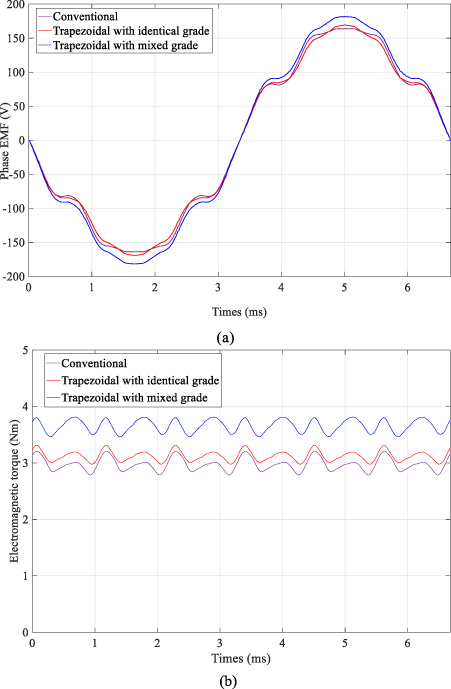
Comparison between phase EMF and electromagnetic torque waveforms of three optimized machines. (a) Phase EMF waveforms. (b) Electromagnetic torque waveforms.
Figure 9 shows the phase induced EMF and electromagnetic torque waveform comparison of three optimized surface-inset Halbach machines. Table 3 lists the performance comparison between three optimized machines with different magnets. It can be observed that the proposed optimized model has the best electromagnetic performance.
Comparison between optimized parameters of surface-inset machines with diferent magnets
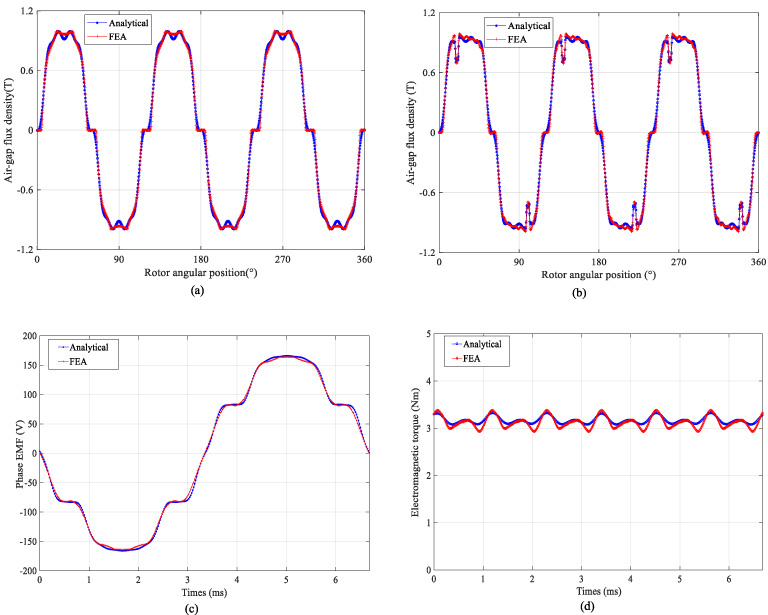
Comparison between analytical and FEA prediction waveforms. (a) Slotless air-gap flux density waveforms. (b) Slotted air-gap flux density waveforms. (c) Phase EMF waveforms. (d) Electromagnetic torque waveforms.
Comparison of electromagnetic performances from analytical and FEA predictions
Figure 10 shows the comparison between the prediction waveforms by analytical and finite element analysis (FEA) methods. The comparison of the electromagnetic performances from analytical and FEA predictions is shown in Table 4. Through the comparison verification, the analytical model of the proposed surface-inset trapezoidal Halbach machine with mixed grade magnets is valid and correct.
Demagnetization performance is an important aspect to be considered in the design and optimization of PM machines. Temperature rise and external magnetic field are two important factors to produce demagnetization. In this section, the temperature rise effect on the electromagnetic torque of the conventional/proposed machines is analyzed by the FEA technique.
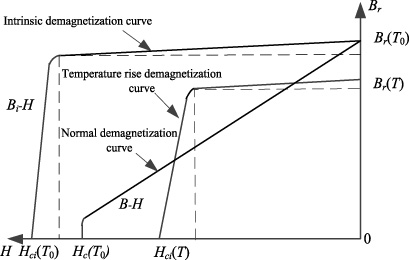
Figure 11 shows the normal and intrinsic demagnetization curves (i.e, B-H and B i -H curves, respectively) of the nonlinear PM materials.
According to [25], compared to the initial temperature T
0, the expression of the temperature rise of the demagnetization curve at the temperature T can be written as
Figure 12 shows the electromagnetic torque variation of two machines at different temperatures in the same demagnetization interval. When the temperature rises from 20 to 140 °C, for the conventional machine, the average electromagnetic torque is reduced from 3.12 to 2.90 Nm, while for the proposed machine with trapezoidal mixed grade magnets, it is reduced from 3.38 to 3.24 Nm. It can be observed that after 7 ms, both machines undergo partial irreversible demagnetization caused by the temperature rise, and the irreversible demagnetization rate of the proposed machine is obviously lower than that of the conventional one.
Demagnetization curves of PM material.
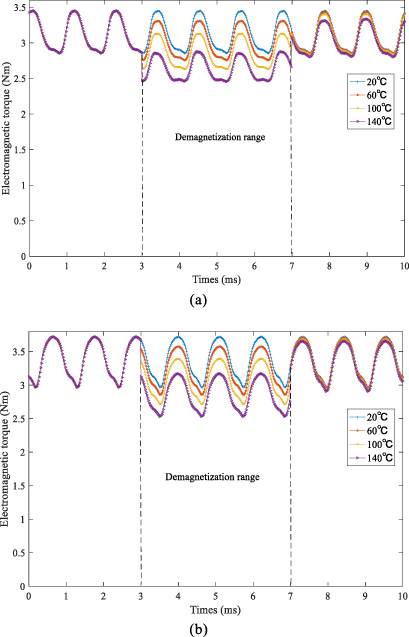
Influence of demagnetization on electromagnetic torque of two machines at different temperatures. (a) Conventional machine. (b) Proposed machine with trapezoidal mixed grade magnets.
A surface-inset Halbach machine with trapezoidal mixed grade magnets has been proposed and investigated. Taking a 6-pole/9-slot surface-inset machine as an example, using a linear superposition technique, the magnetic field in the machine has been analytically solved and the Halbach magnet parameters including the inner-/outer-arc ratios of mid-magnet and the magnetization angle have been optimized. Under the same volume of magnets, the proposed optimized machine with trapezoidal mixed grade Halbach magnets has better performances including the air-gap flux density, induced phase EMF and electromagnetic torque than the optimized conventional Halbach and trapezoidal Halbach identical grade machines. Besides, the proposed machine has better temperature rise demagnetization performance than the conventional machine. The analytical results have been compared with FEA to prove the correctness of the proposed model.
Footnotes
Acknowledgements
This work was supported by Anhui Provincial Natural Science Foundation under Grant 2008085ME179, Anhui Province Key Laboratory of Renewable Energy Utilization and Energy Saving and the 111 Project under Grant BP0719039.