




Abstract
BACKGROUND:
Berries are important sources of crucial dietary components such as vitamins and minerals, as well as various phytonutrients that may be potentially beneficial to human health and could be used against chronic diseases including cancer and cardiovascular disorders.
OBJECTIVE:
The current study aimed to identify and analyze the 100 most cited papers related to berry research.
METHODS:
The Scopus database was searched to extract data. Two of the authors independently evaluated the manuscripts for relevance. Bibliometric data, including citation count, were analyzed together with the words in the titles and abstracts of the 100 most cited berry-related papers.
RESULTS:
Seventy-two of the 100 most cited papers were research articles. Most of them were published during the 2000s, and related to subject areas of agricultural and biological sciences (n = 64), biochemistry, genetics and molecular biology (n = 35), chemistry (n = 29), medicine (n = 24), and nursing (n = 10). Journal of Agricultural and Food Chemistry was the dominating choice of publication outlet (n = 26).
CONCLUSIONS:
Antioxidant and anticancer benefits appeared to be the major subject terms. Berries that were mentioned in at least 10% of the 100 papers were strawberry, blueberry, cranberry, raspberry, blackberry, bilberry, and grape berry. The review could provide a valuable guide for designing future studies based on berries, berry extracts, and bioactive compounds.
Keywords
Introduction
Berries contain not only crucial dietary components such as vitamins and minerals, but also a wide range of phytonutrients that may be potentially beneficial to human health [1] and could be used against chronic diseases including cancer and heart disorders [2]. For instance, the consumption of berry may enhance the human liver function in terms of reducing the alanine aminotransferase (ALAT) values [3], increasing high-density lipoprotein (HDL) cholesterol, and reducing blood pressure, all of which could help reduce systemic inflammation and risk of cardiovascular and metabolic diseases [4]. Moreover, it was reported that dietary consumption of strawberry could increase the plasma antioxidant capacity [5, 6] and improve the insulin sensitivity [7]. There have been numerous comprehensive reviews on the phenolic contents of berries, including phenolic acids, tannins, lignans, stilbenes, and flavonoids [8], and their antioxidant, anticancer, anti-inflammatory as well as neuroprotective properties [9, 10].
Research on berries could be traced back as early as in the mid–18th century, according to Scopus literature database (https://www-scopus-com-s.web.bisu.edu.cn). Interestingly, the earliest publications seemed to focus on berry poisoning and associated deaths [11–13], instead of the current focus on the health benefits of consuming berries as introduced above. Undoubtedly, there have been numerous publications on berry ripening; the berry research field, after over two centuries of development, has literally ripened. It is worthwhile to identify the most impactful publications on berries and give a brief overview of them. Therefore, in the current study, we aimed to identify and analyze the 100 most cited papers on berries. Besides, the aim was to identify also the hot topics, prominent authors and countries contributing to these publications, as well as the most popular berries that were investigated in these publications. Last but not least, as multiple studies have indicated a higher journal impact factor as well as defined journal specialties would lead to an increased citation count [14–16]. We tested if such association existed within the 100 most cited berry-related papers, and hypothesized the existence of a positive correlation between the journal impact factor and the paper citation count (both total and adjusted counts).
Materials and methods
Data source
Bibliometric data were extracted from Scopus, an online multidisciplinary, bibliographic and citation database launched in 2004 and hosted by Elsevier. Upon a preliminary search, we have found that many of the highly cited papers involving the word “berry” were related to Berry’s phase or Berry’s conjecture which are the concepts used in physics, but certainly not related to the berry fruits. To systematically exclude these irrelevant papers, in September 2018, we searched Scopus to identify papers with the following string: TITLE-ABS-KEY (“berry” OR “berry*” OR “berries” OR “berries*”) AND NOT (“berry’s phase” OR “berry phase” OR “berry’s conjecture” OR “berry conjecture” OR “berry’s curvature” OR “berry curvature”). This string searched for papers that mentioned berry or berries in their titles, abstracts or keywords as fruits, but not Berry as a part of terms used in physics named after a scientist.
The identified papers were sorted out by citation count in descending order. Two of the authors (AWKY and AGA) independently evaluated the manuscripts for relevance and compiled the list of 100 most cited papers. We did not place any additional restrictions on the search, such as year of publication and other parameters.
Data extraction
The 100 most cited papers were evaluated and recorded for: (1) publication year; (2) journal title; (3) 2017 journal impact factor (released by Clarivate Analytics in InCites Journal Citation Reports 2018); (4) total citation count; (5) adjusted citation count (i.e., citation count per year since publication); (6) authorship; and (7) manuscript type.
Meanwhile, Pearson’s correlation tests were conducted in SPSS 25.0 (IBM, New York, USA) to evaluate if there existed a correlation between the citation counts (total / adjusted) of the 100 most cited papers and journal impact factor or number of authors. Test results with p < 0.05 were considered significant.
Term map
The software VOSviewer was utilized to extract and analyze words that appeared in the titles and abstracts of these 100 most cited papers [17], and visualize them with a bubble map. Each bubble represents a term or phrase. The bubble size indicates how often the word appeared among the 100 manuscripts (binary counting was used, which implied that multiple appearances in a single paper counted as one). The bubble color indicates the averaged citation count received by manuscripts involving the term. Two bubbles are nearer to each other if the two terms co-occurred in manuscripts more often. The term map visualizes terms that appeared in at least two of the 100 papers.
Results and discussion
The search resulted in 21,508 papers. The 100 most cited berry-related papers are listed in Table 1. They were mainly research articles (n = 72) and reviews (n = 21), with a few conference papers (n = 6) and a short survey (n = 1). All 100 papers were written in English, most of which published during the 2000s (Fig. 1), and were related to subject areas of agricultural and biological sciences (n = 64), biochemistry, genetics and molecular biology (n = 35), chemistry (n = 29), medicine (n = 24), and nursing (n = 10). These 100 papers listed 1 to 17 authors (mean±SD: 4.4±3.2), and were published in journals with impact factor ranging from no impact factor value to 79.258 (mean±SD: 4.882±7.860).

Distribution of the 100 most cited berry-related papers across the publication years. Year 2007 was the most influential year when 16 out of the 100 most cited berry-related papers were published.
The list of 100 most cited berry-related papers
The citation count of these 100 papers ranged from 264 to 2,190 (mean±SD: 454.1±276.7). The adjusted citation count (i.e., citation count per year since publication) ranged from 10.7 to 155.4 (mean±SD: 33.0±22.6). In terms of total citation count, Kähkönen et al. published a top-ranked article that reported the antioxidant activity of plant extracts, containing phenolic compounds, which were particularly abundant in aronia and crowberry [18]. In terms of adjusted citation count, the top-ranked paper was a review, published by Del Rio et al. on availability and evidence of benefits of dietary polyphenolics such as anthocyanins from blueberries, blackberries and strawberries against chronic diseases [19].
Major contributors
The papers were contributed by 160 authors, affiliated with 149 institutions distributed among 25 countries / territories. The five most prolific authors for the most cited papers were Simon P. Robinson from Commonwealth Scientific and Industrial Research Organisation (CSIRO) Plant Industry in Australia (n = 5); Herman Adlercreutz, Marina Heinonen from the University of Helsinki in Finland, Rune Blomhoff and Kari Holte from the University of Oslo in Norway, Navindra P. Seeram from the University of Rhode Island in the United States, and Bharat B. Aggarwal currently affiliated with the Inflammation Research Center in the United States of America (each n = 4, equally ranked second).
The five most prolific institutions were the University of Helsinki (n = 15), the United States Department of Agriculture (USDA, n = 6), the University of Eastern Finland (n = 6), Cooperative Research Centre for Viticulture (Australia, n = 5), and Agriculture and Agri-Food Canada (n = 5). The United States of America has contributed to 38 of these 100 papers, followed by Finland (n = 20), Australia (n = 9), Canada (n = 8), and Japan (n = 6). Perhaps unsurprisingly, the dominance of the United States of America was similar to other research fields such as neuroimaging [20], public health [21], general neuroscience [22–24], and nutritional neuroscience [25]. This could be potentially explained by the large amount of money invested by private sector into research and development, as well as the large number of PhD students and full-time researchers in the nation [26]. Here in berry research, however, the contribution by Finland was significantly higher than its contribution to the highly cited manuscripts dealing with related fields such as ethnopharmacology [27], phytochemistry concerning cancer [28], and nutraceuticals and functional foods [29]. In fact, berries were identified as important sources of flavonoid intake for Finnish people [30]. This might have hinted an ethnobotanical reason, which is worth to be further investigated. Regarding journals, Journal of Agricultural and Food Chemistry was the dominating choice of publication outlet (n = 26), followed by American Journal of Enology and Viticulture (n = 6). The rest of the journals have each contributed to less than 5% of the 100 most cited berry-related papers. Such dominance by a single most prolific journal is similar to the situation of the 100 most cited papers in ethnopharmacology (Journal of Ethnopharmacology, 17%) [27] but not in nutraceuticals and functional foods field [29].
Relationship between citation count and author number or journal impact factor
Total citation count and adjusted citation count did not have significant correlation with author number (r = 0.031, p = 0.760; r = 0.135, p = 0.181) or journal impact factor (r = –0.073, p = 0.469; r = –0.065, p = 0.522). Meanwhile, total citation count was positively correlated with adjusted citation count (r = 0.695, p < 0.001).
Term map
A term map was generated to visualize the words in the titles and abstracts of the 100 papers. There were 731 terms that appeared in two or more of the 100 papers, covering various basic science aspects such as antioxidant and angiogenesis, which in turn might influence carcinogenesis and some chronic diseases (Fig. 2). These foci seemed to have formed the cornerstones of the most cited berry research. Several molecules have 500 + citations per manuscript (Fig. 3), namely trihydroxystilbene (n = 2, citations per paper = 737), isoflavonoid glycoside (n = 3, citations per paper = 704), carotene (n = 3, citations per paper = 637), ferulic acid (n = 2, citations per paper = 629) and caffeic acid (n = 3, citations per paper = 604), isoflavonoid (n = 4, citations per paper = 594), catechin (n = 3, citations per paper = 584), cinnamic acid (n = 2, citations per paper = 580), procyanidin (n = 2, citations per paper = 557), lignin (n = 6, citations per paper = 545), and ellagic acid (n = 4, citations per paper = 543).

Term map of words from the titles and abstracts of the 100 most cited berry-related papers. There were 731 words or phrases that appeared in at least two papers and hence included in the visualization. Each bubble represents a term or phrase. The bubble size indicates its number of appearance. The bubble color indicates the averaged citation count received by papers containing the term or phrase. Two bubbles are closer to each other if the two terms co-appeared in more papers. It seemed that antioxidant capacity and angiogenesis effect were the two major aspects under investigation that may lead to potential health benefits against cancer and chronic diseases.
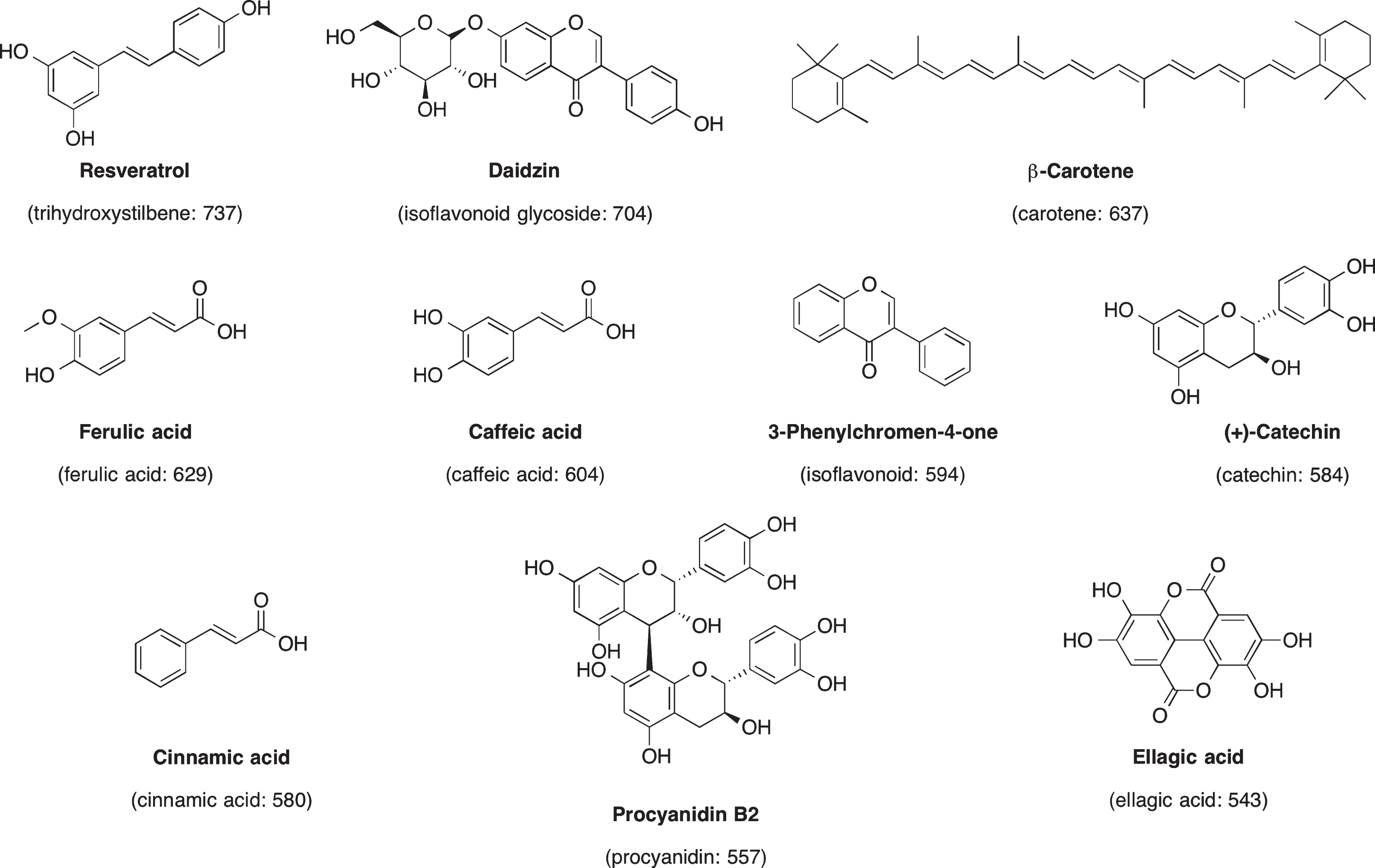
Notable representative molecules mentioned by berry-related papers. The respective search name and citation per manuscript are in parenthesis.
Meanwhile, the most frequently mentioned berries were strawberry (n = 18, citations per paper = 423), blueberry (n = 16, citations per paper = 456), cranberry (n = 13, citations per paper = 395), raspberry (n = 12, citations per paper = 485), blackberry (n = 12, citations per paper = 463), bilberry (n = 10, citations per paper = 441), and grape berry (n = 10, citations per paper = 351). However, it should be noted that the studies usually investigated multiple berries species [31–33], instead of focusing on a single one.
One potential limitation was that the list is compiled by extracting data from Scopus database only, meaning that manuscripts not listed in Scopus were not included in the current report. Scopus in particular was chosen due to its broader coverage of biomedical literature relative to Web of Science Core Collection, another well-known database that keeps track of citation data [34]. On the other hand, Google Scholar, for example, counts citations from non-academic sources such as websites, and hence was not selected by us for performing the current analysis.
Conclusions
A bibliometric analysis was performed to identify the 100 most cited berry-related papers. The Journal of Agricultural and Food Chemistry was the preferred choice of publication outlet. The total citation count and adjusted citation count did not appear to have a significant correlation with the number of authors or the journal impact factor. Antioxidant and anti-cancer benefits seemed to be the major topics. Berries species that were mentioned in at least 10% of the 100 papers were strawberry, blueberry, cranberry, raspberry, blackberry, bilberry, and grape berry.
Conflict of interest
The authors have no conflict of interest to report.
Footnotes
Acknowledgments
Atanas G. Atanasov and Dongdong Wang acknowledge the support by the Polish KNOW (Leading National Research Centre) Scientific Consortium “Healthy Animal—Safe Food,” decision of Ministry of Science and Higher Education No. 05–1/KNOW2/2015 and the HOMING programme of the Foundation for Polish Science co-financed by the European Union under the European Regional Development Fund. Milen I. Georgiev gratefully acknowledges the support obtained through the project SusMAPWaste, SMIS 104323, Contract No. 89/09.09.2016, from the Operational Program Competitiveness 2014–2020, project co-financed from the European Regional Development Fund.