



Abstract
To find the optimal escape path in mine water bursting disaster, present researches have proposed the Dijkstra iterative algorithm. The optimal escape route should be chosen according to the extent of the disaster development and its impact scope. However, the traditional algorithm does not have a real-time analysis on the water flow and the escaping process, thus its solution is not or even far from optimal. Based on the traditional algorithm, this paper puts forward an algorithm with real-time analysis of escaping and water bursting processes. It analyzes water bursting range in real time according to the time of passing through each roadway on a path, and then finds an optimal escape path which is most secure and least time-consuming through comparison. The experiments show that the algorithmis able to find the optimal escape path more effectively compared with other algorithms.
Introduction
The accidents of mine water bursting are sudden, destructive and secondary. The complexity of the underground roadway environment brings difficulties to rescuers to know the overall situation of water bursting in a short time and master the inundated range and the risks that the people in the mine suffer. Therefore, it is hard to take effective measures to evacuate people in best escaping time, which can be fatally damaging [1].
The shortest path problem aims to find the best path with respect to some cost measure between two distinct nodes in a graph [2]. The shortest path refers to a path where the sum of the weights on each edge is the smallest of the paths along the vertex and reaching the other vertex along the edge of the graph. The shortest path problem is solved by the following algorithms: Dijkstra algorithm, Bellman-Ford algorithm, Floyd algorithm and SPFA algorithm. In addition, there is also the famous heuristic search algorithm A*. In 1959, computer scholars in Holland proposed Dijkstra algorithm, whose advantage is that it can get the optimal solution of the shortest path. However, to find the best disaster avoidance path of mine roadways means the consideration of not only the shortest spacial distance but also other factors such as difficulty of passage, escaping time, etc. [3]. Li et al. [4] and Wang et al. [5] believed that to set the best escaping path to which type of shortest path mainly depends on the degree of the disaster development and the impact scope in underground roadway. Wang and Wu [6] optimized the algorithm based on the original Dijkstra algorithm in aspects of search efficiency and search range.
The main documents contributing to this paper include:
Sifaleras [7] presented a wide range of problems concerning minimum cost network flows, and also discussed state-of-the-art algorithmic and recent advances in the solution to the MCNFP. Although the classic linear MCNFP could be efficiently solved in strongly polynomial time by algorithms that exploited the network structure of the problem, there were several other intractable generalizations (e.g., time-varying MCNFP). Therefore, further research effort was required. In Marinakis et al.’s research [8], the following variant of the Shortest Path problem is solved. Given a graph G of which each arc is associated with two positive weights, cost and delay, we consider the problem of selecting a set of Hu [9] said that in urban area, the delay due to the traffic lights should be taken into consideration when searching for the optimal path. So this paper presents an algorithm to find the real-time shortest path in urban area with traffic lights. It uses a heuristic evaluation function which contains information on issues to sort the nodes of Open list, so that the search was guided to the direction with high possibility to produce the optimal solution to find the target. Roth [10] wanted to compute all shortest paths from a set of starts to a set of targets. If we use the one-to-one planning in a loop, we consider each path as an independent computation. The drawback: we cannot take benefit of similarities between planning steps. In this paper he described the efficient many-to-many path planning that is based on A*. It significantly reduced the number of visited crossings due to computation similarities. Yuan and Wang [11] considered more practical factors, A multi-objective path selection model is presented to minimize the total travel time along a path and to minimize the path complexity. Zhang et al. [12] talked about the path selection in emergency logistics management. He thought the travel speed will change that with the extension of the disaster, a novel bio-inspired method is proposed to solve this problem.
These studies had been more or less applied in solving the optimal escape route of mine water bursting disaster, but for the water flooding process, there is no real-time analysis, thus the solution is not or far from optimal. In this paper, in the condition of no globally optimal solution, the path decomposition analysis is carried out. According to the time of passing through each roadway, the water bursting range in this time can be calculated. Then through comparison, the escape path that does not pass through the water bursting range can be found. If there is no such path, the traffic ability of submerged roadways will be assessed to solve the optimal path.
Equivalent length of roadway
The difficulty of roadway passing is mainly affected by nclination angle of the roadway, the accumulation of obstacles, the height of the roadway and so on. The equivalent length of roadway is the product of different factors’ quantization result and the actual length of the roadway.
The influence coefficients of different factors need to be determined in advance to calculate roadway equivalent length [13], these factors mainly include: roadway inclination, roadway height, obstruction in roadway, transportation facilities and water bursting situation. Set the coefficients of influence factors as:
where,
After calculating the influence coefficient of each influencing factor in the current roadway, the formula of the equivalent length of the single roadway is shown in the Eq. (2):
where,
According to the above analysis, there are many factors influencing the traffic ability of roadway. Due to the difficulty of quantifying all the influence factors in reality, the people forward speed in roadway is adopted to indirectly measure the traffic ability of roadway [14].
The calculation of optimal escape route needs the roadway traffic ability weight as parameter. The height of the water level in the roadway and the average height of the Chinese 1.70 meters are used to design the traffic ability weigh of roadway, as shown in Table 1.
Roadway traffic ability weight
Roadway traffic ability weight
This paper applies the graph theory to define the mine roadway network as
Flow chat of water spreading downward.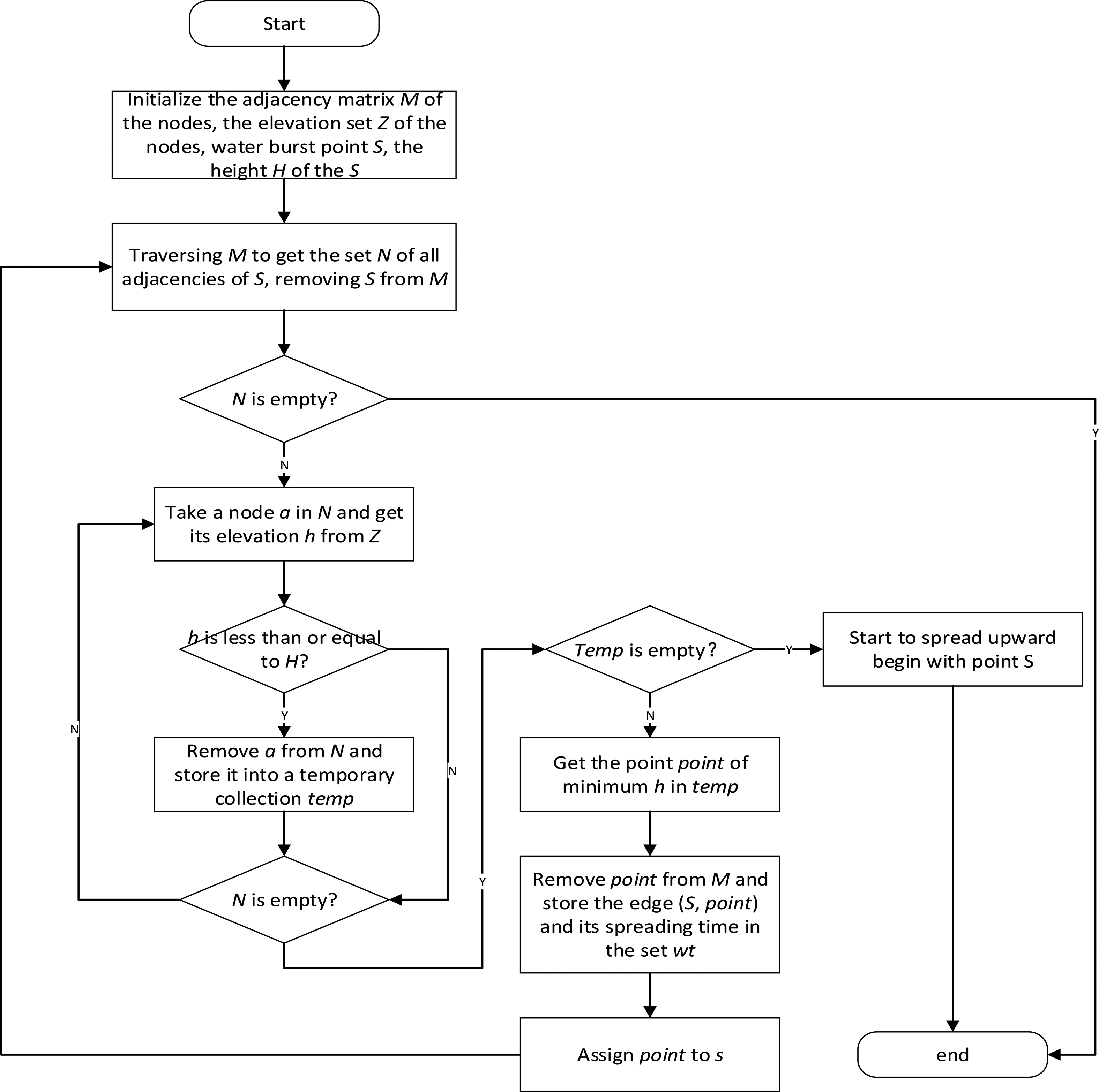
For optimal escape route analysis, the road traffic ability weight is the most important factor, and it is comprehensive evaluation of the parameters such as the equivalent length of roadway and the weight of traffic efficiency.
Mathematical Model of Roadway Traffic Ability Weight is shown in Eq. (4):
where,
The Dijkstra algorithm is a classical algorithm to solve the shortest path problem in network graph analysis. The algorithm solves the shortest path according the increasing order of the path length using greedy algorithm strategy. The algorithm is widely used for its high robustness and simple program [15]. Therefore this paper employs this algorithm solve the shortest path.
Calculation of spreading range of water bursting
In the mine roadway, the direction of the water flow is weighted digraph. Suppose
Calculation of downward water spreading path
Due to the gravity, water preferentially flows into the roadway of lower elevation. Finally it reaches the global or local lowest point. At this time the downward water spreading process is over, then the water level will rise. See Fig. 1.
From the downward water spreading algorithm, the spreading sequence of the key nodes on the flow path is obtained. The influencing factors of gravity in actual water flowing process will ensure that water flows to the point with lowest potential energy.
Flow chat of water spreading upward.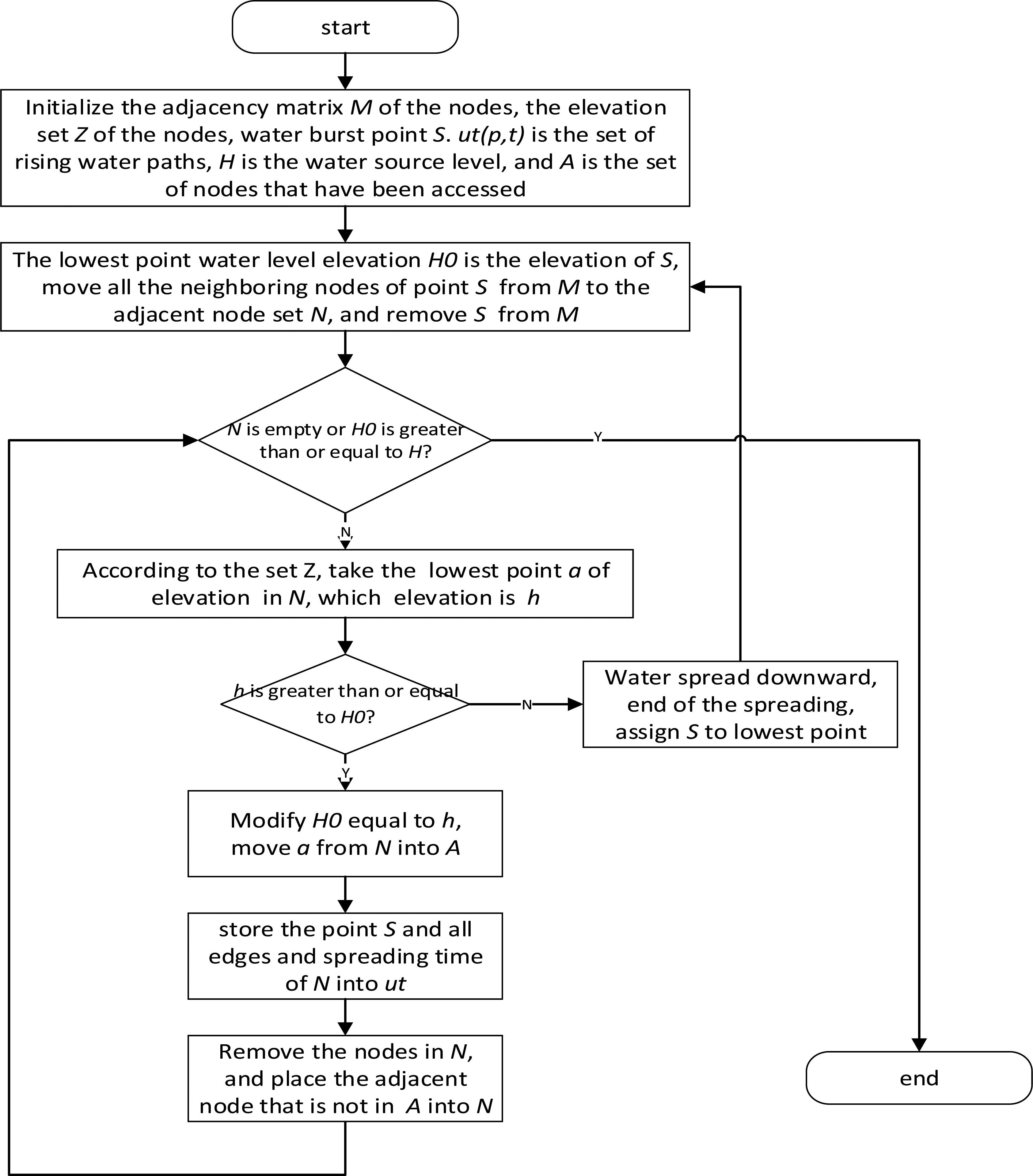
The start point of water level rise algorithm is the end point of downward water spreading algorithm, namely the local or global lowest point in the roadway, which is to say, from this point, water level starts to rise to the points with higher potential energy. The termination of water rising process is confirmed by the balance between the total amount of gushed water and the amount of water in roadways. See Fig. 2.
In the mine roadway network, the water level value H0 of a key node is the roadway water capacity of all key points, namely, the amount of burst water in mine when the water level of all the key points rises, divided by the cross-section area of water in roadway in depth direction, and the calculated length is the water level value H0.
Calculation of water spreading speed and time
Downward water spreading speed and time
Calculate water flow along horizontal roadway according to the constant flow and open channel flow. And according to other relevant factors, the speed of downward water flow is calculated considering the XieCai formula in hydrodynamics, as shown in Eq. (5)
where,
When the water flow down along the vertical roadway, it can be deemed as the free falling of water. Gravity acceleration is the key influencing factor, so the water spreading speed can be calculated by the energy conversion formula, as shown in Eq. (6)
where,
When water flows downward along inclined roadway, if the angle of inclination is less than 45
The time that water spreads to an arbitrary position in the downward spreading path is calculated by summing the ratios of the length of each roadway on the current path and its speed of spreading. As shown in Eq. (7)
where,
Flow chart of optimal escape path algorithm.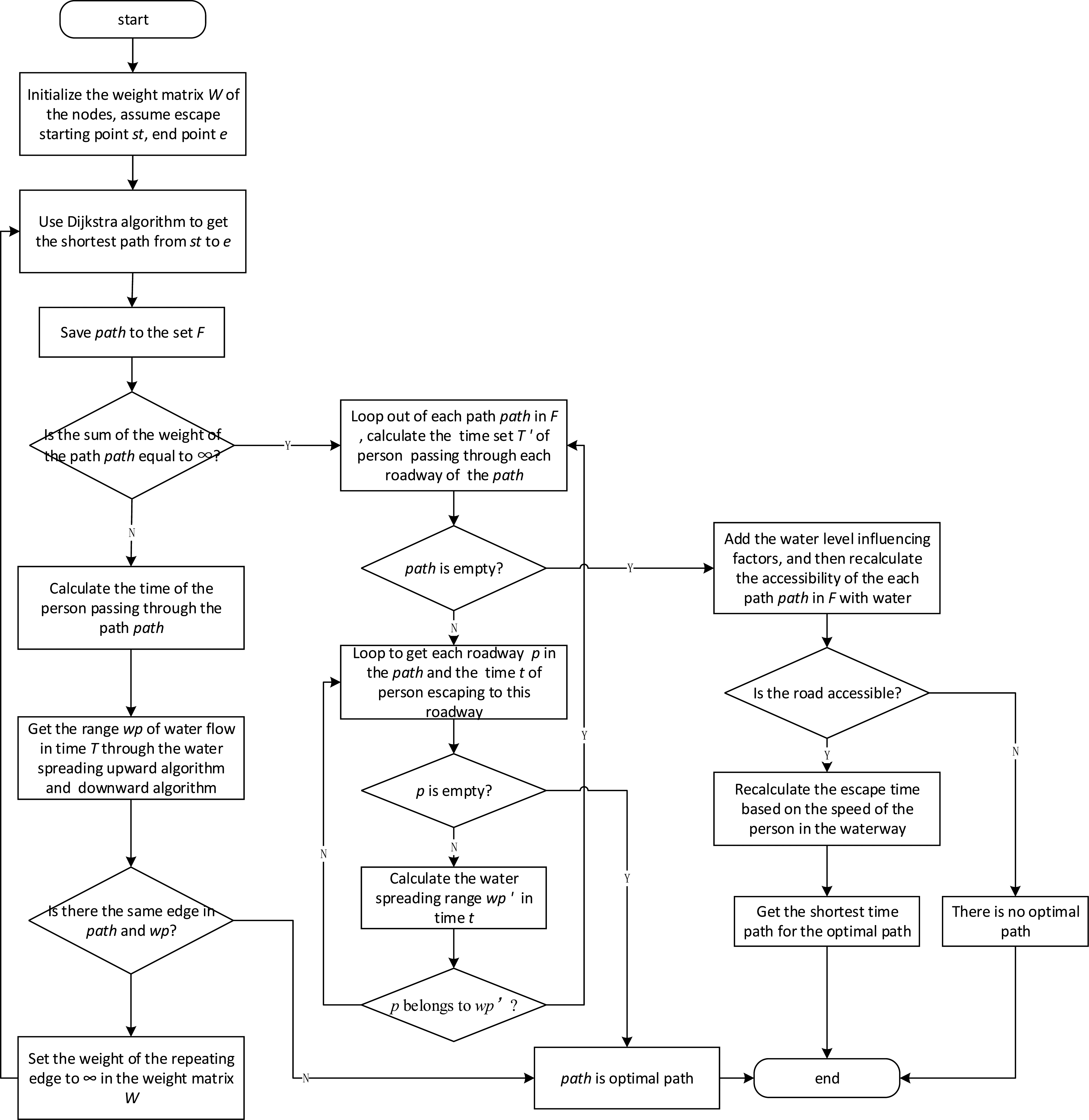
The condition for the stop of water level rising is that the current roadway water level is equal to the water level at water bursting point, so if the water level at bursting point is always higher than the current roadway level, the water level will go on rising until the water fills the entire roadway. Based on this, according to the amount of burst water in unit time and the capacity of roadway, the time for water to fill entire roadway, namely the water level rising time, can be calculated [16], as shown in Eq. (8)
where,
Because the water spreading is real-time and dynamic, the wight shortest path or the time shortest path obtained using the shortest path algorithm is not certainly the optimal path, and it is not consistent with the actual situation of underground personnel escape. Based on the shortest path algorithm, this paper proposes a method to solve the optimal path. The idea is to obtain the shortest path using the Dijkstra algorithm, and then calculate the range of the water flow, and compare the shortest path and the range of the water flow, the path that does not pass through the flooding range is the optimal path, if there is no optimal path, it is necessary to analyze the shortest path decomposition to find the optimal path that does not pass through the flooded range. If it is not found, it means that people must go through the water spread range in the process of escape, at this time, it is necessary to recalculate the traffic ability of the roadways in the path. With the precondition of traffic ability, the path using the shortest time is the optimal path.
Calculate the weight Use the Dijkstra algorithm to get the shortest path path from st to Calculate the time Determine whether the edges of the path overlap the edges of wp, if no, it means that the people can escape to the security node and without passing through the flooding path, and the path is the optimal escape path, program ends; if yes, set the weight of the repeated edges to infinity in the weight matrix Repeatedly take each path in Loop to get each roadway Calculate the water spreading range wp Add the water level influencing factors, and then recalculate the traffic ability of submerged roadways on each path in Repeat Steps 2
The optimal escape path algorithm obtained by improving the shortest path algorithm is more suitable for the actual situation of personnel escape when mine water bursting occurs, its optimal escape path is safer.
According to the information table of a mine roadway in the literature [17], the data such as cross-sectional area, length, inclination angle and water capacity of each roadway are obtained.
Information table of mine roadway
Information table of mine roadway
Passable weights of each roadway
Mine roadway network generated by Matlab.
The time required for the personnel passing through each roadway
Spreading time of node to node in driftway
According to the coordinates of roadway nodes in Table 2, the mine roadway network is generated by Matlab, as shown in Fig. 4. The weight of the line segment is the actual length between the nodes.
The traffic ability weight of each roadway are calculated by the Eqs (1), (2) and (4), as shown in Table 3.
According to the traffic ability weight of the roadway shown in Table 5, the time required for passing through each roadway is calculated according to the free walking speed of 1.3 m/s, as shown in Table 4.
Calculate the water spreading range, speed and time
Assume that node
Through the water level sensor placed in the mine roadway, it can be known that the time of water flowing to node
According to the amount of burst water in unit time 5.86 m
Spreading time of node to node in oblique lane
Spreading time of node to node in oblique lane
Nodes path of water bursting.
The shortest escape path in the roadway network.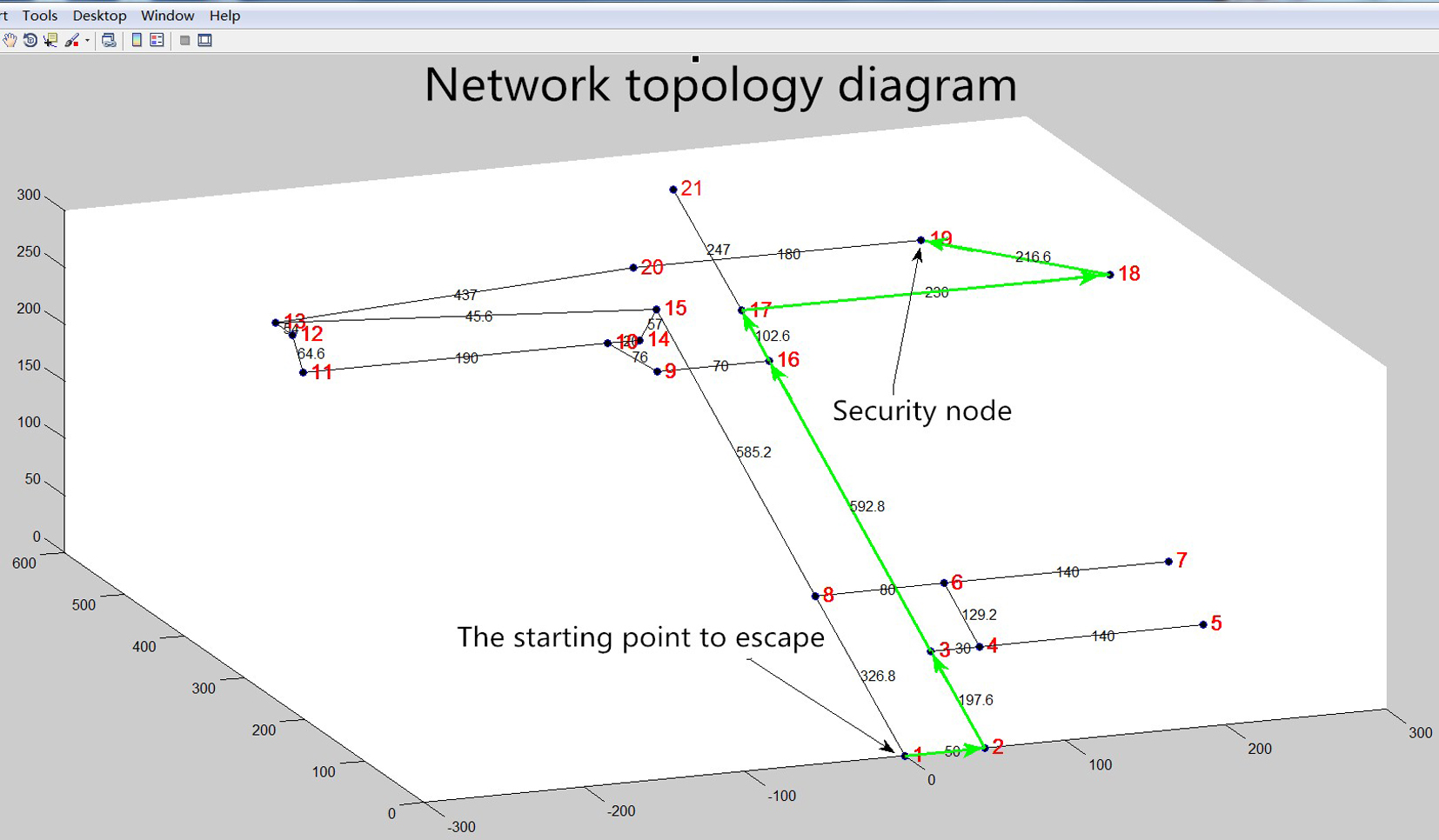
Using Matlab to calculate the shortest escape path on the roadway according to Dijkstra algorithm,
Get the optimal escape path
Calculate the spread of water in the escape time
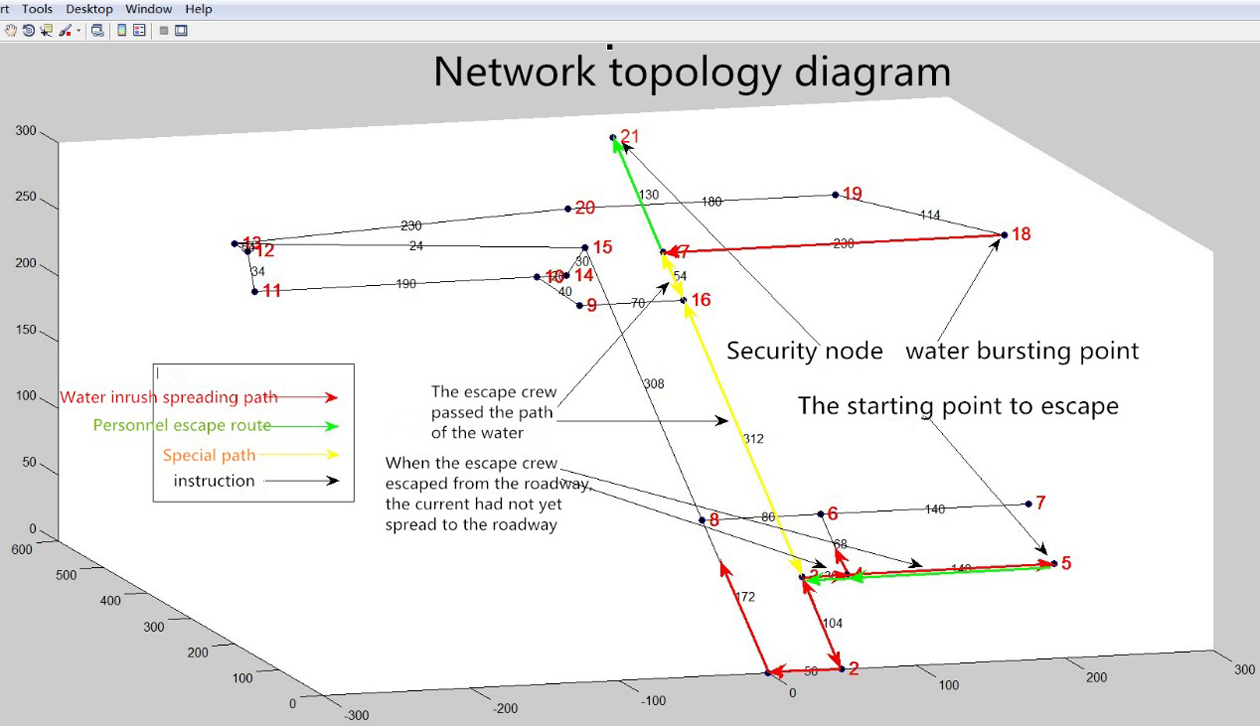
According to the time of 1069 s that people in mine need to pass through the shortest escape path, considering the solved water spreading range and the relevant time, the water spreading path in 1069 s can be obtained as shown in Fig. 7.
Water spreading path at time 1069 s.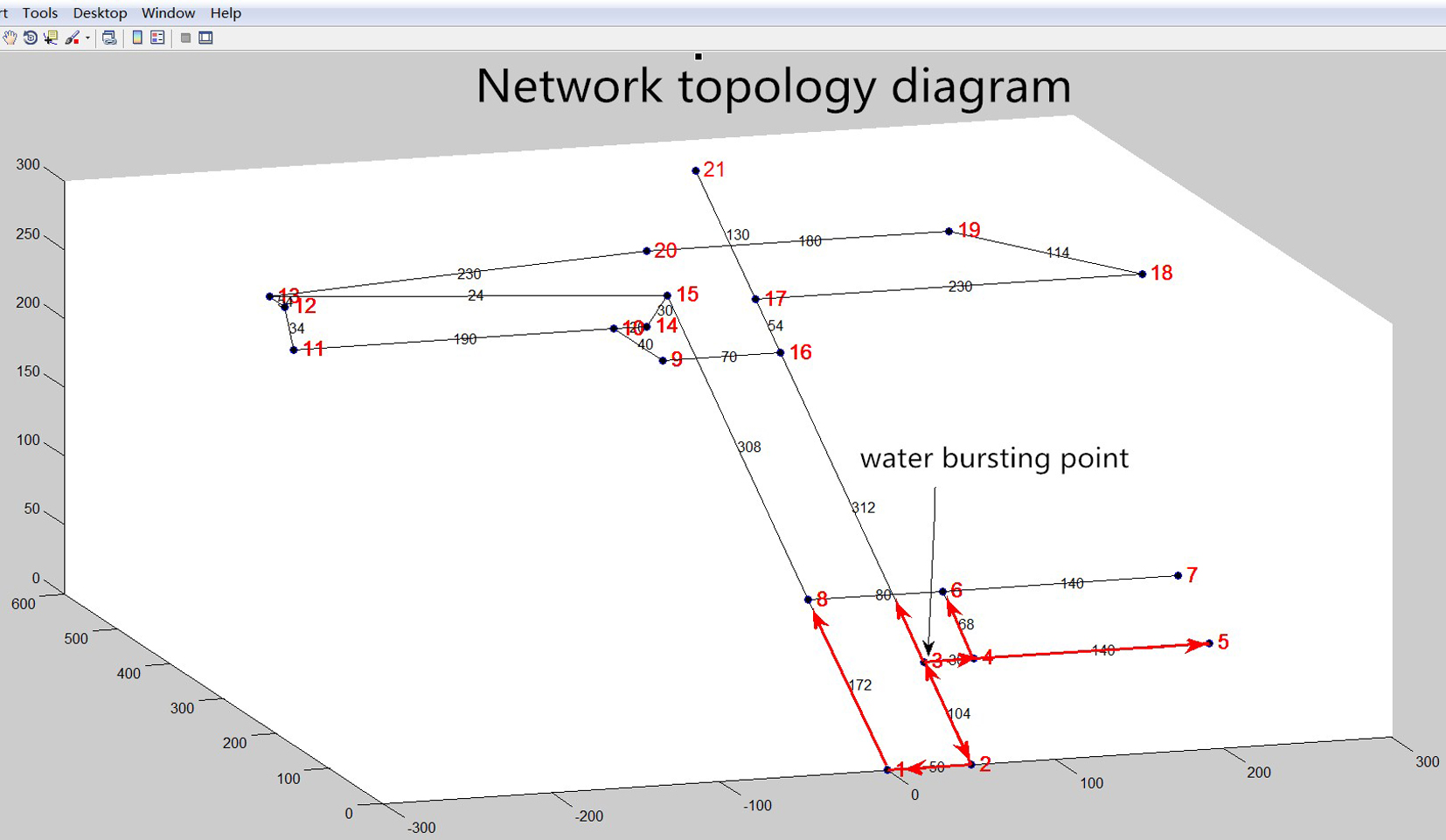
By comparison between the shortest escape path and the water spreading path, it can be known that the overlapped roadways are e1, e2, e9, then mark their traffic ability weights as infinity, and recalculate the shortest escape path and the escape time, result shows that the path is
Analysis of escape path decomposition
Path Table 4 shows that the time for escaping from Path From Table 4 it can be seen that the time for the people to escape from
From Tables 4–3, the time for people to escape from
Table 4 shows that the time for people to escape from
At the time 1211.4 s the roadway real-time situation map.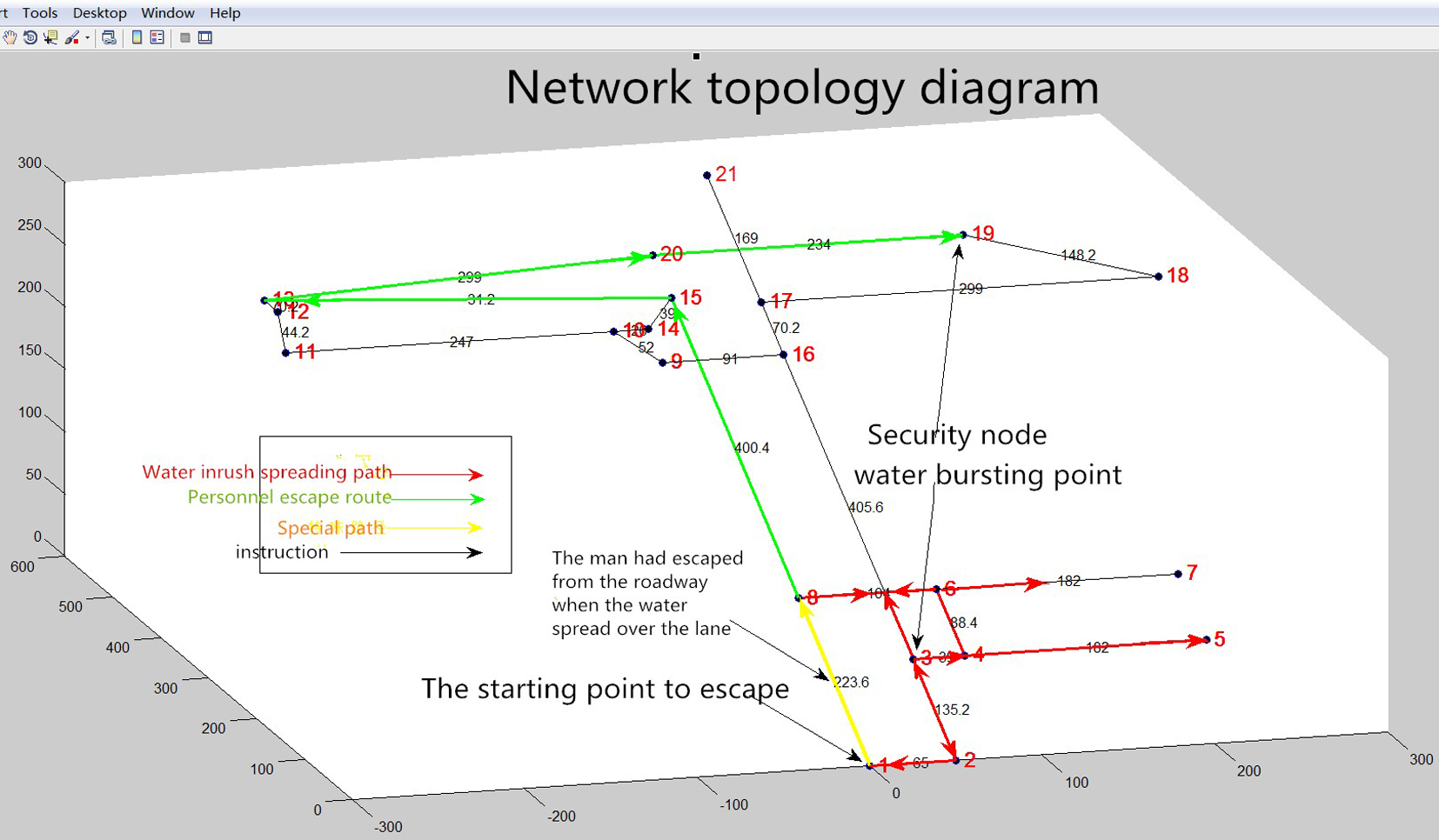
Table 4 shows that the time people to escape from
The shortest escape route in the roadway network.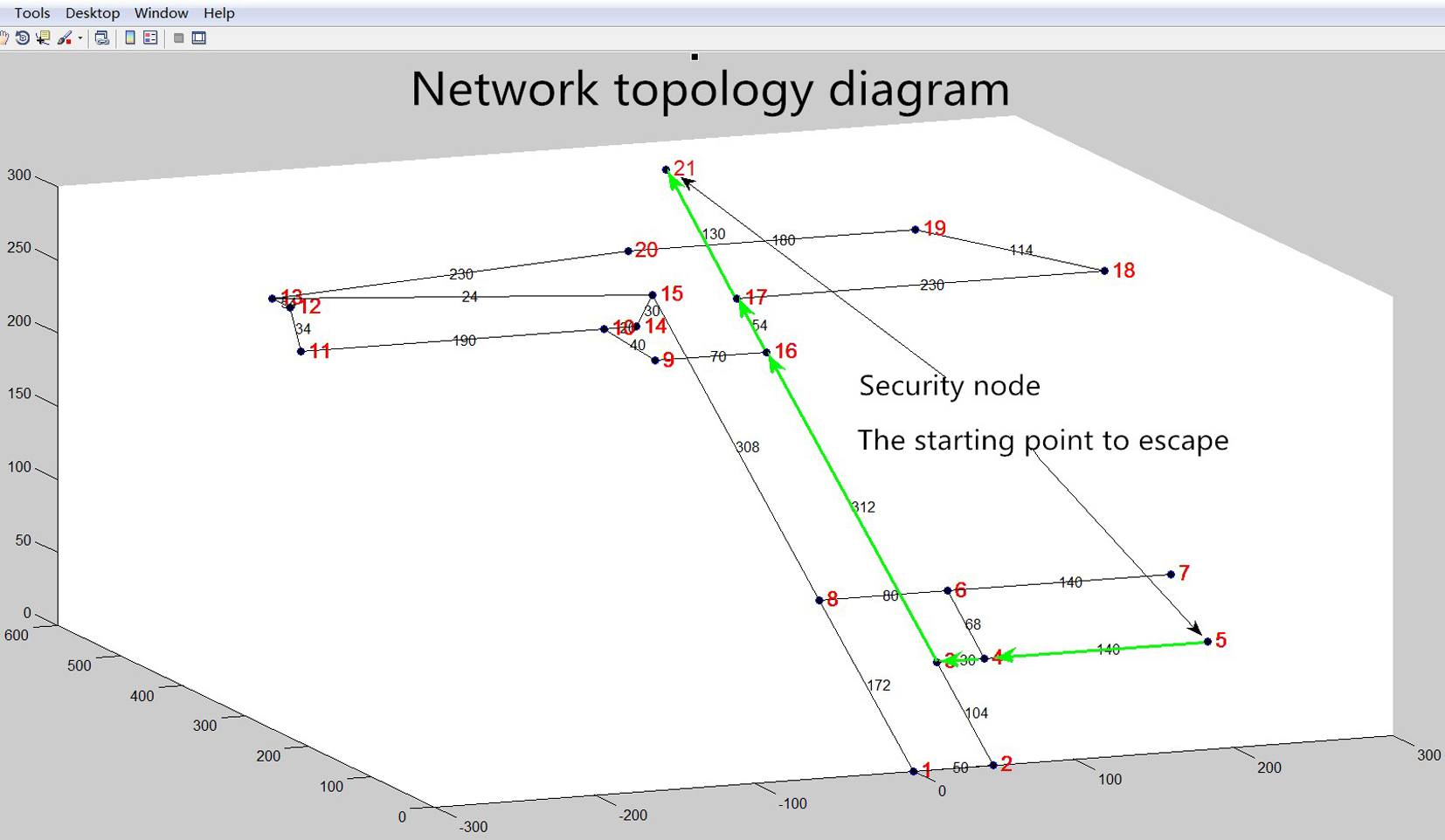
Water spreading path at time of 855.7 s.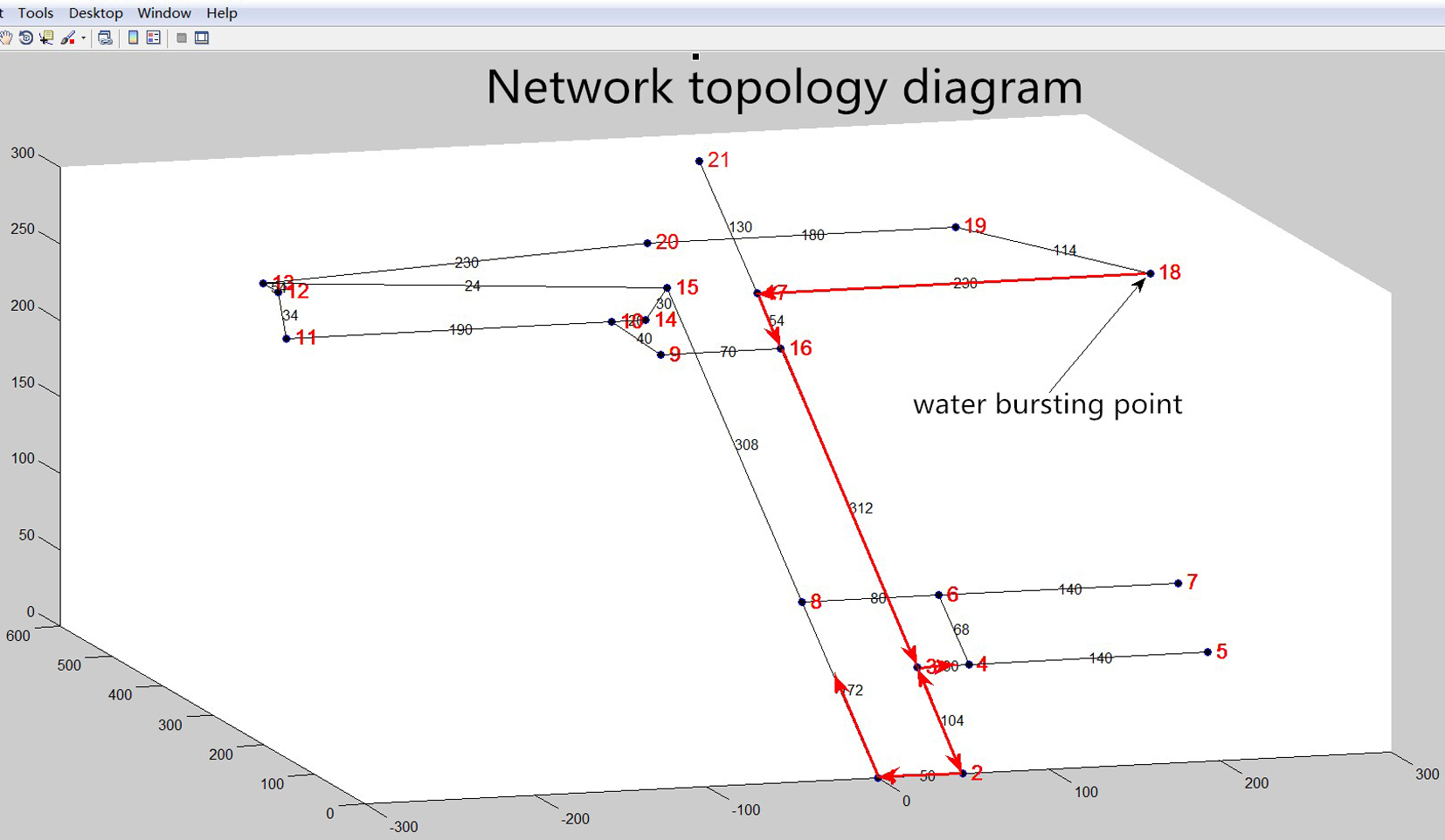
Table 4 demonstrates that the time for people to escape from
Through analysis, it can be known that although the shortest escape route
Set node
Calculate the shortest escape path and time
According to the Dijkstra algorithm, the shortest escape path in the roadway is calculated using Matlab, and according to the roadway traffic ability weights Table 3, the shortest escape path is:
The height of the waterway in the roadway corresponds to the speed of the person
The height of the waterway in the roadway corresponds to the speed of the person
Calculate the range of water in the escape time According to the time of 855.7 s for the people in mine to pass through the shortest escape path, considering the solved water spreading range and water spreading time, it can be concluded that in 855.7 s, the water spreading path is as Fig. 10 shows. Analysis of water spreading path and escape path Compare the shortest escape path with the water spreading path to get the overlapping roadways e1, e2, e9 and e16, then mark their traffic ability weights as infinity, and recalculate the shortest escape path and the escape time to get the result that the path is: Analysis of escape path decomposition
Path
The real time situation of roadway at time 1314.2 s. From Table 4, the time for people to escape from Path From Table 4, the time needed to escape from Accessibility analysis of escape route Because the roadways of the two paths which overlaps the water spreading path are not filled with water, both paths are passable. Assuming that the water level in inclined roadway and that in horizontal roadway are lower than 55 cm, referring to Table 7 it can be known that people’s moving speed through water is 0.7 m/s. For the path
This paper gave the calculation of roadway weights for first, which lays the foundation for solving the shortest escape route for evacuation in mine. Then, downward water spreading path and water level rising path were solved, in addition, water spreading speed and time were calculated, which laid a foundation for solving the optimal escape rout. finally, the optimal escape route was solved.
The shortest path of the first solution in Case 1 is not the optimal path because on this path the escaping people will pass through flooded roadway. The relative shortest path of the second solution is the optimal path. Although the path weight is relatively large, the safety of the escaping people is ensured. In Case 2, the people in mine must pass through the path flooded by water. In this case, it is necessary to judge the traffic ability of the roadway with water flow and recalculate the time that people passing through each path in accordance with people moving speed through water. Finally the path which need the shortest time is the optimal path.
According to the actual situation of coal mine, the optimal path generated by the algorithm can minimize the injuries and death caused by water bursting, and make the rescue in mine water bursting disaster more successful.
Footnotes
Acknowledgments
This work is financially supported by Yulin City Science and Technology Project No. Cxy12-2-07 and Natural Science Foundation of Shaanxi Provincial under Grant No. 2016JM6031.