



Abstract
To solve the global optimization problem in heavy machinery, a multidisciplinary design optimization (MDO) computing environment is developed based on high level architecture (HLA). The computing environment encapsulates the analysis optimization tools in relevant disciplinary fields to seek global optimization design based on a single disciplinary optimization. The goal of a minimum discrepancy between the subsystem-level design variables and system-level target values is reached by establishing multidisciplinary consistency constraints. The HLA-compliant optimization model realizes collaboration and interoperation between the disciplines through mapping the coupled state variables to corresponding published or subscribed attributes of an object class according to the rules of HLA. Finally, an example application of designing a hydraulic-powered support is presented to demonstrate the effectiveness of the optimization environment.
Keywords
Introduction
As a method for solving complex system optimization designs, multidisciplinary design optimization (MDO) has been primarily applied in the aerospace field including large aircraft [1, 2, 3] and carrier rockets [4, 5] firstly. It has versatile areas of application in civil machinery in the past 20 years. Heavy machinery such as coal-mine machinery involves multiple disciplines. Its design process must be optimized due to the long design cycle, high consumption of steel, and increasing requirements for accuracy and reliability. However, its design optimization tends to be limited to a single discipline [6] and it is difficult to achieve overall optimization because the large-scale design problem involving multiple disciplines may be cumbersome to manage. What needs to be further explained is that MDO can enhance system design by exploiting synergies among different disciplines [7].
There are currently two main types of computing environments for multidisciplinary optimization design. One is based on Unified Modeling Language [8], but there is little mature commercial simulation software for support. The other is based on the interfaces between simulation software for different disciplines [9]. This widely used method is currently supported by many kinds of commercial simulation software. However, the interfaces of simulation software in various disciplines lack standards and are not open. High level architecture (HLA) [10, 11] is applied in collaborative simulation, as it supports heterogeneous combinations and interoperation between distributed optimization simulation models in various disciplines.
In this paper, the MDO computing environment based on HLA for designing a type of coal heavy machinery is developed and presented. Its primary contribution is to collaborate the optimization of subsystems which are decomposed along disciplinary boundaries from a complex system. The problem of multidisciplinary interaction is solved with use of the publish-and-subscribe mechanism provided by HLA for passing messages between disciplines.
The remainder of this paper is organized as follows. The next section discusses individual discipline optimization. Section 3 details our approach for model using the collaborative optimization computing environment based on HLA. Finally, an example application of the design process of a type of hydraulic-powered support with experiment results and conclusions are given in Sections 4 and 5, separately.
Individual discipline optimization model
The mathematical model of typical nonlinear individual discipline optimization is
where
The optimizer is a mathematical model that seeks the optimal solution using the iteration of the objective function
Diagram of iterative loops of individual disciplines.
The analysis module seeks the optimal solution
Multidisciplinary design optimization emphasizes the interdisciplinary coupling effect rather than simply superposing optimization results in single discipline. A major goal of the HLA is to support interoperability between distributed models and reuse of simulations. The variables requiring interactions are mapped as federation member object class attributes according to the HLA standard, thus achieving interdisciplinary interactions. Below we explain how to establish a collaborative optimization computing environment based on HLA followed by an analysis of the collaborative optimization model.
Multidisciplinary collaborative optimization model
The collaborative optimization method involves approaches to system decomposition and interdisciplinary communication. The complex system design problems are divided into several subsystem problems (which may correspond to one discipline). With the use of subsystem optimizers, each discipline is given control over its own set of design variables and is charged with satisfying its own disciplinary constraints. The system optimizer utilizes the consistency constraints to coordinate subsystem-level optimization results and target values of the system-level design variables and to update the system-level design variable. It finally obtains the global optimal solution which satisfies the consistency constraints.
The general model of system optimization can be stated as
where
The optimization model of the
where
Accordingly, an optimization model involving two disciplines or subsystems is shown in Fig. 2. In this model, a complex system is hierarchically decomposed along disciplinary boundaries into two subsystems. The upper part illustrates a system-level optimization model which provides coordination and minimizes the overall objective. The lower part illustrates an optimization model involving two subsystems.
Model of multidisciplinary optimization.
In the model,
The high level architecture is a distributed system architecture. It achieves interoperability between models while improving the reusability, scalability, real-time capability, and cooperation of the simulation models in different fields.
The models developed by commercial simulation software in different disciplinary fields are first divided into federation members. Then, as for the coupling state variables, the publication/subscription attributes of object classes are developed according to the run time infrastructure (RTI) interface specification. A federation member sends an interaction, registers a new instance of an object class, and updates its attributes. Other members subscribe and receive the interaction as required, identify new object instances, and reflect the new attribute value of an object instance, thus achieving interactions between coupling state variables in different disciplinary fields.
To establish the multidisciplinary collaborative optimization model, two classes and four federations are designed based on the HLA rules, object model template (OMT), and interface specification.
One type of member is the collaborative design optimization computation federation, including two federation members:
System-level optimization federation members are meant to achieve the system-level optimization algorithm, and to finally obtain the optimal solution of the system Subsystem-level optimization federation members are intended to obtain the subsystem-level optimization results
The other type of member is to manage optimization simulation, also including two types of federation members.
Optimization process monitoring members are responsible for monitoring the state of the entire optimization computation. To improve system efficiency and reduce network-data redundancy, optimization process monitoring members only subscribe the target values of the system-level design variables Optimization-data collection members are responsible for collecting the data generated in the optimization computation for post analysis. These mainly involve system-level design variables
We present a case study in product development of a type of hydraulic-powered support (ZY3500/ 12/26) to demonstrate the multidisciplinary collaborative optimization computing environment as well as show how it can be established based on HLA.
This case study is a typical multidisciplinary design optimization problem involving two disciplines, structural mechanics and kinematics. As the major stressed component of the hydraulic-powered support, the shield-beam is subjected to the coalseam pressure together with the top beam. Structural optimization design of the shield-beam is carried out to determine the length and sectional dimensions, which involves the fields of structural mechanics. On the other hand, the shield-beam, foundation, and front and back linkages form a four-bar mechanism. The optimization objective of the four-bar mechanism is to control and optimize the trajectory of the endpoint A shown in Fig. 3 when the support is operating, which involves the fields of kinematics. The length of the shield-beam and the position of the hinge point can be designed as coupling state variables as they can influence the optimization of two subsystems.
Geometric parameters of the four-bar mechanism.
Cross-section parameters of the shield-beam.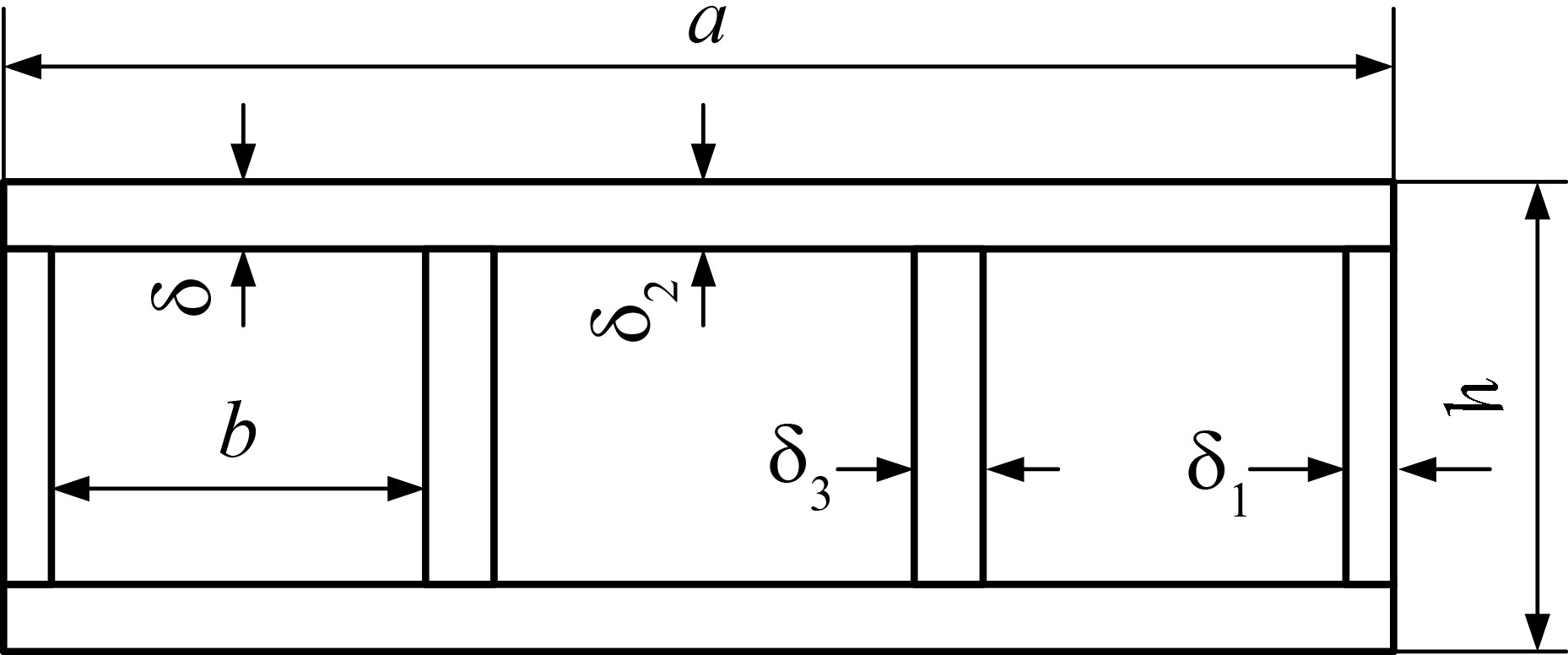
As shown in Fig. 3, the range of the motion trajectory of endpoint A of the top beam should be no larger than 70 mm.
The subsystem analysis module is simplified as follows.
Where, the objective function
The subsystem optimizer can be expressed as
Where,
The constraint conditions of the analysis module and the optimizer should meet the constraint requirements of the discipline, i.e.
The parametric modeling function offered by ADAMS/View is used to establish a kinematic model of the four-bar mechanism of the hydraulic powered support. Within the variation range, the design variables are computed and optimized to obtain the optimal design based on the optimization analysis procedures. The optimizer is used to satisfy multidisciplinary consistency constraints according to the description in Eq. (5).
The box-section shield-beam of a hydraulic-powered support has a high capacity to be subjected to combined bending and torsion. A general optimization objective is to optimize the cross-section size and reduce the area of the cross section of the beam, thus reducing the weight of the shield-beam provided that its length is fixed. The example considers the coupling effect of the four-bar linkage parameters for optimization of the cross-section size.
For instance, the cross-section parameters of a three-chamber box section, as shown in Fig. 4, will be optimized by the finite element method with the use of ANSYS Workbench software.
Based on the analysis in Reference [12], optimization of the cross-section size, i.e. the analysis module of the discipline can be stated as
The subsystem optimization can be stated as
The constraint conditions of the analysis module and optimizer of the subsystem should also meet the constraint requirements of the discipline, i.e.,
where
The objective of the system-level optimization design is to optimize the structure and cross-section size parameters of the shield-beam and reduce the weight of various components while satisfying strength requirements and achieving economical design.
As mentioned above, the length of the shield-beam and the position of the hinge point would influence the optimization result of the cross-section size. Therefore, the lengths of
where
This study omits the optimization simulation management members and only describes the collaborative design optimization computation federation members. These include a system-level federation member FedSystem, and two subsystem-level federation members, Fed4BarL-Adams and FedShieldB-Ansys. The former encapsulates the four-bar linkage optimization model created by the Adams software and the latter encapsulates the parameter optimization model of the shield-beam created by the Ansys software. The principles are shown in Fig. 5.
Optimization result of four-bar linkage parameters
Optimization result of four-bar linkage parameters
Optimization result of the cross-section dimension of the shield-beam
Federation design based on HLA.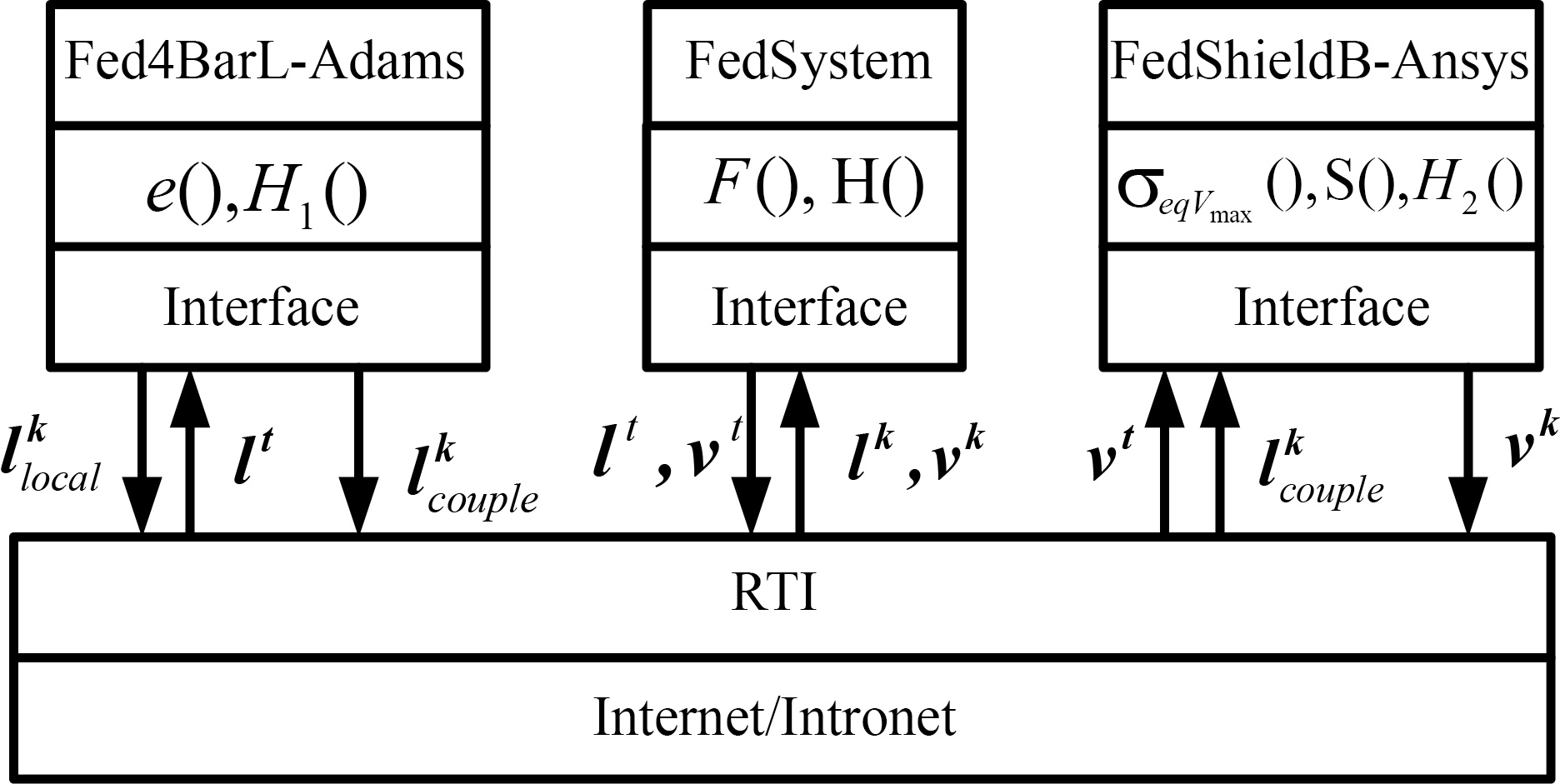
Vector
In the example, the minimum mining height is
Cross-section parameters of the shield-beam.
Tables 1 and 2 present the optimization results of the two subsystems while considering the coupling effect, respectively. Figure 6 describes the iteration curve under the condition of the consistency constraint. From the results shown in Tables 1, 2 and Fig. 6, it is clear that the sizes compared with original parameters are reduced, meanwhile, the consistency constraint is gradually being met.
It is a challenging problem to solve the global optimization problem in complex system especially for large-scale, distributed analysis applications. In this paper, an MDO computing environment was developed to solve the global optimization problem of a complex system which is hierarchically decomposed along disciplinary boundaries into numerous subsystems. The problem of interdisciplinary communication was solved based on HLA. In addition, the process of collaborative optimization which is easily parallelized on heterogenous applications was simplified through the consistency constraints. The computing environment was successfully applied to designing of heavy machinery. It was demonstrated that this method is well-suited for MDO.
Footnotes
Acknowledgments
This work was supported by the Research Award Fund for Outstanding Young and Middle-aged Scientists of Shandong Province (No. BS2011ZZ018).