



Abstract
Wireless Multimedia Sensor Networks (WMSNs) is inherited and developed from the traditional Wireless Sensor Networks (WSNs). Quality of service (QoS) has become an important index to evaluate the quality of the WMSNs. This paper discusses the following two aspects. Firstly, we propose a method to handle sudden network congestion–improving the way of key frame transmission, namely increasing the compression ratio of the key frames. The process reduces the video image quality, it can guarantee the continuity of video signal and conform the requirement of people’s daily viewing. Secondly, the paper is discussing to apply the Ant Colony Optimization (ACO) to improve the mathematical model and make it apply to WMSNs. At last, the experiment turns out that the improved ACO can be used in routing and this has certain application value.
Introduction
With the deepening of various research institutions, the rapid development of wireless sensor technology has begun to take shape, and its wide range of applications are gradually being recognized. In the past the end of the 20th century, American scientific and technological community unanimously have agreed to regard wireless sensor technology [7] as one of the most promising and influential new science and technology in the future. Wireless multimedia sensor network in the military, civil, commercial has a very broad application prospects. Specific areas of application focused on: (1) Battlefield Detection and Surveillance. The multimedia sensor network has such features as rapid deployment that a large number of WSNs are deployed on the battlefield to collect and relay information and filter a large amount of raw data, and then the important information is transmitted to the data fusion center to greatly enhance the commander’s battlefield posture perceived level. (2) Smart home network. In the smart home wireless network, the most basic unit is a wireless sensor node, its function is responsible for sensing and preprocessing of information, in response to monitoring host commands and then send data, such as monitoring and tracking of children’s activity trajectory. (3) Environmental monitoring. WSN is very suitable for use in the field environment, which greatly facilitates the acquisition of raw data needed for environmental research. (4) Agricultural monitoring. Wireless sensor networks can realize the decentralized requirements of non-central nodes. This system has the advantages of flexible expansion, high reliability, convenient installation and high precision, overcomes the shortcomings of traditional environmental monitoring, and realizes automatic, real-time, remote and accurate monitoring of agriculture Facilities and environment, effectively meet the requirements of agricultural environment monitoring. Wireless sensor networks have real-time monitoring with wireless communication features, so that it has great development prospects in agricultural production. Generally, wireless sensor networks consist of a large number of densely deployed small sensor nodes with sensing, computation, and wireless communication capabilities. Sensor nodes do not incorporate an infrastructure. With the increasing demand for information diversification, the traditional wireless sensors that can only transmit simple physical information can not meet the demand of diversified information ever more and more. For example, with audio, video and other intelligent graphics information, and intelligent services are constantly changing our daily habits. As a result, wireless multimedia sensor networks are produced in this way.
Now, in our daily life, wireless multimedia sensor network applications are everywhere. Due to the characteristics of wireless multimedia sensor network [3] (WMSNs), it makes a big difference with the traditional wireless sensor network. On the one hand, it inherits the characteristics of wireless sensor networks such as self-organization and limited resources. On the other hand, it puts forward higher and higher requirements for multimedia information collection, transmission, hardware design, energy saving control, service guarantee, information processing and so on. Therefore, more and more attention has been paid to the research of wireless multimedia sensor networks. Especially in the multiple age, with the development of business types and the upgrade of information requirement, people are no longer contented with the simple data from the existing environment, but hope to get the various information such as images, sound and video. Whereas, the traditional WSN cannot fully meet people’s needs of multimedia information, therefore, the WMSN comes into people’s eyes. WMSNs is based on the traditional sensor network, but differs from it largely. The higher demand of multimedia information service quality makes WMSN more and more important.
There is a large amount of data to be processed and transmitted in wireless multimedia sensor networks with limited resources. Video streaming is a typical application in wireless multimedia networks. The video sensor node transmits video data to the sink node through multi-hop. The video transmission in the wireless multimedia sensor network should consider two factors: on the one hand, streaming media data has strict requirements on QoS, such as bandwidth, delay and packet loss rate; on the other hand, the whole network energy balance. Therefore, this paper by compressing video and improving ant colony algorithm to ensure the quality of video streaming.
This paper solves the following two aspects of the problem. First of all, the common congestion mitigation methods for node congestion include controlling the transmission speed and discarding some frames, but there is a problem of losing important data packets in the wireless multimedia sensor network. Therefore, we propose a solution to the problem of sudden network congestion method – improve the key frame transmission, that is, increase the compression ratio of key frames. This process reduces the quality of the video image, ensures the continuity of the video signal, and meets the needs of people’s daily viewing. Secondly, this article is discussing the application of ant colony optimization (ACO) to improve the mathematical model, and applying it to WMSN to improve the QoS guarantee of routing. Finally, experiments show that the improved ACO can be used for routing, which has certain application value.
Related works
Wireless multimedia sensor network is based on the application of the traditional wireless sensor networks [1] to improve the upgrade, but it is on the basis of traditional wireless sensor network and add some of multimedia information collection and transmission, but also increasing each node in the network transmission of data packets, throughput and the rate of data streams. However, because of the limitation of network resources and limited processing ability on network node, the wireless multimedia sensor network will face more serious network congestion than traditional wireless sensor networks, which makes that wireless multimedia sensor network congestion control becomes extremely important, so now it is a national research scholars are working on one of the hot spots.
The research of the wireless multimedia sensor network is relatively late in our country, so the research on the congestion control of its network is not very rich, and now most of the research is based on the experiment of traditional wireless sensor networks on the congestion control of the network mostly. In 2003, Wan et al. proposed the CODA protocol [12, 20]. The principle of this protocol is to control the congestion by controlling the energy consumption of the node. In 2006, Wang et al. proposed another protocol that controls the congestion of PCCP (Priority-based congestion control protocol is one of the uplink communication congestion control protocols in wireless sensor networks) at node priority [6]. It can adjust node rate based on the different priorities of different nodes’ data to control network congestion phenomenon. In 2009, Yin et al., who proposed the FACC protocol [17], that is, for the relative fairness of transmission in the network for different data streams, the source node allocates different transmission speeds for different data streams. These are all experiments conducted on traditional wireless sensor networks. Therefore, most of the research results of congestion control in wireless multimedia sensor networks are based on the congestion control protocol of traditional wireless sensor networks, and then continue to improve and expand, for example, Kuang et al. proposed a QoS constrained multicast routing algorithm for cognitive wireless mesh networks [24], aiming at minimizing the total number of multicast tree channel collisions and also taking advantage of a lower number of channel collisions. However, it is not suitable for most situations due to the fixed transmission distance. (CQCP-PS congestion control protocol [15, 22]) proposed by Yaghmae et al. The principle is to study the more excellent congestion control protocol based on the traditional wireless sensor. At the same time, aiming at the problem of QoS routing [14] in wireless multimedia sensor networks, there are a lot of researches. Among the existing QoS routing protocols, the classical algorithms are Sequential Assignment Routing (SAR) [9] and SPEED [16]. Multipath routing is a commonly routing method to guarantee QoS, in [25] proposed a QoS routing protocol based on Ant Colony Optimization, the protocol considering energy, delay, bandwidth and other factors, how to search the optimal path problem is abstracted as portfolio planning problem. According to the rule of minimum cost flow, the decision conditions of high bandwidth and low delay path are defined. By using Ant Colony Optimization algorithm, the paths of different objective functions are found to meet different QoS requirements. On the basis of SPEED, reference [10, 18] proposes a multi-path, multi speed routing protocol MMSPEED. This protocol considers real-time and reliability of QoS, and for real-time, providing a multi packet transmission speed guarantee to support a variety of QoS levels. In addition to the idea of cross layer design, implementation of QoS guaranteed routing is a very active research field, but the interaction between the layers and the joint optimization will bring high complexity of the algorithm, the wireless sensor network node computing ability and storage capacity is a great challenge.
This paper mainly has the following two innovations: first, according to adjust the data transmission speed and targeted to discard part of the data packet proposed a way to deal with the sudden network congestion – improving the way of key frame transmission, to ensure the continuity of the video signal. Secondly, improving the mathematic model of ant colony algorithm and increment mechanism of pheromone, adding the pheromone restriction factor of next-hop node and considering the residual energy, so we can get the optimized QoS routing algorithm.
Multimedia data transmission based on improved key frame
Problem statement
In the network congestion control, common congestion includes node congestion and link congestion. The usual way to alleviate congestion is to control the transmission speed and discard some frames. These two methods are feasible in wireless sensor networks, but these two methods will cause problems in wireless multimedia sensor networks:
Control transmission speed: at present, the vast majority of wireless multimedia sensor network congestion control protocol are basically derived from the traditional TCP protocol [2, 3], through the control method of adjustment sending rate of the information in the terminal node to realize the congestion suddenly appeared in the network. Therefore, in the wireless multimedia sensor network, by adjusting the transmission congestion rate of multimedia data stream, will allow the transmission of these important data packets have a serious impact, and optimize the network performance and not much benefit, so for this situation, in the design of wireless multimedia sensor network appear in the congestion phenomenon, which must be based on different priorities of the data stream to distinguish, it will become one of the hotpots in the research of congestion control protocol for wireless multimedia sensor networks. Discarding part of the frame [19] is also a common way to control congestion in the sensor network. However, if some key frames are discarded, the quality of the final video will be directly affected, and the screen may not be restored to affect the user’s needs. Therefore, most of the cases are selectively discard some non-key frames, but will not have much impact on image quality, while could not discard lots of non-key frames [13], this will also have a big impact on the eventual recovery of video.
In the streaming media video, the real-time and the picture quality requirements are relatively high, so, in our daily life, when we watch multimedia information may appear fuzzy picture at a moment, there may be a moment of multimedia information disruption phenomenon, compared to these two phenomena, people are more receptive to the former.
Therefore, in order to solve the problem that the user is affected by the interruption of multimedia information caused by network congestion, this paper proposes a new key frame transmission method. This model is Wyner-Ziv encoding [8] domain model improved based on distributed wireless multimedia sensor network codec transform, it aims at the network congestion problem suddenly appeared in a short of time, and by alleviating the compressed key frames at the sensor nodes to alleviate network congestion. In essence, this scheme is to guarantee the quality of multimedia information by sacrificing the quality of multimedia information transmission.
In wireless multimedia sensor networks, due to the implementation of audio, video, humidity, temperature, light intensity, ultrasonic, acceleration and other multimedia information acquisition, there will be different types of various sensor nodes. At present, in the multimedia video encoding standard, by the International Telecommunication Union, H.26x series and ISO/ICE MPEG [4] standard as the representative, in order to make use of time and space redundancy of the video sequence, usually using predictive encoding based on inter frame and DCT transform based on block. In recent years, a new video coding framework – Distributed Video Coding [22], DVC has been widely concerned by scholars in various countries.
We will use the MPEG-4 video coding that everywhere to be seen standard as an example to illustrate. In the MPEG-4 video coding standard, a video screen is encoded in a set of frames, which will be sent out in transmission through the network, the receiver receives the set of frames decoded into the original image. In MPEG-4, as shown in the figure below, the set of frames after encoding are divided into key frames (I frames), minor key frames (P frames) and non-key frames (B frames), their importance in the group is decreasing, In order to reduce congestion, we can first discard the B frame, but if the situation is more serious, we can increase the P frame compression ratio to further alleviate the congestion situation.
MPEG-4 encoding is the current popular distributed video coding process, at the node by adjusting the transmission speed of information flow and discard part of the information frame method have been not satisfied with the current high flow of multimedia information network, which is now attracting attention to the wireless multimedia sensor network. Thus, an overly peculiar approach has been devised for this phenomenon to alleviate this situation.
The main idea is that should not firstly reduce the flow of information transmission speed, just drop part of the non key frames, when it is still can’t effectively alleviate the network congestion phenomenon, the compression of sub key frames is increased appropriately, and the amount of information transmitted is further increased. Finally, the method achieves the continuity of the video image by sacrificing the quality of the picture.
When the information frame transmission speed is reduced, it can be seen from Fig. 2 that some key frames can’t reach the terminal node in time, the picture information of a certain frame can’t be reconstructed, which will lead to the multimedia information in the picture can’t reconstruct and cause the interruption phenomenon of multimedia information ;when discarded the part is not non key frames, if the congestion is serious, the discarded non-key frames will be increased, and the terminal nodes can’t be restored the original phenomenon of multimedia information, the same multimedia information will be interrupted phenomenon.
It can be seen from the above diagram that people only adjust the non-key frames to reduce the network congestion. However, this method can’t meet the current requirement in the wireless multimedia sensor network. Therefore, key frame and non-key frame combination of methods to adjust, that is, without reducing the transmission speed of the information flow, the sub-key frames are appropriately compressed and the number of discarded non-key frames in the case of congestion is reduced, further reducing the network congestion.
Implementation process
The following is the key frame compression of the basic coding process.
The video sequence is divided into Wyner-Ziv frames (W frames) and key frames (K frames), where the key frame is periodically inserted, depending on the size of the GOP (Group of Picture). The video sequence is divided into different frames by using a frame splitter. For each different video sequence, the attributes given by each frame are different due to the different coding structure. Therefore, the coding method is different. Block-based transformations, in particular the application of DCT to each K-frame. Then, the DCT coefficients of the entire W frame are divided into different groups according to the position of the DCT coefficients of each block, thereby forming different sets of DCT coefficients. After quantizing each DCT coefficient set, these quantization sets depend on the quality of the image to be obtained. For a given set, the bitstreams of all the quantized signals will be assigned to a group, forming a bit plane. And then the formation of Z-shaped coding, the main significance of this step is to ensure that the priority of low-frequency components appear, and make high-frequency components appear later, thus increasing the number of consecutive “0”, so it will use these 63 elements with the “z” (Zig-Zag) arrangement. Finally, in order to further compress the data, and the need for entropy coding. Get the final compressed data.
The above basic steps are the sub-key frame coding process, the idea of this paper is based on this step, which innovation is to add a control key in the quantification process.
Through the analysis of the basic coding process we can know that the control of the image frame compression ratio is the key to the quantification process, the purpose of this process is to reduce the non-“0” coefficient and increase the “0” value of the number of coefficients, by controlling the “0” value of the number of coefficients can adjust the compression ratio, which is also the main source of loss compression in image encoding process, so we are for this process to carry out a simple change.
After the previous section of the change, the key frame encoding process adapted as follows:
Firstly, the key frame passing through the frame splitter is carried out the forward discrete cosine transform (FDCT) [5]. This step is basically the same as the standard compression algorithm, and there is no change; Quantization, this step is the key we played, first by the network terminal judges whether there is network congestion, if not still in accordance with the standard encoding implementation; if there is congestion, then judge the congestion degree, and then the corresponding regulator of size. If the network congestion degree is not very big, it can slightly adjust the adjustment factor, if the congestion degree is relatively large, can be adjusted relatively large adjustment factor; After quantizing each DCT coefficient set, these quantization sets depend on the quality of the image to be obtained. For a given set, the bitstreams of all the quantized signals will be assigned to a group, forming a bit plane. And then the formation of Z-shaped coding, the main significance of this step is to ensure that the priority of low-frequency components appear, and make high-frequency components appear later, thus increasing the number of consecutive “0”, so it will use these 63 elements with the “z” (Zig-Zag) arrangement. Finally, in order to further compress the data, and the need for entropy coding. Get the final compressed data.
This idea proposes a further compression coding key frame mode transmission, which based on the transformation domain Wyner-Ziv video codec scheme.
In the transmission of multimedia information (especially video streaming), key frames often play a decisive role, so the transmission of QoS services for data flow will be one of the focuses of multimedia sensor network routing research.
Source of thought
Now, in view of the research of wireless multimedia sensor network, in order to protect the real-time and reliability of multimedia data stream, QoS transmission has become a very important research direction. In the reliability of network data transmission, QoS routing has become a more important means of application. Compared with other routes, it can be known that QoS routing will establish an effective QoS transmission path between the source node and the base station during data transmission, thus ensuring reliable data transmission to the destination node. This will make the data transmitted to the terminal node has a more reliable network guarantee. This can not only effectively balance the load of the network, but also can effectively reduce that the single path suddenly failure brought about by the high risk for the transmission of multimedia information.
In traditional wireless sensor networks, ant colony algorithm [11, 23] is QoS routing algorithm for more research, but also this has good application effects in the application. But in wireless multimedia sensor networks, ant colony algorithm is not very good effect. In order to make the ant colony algorithm in the wireless multimedia sensor network be a better use, this paper improves it more suitable for wireless multimedia sensor network.
Introduction to basic ant colony algorithm
In the process of the initial initialization for the algorithm, we will give them a certain pheromone concentration for each edge in the model, and each ant
Among them,
Among them,
The volatilization coefficient of pheromone
Among them,
Ant colony algorithm can be optimized for network routing with self-organization and adaptive optimization mechanism [21], so it has a good application in wireless sensor networks. However, the main function of the wireless sensor network is to collect and forward the physical vector data, the information flow is small, so that the ant colony algorithm on its application research mainly focused on how to reduce the energy consumption, so in the application of wireless multimedia sensor network is powerless, therefore, this section will focus on the characteristics of infinite multimedia sensor network in the ant colony algorithm positive feedback process by adding packet loss rate, delay and other weight factors to improve the routing algorithm QoS guarantee, making it equally applicable to wireless multimedia sensor network.
Ant colony algorithm has the advantage that the ants will continuous to strengthen the pheromone in the process of the algorithm running, thus making the algorithm will eventually get the optimal solution, this ants positive feedback behavior of the algorithm makes the convergence speed is improved greatly; the basic ant colony algorithm can be used to solve many complex problems, and also has a good robustness; ant colony algorithm is a lot of ants through the continuous path to achieve, so the algorithm is parallel, so that it can be used for distributed computing; finally, because the ant colony algorithm with the distributed computing compared with other algorithms is relatively easy, which makes it possible with other heuristic algorithm, which can be used to improve the performance of the algorithm.
But at the same time ant colony algorithm also has more shortcomings: the reality will have a lot of ants in the path, the same wireless sensor network in the presence of a large number of sensor nodes, which will cause the existence of multi-path, which Will lead to the algorithm in the convergence of the time required for a long time; Second, the basic ant colony algorithm to find the path to consider the results from the nest to the food the shortest path, and in reality, especially in the sensor network It is easy to cause the algorithm to fall into the local excessive consumption, while the other nodes have not been fully utilized. Therefore, in the design of QoS routing algorithm when we should also transfer the packet loss rate and transmission delay and other factors into account.
Improvement of mathematical model of ant colony algorithm
Assumption 1 The deployment of sensor nodes in the network is relatively random, and the whole network is a relatively symmetrical structure, and basically the performance of each node are the same, both to receive data, and the data forwarding. We can define the following mathematical model to represent the application of the ant colony optimization algorithm in the QoS routing of the wireless multimedia sensor network, according to the metric of the QoS routing of the wireless multimedia sensor network described in the previous section.
Definition 1 The topology of the basic model of the wireless multimedia sensor network is set to an undirected graph G (V, E), so we use to represent any node of the sensor, and V is a set of all sensor nodes. One of the two nodes and the ability to communicate directly, we set their communication path to the edge, and at this time all the edges of the network we use E to represent. At the same time, we put the sensor nodes send data in WMSNs as a source node and Sink node is used as a food source or destination node, due to the random node and a large number of deployment of the node, there are many paths to the source node to the destination node. We use the ant colony optimization algorithm to find the most suitable path from the source node to the destination node in the network, and then find the most suitable effective path to meet the network QoS.
Example of a basic model. 
Definition 2 In the improved ant colony algorithm, we will redefine the probability function of the kth ant at node
Among them,
After the transfer probability function improved in the algorithm, we add the next hop pheromone the limiting factor, so it makes the pheromone in the new algorithm is particularly important, but also one of the factors we have to consider the impact of. In the search path, algorithm of ants whenever a path through the node will be in the node on the left a certain concentration of pheromone, so after the behind the ant put the pheromone as they choose an important parameter of a path, and then can get the a ideal path. But the above algorithm we can know that in the early operation of the algorithm, we all set in the path of the whole environment of the pheromone concentration are the same, so that the ants starting from the source node is only able to play in the basis of some constraint conditions of a node selection criteria. It is not difficult for us to find out that the positive feedback process is more meaningful because of the participation of these selection factors. At the same time in the path if a path where the pheromone accumulation is faster than the other path more quickly when they can affect subsequent ants choose path, which makes the algorithm converges more quickly.
Because the sensor nodes in the real environment are random and large in number, this makes the wireless multimedia sensor network have the problem of multipath, so this will reduce the convergence speed of the algorithm at the beginning of the algorithm. In order to make the algorithm in the network get the optimal path solution, we will improve the pheromone increment to a certain extent, that is, when the pheromone update will take into account the remaining energy of the node, which can be more accurate to get the best path solution, so that the algorithm can be more effective in the entire network traversal. Its change as shown in the following formula:
WMSNs are susceptible to the impact of the environment, which can lead to node packet loss rate and transmission delay in the transmission of data. The most important thing is that all the sensor nodes in WMSNs are generally limited in energy, so the measurement of QoS routing for wireless multimedia sensor networks is mainly considered from the following parameters:
Transmission delay. In reality, the sensor network is extremely easy to be affected by the environment, so the sensor nodes in the transmission of data not only by the inherent delay of the network, but also extremely easy to be affected by environmental changes caused by the transmission delay. So the design of wireless multimedia sensor network QoS routing algorithm must take into account the transmission time delay. Packet loss rate. As the network transmission of data, it is extremely easy to be affected by the surrounding environment and the impact of nearby nodes, which will inevitably lead to a certain loss of data packets, so the design of QoS routing algorithm when the need to consider the network lost Packet rate problem. Network energy limits. As the sensor is a lot of deployment, so manufacturers in the production of the inevitable time to take into account its cost, while the general sensor nodes are provided by the battery to provide energy, so the energy of the network is inevitable to be affected. Therefore, the design of QoS routing algorithm should be the same as the energy consumption in the network as an important parameter to consider, and also make every effort to ensure that the entire network can have a long enough life cycle.
In this section, we also make some improvements to the various heuristic factors, as shown in the Eq. (5). When we select the next hop node in the path, we add three factors, such as the remaining energy of the next hop node, the transmission delay and the packet loss rate, when the next hop node is selected. So the ant colony optimization algorithm ant search path P.
In order to further guarantee the accuracy of the algorithm QoS value, we have added the transmission delay, packet loss rate and the remaining energy of these QoS reference parameters. We assume that the path P has n nodes on it, so we will represent the transition probability function of the next node P according to the Eq. (5).
WMSNs usually use wireless communication transmission mode, so their transmission link ability is often not very good, which led to its packet loss rate is generally higher, under normal circumstances the packet loss rate is about 0.1% to 10%, In the case of interference, its packet loss rate is often high about 8% to 50%, so in this section we put the number of packet loss rate set to 10
Assuming that
Schematic diagram of simple proof. 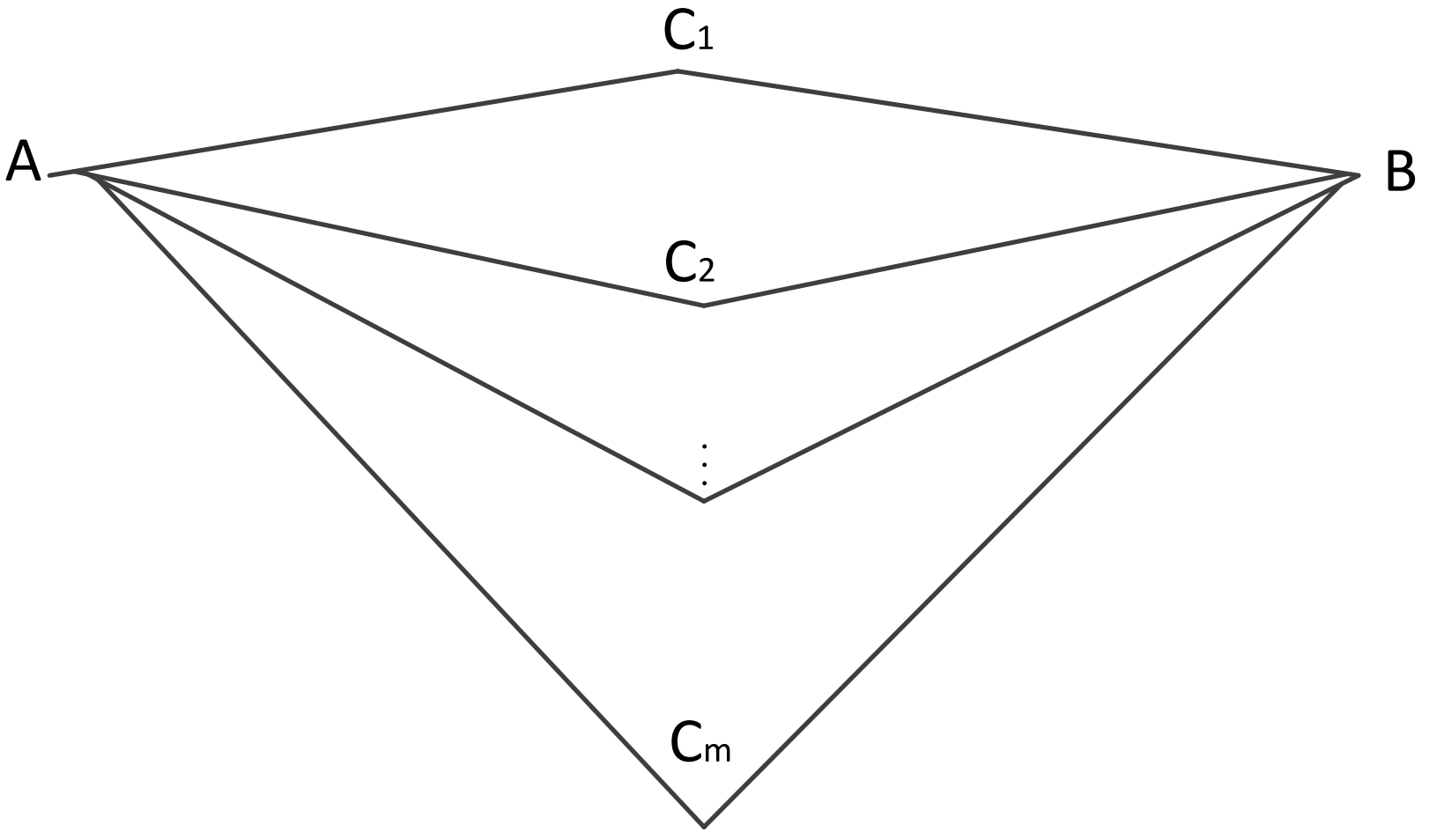
With the above analysis we can see that in the ideal case.
Due to
we can see:
Due to
Thereby
so,
And so on, we can get it
According to the mathematical induction method, in the ideal case, we can see:
From the above derivation, it can be seen that the average pheromone on AC1B is the largest, and the probability of choosing route AC1B is the largest in the ideal case after each run.
In the test environment, we can set the change of time, the delay of each node, packet loss rate and energy will continue to change, we can see at this time, a node’s energy is gradually reduced with time, so its reduction will cause the probability function
After we redefine the above model, we can define a metric to evaluate the selected path to see if it can be the optimal solution in the current path.
We define the formula:
Among them,
The basic steps of the optimized ant colony QoS routing algorithm in WMSNs are as follows:
NC In the process of path finding, we use the transition probability function When the ants reach the Sink node, update the pheromone concentration on the network; Recording the experimental data, and recording the Q which meets the requirements as a candidate path; NC
Video codification experiment results and analysis
In this experiment, the traditional sub-key frame coding is completed by JPEG coding. The experiment mainly simulates the simple process of JPEG programming: color gray level transform, DCT transform, quantization, zigzag coding, DC AC coding, Huffman coding.
Evaluation Criteria (PSNR), an objective criterion for evaluating images. It has limitations and PSNR stands for “Peak Signal to Noise Ratio”. The Chinese meaning of peak is the vertex. The whole idea is to reach the top of the noise ratio signal. Usually after image compression, the output image will be somewhat different from the original image. In order to measure the quality of processed images, we usually measure a handler by referring to the PSNR value. It is the logarithm of the mean squared error between the original image and the image being processed relative to
MSE is the mean square error between the original image and the processed image, and the unit of PSNR is dB. That is, the larger the PSNR value is, the smaller the distortion is.
The following is a simple implementation of the PSNR formula in MATLAB:
function PSNR
calculate the peak signal-to-noise ratio of two images, f1 represents the original image, f2 represents the decoded image after the original image is compressed and transmitted.
k
fmax
a
e
[m, n]
b
PSNR
compression ratio: The figure shows that the compression ratio changes with the adjustment factor q changes. Basic parameters of the experiment
Compression ratio and q relationship. 
PSNR: the larger the PSNR value, the smaller the distortion is. When the PSNR value is above 28, the difference in the image is not so great.
Relationship between PSNR and q. 
Actual renderings: The following is a comparison chart of the actual effect of grayscale images before and after compression with changing adjustment factors.
Comparison of images before and after compression recovery. 
After comparing the above three aspects, we can find that when the compression ratio is increased, the compression ratio of the image changes a lot, but the PSNR value of the actual image before and after the change is not very large, and then from the actual renderings, it can be found that when the adjustment factor
The experimental environment in this paper is OMNeT++. OMNeT++ is an acronym for Objective Modular Network TestBed in C++, an open source, component-based modular open network simulation platform. OMNeT++ as a discrete event simulator, with a strong and perfect graphical interface interface and can be embedded simulation core, with NS2, OPNET and JavaSim simulation platform compared to OMNeT++ running on multiple operating system platform, we can easily define the network topology, programming, debugging and tracking support.
This section analyzes the validity of the ant colony optimization algorithm in the WMSNs routing algorithm, but the experiment only selects the optimal path to do the experimental comparison, and at the same time for the obvious effect, compared with the same experimental environment optimization algorithm and MMAS algorithm results comparison. Among them, the simulation scene is the base station coordinates (0, 0) in the region randomly distributed 100, 150, 200, 250 four different number of sensor nodes, the region size of 300 m
Energy consumption of 150 nodes. 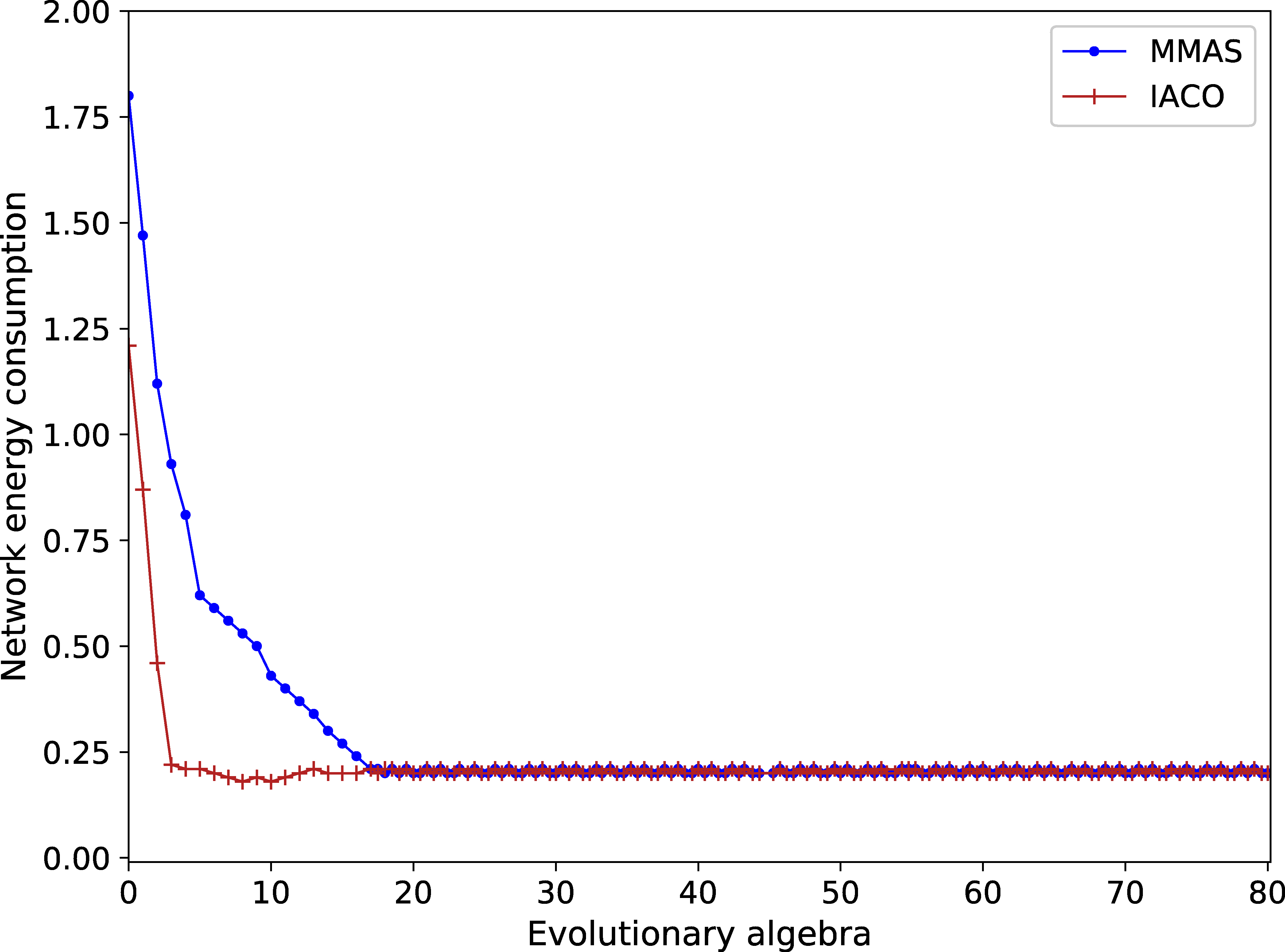
Energy consumption of 200 nodes. 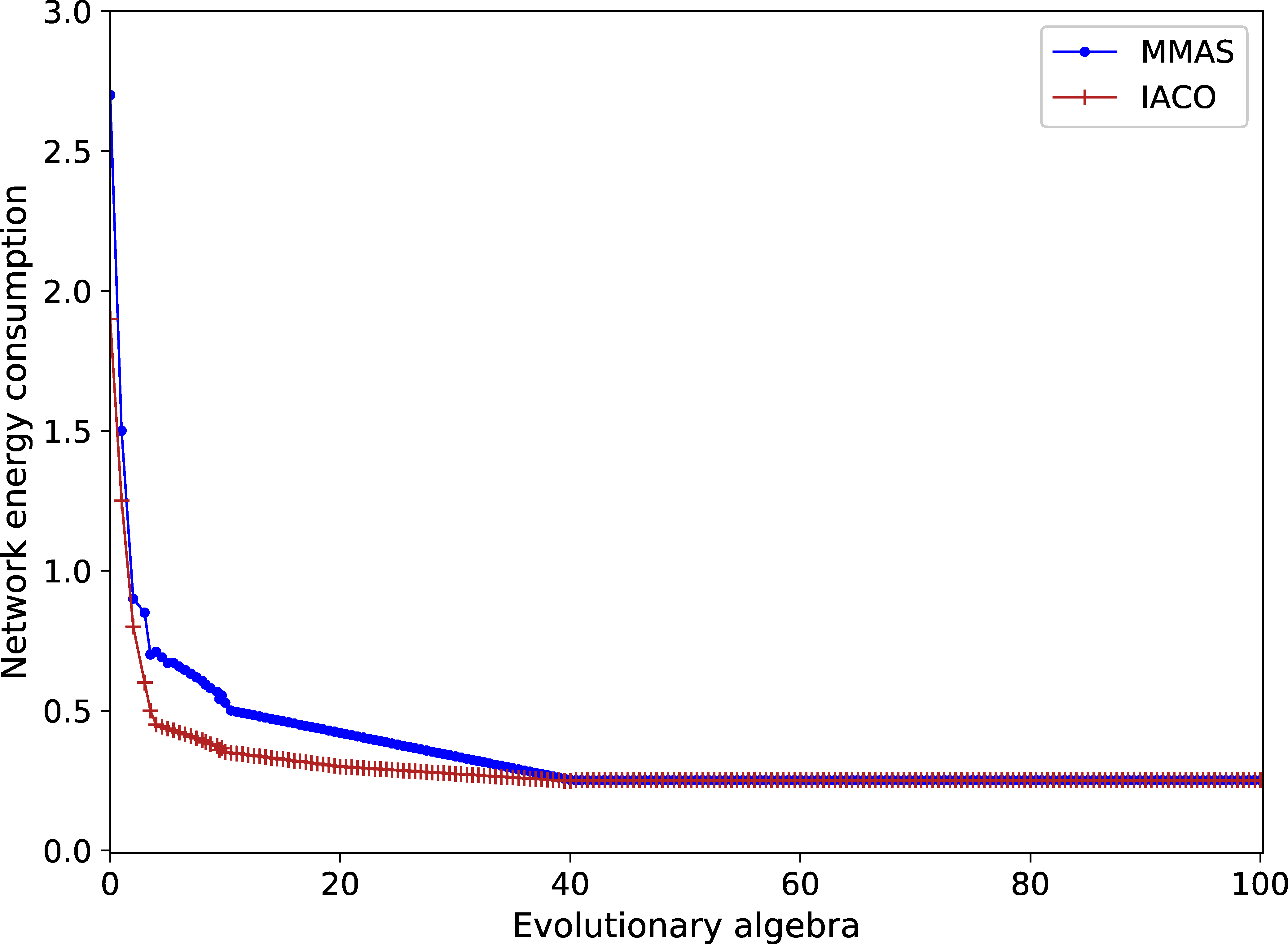
Energy consumption of 250 nodes. 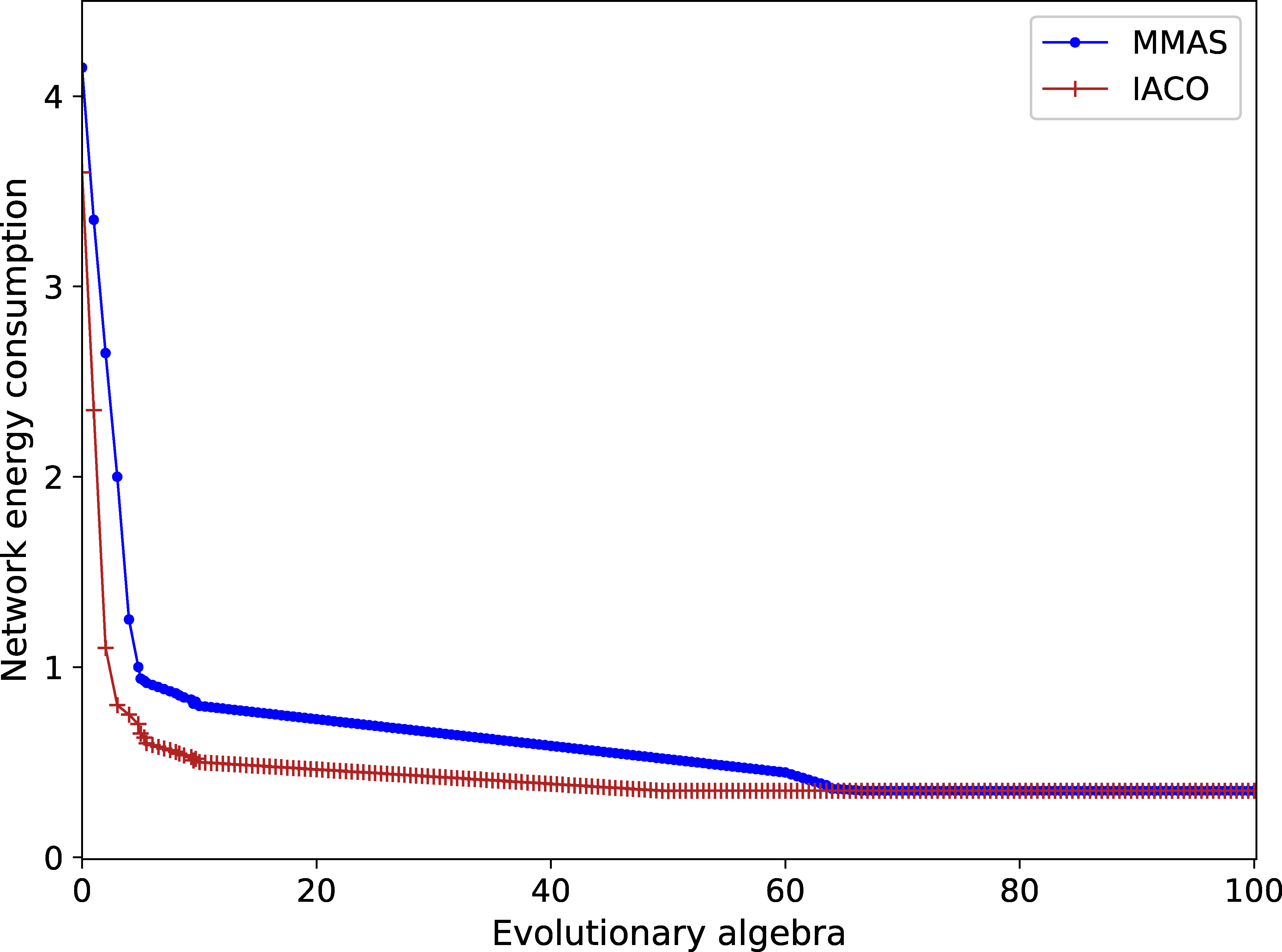
In order to analyze and compare the QoS of this algorithm, two interference sources are added to the simulation. The closer the interference source is, the higher the packet loss rate at the time of data transmission and the higher the transmission delay. Transmission packet loss rate can be calculated according to Eq. (10).
Delay at 150 nodes. 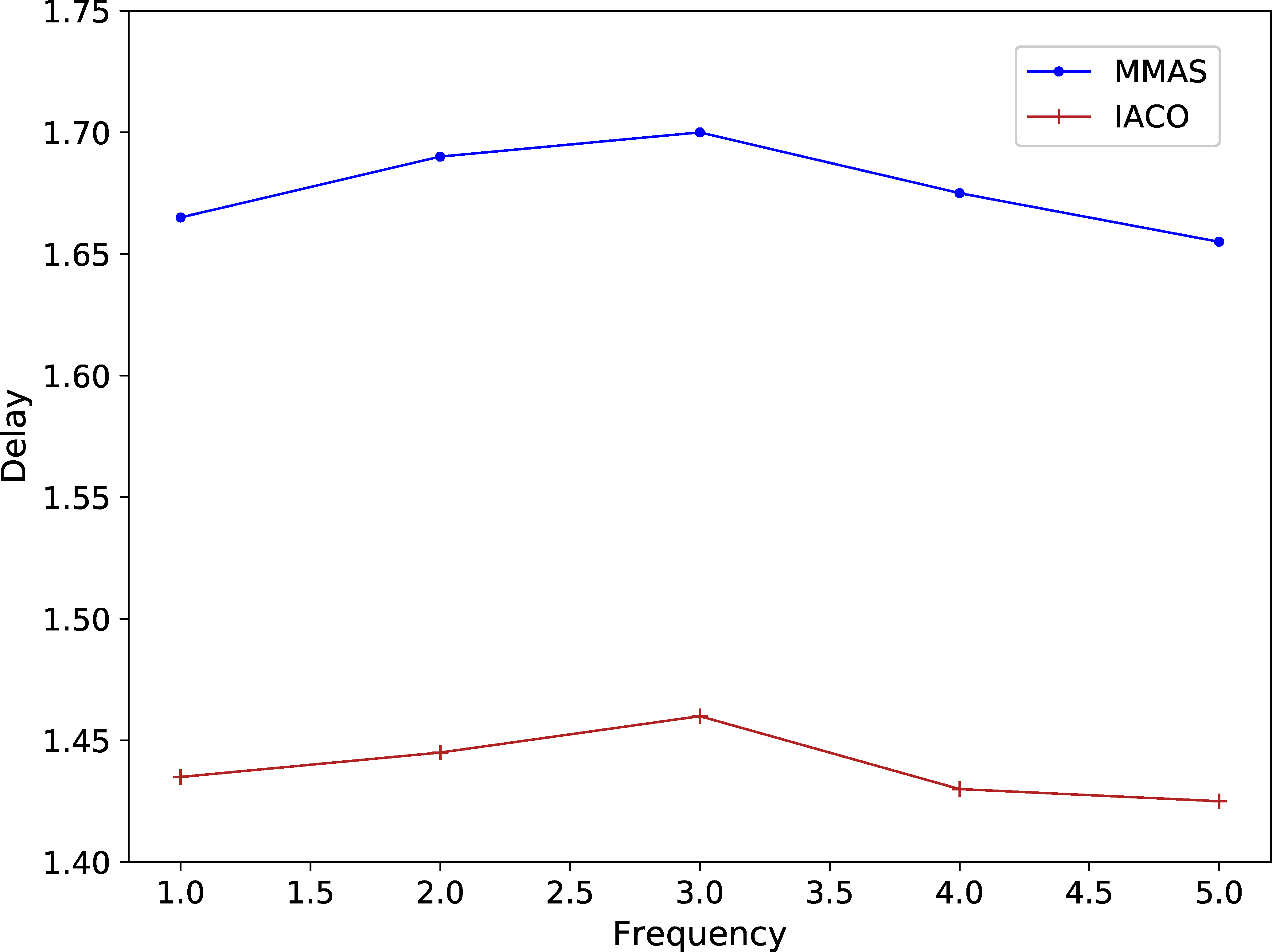
Delay at 200 nodes. 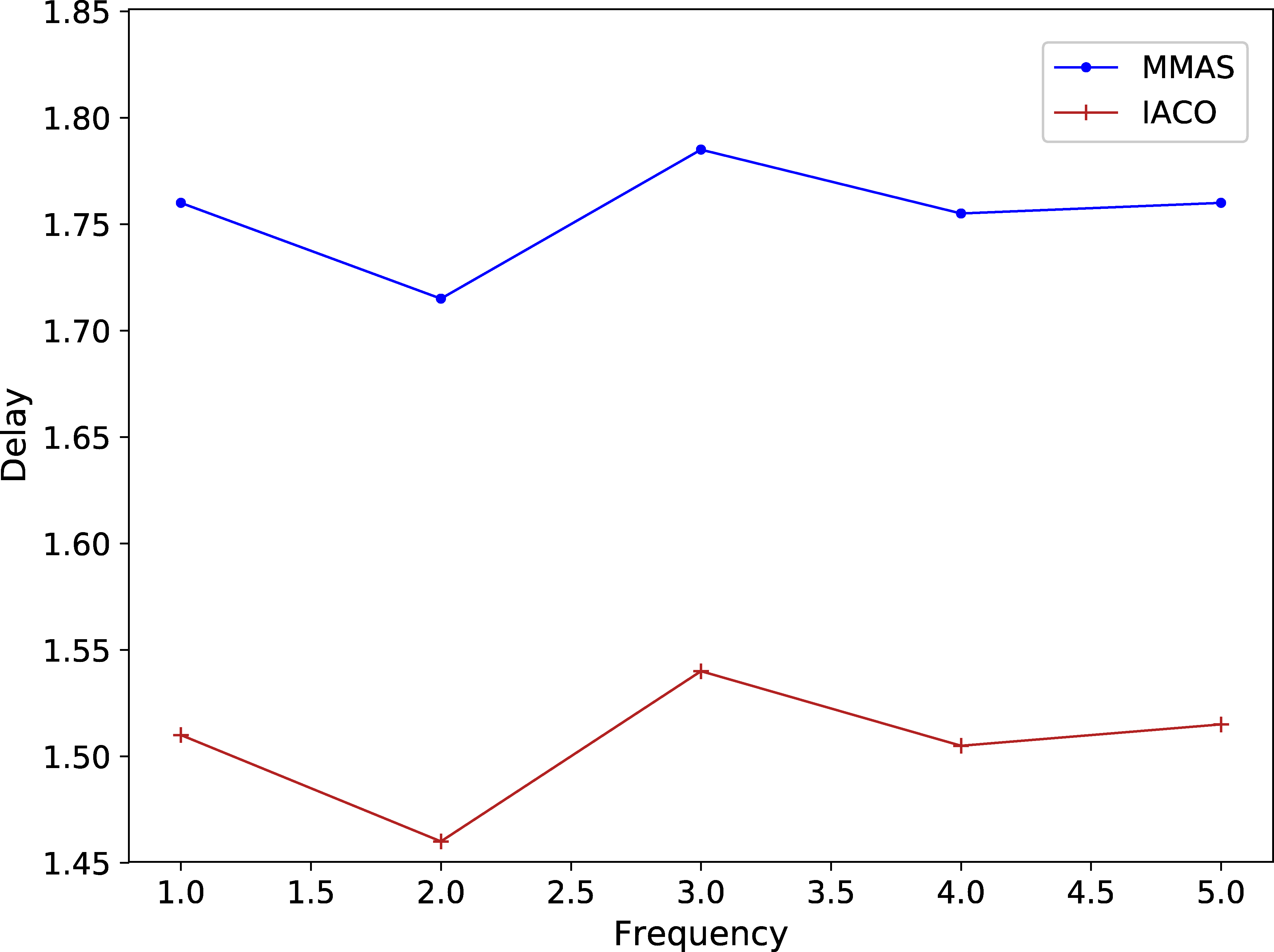
Delay at 250 nodes. 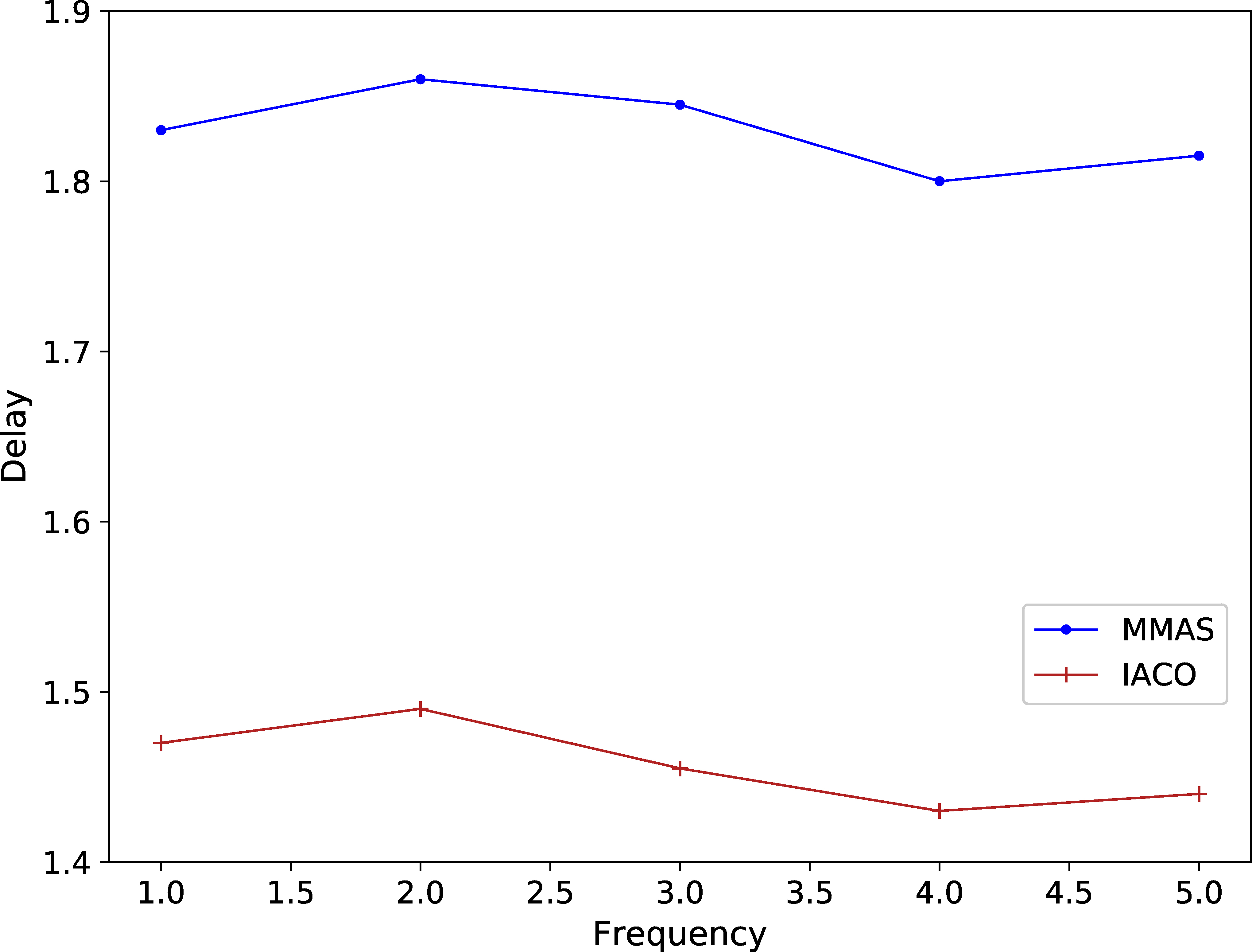
Among them,
The experimental results are mainly from the following three aspects were compared:
Packet loss rate at 150 nodes. 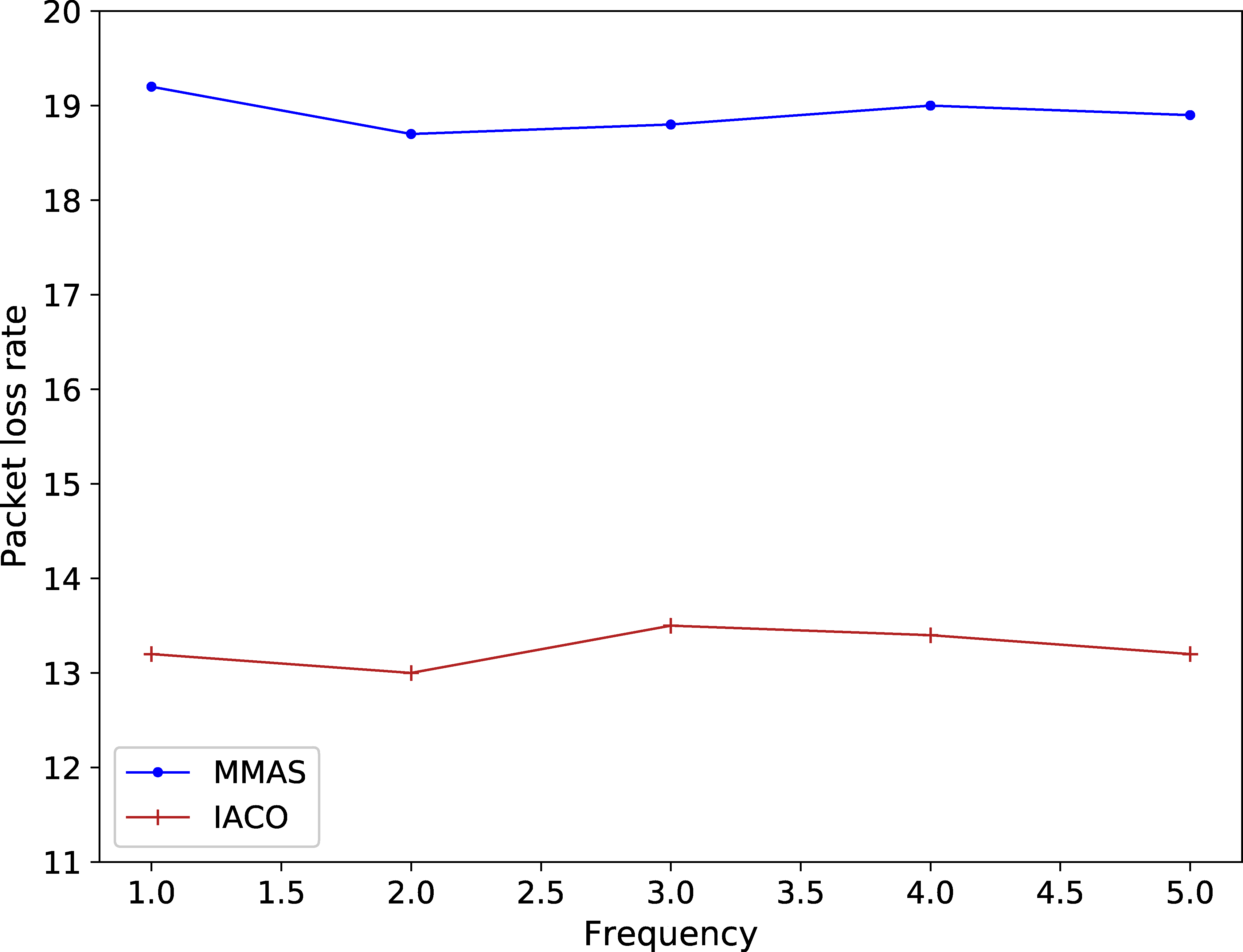
Packet loss rate at 200 nodes. 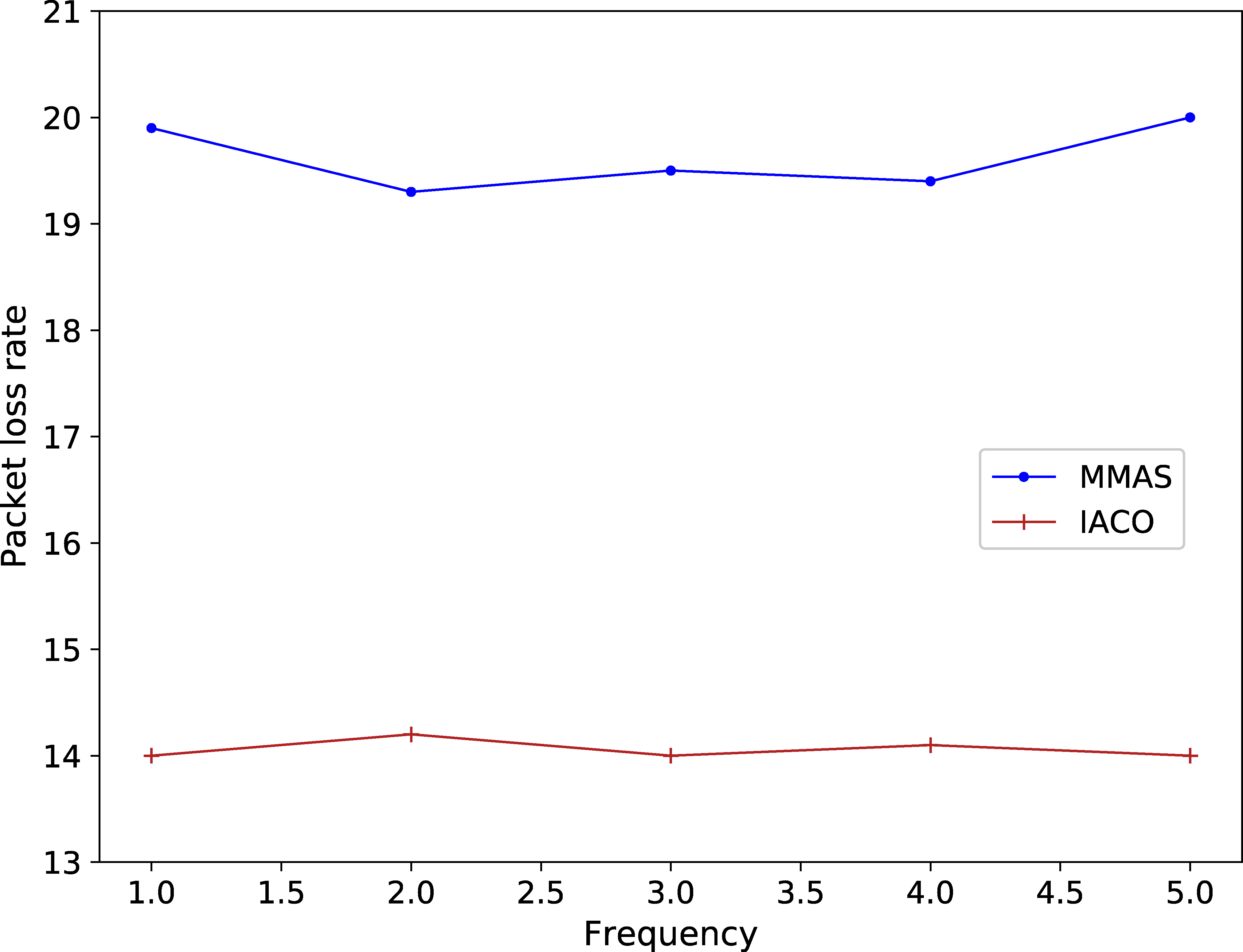
Packet loss rate at 250 nodes. 
(1) Average energy consumption
The average energy consumption is able to reflect the entire network for the observation of each node, to reflect the basic life cycle of the network is a path to achieve the most basic guarantee.
In the experiment, we track the energy consumed in the network. It can be seen from the figure that the energy consumption of the early network is larger, because the initial network of the algorithm needs to find the path. Due to the algorithm does not have the optimal path at the beginning of the algorithm, the energy consumption of the optimal path is more stable. In the middle stage, the energy consumption tends to be stable when the optimal path is found. The final stage is that the energy flow has gradually stabilized, because the algorithm has found the optimal path.
Figure 6 is the network energy consumption chart of 150 nodes after 80 rounds of path search. Figure 7 shows the network energy consumption chart after 200 rounds of 100 rounds. Figure 8 shows the network energy consumption of 250 nodes, after the network energy consumption chart.
(2) Delay
The delay is also an essential evaluation criterion for wireless multimedia sensor networks, which reflects the real-time nature of data transmission. The following figure is delay comparison used 5 times delay comparison by the optimization algorithm and MMAS, the number of rounds per choice of the last 20 times the average. It can be seen from the figure that the optimization algorithm delay is lower than that of the MMAS (maximum – minimum ant colony algorithm) algorithm, because the algorithm takes the delay in the heuristic factor required for the ant transfer probability. Therefore, the optimization algorithm can search for a lower delay path in the process of ants search path, so that the path searched by ants can meet the requirement of path delay.
(3) Packet loss rate
The following figure is a comparison between the optimization algorithm and the MMAS algorithm in the packet loss direction. Each time the last 20 rounds of the algorithm are selected to stabilize the average data. It can be seen from the figure that this algorithm has a drop in packet loss rate because the optimization algorithm embeds the packet loss rate in the heuristic factor and can effectively guide the ant to search for a path with a lower packet loss, so that the path of the ants search to meet a certain packet loss rate requirements.
From the above three experimental results can be obtained, this paper can be improved based on the ant colony algorithm, and in practical applications, we can also according to the different characteristics of the data flow reasonable adjustment of the adjustment factor, so that according to different of the data stream requires an optimal path for the data stream transmission.
To sum up, the improvement of this paper is feasible for the basic ant colony algorithm, and has a certain theoretical value.
In this paper, we focus on some research hotspots of wireless multimedia sensor networks, and do some research on it. This paper mainly discusses the following two aspects. Firstly, there are two kinds of coping methods for network congestion, one is to adjust the data transmission speed, and the other is to discard some non-critical data, although these two methods in the wireless sensor network has a certain application value, but for the wireless multimedia sensor network is not practical, Thus, an improved key frame transmission is achieved, mainly for the sudden network congestion. Secondly, for the routing algorithm, the ant colony algorithm which is researched in the wireless sensor network is introduced again, and the specific characteristics of the wireless multimedia sensor network are improved, and it is proved that the idea is feasible.
Footnotes
Acknowledgments
The work has been supported by the National Nature Science Foundation of China (No. 61672004) and the Chongqing Research Program of Basic Research and Frontier Technology under Grant NO. cstc2016jcyjA0590.