



Abstract
An accurate HTHP rheological model is essential for safe and economical deep drilling. In this work, the water-based fluid applied in Southwest China Gas Fields is selected as a typical example to systematically explore rheological modeling at elevated temperature(up to 180
Introduction
The past few years have witnessed a rapid widespread for the deep drilling in China, especially in the southwest region, due to an increased demand for hydrocarbon energy. Generally, the deep gas drilling readily encounters harsh downhole environments, particularly the high temperature and high pressure (HTHP), which may severely affect properties of drilling fluids and the drilling progress. Hence, it is significant to maintain moderate properties of drilling fluids under the extreme conditions [1].
The rheology, as an important property of drilling fluids, appears to be critical for the successful drilling of deep, hot wells. Reasonable control of rheology is essential in most drilling operations, e.g., hydraulic calculation, pressure loss calculation, hole cleaning efficiency, and equivalent circulating density (ECD) determination, which enable high rate of penetration (ROP) and low drilling cost. The determination of rheologcal data relies, to a large extent, on a rheological mathematic representation, which allows an accurate theoretical prediction. Therefore, rheological modeling usually behaves as the first step in the HTHP drilling operation. However, it is well-known that in deep operations, rheology of drilling fluid is relatively complicated and often influenced by temperature, pressure, shear history, and composition of the drilling fluid [2, 3, 4]. Otherwise, temperature and pressure effects on rheology of drilling fluids are much different in downhole. As a result, HTHP rheological modeling can be restrained by complex fluid behaviors.
In the current work, rheological modeling has been examined based on the water-based drilling fluid applied in Southwest Gas Fields in China. A systematic investigation from rheological variation with temperature and pressure, selection of transient rheological models at constant temperatures and pressures, to a detailed comparison of dynamic rheological models, has been conducted, for the purpose of improving HTHP rheological modeling strategy. A newly modeling process has been developed, based on the modified HTHP rheological models. The literature linked with HTHP models has been firstly reviewed, which would be helpful to understand the profiles of HPHT rheological modeling.
HTHP rheological modeling progress
In view of the application mode, HTHP rheological models can be divided into two classes: the transient and dynamic models. The former is based on mathematical equations relating shear stress (
In general, introducing T/P correction into traditional models is the most direct way, which can modify rheological models by three variable equations. At present, the two HTHP rheological modeling, multiplicative factor (MF) and relative dial readings (RDR) methods, have been developed in terms of such modification strategy.
The common MF expression is given in,
where
where
To diminish the correlation of parameters, Rommetveit and Bjorkevoll [9]proposed another way to construct base equation, which is written as,
where
Also, such modeling approach is recommended in the American Petroleum Institute (API) and the HTHP rheological model is,
where
where
Another HTHP modeling approach is the RDR method developed by Hemphill [15], which has been used to predict rheological behaviors of ester-based drilling fluids. The RDRs are defined as,
where
where
To sum up, all HTHP rheological models are closely contacted with physical and mathematic views in nature. It should be pointed out that previous studies on HTHP rheological modeling were chiefly concentrated on methodology, while systematic modeling application is rarely referenced. Meanwhile, HTHP rheological models are primarily performed on the oil-, synthetic-, and invert emulsion-based drilling fluids rather than the water-based drilling fluids. Therefore, a systematic investigation into HTHP rheological modeling for the water-based drilling fluids can not only enrich rheological knowledge, but also provide a modeling strategy for establishing accurate HTHP rheological models for water-based drilling fluids.
Water-based drilling fluid
The field water-based drilling fluid has a density of 1.5 g/ml, and it consists of at least 7 functional additives, such as hydrophilic solid phase, pH control agent, loss control agent, viscosifier, inhibitor, antioxidant, and weighting material (see Table 1). To enhance the temperature resistance, most polymeric additives underwent the sulphonated treatment. The prepared sample was heat-aged at 180
Design of experiments
In the target reservoir, the geothermal gradient ranges between 2.3
Modeling methods
The MF and RDR approaches mentioned above have been employed to build dynamic rheological models, wherein the
Main components for the water-based fluid
Main components for the water-based fluid
Fann viscometer: dial readings measured under different HPHT conditions
HTHP Rheological characterization
Table 2 collects the dial reading and RDR values under the considered conditions. As might be anticipated, the water-based fluid is rarely pressure-dependent and highly temperature-dependent. For example, in the pressure range of 15
Despite a slight rise, effects of pressure on rheology can be ignored as compared with that of temperature. For instance, at each pressure, variations of dial readings at six shear rates rpm exceed 70%, when increasing temperature from 60
Figure 1 further visually compares the temperature and pressure effects on rheology. It is apparent that in Fig. 1, several regular color belts parallel to
Effect of temperature and pressure on shear stress at different shear rates, the surfaces are colored on a blue-green-red (BGR) scale with respect to the magnitude of dial reading.
Inspection of Table 2 and Fig. 1 indicates that in the water-based systems, the pressure effect on rheology can be ignored in principle. However, the pressure variable (
Transient HTHP modeling generally denotes selection of the mathematic expression from the traditional models. It would be available in the targeted section because of the known downhole environment. Otherwise, understanding HPHT transient rheological model would be helpful to further construct the dynamic HPHT rheological model with T/P factors.
Herein, the 25 sets of dial readings listed in Table 2 were fitted to five typical rheological models, including the Bingham Plastic, Power Law, Casson, Herschel-Bulkley, and Robertson-Stiff models. Characteristic constants and correlation coefficients for various models are given in Table S1 (See supplementary material). As expected, the three-parameter models, Herschel-Bulkley and Robertson-Stiff models, are more reliable than the two-parameter models in extrapolation calculations. Their average correlation coefficients arrive at 0.9996
Meanwhile, the two-parameter Bingham model also gives good fits to the experimental data and its correlation coefficients are all more than 0.99, which are compatible to the three-parameter models. That is to say, the Bingham model can be used to characterize the rheology at constant conditions. This finding is relatively different from the results attained in non-aqueous drilling fluids, wherein the Power Law model would perform well in predicating flow behaviors [20, 21].
Dynamic HTHP rheological modeling analyses
Dynamic HTHP rheological modeling means an incursion of T/P factors to the initial mathematic expression. As described above, two strategies, i.e., MF and RDR approaches, are usually used for establishing dynamic HTHP rheological models. In the oil industry, HTHP dynamic rheological models should be more popular and practical than the transient HTHP models.
MF approach
Establishment of general MF-corrected models is usually based on a transient base model. With the Arrhenius empirical relation, subsequently, the T/P correction factors are introduced to construct three-variable equation. This strategy has been used in the oil-based drilling fluid and, as a result, a MF-corrected Power Law model has been successfully established (see Eq. (2)). Here, the two-parameter Bingham and three-parameter Herschel-Bulkley models that are validated accuracy in the transient prediction, have been utilized to examine the general MF approach.
Characterized constants of MF-corrected models
Characterized constants of MF-corrected models
In view of the MF-corrected modeling, the dynamic HTHP rheological equations of Bingham and Herschel-Bulkley models can be determined as follows:
where
Statistic comparisons of error percentage for MF-corrected Bingham (top) and Herschel-Bulkley (bottom) models; the rhombus denotes the box (the inter-quartile region), the middle line denotes the median line, and the vertical lines denote the whisker.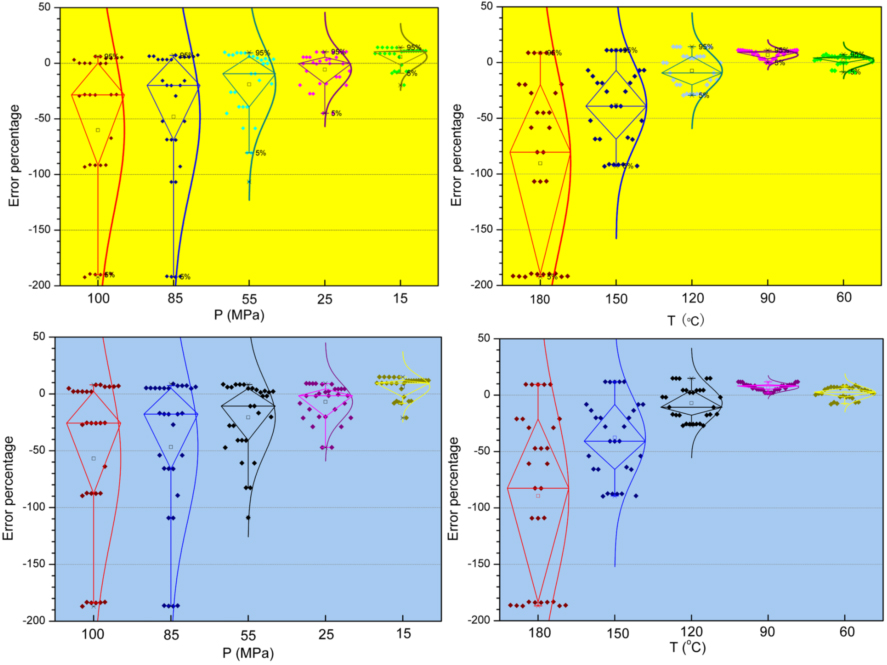
Table 3 presents all parameter and constant values in Eqs (8) and (9). As might be anticipated, the temperature constant B is the largest, which is about seven orders of magnitude larger than pressure constant A. This finding discloses the strongest correlation of temperature in the MF-corrected models, which is well consistent with results in Fig. 1. However, these two MF-corrected models yield poor agreement between measured and predicted values, as depicted in Fig. 2.
The established models have a low precision of prediction, especially at HTHP. For instance, the distribution of error percentage vs.
Similar to distribution of error percentages in the MF-corrected Bingham model, the MF-corrected Herschel-Bulkley model presents the large prediction deviation under the considered conditions, as shown in Fig. 2.
In terms of statistic population of error percentage, undoubtedly, the general MF approach fails to construct T/P-corrected rheological models. It should be ascribed to an unreasonable usage of Arrhenius empirical relation, which can impose the intrinsic restriction to the resulting models. Therefore, the MF modeling strategy would be modified by a direct approach of fitting variables to avoid uncertainty of assumed empirical relation.
On account of restriction of general MF approach, a direct fitting approach is used to establish the more accurate T/P dependence for each characterized constant, instead of the Arrhenius relation. Note that, this treatment involves nonlinear regression that demands a complex screening from logarithmic, exponential, and polynomial functions, which will minimize restriction of assumed equations. The modified rheolgical model expressions are given by
where
With characterized data listed in Table S3 characterized constants
Obviously, Eqs (12) and (13) are nonlinear polynomial functions, and both exhibit high correlation between actual and predicted values (0.9996 and 0.9990).
The error analyses of constant functions for the Bingham plastic model are presented in Table S3. Equations (12) and (13) predict the characterized constants with high accuracies under the investigated conditions. Notably, at 180
Similarly, characterized constant functions,
The coefficients of multiple determination for Eqs (14)–(16) are 0.9997, 0.9626, and 0.9654, respectively. Likewise, error analyses of constant functions for the modified Herschel-Bulkley model are given in supplement material(see Table S3). Obviously,
Box plots of error percentage vs. variable for the modified models attained by the defined MF approach; left: Bingham plastic model, right: Herschel-Bulkley model; In box plots of the modified Bingham plastic model, the 10th, 25th, 50th, 75th, and 90th percentile of deviation dataset are marked.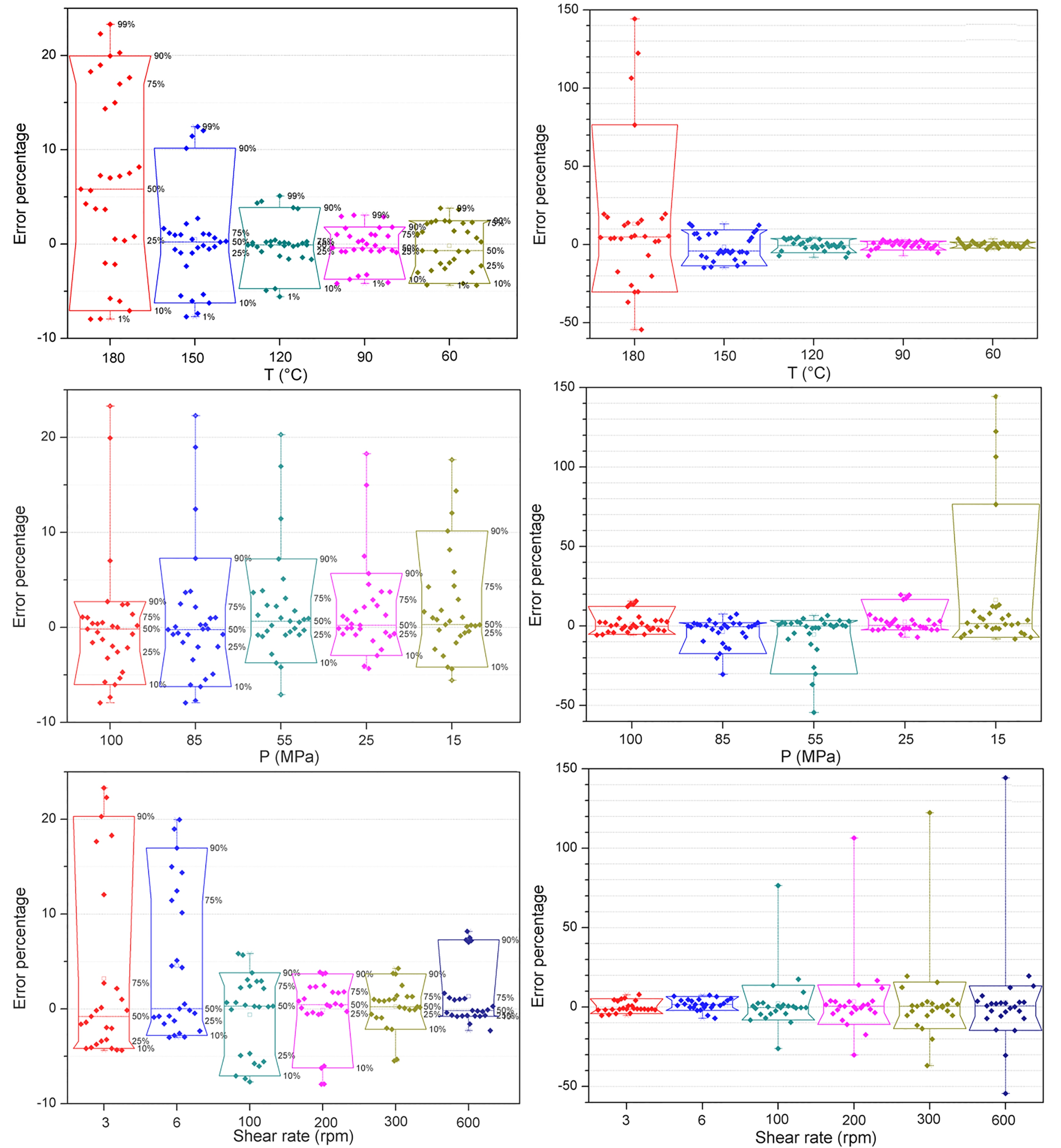
Figure 3 compares distribution of error percentages with respect to
Furthermore, the modified Bingham model exhibits higher accuracy relative to the modified Herschel-Bulkley model. In the modified Bingham model, exceeding 90% of error percentages are in the range of
The direct approach of fitting appears to be an effective strategy to improve HTHP rheological modeling by establishing accurate constant functions. Despite a large improvement, the dynamic HTHP rheological equations obtained by the modified-MF approach are limited due to their extreme values, which affect the prediction accuracy. To develop more reliable dynamic rheological models, we further carry out modeling on the basis of RDR approach.
The general RDR approach contains various fitting steps, especially the Arrhenius relation, which is previously verified to possibly damage accuracy of HTHP rheological model. Even so, we still established the dynamic HTHP models with the general RDR approach for modeling integrity. Herein, the ambient condition, i.e., 0.1 MPa and 30
Following the standard steps of RDR approach, the dynamic equation was built based on data listed in Table 2. As expected, a large deviation range of
Accordingly, we resort to another RDR approach proposed by Rommetveit and Bjorkevoll [9], through which fitting steps can be reduced. However, it also involves Arrhenius empirical relation in the constant functions. Hence, such RDR approach is modified by substituting exponential functions with a direct fitting function to T/P.
Modified RDR approach
The dynamic HTHP rheological expression based on the modified RDR approach is given by,
where
Once the linear relation between
Substituting Eqs (18) and (10) into Eq. (17), the final expression relating RDR to T/P and
As a next step, the accuracy of the developed model is investigated. Figure 4 compares error percentages versus temperature and pressure.
The error percentages vary ranging from
Comparison of distribution of error percentage, left: error percentage vs. T/P; right: error percentage vs. T/
The HTHP rheology modeling is complex and even uncertain due to multiple variables. In the present work, the water-based drilling fluid applied in Southwest China Gas Fields is used as the typical series to explore the HTHP rheological modeling. The HTHP rheology has been examined and the two general HTHP models have been compared in some details for improving the modeling strategy. The results showed that the simple Bingham plastic model is more favorable for a transient simulation of rheology at constant temperatures and pressures. The direct approach of fitting is more effective than empirical relations to establish accurate constant functions. A dynamic HTHP rheological model has been obtained by modified relative dial reading approach, and its prediction deviation is in the range of
These conclusions derived from systematic investigations into influence of HTHP on rheology, the analyses of general rheological models, the general HTHP rheological modeling, and the modified strategy of HTHP rheological modeling, will not only enrich knowledge on HTHP rheology for the water-based drilling fluid, but also provide an improved procedure for dynamic HTHP rheological modeling.
Footnotes
Acknowledgments
The authors thank COSL and Beiken Lab for instrument support. The authors also thank the National Natural Science Foundation of China (No. 11472246), the National Key Scientific and Technological Project (No. 2016ZX05060-015) and Scientific Research Foundation of Zhejiang Ocean University(Project No. Q1510) for financial support.
Supplementary materials
Characteristic constants and correlation coefficients for several rheological models fitted under varying temperatures and pressure *Italic denotes the characterized constants.
P
T
Rheological models
(MPa)
(
C)
Bingham plastic
Power law
Casson
HerschelBulkley
RobertsonStiff
(Pa)
(mPa
(Pa
(Pa)
(Pa)
(Pa
(Pa
(s
15
60
53.3596
0.1049
0.9962
37.4647
0.1541
0.8221
6.7174
0.1556
0.9770
51.6388
0.2385
0.8725
0.9999
1.2979
260.7827
0.6634
0.9998
15
90
24.8322
0.0728
0.9980
14.4052
0.2198
0.8351
4.4205
0.1491
0.9767
24.0763
0.1253
0.9156
0.9996
0.3063
230.7897
0.8035
0.9994
15
120
12.9005
0.0601
0.9985
4.8356
0.3411
0.8328
2.9988
0.1562
0.9649
13.1132
0.0489
1.0321
0.9987
0.0386
241.2880
1.0613
0.9986
15
150
7.3520
0.0504
0.9983
1.2036
0.5271
0.8740
2.0943
0.1592
0.9666
7.8375
0.0279
1.0919
0.9999
0.0116
219.7148
1.2072
0.9999
15
180
3.3878
0.0469
0.9976
0.1914
0.7965
0.9545
1.1256
0.1805
0.9797
3.9107
0.0235
1.1077
0.9998
0.0125
122.1524
1.1922
0.9998
25
60
53.5702
0.1080
0.9953
37.1626
0.1582
0.8290
6.7158
0.1595
0.9791
51.6263
0.2633
0.8617
0.9998
1.4514
244.2977
0.6512
0.9995
25
90
24.8322
0.0728
0.9980
14.4052
0.2198
0.8351
4.4205
0.1491
0.9767
24.0763
0.1253
0.9156
0.9996
0.3063
230.7897
0.8035
0.9994
25
120
13.3148
0.0597
0.9989
5.2827
0.3275
0.8508
3.0651
0.1541
0.9739
13.1573
0.0690
0.9772
0.9990
0.0862
200.8416
0.9485
0.9990
25
150
6.7091
0.0519
0.9998
0.9536
0.5662
0.9107
1.9517
0.1666
0.9796
6.8308
0.0453
1.0211
0.9999
0.0380
143.8418
1.0447
0.9999
25
180
3.3878
0.0469
0.9976
0.1914
0.7965
0.9545
1.1256
0.1805
0.9797
3.9107
0.0235
1.1077
0.9998
0.0125
122.1524
1.1922
0.9998
55
60
53.5702
0.1080
0.9953
37.1626
0.1582
0.8290
6.7158
0.1595
0.9791
51.6263
0.2633
0.8617
0.9998
1.4514
244.2977
0.6512
0.9995
55
90
24.8322
0.0728
0.9980
14.4052
0.2198
0.8351
4.4205
0.1491
0.9767
24.0763
0.1253
0.9156
0.9996
0.3063
230.7897
0.8035
0.9994
55
120
13.3148
0.0597
0.9989
5.2827
0.3275
0.8508
3.0651
0.1541
0.9739
13.1573
0.0690
0.9772
0.9990
0.0862
200.8416
0.9485
0.9990
55
150
7.0293
0.0511
0.9988
1.0805
0.5453
0.8940
2.0234
0.1631
0.9737
7.3271
0.0362
1.0538
0.9994
0.0227
176.7693
1.1153
0.9994
55
180
3.1414
0.0473
0.9960
0.1531
0.8326
0.9562
1.0232
0.1851
0.9768
3.7726
0.0203
1.132
0.9993
0.0105
121.6091
1.2187
0.9990
85
60
54.7167
0.1065
0.9942
38.3755
0.1538
0.8330
6.8038
0.1565
0.9810
52.5313
0.2890
0.8451
0.9999
1.8663
230.1292
0.6154
0.9996
85
90
24.4179
0.0732
0.9993
14.0929
0.2224
0.8172
4.3766
0.1503
0.9694
24.0792
0.0942
0.9607
0.9996
0.1596
274.3705
0.8940
0.9996
85
120
12.5802
0.0608
0.9994
4.4437
0.3557
0.8470
2.9429
0.1591
0.9705
12.6202
0.0586
1.0058
0.9994
0.0609
206.8224
0.9999
0.9994
85
150
6.5258
0.0512
0.9943
0.6933
0.6162
0.8777
1.8970
0.1668
0.9585
7.3630
0.0177
1.1655
0.9993
0.0028
266.1778
1.4061
0.9992
85
180
2.8843
0.0468
0.9904
0.1043
0.8923
0.9504
0.8867
0.1895
0.9674
3.9193
0.0104
1.2351
0.9999
0.0018
183.2830
1.4711
0.9997
100
60
54.0394
0.1057
0.9953
37.9367
0.1539
0.8260
6.7612
0.1560
0.9787
52.1101
0.2605
0.8600
0.9999
1.5567
245.5085
0.6395
0.9997
100
90
24.4179
0.0732
0.9993
14.0929
0.2224
0.8172
4.3766
0.1503
0.9694
24.0792
0.0942
0.9607
0.9996
0.1596
274.3705
0.8940
0.9996
100
120
12.5802
0.0608
0.9994
4.4437
0.3557
0.8470
2.9429
0.1591
0.9705
12.6202
0.0586
1.0058
0.9994
0.0609
206.8224
0.9999
0.9994
100
150
6.2055
0.0519
0.9969
0.6178
0.6354
0.8968
1.8210
0.1706
0.9663
6.8845
0.0228
1.1284
0.9999
0.0068
213.5777
1.2878
0.9999
100
180
2.8843
0.0468
0.9904
0.1043
0.8923
0.9504
0.8867
0.1895
0.9674
3.9193
0.0104
1.2351
0.9999
0.0018
183.2830
1.4711
0.9997
Error analyses of constant functions for the Bingham plastic model Error analyses of constant functions for the Herschel-Bulkley model
No.
P (MPa)
T (
Error (%)
Error (%)
Measured
Predicted
Measured
Predicted
1
15
60
53.3596
53.9604
0.1049
0.1061
2
15
90
24.8322
24.7869
0.18
0.0728
0.0725
0.45
3
15
120
12.9005
13.0314
0.0601
0.0597
0.61
4
15
150
7.352
6.8840
6.37
0.0504
0.0508
5
15
180
3.3878
3.1633
6.63
0.0469
0.0437
6.82
6
25
60
53.5702
53.9334
0.108
0.1065
1.41
7
25
90
24.8322
24.7599
0.29
0.0728
0.0728
8
25
120
13.3148
13.0044
2.33
0.0597
0.0601
9
25
150
6.7091
6.8571
0.0519
0.0512
1.42
10
25
180
3.3878
3.1363
7.42
0.0469
0.0441
5.97
11
55
60
53.5702
53.8525
0.108
0.1068
1.14
12
55
90
24.8322
24.6790
0.62
0.0728
0.0731
13
55
120
13.3148
12.9234
2.94
0.0597
0.0604
14
55
150
7.0293
6.7761
3.60
0.0511
0.0514
15
55
180
3.1414
3.0554
2.74
0.0473
0.0444
6.13
16
85
60
54.7167
53.7715
1.73
0.1065
0.1068
17
85
90
24.4179
24.5980
0.0732
0.0732
0.02
18
85
120
12.5802
12.8425
0.0608
0.0604
0.58
19
85
150
6.5258
6.6951
0.0512
0.0515
20
85
180
2.8843
2.9744
0.0468
0.0445
4.91
21
100
60
54.0394
53.7310
0.57
0.1057
0.1069
22
100
90
24.4179
24.5575
0.0732
0.0732
23
100
120
12.5802
12.8020
0.0608
0.0605
0.54
24
100
150
6.2055
6.6546
0.0519
0.0516
0.67
25
100
180
2.8843
2.9339
0.0468
0.0447
4.49
No.
Error (%)
Error (%)
Error (%)
Measured
Predicted
Measured
Predicted
Measured
Predicted
1
100
60
52.1101
51.8784
0.44
0.2605
0.2700
0.8600
0.8632
2
100
90
24.0792
24.0251
0.22
0.0942
0.0980
0.9607
0.9482
1.30
3
100
120
12.6202
12.9398
0.0586
0.0478
18.43
1.0058
1.0296
4
100
150
6.8845
7.1979
0.0228
0.0221
3.07
1.1284
1.1414
5
100
180
3.9193
3.7487
4.35
0.0104
0.0053
49.04
1.2351
1.3177
6
85
60
52.5313
51.8813
1.24
0.2890
0.2711
6.19
0.8451
0.8587
7
85
90
24.0792
24.0280
0.21
0.0942
0.1042
0.9607
0.9396
2.20
8
85
120
12.6202
12.9427
0.0586
0.0539
8.02
1.0058
1.0165
9
85
150
7.3630
7.2007
2.20
0.0177
0.0273
1.1655
1.1235
3.60
10
85
180
3.9193
3.7516
4.28
0.0104
0.0096
7.69
1.2351
1.2946
11
55
60
51.6263
51.8917
0.2633
0.2723
0.8617
0.8497
1.39
12
55
90
24.0763
24.0384
0.16
0.1253
0.1180
5.83
0.9156
0.9178
13
55
120
13.1573
12.9531
1.55
0.0690
0.0672
2.61
0.9772
0.9807
14
55
150
7.3271
7.2111
1.58
0.0362
0.0381
1.0538
1.0723
15
55
180
3.7726
3.762
0.28
0.0203
0.0178
12.32
1.132
1.2267
16
25
60
51.6263
51.9269
0.2633
0.2613
0.76
0.8617
0.8690
17
25
90
24.0763
24.0737
0.01
0.1253
0.1272
0.9156
0.9195
18
25
120
13.1573
12.9883
1.28
0.0690
0.0740
0.9772
0.9603
1.73
19
25
150
6.8308
7.2463
0.0453
0.0396
12.58
1.0211
1.0255
20
25
180
3.9107
3.7972
2.90
0.0235
0.0141
40.00
1.1077
1.1491
21
15
60
51.6388
51.9701
0.2385
0.2399
0.8725
0.8602
1.41
22
15
90
24.0763
24.1168
0.1253
0.1169
6.70
0.9156
0.9431
23
15
120
13.1132
13.0314
0.62
0.0489
0.0613
1.0321
1.0110
2.04
24
15
150
7.8375
7.2895
6.99
0.0279
0.0228
18.28
1.0919
1.0980
25
15
180
3.9107
3.8403
1.80
0.0235
127.66
1.1077
1.2379
Modeling of
P (MPa)
T (
a
b
100
60
1.55E
06
0.545807
100
90
1.15E
04
0.254021
100
120
1.62E
04
0.138138
100
150
1.81E
04
7.37E
02
100
180
1.89E
04
3.98E
02
85
60
2.07E
06
0.552935
85
90
1.15E
04
0.254021
85
120
1.62E
04
0.138138
85
150
1.76E
04
7.60E
02
85
180
1.89E
04
3.98E
02
55
60
1.57E
05
0.542182
55
90
1.08E
04
0.258657
55
120
1.49E
04
0.145094
55
150
1.67E
04
8.22E
02
55
180
1.85E
04
4.36E
02
25
60
1.57E
05
0.542182
25
90
1.08E
04
0.258657
25
120
1.49E
04
0.145094
25
150
1.72E
04
7.99E
02
25
180
1.81E
04
4.60E
02
15
60
5.01E
06
0.538766
15
90
1.08E
04
0.258657
15
120
1.57E
04
0.140458
15
150
1.63E
04
8.44E
02
15
180
1.81E
04
4.60E
02