



Abstract
As a high density and mobility area of population, urban areas need monitoring of communicable diseases desperately. In additional, there are some smart bracelets equipped with diverse sensors, which can provide the continuously individual health analysis of physiological parameters. Therefore, some individual abnormal signal, such as body temperature, heart rate, private pulse and other signals can be detected after a short-period time. Delay Tolerant Networks (DTNs) becoming mature enough to be used for the outbreak of communicable diseases observation. This paper presents a monitoring system architecture for sudden public health incidents in urban environments, and a routing algorithm named Historical Probability based Relay Selection (HPRS) is introduced, which is more suitable than other existing routing algorithms such as Epidemic and Prophet algorithms. Simulation results suggest that HPRS outperforms Direct Delivery, Epidemic, and Prophet routing for communicable diseases monitoring system in urban environments.
Introduction
The infectious, which have newly appeared and rapid increase in incidence or geographic range, are described as emerging infections (EIs) [1]. Some of EIs outbreaks are more likely to occur in urban areas where relatively high population density. These EIs, such as severe acute respiratory syndrome (SARS) [2], influenza A (H1N1) virus [3] has some characteristics which include highly contagious, recurring or prolonged fever [4, 5], abnormal heart rate etc. [6]. These irregular physiological signals can be detected by smart sensors which equipped with smart devices. Likewise, Delay Tolerant Networks (DTNs) consist of many sensors for data transmission. In DTNs, the transmission behavior relies on the encounter opportunity, so it results low delivery ratio and relatively high latency [7]. There are some special features with DTNs such as asymmetric data flow, high latency and constantly changing network topology [8]. DTNs play an important role in different areas, such as temporary battlefield communication and wildlife monitoring. In urban environments, DTNs technologies have been potential to change the way of healthcare with the development of intelligent sensor [9].
In urban environments, there are some large populations and high density areas. Therefore, the probability of communicable disease is very high and epidemic may spreads fast. Hence, emerging communicable diseases are now a much larger health and economic menace in urban environments. Indeed, it should also be noted that the features about the population distribution and person’s mobility are suited for the DTNs applications. Communicable diseases surveillance makes the smart detection for diseases possible in urban area. The DTNs based surveillance can be composed of the wearable smart devices such as smart mobile phone, smart band, and smart clothing [10]. Most of these devices are carried by pedestrians. Therefore, it is possible that the human physiologic indicators can be monitored by such devices. Besides, almost every wearable device equipped with the wireless communication module, some abnormal physiological indicators can be transmitted by wireless way. Hence, the DTNs based communicable diseases surveillance is a feasible scheme in urban environments. Generally speaking, better indicators of DTN, which can improve the performance of the monitoring system. In this paper, we focus on the DTN based communicable diseases monitoring in urban environments, which could detect the abnormal health status of groups and individuals after a relatively short period time. The main contributions in this paper are listed as follows.
A communicable disease monitoring system based on distributed smart devices is introduced, this system is suitable for fast deployment in urban environment. A DTNs routing algorithm named Historical Probability based Relay Selection (HPRS) is proposed for urban environments. Series experimentations are conducted to validate the performance of the proposed algorithm for communicable diseases system in an urban scenario. The simulation results have suggested that the HPRS has better performance than the existing routings, which include Epidemic, Direct Delivery and Prophet algorithm in such a monitoring system.
The rest of paper is organized as follows. In Section 3, we formal introduce the communicable diseases monitoring system in urban environments. Section 4 presents the HPRS algorithm. We present simulation results show a better performance for HPRS in urban scenario in Section 5. Finally, this paper is concluded in Section 6.
In urban environments, some virus can cause communicable diseases rapid spread. For instance, the pandemic influenza A (H1N1) virus were identified in the United States and Mexico in April 2009 [11, 12], and then it spreads to 20 provinces of China during May and June 2009 [13]. The communicable diseases lead to a great number of economic losses. The impact of the communicable diseases on society can be reduced if we can detect the communicable diseases timely and have some prompt measures. Unfortunately, communicable diseases are diagnosed after the patient in hospital and miss the communicable diseases earlier detection. The continuous monitoring of a human’s physiological indicators is be allowed by the recent technological advantages in micro-electronics technologies and nanotechnologies, miniaturization of sensors [14]. Recently, research has focus on the wearable sensor systems, which have been proposed with wireless transmission, Global Position System (GPS) location and local processing [15, 16]. However, the most health monitoring systems are for individual health monitoring, and the personal healthy data is routed to a central server. On this occasion, we focus on communicable diseases monitoring in urban environment. The system is designed based on the DTNs, and we assume that the mobile sensors are wearable sensors, and it is equipped with various modules such as communication module, body monitoring module and GPS module.
The impacts of communicable diseases break out in urban environments which are more than in other environments, so we focus on the detection of communicable diseases in urban environments. Therefore, the design of the DTNs routing should fit with the characteristics of urban environments. The monitoring system has higher requirements for data transmission capacity and the delivery latency. There are various DTNs algorithms such as Epidemic algorithm [17] and Prophet algorithm [18] which have typical representation for such detection systems. When Epidemic algorithm is starting, two nodes exchange the messages with each other for content uniformity. Generally, the message will be aborted in DTNs after a period time for network resource conservation. In urban environments, people may stay at one place for a long time, and then the Epidemic approach is difficult to play an important role. On this occasion, the Prophet algorithm can have good performance than the Epidemic algorithm in urban environment. Prophet forward messages by probability and statistics way, but it is largely influenced by time because of the aging constant. In urban environment, people will stay in one place for a long-period time, such as home or office. Thus, the delivery probability of nodes will decrease constantly under such circumstances. There are the other DTNs Routing, for instance, the single copy routing-Direct Delivery, which just delivers the packet to the destination without any relay process. Obviously, it will miss the information of transmission path in such detecting system, thus it is not suitable for such system by the simple delivery method and poor performance. Therefore, the existing algorithms cannot release its potential performance. In order to be more sensitive detecting for communicable diseases, the more suitable algorithms are helpful to improve abnormal case detecting.
The communicable diseases monitoring system (CDMS)
The communicable diseases spread more rapidly and lead to large losses in urban environment, thus, it is important for early detection of diseases’ outbreaks. Generally speaking, the analyzes methods of communicable disease are included the time analysis, region analysis and community analysis [19, 20]. Therefore, the proposed communicable diseases monitoring system should be designed as a DTN based data-collection system, which topology is shown as Fig. 1.
The topology of communicable diseases monitoring system.
It is clear from Fig. 1, the CDMS is composed by mobile nodes, data sink stations (DTN gateway) and data analyzing center. Thus, CDMS has some advantages, such as quickly deployment, low cost and strong expansibility.
The CDMS mainly consists of three parts: Data transmission structure, sensor deployment and case status. The details of the three parts list as follows.
The data transmission structure: The data’s transmission structure contains types of sensor carrier, transmitting interfaces and sink station. There are three types of nodes in DTNs:
Pedestrian nodes: They are some smart devices which are worn by pedestrians. These smart devices can get personal physiological data such as body temperature or pulse rate. Pedestrian nodes are mainly responsible for data analysis, data collection and data transmission. Vehicle nodes: Some public transportation can be equipped with sensors for data relay. The buses and taxies usually across among communities of the urban, so they are the suitable carriers for data transport. Sink stations (fixed sink stations): They are data collecting stations, which are distributed located in different urban regions. This fixed station based DTNs we had introduced in literature [21], and the data analyzing center of DTNs can receive data from static sink stations. There are low-speed interfaces and high-speed interfaces in our simulations. The low-speed interface has the 10 m of transmission range and 250 Bps of data rate, these interfaces equipped by pedestrian nodes. The high-speed interface has 100 m of transmission range and 10 MBps of data rate. High-speed interfaces need the power supply such as vehicle nodes and fixed sink station. Then, the fixed sink station can transmit the captured data to a data center for analysis. Sensor deployment: Communicable diseases can spread fast in a community [22], so the monitored targets can’t gather in some relative small area. In order to let monitoring space as large as possible, deployment of node should follow certain rules. The pedestrian nodes should be distributed in different urban areas, such as the status monitoring of communities can be covered as more as possible. The pedestrian, who has carried the sensors, are the monitored targets. In urban environments, distinct regions have different human activity, and fortunately, the buses or taxies always across the wide area for transportation, so they are a good choice as the relay nodes. In additional, the fixed sink stations should be located in relative high-density area for data receiving advantageously. The case status: There are two types of case in DTNs. The one is a normal case, another one is an abnormal case. The prior cases generate normal packets continuously which are used to convergence in delivery probability. Whereas, the abnormal packets usually contain the abnormal Physiological Indicators (PIs). For instance, from the Swine-Origin Influenza A (H1N1) Virus Investigation Team’s report in [19], 94% of 394 patients with H1N1 developed symptoms of fever, and 92% of 397 patients developed symptoms of cough. The cough can lead to increased blood pressure instantly [23], so we can detect this abnormal blood pressure and body temperature by sensors. It is important to note that, the abnormal case is not the confirmed case, but it is a suspected case.
Each packet should contain a variety of data to achieve several functions. Then the CDMS can provide the time, region and community data of communicable diseases for analysis. The structure of each packet is shown as Fig. 2.
The data structure of packet which is generated by pedestrian nodes.
We can get a lot of useful information from analyzing packets. For instance, we can know that who is a suspected case, he encounters whom and where the abnormal case occurred? One other thing to note is that some of packets will not deliver to the destination (fixed sink station) in DTNs, so the data structure should contain many aspects of information. Finally, each fixed sink station delivers the captured packets to a data center for data fusion by way of the Internet.
CDMS is based on the DTNs construction, so the routing algorithms are important for this monitoring system. Thus, the CDMS can run with some existing DTN routing such as Direct Delivery, Epidemic and Prophet. However, CDMS is applied to human health monitoring of an urban environment, so the Direct Delivery is not suitable, meanwhile the Epidemic and Prophet cannot release potential performance in such an environment. Packets in DTNs have relatively high packet loss ratio and end-to-end transmission latency; Thus it is significant to decrease the packet loss ratio and transmission latency for communicable diseases monitoring. As we know, the better routing algorithm can get the less latency and higher delivery ratio in CDMS. The delivery ratio concerns that as many patients are detected. Similarly, the delivery ratio concerns that the patients may be detected as early as possible. Therefore, using more efficient routing algorithm for CDMS can achieve better performance.
The historical probability based relay selection (HPRS) routing algorithm
In urban environments, most people move regularly. For instance, people go to work on the morning, spend leisure time in a coffee bar or shop and go home to bed at night. It means that encountering opportunities among people showing regular too. If one person met another one in the past one week frequently, it can be speculated that they are associates or family, and their encounter probability is relatively high. Thus, the HPRS is designed based upon the thought.
In HPRS, a table
The HPRS algorithm consists of two parts as below:
The relay node selection: The nodes are scanning the neighbor nodes continually when the routing started. Each node establishes a neighbor set Once the relay node
Step 1. The history successful delivering probability
Where the
Here the
We introduce the simulation design, settings and the results in this section. The performance of DTNs can be affected by movement model. The encountering times and encountering duration of nodes are different in distinct environments. We selected the Working Day Movement (WDM) model, which can improve the reality for urban scenario [25], and the experiments are carried out by The Opportunistic Network Environment (The ONE) simulator [26].
Simulation design
There are several node groups in simulations, and the details of these groups are shown as below (Table 1).
The group details in the simulations
The group details in the simulations
We use the Helsinki maps as the monitoring target area. The pedestrian nodes are controlled by WDM path files. The bus and taxi nodes are follows suitable movement model the in order to increase the reliability of urban scenario. The path-control files are Well Know Text (WKT) format which are provided by The ONE simulator. Each pedestrian node generates packet constantly for health status, and it also can result the routing probability converge. We assume that some pedestrian nodes detected abnormal status by smart wearable devices at a time point. Then, the abnormal cases can be monitored by the communicable diseases system after detection latency time. Obviously, CDMS with different algorithms can led to different performance. We make 10 nodes (ID: B53-B62) send abnormal signals constantly after time point 18000 s, so that the performance of CDMS can be observed.
We located six fixed sink stations, which are distributed in city map (Helsinki). The coordinates of these stations (S1
The key simulation parameters
The key simulation parameters
First, we compare the proposed routing performance of the algorithm HPRS with existing algorithm Direct Delivery, Epidemic and Prophet in key network metrics, which include delivery ratio, delivery latency and overhead ratio. These indicators can influence the performance of CDMS. We observed the indicators with different number of fixed sink station in order to know which algorithm is better for CDMS.
Comparisons of successful delivery ratio with different number of fixed sink station.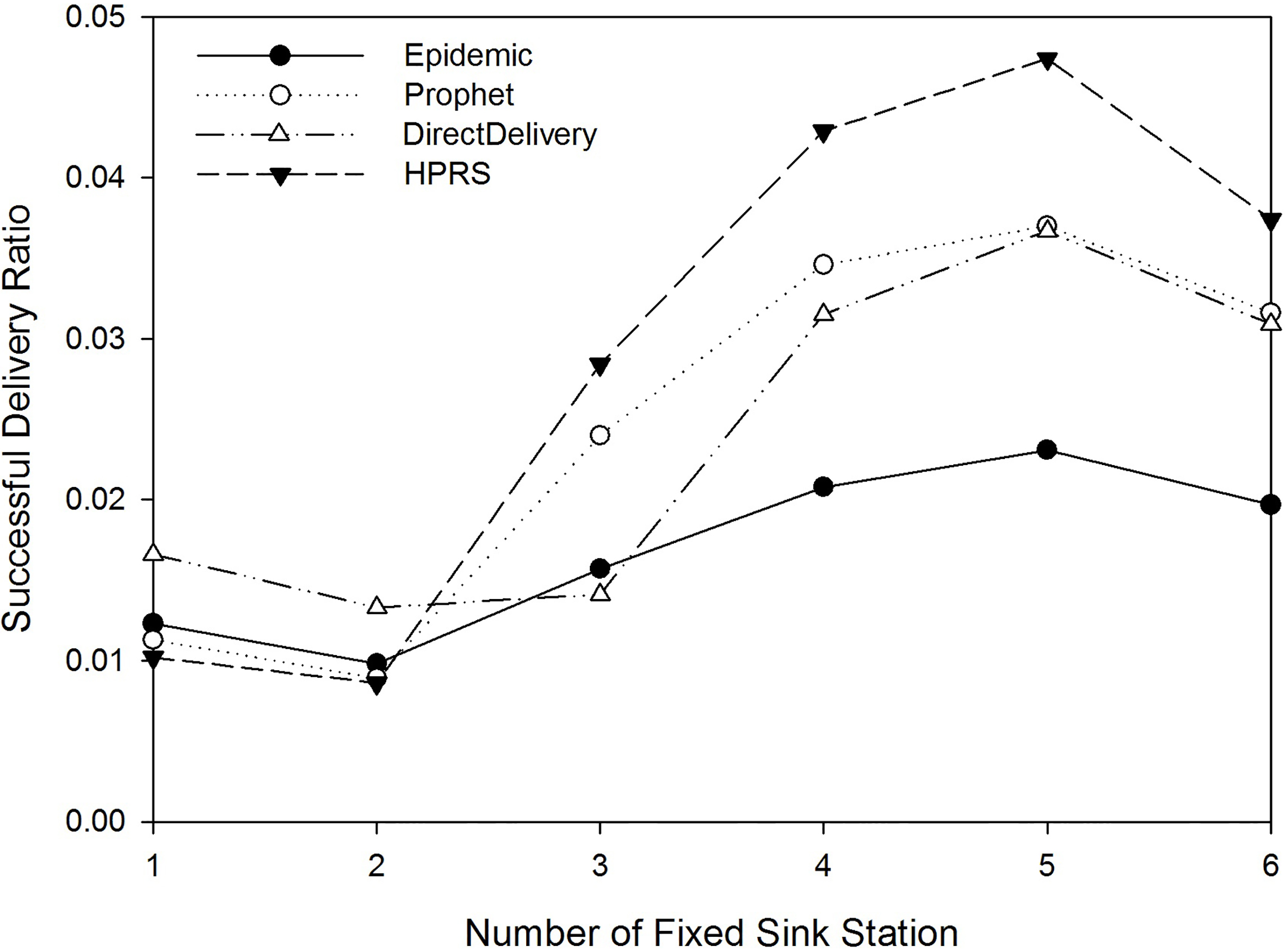
The successful delivery ratio is important for CDMS, the higher delivery ratio means that the more packets are received by fixed sink stations. It’s hard to predict when or where the communicable diseases start, so the higher delivery ratio can improve the detecting probability. The Fig. 3 suggested that HPRS outperformed the Direct Delivery, Epidemic and Prophet in delivery ratio when the number of fixed sink station more than or equal 3. The first two points in Fig. 3 have the irregular trend which is caused by excessive spare sink stations and uneven population density in the urban scenario.
Comparisons of average delivery latency with different number of fixed sink station.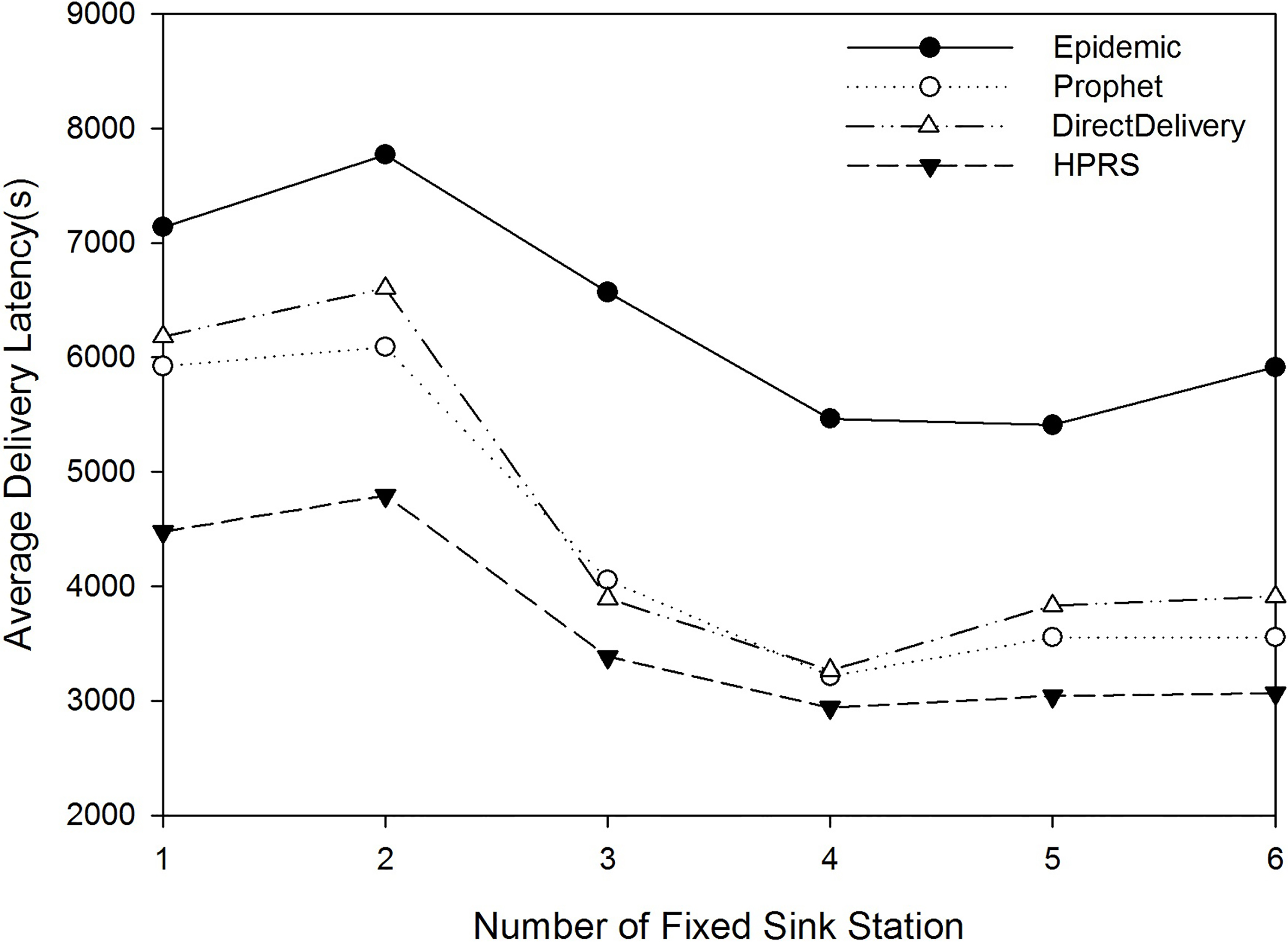
Most valuable delivered packets are forwarded multiple times. The source-to-destination path latency is important in CDMS, the lower transmission latency can decrease the detecting time of abnormal cases. From Fig. 4, the average latency of HPRS is better than Direct Delivery, Epidemic and Prophet in the urban scenario.
Comparisons of network overhead ratio with different number of fixed sink station.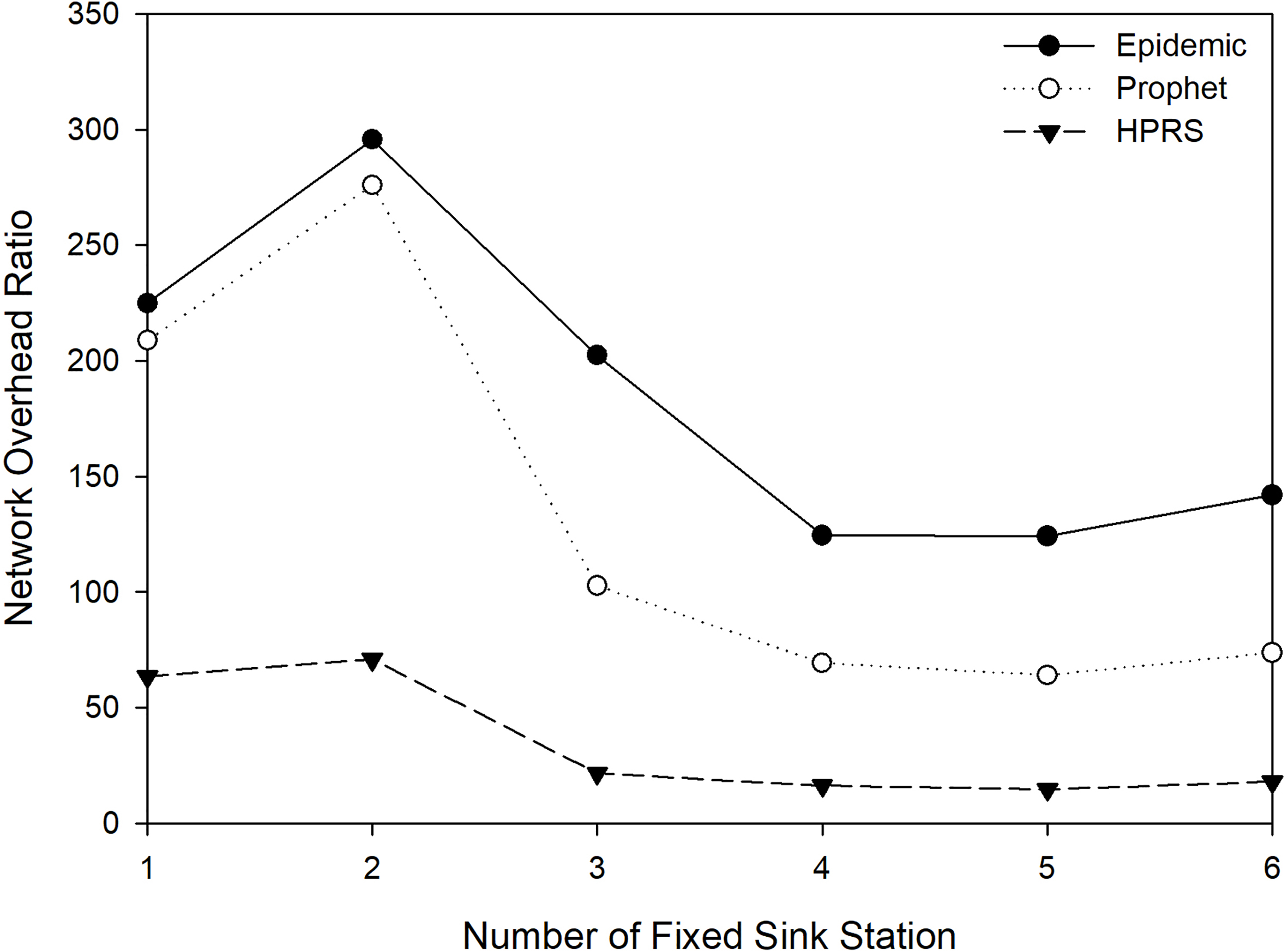
In CDMS, the increasing packets led to an increasing of the overhead ratio. A better routing algorithm should have the lower overhead ratio in DTNs. This is an important indicator for disease monitoring system, because of two reasons. First, the number of monitored people may be large, or more relay devices will join the network. The taller overhead ratio will led to a higher packet drop ratio due to the multi-copy based routing. Second, the monitored urban area, where have some high node-density regions, the taller overhead ratio is not conducive to the average latency.
The overhead ratio
Abnormal detected event by different routing algorithms.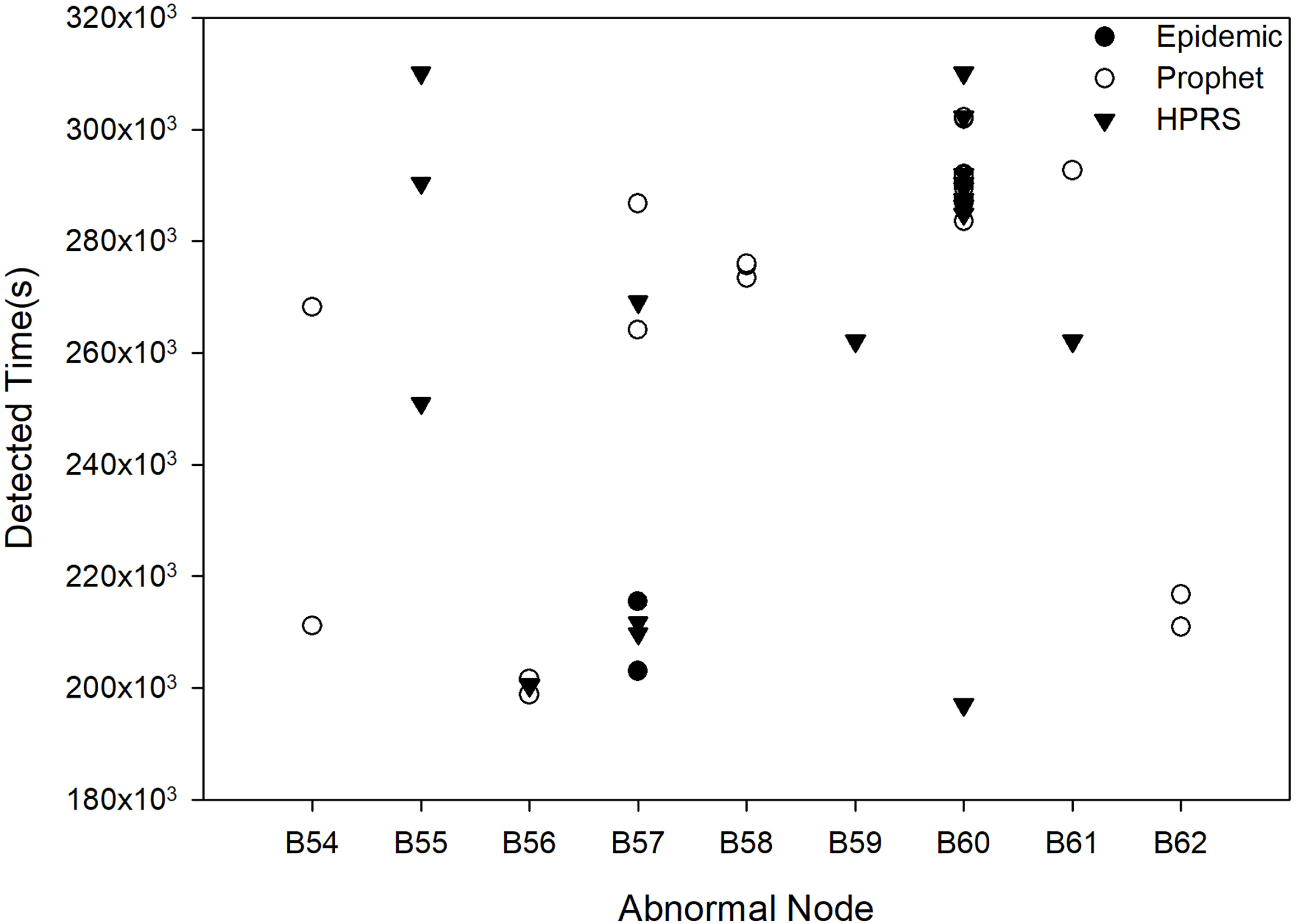
The irregular signals are created constantly at time point 180000 s by nodes (B54
If the two nodes appeared an alike abnormal case, it is similar to the phenomenon of which communicable diseases occur in certain specific groups during a short time. Figure 7 describes that two different nodes occur the same type of abnormal case which is detected by CDMS with three algorithms. Obviously, Direct Delivery doesn’t exist the two abnormal nodes joint detection. The CDMS with Prophet and HPRS limited detecting time to 35000 s (9.5 hours) except that which monitoring system owned the one or two fixed sink stations. From Fig. 7, HPRS is better than other two traditional algorithms in CDMS. Likewise, time analyzing data is important for communicable disease monitoring.
Created region of abnormal cases with HPRS
Two abnormal nodes joint detected time by different routing algorithms.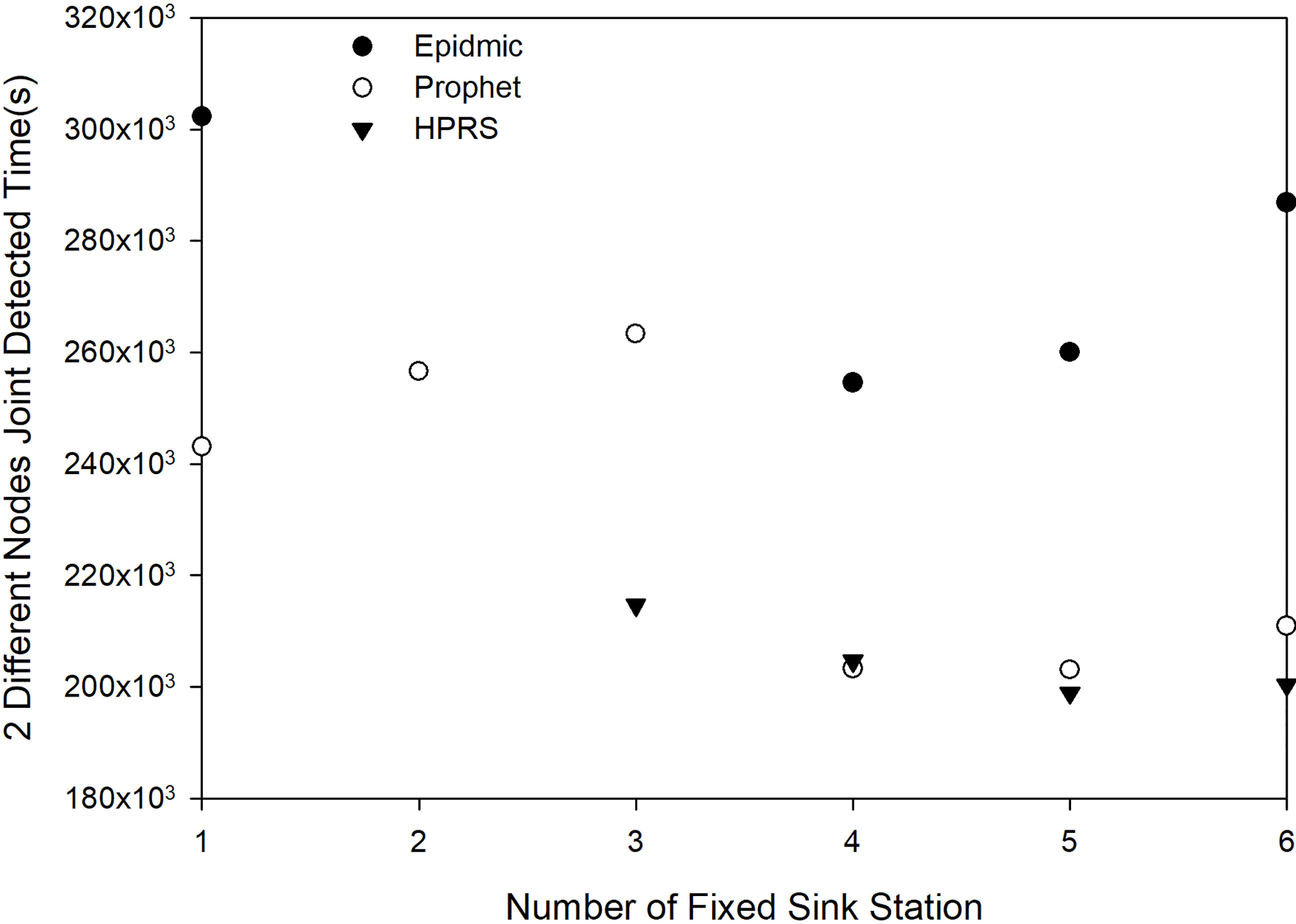
The passing process of abnormal cases in CDMS (with help of Graphviz).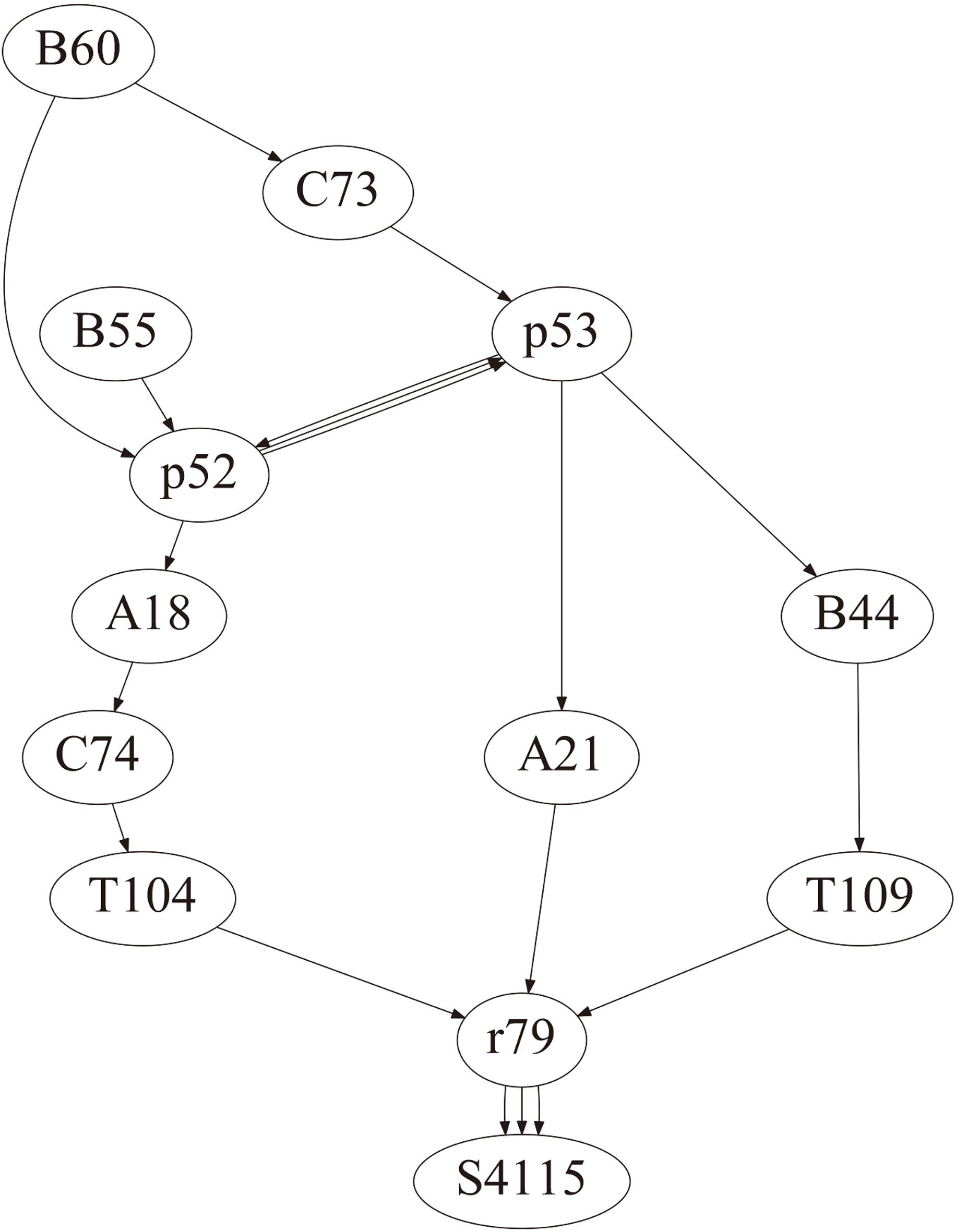
Each packet contains the GPS data field, which can be calculated for the location coordinates for geographic information. The created packet regions Cregion
The
Where the
From CDMS, we can also get the encounter path status. Each forwarding behavior means that two people have an encounter at some point. Similarly, these people are also the monitoring targets. CDMS can describe this process as Fig. 8.
From the Fig. 8, we could detect that the abnormal node B60 may get close to node C73 frequently. In other words, CDMS can be derived the social graph by this community analyzing data easily, which is shown like the Fig. 1. A part of people, who have been highly suspected to being infected virus, can be detected and further diagnosed.
The communicable disease monitoring system (CDMS) in urban environment is proposed in this paper, which is based on DTNs. We describe a data structure of the packet and new suitable routing algorithm in CDMS. This system can provide the time analyzing data, region analyzing data and community analyzing data. Furthermore, the simulation suggests that the proposed routing algorithm HPRS has better performance than other traditional Epidemic and Prophet algorithms in CDMS. With the development of technology of sensors and the applications of data fusion, DTNs based monitoring system can detect various communicable diseases with the increase of intelligent sensors.
Footnotes
Acknowledgments
The authors would like to thank the reviewers for their insightful feedback and valuable suggestions. We also appreciate the Dr. T. E. Siomons. Additionally, this work is supported by Natural Science Foundation of China (No. 61272448), Doctoral Fund of Ministry of Education of China (No. 20110181130007), Science and Technology Supporting Plan of Sichuan (Nos. 2011RZ0004 and 2012GZ0005), Soft Science Found of Science and Technology Department of Sichuan (No. 2014ZR0146). Seedling Incubation Found of Science and Technology Department of Sichuan (No. 2014-YCG052) CUIT Fund. Science and Technology Department of Sichuan Province, Fund of Science and Technology Planning (No. 2018JY0290).