




Abstract
One core technology in the model of Attribute Comprehensive Evaluation is the application of the barycentric curve which simulates the psychological change of the evaluators, but original method can only select three total score hyperplanes when calculates the barycentric curve, when data set is big, it’s impossible to accurately reflect the psychological change of the evaluators. In order to solve this problem, in this paper morphic computing is applied to calculate the barycentric curve, it can apply more total score hyperplanes when compute the barycentric curve, so makes the results more accurate. The simulation results show the effectiveness of the improved method.
The overview
In the comprehensive evaluation method, there are Delphi method and AHP, etc., whose weight is set by the subjective method, and the weights of each index are set based on the experience of expert. Attribute coordinate evaluation method in essence also belongs to this kind of method, and based on this, the concept of dynamic weight is proposed, the weight is not fixed, but dynamically changes along with the change of total scores of evaluated objects. When calculating the dynamic weight, the original method adopted Lagrange interpolation formula, which fits the polynomial curve according to the remarks of the experts on the three hyperplanes, and then reflect the dynamic weight with this curve. This method is simple, however, when the evaluation data set is big, even if the expert evaluates multiple total score hyperplanes, the method can only select three hyperplanes, and the contributions of other hyperplanes have to be ignored. The core of morphogenetic system is the morphic computing, which uses the form record and reproduce to solve the problem of computing and make the tensor inversion component to be related to a projection operator in the transformation. Therefore, it can take into account all of total score hyperplanes evaluated by experts in the final barycentric curve through morphic computing, so as to make the evaluation result more accurate. In this paper, the attribute coordinate evaluation method of morphic computing is introduced firstly, and then the results are compared with the improved results by simulation experiment.
Overview of comprehensive evaluation issues
The key of the comprehensive evaluation is to evaluate the optimal and inferior quality of the evaluated objects. First, the indexes of the evaluated object are determined, and then all the evaluated objects are given some kind of uniform dimensional index value. Finally, the evaluated objects are ranked according to the score. There is no optimal principle in the comprehensive evaluation, and the principle of satisfaction is generally adopted. Therefore, in the real decision making model, all we can get is the satisfactory solution instead of the optimal solution. Therefore, the comprehensive evaluation requires only the most satisfactory solution to meet certain weight conditions. The most satisfying solution is expressed as the extreme value of the utility function u of Eq. (1):
Among the
For the comprehensive evaluation based on subjective empowerment, the question is how to make the preference of the evaluator be reflected in the evaluation model.
The morphogenetic system is a system for recording, preserving and recreating all kinds of forms, which can be adopted to explore the morphogenesis process of the target form. It attempts to provide a mathematical model for morphogenesis phenomena and provides a unified mathematical method for problem solving in various fields, including neural network, genetic algorithm, DNA computing, risk analysis, uncertainty analysis, soft science, quantum mechanics, laser, holographic and so on. It supposes sources mainly include morphogenetic and morphic field theory in biology, second source theory, holographic theory and quantum mechanics in physics, and morphic field, internal source and projection operator are its core concepts.
Morphogenetic system implemented by morphic computing, morphic computing is composed of writing operations and reading operations. Its meaning is similar to the principle of holography. Writing operation writes the implied information from input field on the internal source. Reading operation can reconstruct input field from projection generated by internal source and basic field.
The main features of the form include direct identification, nonconserving and non-measurable, and repeatability and retention.
The direct identification morphic is universal and complex. For example, the world around them is full of forms, but any questions posed by the form are not immediately obvious. We recognize them by various perceptual functions. The nonconserved and non-measurable. Form is not a vector or a scalar, it is not conserved. Repeatable and preservative. For example, seeds grow year after year with the same appearance of plants, and the spiders weave the same mesh generation by generation, and the atoms repeat the same molecular patterns.
The partial most satisfactory solution under certain constraint conditions
For the solution of problem Eq. (1), can be resolved through for a series of subproblems to solve local most satisfied solution, set for total score equal to
Local most satisfactory solution.
Agent scheme of decision attributes one for any node of the graph.
Where
The
Since the space is convex, the barycenter
Agents decision makers graphs (see Fig. 2).
Graph for the three order tensor for
Tensor image of the scheme decision attributes for one agent.
Where the agent decision maker
Among them,
It is worth pointing out: for each training, it can get a neighborhood with the center as sphere, as radius, which can make any solution become one of the satisfactory solutions to the above training.
The knowledge of morphological system can be expressed by morphological information table (Table 1). It is a two-dimensional table representing the relationship between object and attribute, extending the concept of cross table in formal concept analysis, and expressing the degree of connection between object and attribute. The mixed attribute
Morpho information table
Morpho information table
The information in the table can be represented as
When the matrix
Given the colon space matrix
Now because
Where the matrix
Now with the new weights we can built the vector
Now for
Bur we can prove that
The orthogonal projection is
So we have that
Figure 4 is the image of the projection for three dimensions.
Projection of the operator 
For
In Fig. 5, the distance
The distance 
Because
In conclusion the distance
Given the matrix
So the parameters
For the direct barycenter method given by the expression
Where
Are variables and
The
Where
To computed the best parameters
For the agents we have the expression
We have
So we can compute the weights for the multi agents evaluations by the morphogenetic expression
For the previous expression form the data, Table 2 shows the morpho information table of the local preference curve when
Morpho information table of local preference curve (
3)
Morpho information table of local preference curve (
Table 3 shows the morpho information table of the local preference curve when
Morpho information table of local preference curve (
The external source is the basis for calculating the internal source. Therefore, the external source
When
When
In order to verify the advantages of the improved method, we adopt a high school score as the test data, which has a total of 3,394 records. In the first step, we use the original method, only 3 hyperplanes of total score are selected, respectively 591, 689, and 750, then the evaluators were asked to rate each points of different hyperplanes. Table 4 shows the score of the hyperplanes of 689 given by the evaluators. According to Eq. (18), the center of gravity of this hyperplane is 122.22, 148.03, 142.24 and 276.51.
The score of the hyperplanes of 689 given by the evaluators
The score of the hyperplanes of 689 given by the evaluators
The score of the hyperplanes of 591 given by the evaluators
Table 5 shows the score of the hyperplane of 591 given by the evaluators, according to Eq. (2), the center of gravity of the hyperplane was 113.23, 116.02, 127.64 and 232.65.
After obtaining the centers of gravity coordinates of three hyperplanes, the barycentric curves of four attributes were respectively calculated by Lagrange interpolation. Figure 6 shows the barycentric curves of each attribute, among which the dotted line stands for Chinese, the real line stands for mathematics, and the hexagonal star stands for English.
Barycentric curves.
Then we do the same experiment by using the improved method, namely the morphic computing method, the morphic computing method allows to add more total points hyperplanes, also can more accurately reflect the changes of evaluator’s preference curve. Based on the previous experiment, the score of the hyperplanes of 628 is selected and remarked by the evaluators, as shown in Table 6, the corresponding center of gravity of this hyperplane is 116.07, 130.58, 136.06 and 245.29.
The score of the hyperplanes of 628 given by the evaluators
Comparison of the barycentric curves of Chinese attribute.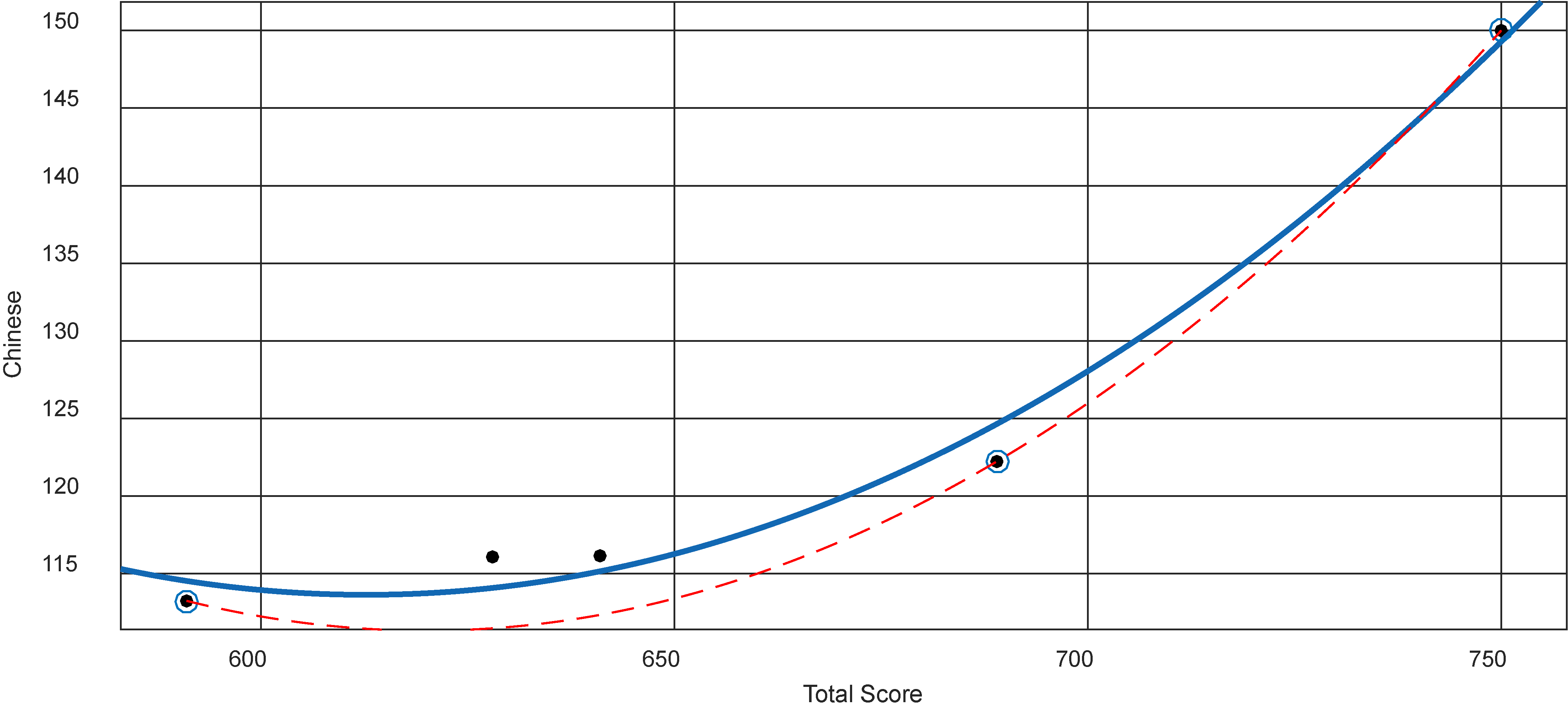
Then, the score of the hyperplanes of 641 was added, after that the evaluators remark the sample points on this hyperplane. The corresponding center of gravity was 116.14, 135.42, 135.59 and 253.84.
The next step is to construct the morpho information table for each index according to Table 2. Table 7 is a Chinese morpho information table.
Chinese morpho information table
By using Eq. (8), we get the barycentric curve of Chinese, which is the real line in Fig. 7, and the dashed line is the barycentric curve obtained by using the original method. It can be clearly seen from the figure that the barycentric curve obtained by using the morphic computing can more accurately reflect the change of the preference of the evaluators.
Mathematical morpho information table
The foreign language morpho information table
Comparison of the barycentric curves of mathematical.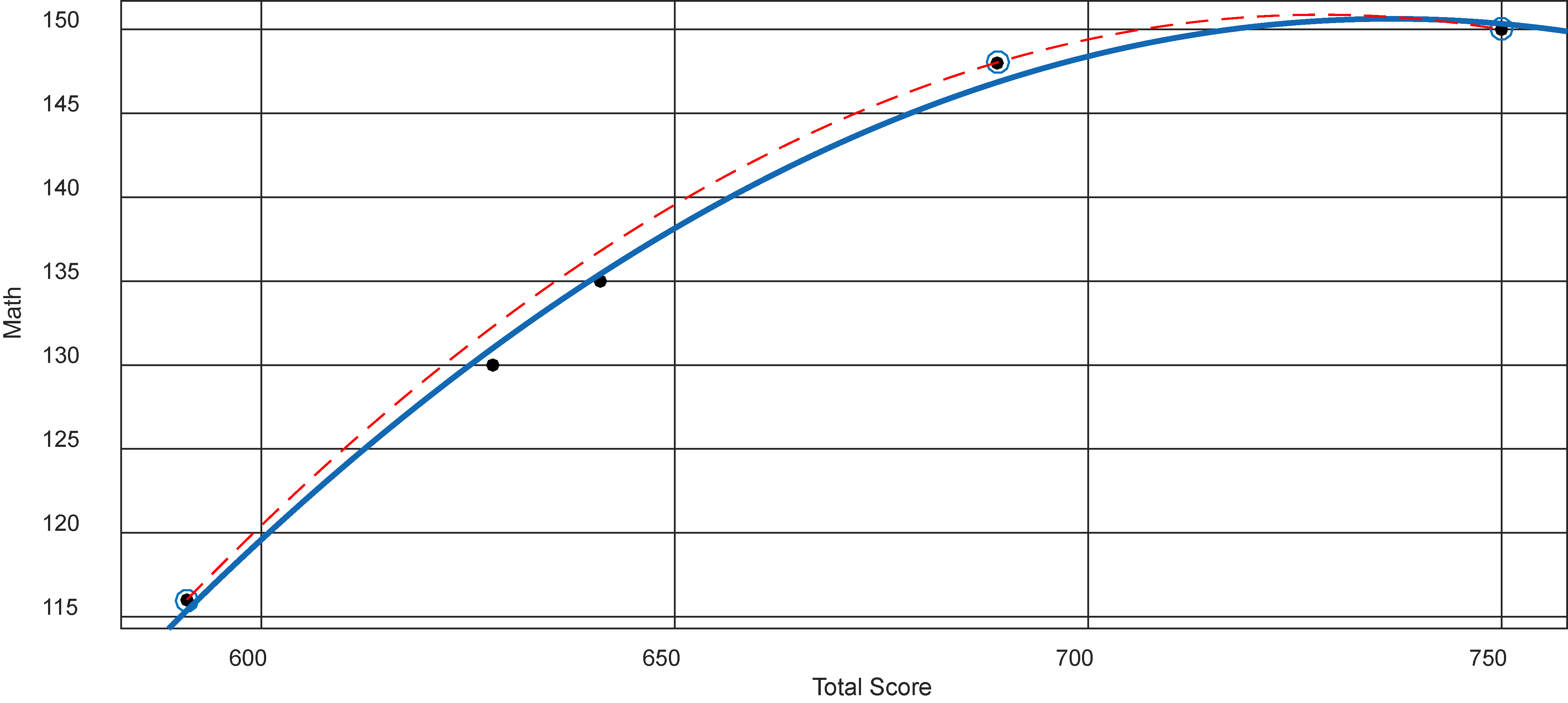
Table 8 is the morpho information table for mathematics. Figure 8 shows the barycentric curve of the evaluator based on the mathematical morpho information table, and the dashed line is the barycentric curve obtained by using the original method which obviously has major defects. One is barycentric curve was supposed to be monotone increasing, but there is an extremum points between 600 and 650, it means the barycentric curve isn’t is monotone increasing, this case is not reasonable, on the contrary, the barycentric curve obtained by morpho computing is monotone increasing.
The other advantage of improved method is it take into account hyperplanes of 628 and 641, the original method obviously ignores both of them.
Table 9 is the foreign language morpho information table. The real line is the center of gravity curve drawn from the attribute table of foreign language, and the dotted line is the center of gravity curve obtained by using the original method. It can be seen from the figure that the improved algorithm reflects the influence of the scoring results of 628 and 641 total point plane experts on the center of gravity curve. In the total score of 625, the original center of gravity curve has a large error, and the improved algorithm error is relatively reduced.
Comparison of the barycentric curves of foreign language attributes.
Respectively through Eq. (15) using two methods on 3394 sample data was received, the sequencing result difference rate was 2.29%, that is to say, there are 2.29% of results obtained the correction, also show the effectiveness of the improved method.
In this paper, the method of attribute coordinate evaluation of morphological calculation is studied and the corresponding mathematical model is given. The experimental results show that the method is not only improved the monotonicity of the original fitting curve problem, also more evaluation planes can be applied to the calculation of dynamic weight, so as to make the evaluation results more accurate and reasonable.