



Abstract
In Underwater Acoustic Sensor Networks (UASNs), the path loss of signal is serious due to the harsh underwater environment. Fractional power control algorithm has been widely used for the compensation of path loss. However, the randomness of underwater sensor nodes makes it hard to derive the performance index for UASNs. To address this issue, stochastic geometry theory is introduced to build an analysis model, which immediately gives the outage probability and transmission capacity for the fractional power control algorithm. Furthermore, the minimum transmission capacity for different power control factors is derived. This paper provides a huge incentive to improve the existing approaches to dynamically manage the power control scheme.
Keywords
Introduction
During the past decade, Underwater Acoustic Sensor Networks (UASNs) have attracted significant interests from academia and industry, because of a wide range of applications, including underwater environment monitoring, offshore structural health monitoring, target tracking, and oceanography data collection [1, 2, 3]. In UASNs, acoustic communications are considered to be an ideal method for long range communication. However, acoustic communications for UASNs are yet facing serious challenge due to many constraint factors: limited and distance-dependent bandwidth, time-varying multi-path propagation, low speed of sound and hard batteries replacement. Furthermore, acoustic channel is one of the most complex channels. Path-loss varies as time-space-frequency. For example, the velocity of underwater sound propagation is 1500 m/s, which are five orders of magnitude less than that of the radio frequency [4]. The slow fading of signal and time-space-frequency features bring more accumulation interference. Furthermore, mobile nodes have high random features because mobile nodes are affected by weather, ocean current, seabed and shipping. Obviously, sink on the surface is affected by accumulation interference generated by random mobile nodes distributed throughout the network. Random nodes in underwater are hard to communicate for Signal-to-Interference-plus-Noise Ratio (SINR) from sink nodes due to accumulation interference, which leads to high outage probability. To address this issue, fractional power control is used to compensate the channel fading and constraint the accumulation interference. However, considering the dependence about channel fading and accumulation interference in UASNs for randomly distributed nodes, less researches are to derive the expression of the network performance index for a chosen power control scheme. Therefore, stochastic geometry theory and Poisson point process are introduced to build the analysis model for fractional power control algorithm, which immediately gives the outage probability and transmission capacity.
For the wireless network deployment, the stochastic geometry theory is widely applied by the academic community. Overland wireless network is firstly modeled as regular grid topology by Wyner, which is named as Wyner model [5]. Although Wyner model is widely applied in wireless network researches, the applicability needs to be further studied. Thus, based on Wyner model, Jeffrey etc. supplied the theoretical analysis for different application scenarios [6]. Wyner model is a simple network topology, but it is difficult to obtain a tractable SINR expression considering for that mobile node is stochastically distributed on the two-dimensional surface. To obtain the network performance evaluation, such as network outage probability and throughput, a large amount of time is needed for the numerical simulation [7]. Due to the shortcomings of Wyner model, researchers start focusing on the stochastic spatial topology by applying stochastic geometry theory. It is easy to obtain tractable network performance expression based on this stochastic model [8]. To analyze the system performance of wireless networks, the location of base stations is modeled as following Poisson point process (PPP) distribution in [9]. Furthermore, for the downlink of wireless network, Jeffrey et al. introduce a new stochastic network model, Poisson Voronoi tessellation (PVT), where the location of base stations is also modeled as PPP topology [7]. For the case of heterogeneous networks, the PVT model is also suitable to the multi-layer networks [10]. Based on PVT model, the outage probability and energy efficiency is analyzed in [11] for the heterogeneous networks.
The stochastic geometry theory is not only applied in wireless cellular networks, but also widely used in Wireless Sensor Networks (WSNs) [12]. The wireless sensor network is a stochastic network where the transmission nodes and reception nodes are randomly deployed. In the WSNs, if one node increases its transmission power, then the links associated with this node will receive higher interference power. Thus, to research the network performance of WSNs, first of all is to model the location of sensor nodes. In [13], the author models the location of sensor nodes as following PPP distribution for the research of WSNs. Furthermore, for the actual applicative requirements, the PPP model is extended form two dimensions to three dimensions in [14].
The stochastic geometry theory is also often used for UASNs to build an analysis model [15]. UASNs have attracted significant interests from both academia and industry due to a wide range of applications including underwater environment monitoring, offshore structural health monitoring, target tracking and oceanography data collection [1, 2, 3]. However, mobile nodes have high random features because mobile nodes are affected by weather, ocean current, seabed and shipping. Obviously, sink on the surface is affected by accumulation interference generated by random mobile nodes distributed throughout the network. The location of nodes deployment is following Poisson point process. Therefore, the stochastic geometry theory is suit for UASNs to build an analysis model, in which the expression of the outage probability and transmission capacity can be obtained.
In [16], Li et al. proposed the Partial Power Control Algorithm based on outage probability minimization, in which stochastic geometry theory is used to build the analysis model. The analysis model gives the approximate expression about power control factor and small scale fading in the whole networks. In long distance transmission, channel fading varies as time- spatial-frequency. Therefore, the analysis model for large scale fading is built to describe the relationship between fractional power control and transmission capacity in cluster. In [15], Stamatiou et al. proposed an analytical model to evaluate the throughput of UASNs, taking full account of the specific propagation characteristics of the underwater channel, as well as the dependence of interference power on the transmission location. The analytical model is based on random geometric approach. The simulation shows that throughput gain varies as carrier frequency. Channel transmission in UASNs is not only affected by carrier frequency but also distance. The cumulative interference varies as transmission distance. Therefore, according to the fading in different transmission distance, fractional power control algorithm in UASNs is proposed to solve the question of transmission capacity in cluster.
In general, due to the features such as random mobility, low power, high interference etc., it is difficult to obtain the dynamic clustering approach. The cumulative interference for sink nodes increases with the number of nodes. To address this issue, fractional power control for UASNs are used to reduce the outage probability. In further, in UASNs the transmission distance is remote between nodes. The path loss is needed to be considered for fractional power control in UASNs. Therefore, analytical model is proposed to give the expression about parameters such as shadow fading, the outage probability and transmission capacity etc.
The main contribution of work is the derivation of outage probability for a randomly chosen mobile node with fractional power control, which is a general power control framework in UASNs. The locations of the mobile nodes are modeled as a realization of the Poisson Point Process (PPP). The transmission power of a mobile in UASNs depends upon the distance to its associated sink nodes due to the fractional power control. It turns out that random variables denoting interfering distance for each mobile node follow the generalized gamma distribution, but this nice property cannot help us to derive a close form of the network performance. However, for the permissible accuracy, this problem can be settled by applying the moment-matching technique and the accuracy of this technique is adequately analyzed in [22]. Furthermore, the transmission capacity of the network is analyzed with a target outage probability. Since it is valuable to study the minimum transmission capacity for the network settings, we have supplied a numerical solution for the minimum transmission capacity. After a discussion of the derived expression for outage probability and transmission capacity, we have evaluated outage probability and transmission capacity as a function of the power control factors.
The rest of this paper is organized as follows. In Section 2, the system is modeled based on the stochastic geometry theory and the signal-to-interference-plus-noise ratio (SINR) under fractional channel inversion power control scheme is introduced. For fractional channel inversion power control, the outage probability and transmission capacity of CM are derived in Section 3. The numerical results are given in Section 4, where the outage probability and transmission capacity with different environment parameters are illustrated. Finally, Section 5 concludes this paper and future work is discussed.
System model
The architecture for UASN concerned by this paper is as shown in Fig. 1, where the signal transmitted by the cluster member is interfered by other cluster members of adjacent clusters. It is assumed that the locations of cluster heads (CHs) and cluster members (CMs) are modeled by two independent homogeneous Poisson point processes (PPPs)
Underwater acoustic sensor network structure.
Comparing to the space electromagnetic transmission, the underwater acoustic channel is much more complex for its complicated underwater environment. Thus, it is unlikely to calculate the power loss accurately. At present, the experienced formula is generally used for the calculation of the transmission energy consumption. According to [19], the attenuation of the transmission is given as
where
in dB/km for
Without the loss of generality, it is assumed that the CMs utilize fractional channel inversion power control in the form of
Under the fractional power control power control scheme, the CM in the typical cluster suffers co-channel interference from CMs of other clusters. The noise power
where
The outage probability of CMs can be formally defined as
where
where
According to [21], the interfering distance
where
Relationships of lognormal distribution and gamma distribution can be obtained by the moment-matching technique and the accuracy of this technique is adequately analyzed in [22]. Similarly, the distribution of the interfering distance can be modeled as lognormal PDF also and the expectation and variance of
According to the relationship between the parameters of the gamma PDF and the lognormal PDF, the parameters of the lognormal PDF can be respectively obtained as
i.e.,
where
Therefore, the outage probability expression can be derived as
As analyzed above, the outage probability, denoted by
in units of number of transmission attempts per unit area.
Due to the complexity of outage probability and transmission capacity derived above, it is difficult to give a simple analytical solution to the minimum transmission capacity. Here we supply a numerical solution for this problem. For a chosen power control factor
where
In a network, the selected CH is required to be set with a minimum transmission capacity to cover its serving cluster for a chosen power control factor. Thus the research of minimum transmission capacity for the sensor nodes of UASNs is valuable.
To illustrate the conclusion described in Section 4, some numerical results for outage probability will be given in this section.
Outage probability with different power control factors.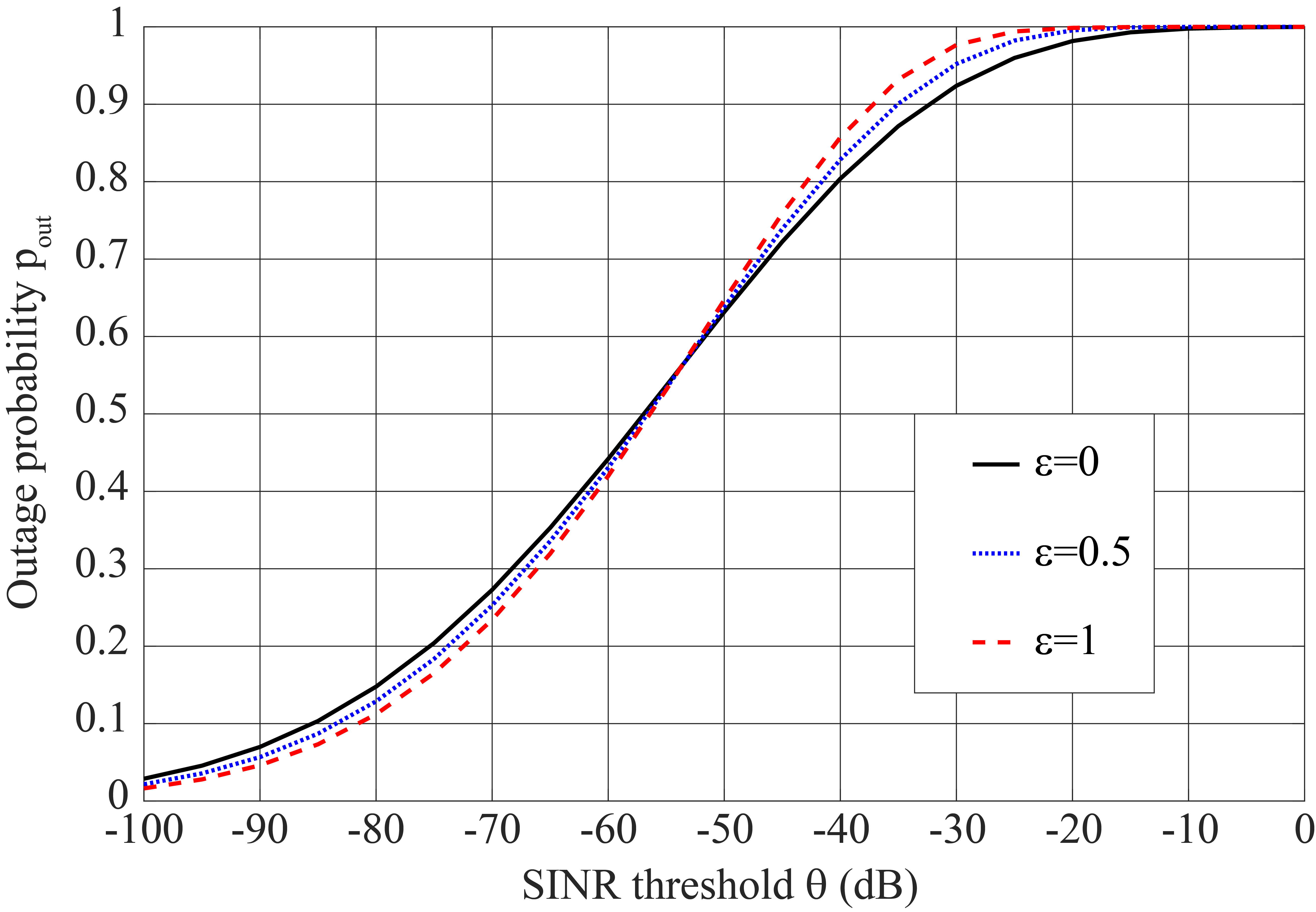
In case of that the geometric spreading loss coefficient is
Outage probability with different geometric spreading loss coefficients.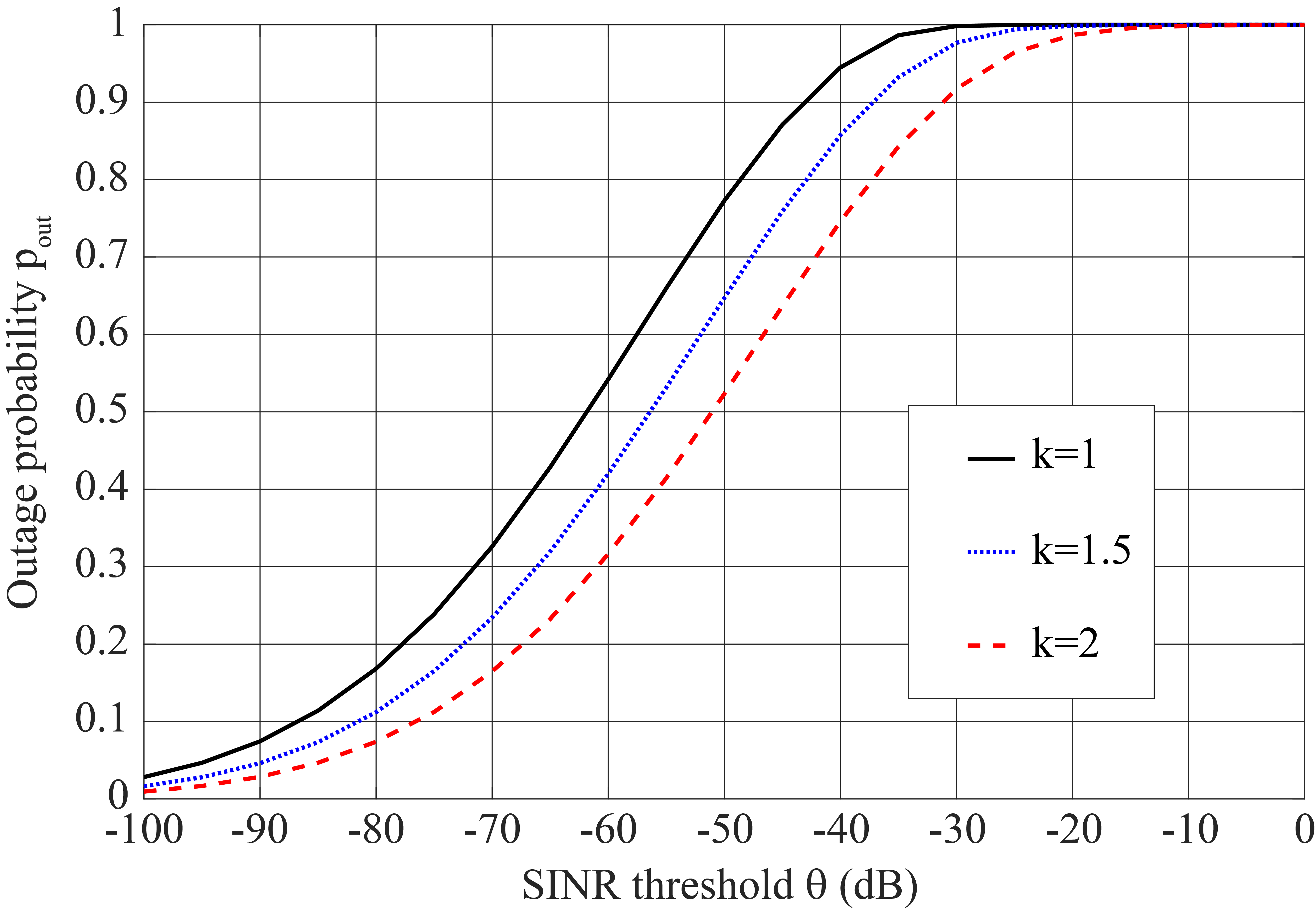
Outage probability with different transmission frequency.
Outage probability with different density of interfering CMs.
Transmission capacity with different density of interfering CMs.
In case of that the fractional power control factor is
In case of that the geometric spreading loss coefficient is
In case of that the geometric spreading loss coefficient is
For the analysis of transmission capacity, the numerical results with different interfering density
Meanwhile, it can be also observed that the transmission capacity and the minimum transmission capacity initially decreases as the power control factor increases, but turns to increase after the power control factor reaching a certain value. The interference gets larger as the power control factor becomes bigger, which ultimately degrades the outage probability. But as the power control factor reaching a certain value, more CMs are accessed to the corresponding CH with a relatively higher outage probability.
In this paper, the outage probability and transmission capacity of CMs under fractional power control scheme is analyzed based on the proposed PPP model. By applying the property of PPP and the moment-matching technique, we have derived the closed form expression of outage probability. Furthermore, the transmission capacity of the network is analyzed with a target outage probability. Since it is valuable to study the minimum transmission capacity for the network settings, we have supplied a numerical solution for the minimum transmission capacity. Finally, numerical simulation is supplied for the outage probability and transmission capacity. Through numerical simulation analysis, we find that the outage probability and transmission capacity are affected by power control factors, path loss coefficients, transmission frequency and density of interfering CMs. These figures provide a huge incentive to improve the existing approaches to dynamically manage the power control scheme, so as to obtain the optimal transmission capacity in UASNs. Some extensive work based on the results in this paper will be explored in the future, such as the optimal power control factor algorithm and the channel fading influence.
Footnotes
Acknowledgments
This work was supported in part by the following projects: the National Natural Science Foundation of China through the Grants 61571318, the Guangxi Nature Science Fund (2015GXNSFAA139298, 2016GXNSFAA380226), Guangxi Science and Technology Project (AC16380094, AA17204086, 1598008-29), Guangxi Nature Science Fund Key Project (2016 GXNSFDA380031), and Guangxi University Science Research Project (ZD 2014146).