



Abstract
This research aims to investigate the airflow patterns and particle deposition in a healthy human upper airways. A realistic 3-D computational model of the upper airways including the vestibule was developed using a series of CT scan images of a healthy human. Simulations of the airflow fields in the upper airway passages were performed by solving the Navier-Stokes and continuity equations for breath rate 20 L/min. The trajectory analysis approach was applied to study the particle transport and deposition for the model with and without mucous lining. The presented results revealed that the mucous layer can have significant impact on airflow analysis and there were noticeable differences in the amount of particle deposition in each models.
Introduction
Inhaled particle deposition in the airway channels has caused serious health problems. These particles consist of dust, microorganisms, photochemical smog and other irritants. From the toxicological point of view, all particles which are smaller than 10
Computational fluid dynamics (CFD) method, which gained more popularity due to the advances in computer technologies, can provide an alternative to the experimental techniques for predicting particle deposition in nasal airways. Many researchers have studied airflow patterns and particle depositions in this field [5, 6]. Techniques have included computational fluid dynamics and particle image velocimetry (PIV) which resulted in better understanding of the physiological and pathological aspects of the nasal cavity [7]. Even though particles are carried by the breathing air through the respiratory system, their trajectories differ from the airflow streamlines due to their inertia and effects of various forces. The most important forces are gravity, drag, and the Brownian excitation. Particles are then deposited on the walls of the airway by sedimentation, impaction, and/or diffusion mechanisms
Particle trajectory analysis can give scientists essential information in the field of inhalation and aerosol therapy. Experimental studies into aerosol deposition have been investigated in the past by a number of researchers [8, 9], but a thorough search of such literatures yielded that this effect was ignored through the airflow and particle deposition studies and its details has not been discussed appropriately. Hence, the mucous layer thickness should be included as a structural feature in 3D analytical models and solved as a non-linear model. Mucous layer is a thin mucous film covered the nasal airway boundary and served as a protection mechanism which is critical for the capture and removal of aerosol particles. Mucous is mostly composed of around 95% water with the assumed thickness of 5 to 50
Methodology
Model outline and mesh
A three dimensional nasal computational model was developed based on the computed tomography (CT) scans of a healthy 39-year old female. The scans data was procured at the Universiti Sains Malaysia (USM), Medical Campus Hospital. The CT scan images were obtained from the axial, coronal and sagittal planes. The increment between each slice of the scan images is 0.8 mm. The scan images were segmented by defining threshold values ranging from
As shown in Fig. 1, the reconstruction of the upper airway section was made in CATIA (Dassault Systems, SA) to smoothen and create the final model. Then the computational domain was exported to Gambit 2.3.16 (Fluent Inc., Lebanon, USA) to generate a hybrid mesh with 7,900,000 elements, which consisted of a total of 5 layers of prism mesh near the wall boundary. Moreover, for the residual plot, it was considered as acceptable only when the residual values in all equations had converged to an acceptable value i.e., between three to four orders of magnitude (10
Cross-sectional view of the nasal cavity showing the hybrid mesh [5].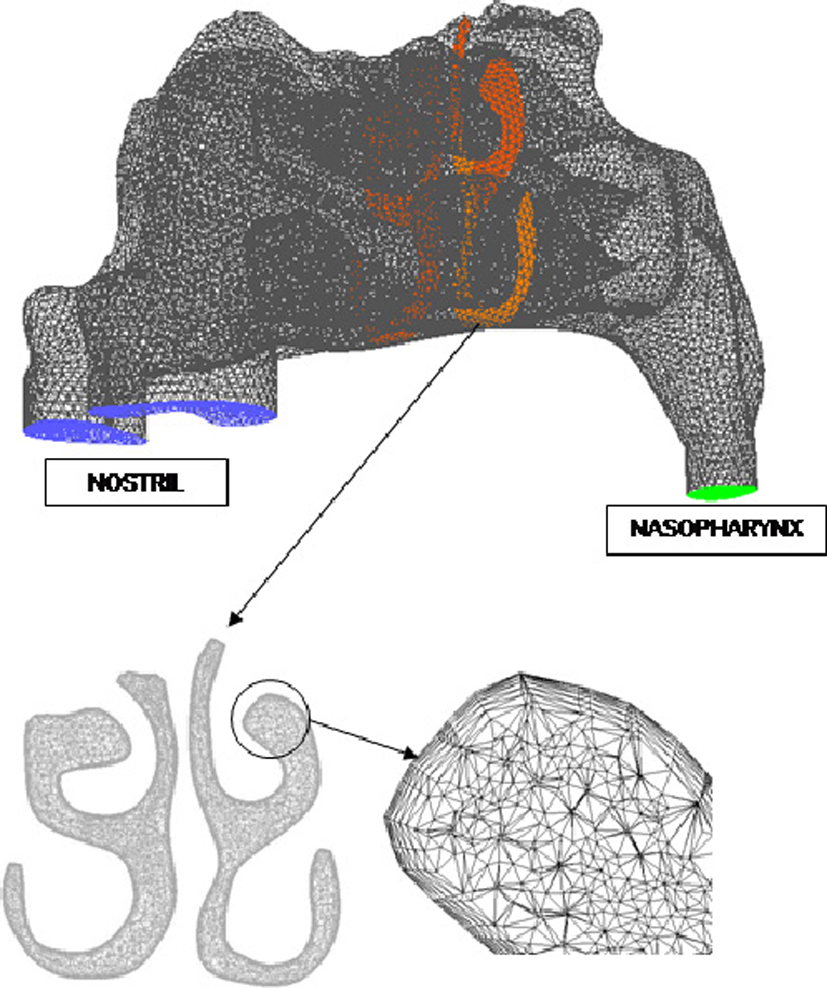
The numerical simulation was performed using the commercial CFD solver COMSOL Multiphysics. The simulation was carried out on an Intel (R) Core (TM) i5-5200U CPU @ 2.20 GHz, 2 cores, which basically required approximately 3 days of runtime for entire simulation. For the boundary condition, the wall for the nasal model was assumed to be rigid with no slip condition. The mass inflow rate defined at nostril and no pressure outflow condition was considered at the nasopharynx. The gravity factor was ignored during the simulation. Inspiratory flow rate of 20 L/min was used in the simulation. Comparison and validation were carried out using the analysis of the mucous and non-mucous models with previous researches [5, 8, 12, 13, 14, 15]. All computational analysis are validated and therefore the research continued with evaluation of mucous layer effect on the particle deposition.
The air flow simulation was based on the Navier-Stokes equations for the continuity Eq. (1):
And conservation of momentum, Eq. (2):
where
The Particle Tracing for Fluid Flow (FPT) module was used to describe the particle trajectories and to derive the collection efficiency by counting the number of particles at the outlet. The particle trajectories are computed using Newtonian formulation with the Stokes drag law,
where
where
Velocity distribution for 20 L/min. (a) Non-mucous (b) Mucous models.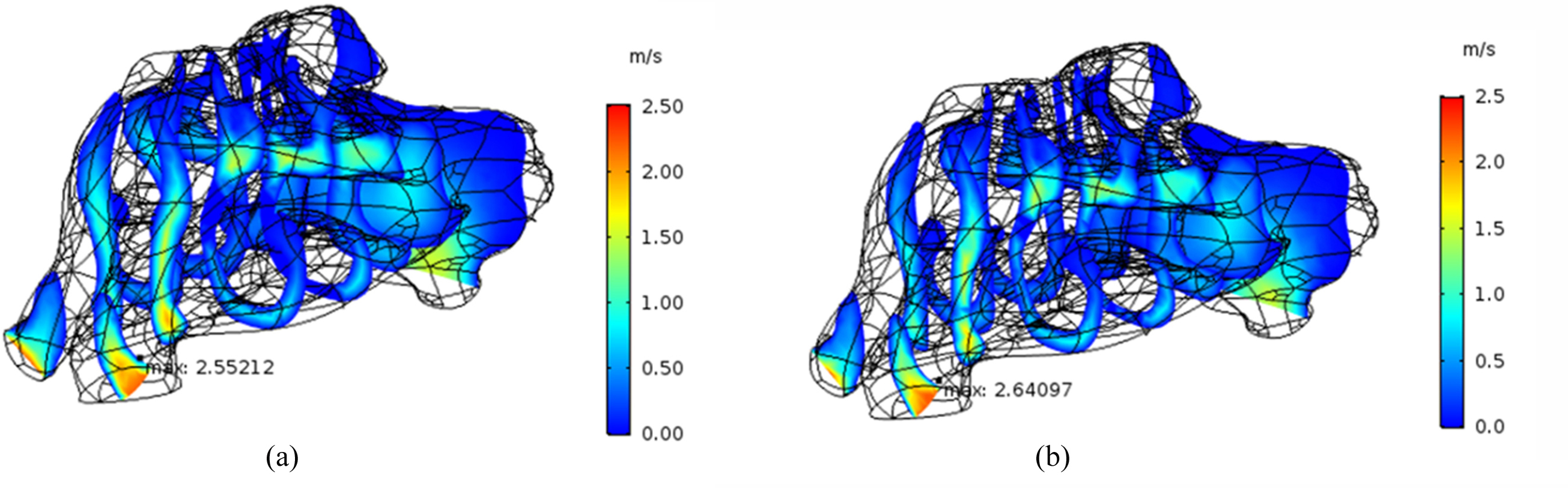
Pressure distribution for 20 L/min. (a) Non-mucous (b) Mucous models.
Model validation
The developed model of nasal cavity in this study was previously validated in terms of the pressure drop [16]. For this reason, the methodology will not be repeated here again. Moreover, For the Mucous effect, the results shows a good agreement with earlier work of Lee et al. [10]. Air flow characteristics and its behavior inside the nasal cavity is equally important for both nasal physiology determination and associated diseases diagnosis. The breathing rates can be ranged from 5 to 12 L/min for light condition activities and from 12 to 40 L/min for heavy work activities such as physical exercise [17]. In this paper, the turbulent breath rate of 20 L/min was considered.
Particle trajectories for the model with mucous thickness of 50 
Deposition rate of 20 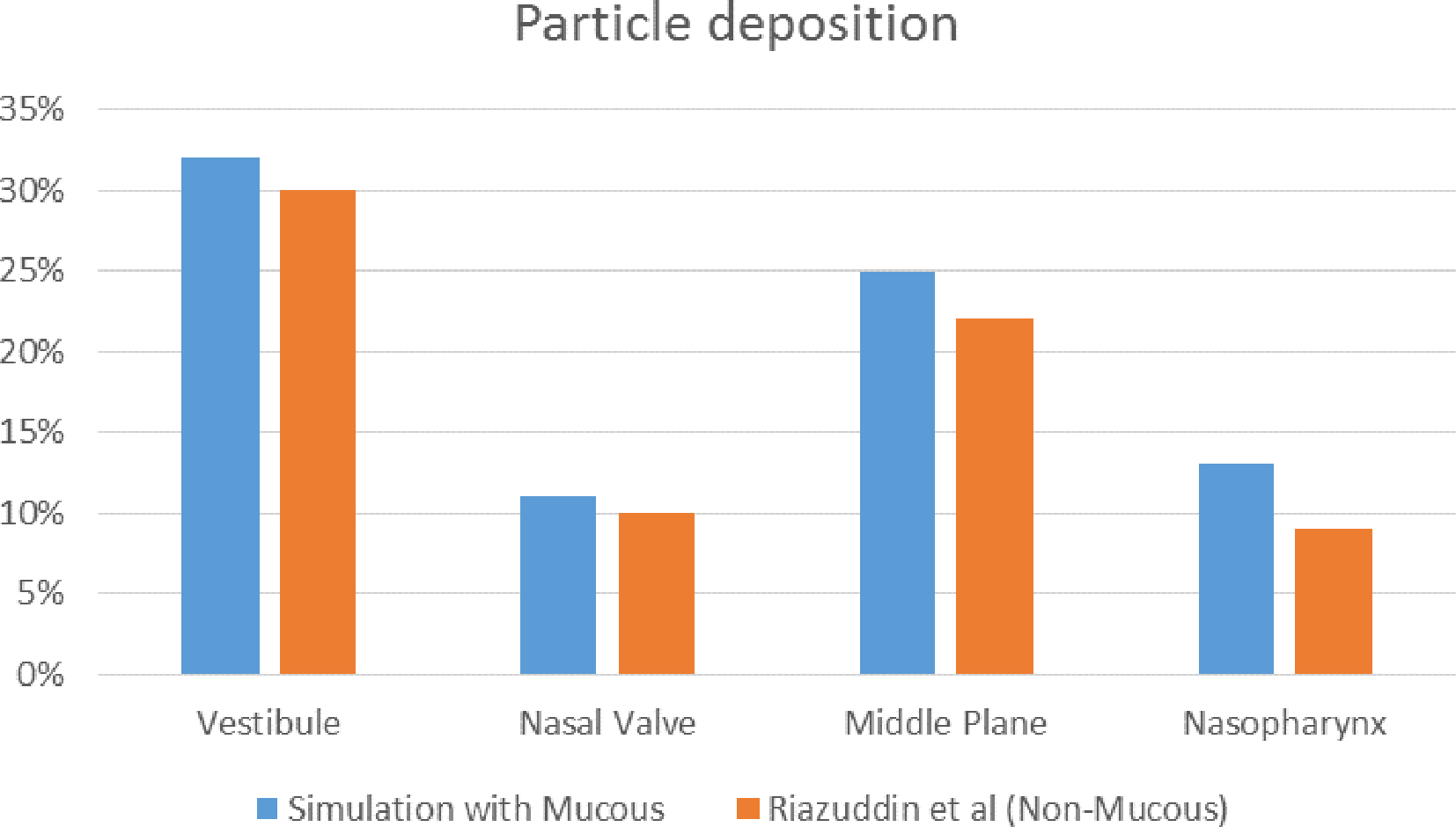
Figure 2 illustrates the velocity slices for flow rate of 20 L/min for mucous and non-mucous models. By having the mucous layer with thickness of 50
Figure 3 displays the pressure contours for the models with and without mucous layer. According to Fig. 3, in the model without mucous layer, the pressure magnitude is higher in comparison with the mucous included model which is understandable due to higher velocity in this model. In both cases, the pressure contours are stronger in the nostril and vestibule regions. These high pressure zones can also be observed in the area where the direction of the airflow changes inside the cavity which are more significant in the left planes. Accordingly, the pressure value decreases until it exits the nasopharynx.
Particle trajectory and deposition rate
Equations (3) and (4) have been used to calculate particle trajectory which were inserted through nostril inlet when flow velocity is known. The articles deposit on the nasal wall when the distance between the particle center and the surface is less than or equal to the particle radius the particle is assumed to be deposited on the wall. The deposition rate in each region, identified by means of particle accumulator in that specific region. Figure 4 shows the particle trajectory in the nasal model with mucous thickness of 50
According to Fig. 5, for flow rate of 20 L/min and particle size 20
Conclusions
A CFD study of airflow and particle deposition in the human upper airway has been the subject of many researchers. However, no numerical study of the particle deposition in an upper airway model with mucous layer has been presented so far in the literatures. Addition of mucous layer in the nasal model disturbed the airflow and thus changed the maximum velocity especially at the middle plane as all the turbinates were involved in determining the maximum velocities. The morphology of the upper airway was found to affect significantly the airflow pattern and the deposition fraction of the microparticles. There was a noticeable difference between models with mucous and without mucous layer. Findings in this study proved that mucous effect cannot be ignored in the numerical simulations and it is required for more precise and in-depth investigations. In this paper, particle transport and deposition in the human nasal model section is limited to one micro-particle size (20