



Abstract
The paper is devoted to developing the new and memory-efficient parallel algorithms based on the nonlinear conjugate gradient method. The algorithms are aimed to solving the nonlinear inverse potential problem of finding a boundary surface between two layers with constant densities. The algorithms utilize the structure of the Jacobian matrix of integral operator by excluding the less significant elements. The efficient implementation for multicore CPU was developed. Investigation of efficiency and speedup of the parallel algorithm was performed. A model problem with synthetic gravitational data was solved. It was shown that the new algorithms reduce the computation time in comparison with the unmodified one.
Keywords
Introduction
The problem of finding the interface between two layers with different densities using observed gravitational data arises in studying the structure of the Earth crust. This problem was studied in many works [1, 2, 3].
The problem is described by the integral equation of the first kind; so, it is the ill-posed problem. After the discretization and approximation, this problem is reduced to solving a large ill-conditioned system of nonlinear algebraic equations.
The real observations are performed on the large areas. To increase the accuracy and degree of details, it is essential to use larger grids producing high dimensional data sets. The way to reduce the computation time is to use parallel algorithms and high-performance computing systems.
In works [4, 5], the effective parallel algorithm for solving such inverse problem was constructed and implemented for the multicore CPU using the OpenMP technology. The algorithm is based on the iterative nonlinear conjugate gradient method.
In this paper, we construct and implement modifications of this algorithm based on the structure of Jacobian matrix. The model problem with a large grid is solved. We also investigate efficiency and speedup of the algorithm.
Statement of the problem and solving method
The problem is to find the contact surface
This surface should satisfy the following equation:
where
As a preliminary processing of gravity observations, we use the heightwise transformations technique described in [6]. The technique will allow us to suppress the effects of shallow and deep objects and extract approximately the signal
We can rewrite Eq. (2) as
where
Model of a two-layer medium for the gravimetry problem.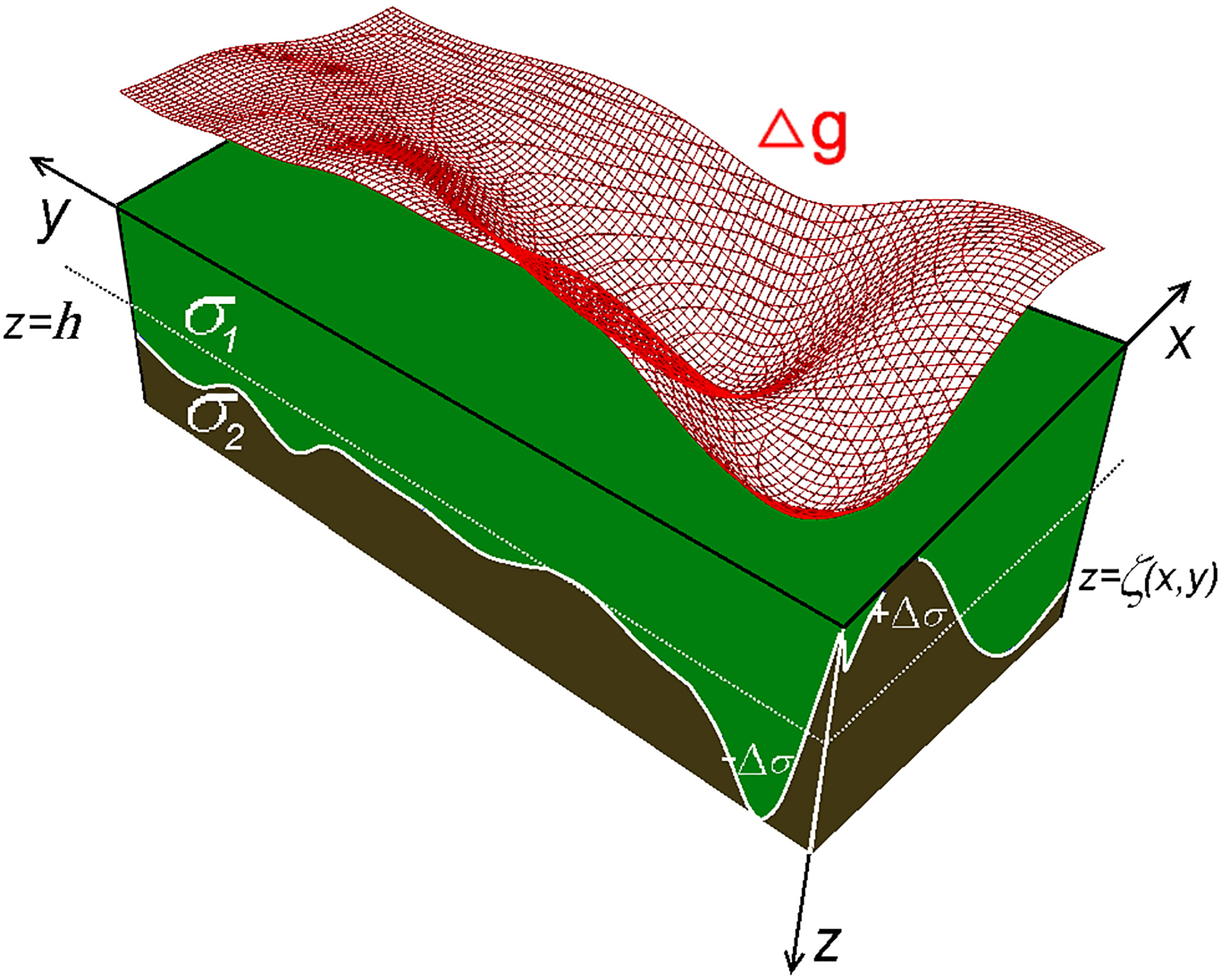
Problem (1-1a) is a nonlinear integral equation of the first kind. This problem belongs to the class of ill-posed problems. After the discretization of the area into
where
To solve system Eq. (2), we use the following iterative linearized conjugate gradient method [5]:
where
The condition
for some sufficiently small
As the initial estimation,
The variant of optimization of this algorithm is based on the idea used in work [7]. Storing the value of the Jacobian matrix
Let us assume that
where
The elements
Structure of the Jacobian matrix 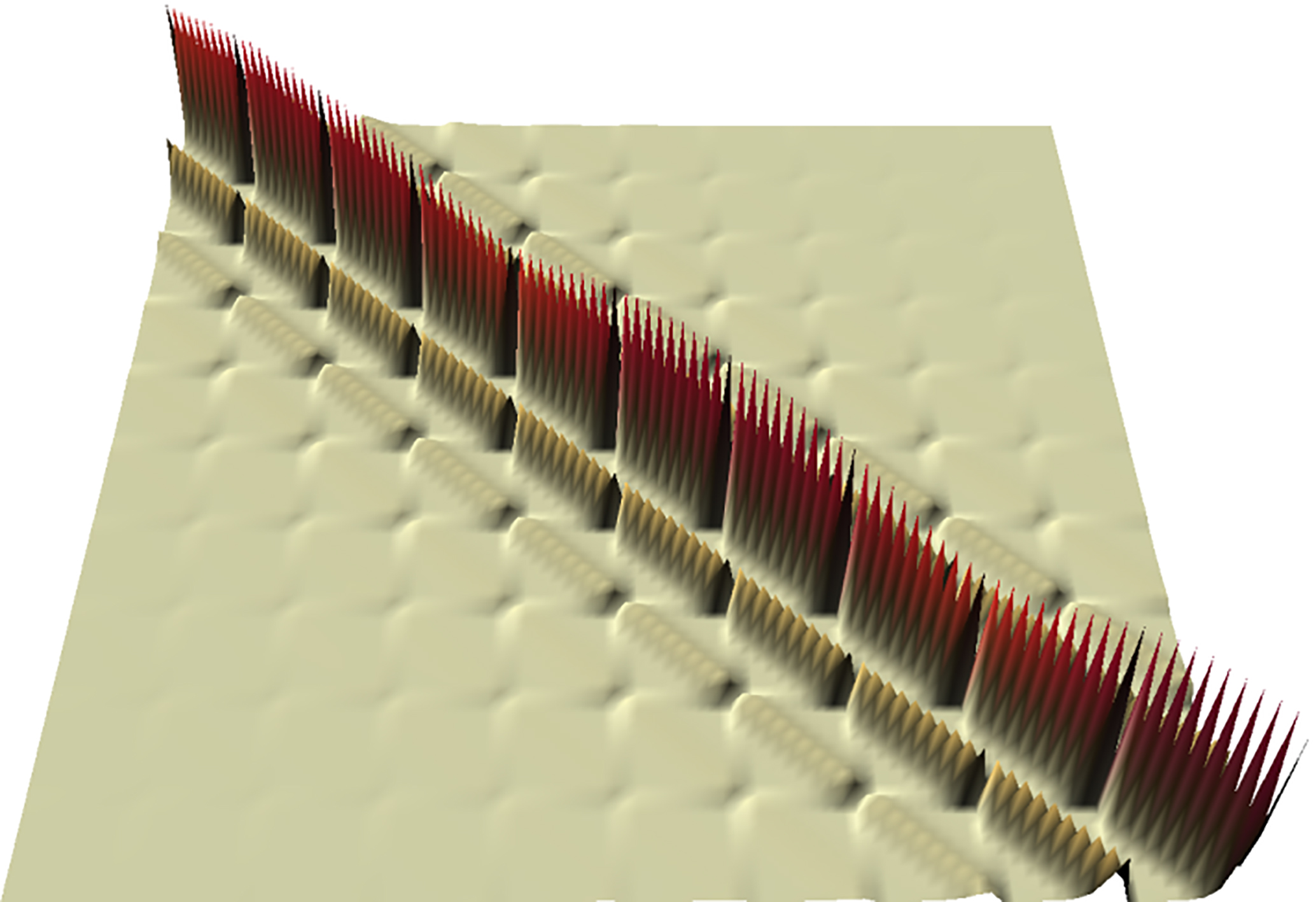
The first way to reduce the number of stored elements is to drop off small elements and to approximate the matrix
where Figure 3 shows the band matrix scheme with respect to the parameter To adjust the parameter
We set the parameter The second way is to retain the elements of
The numbers show the bandwidth parameter 
The scheme of the matrix coefficients with respect to the parameter
The numbers show the distance 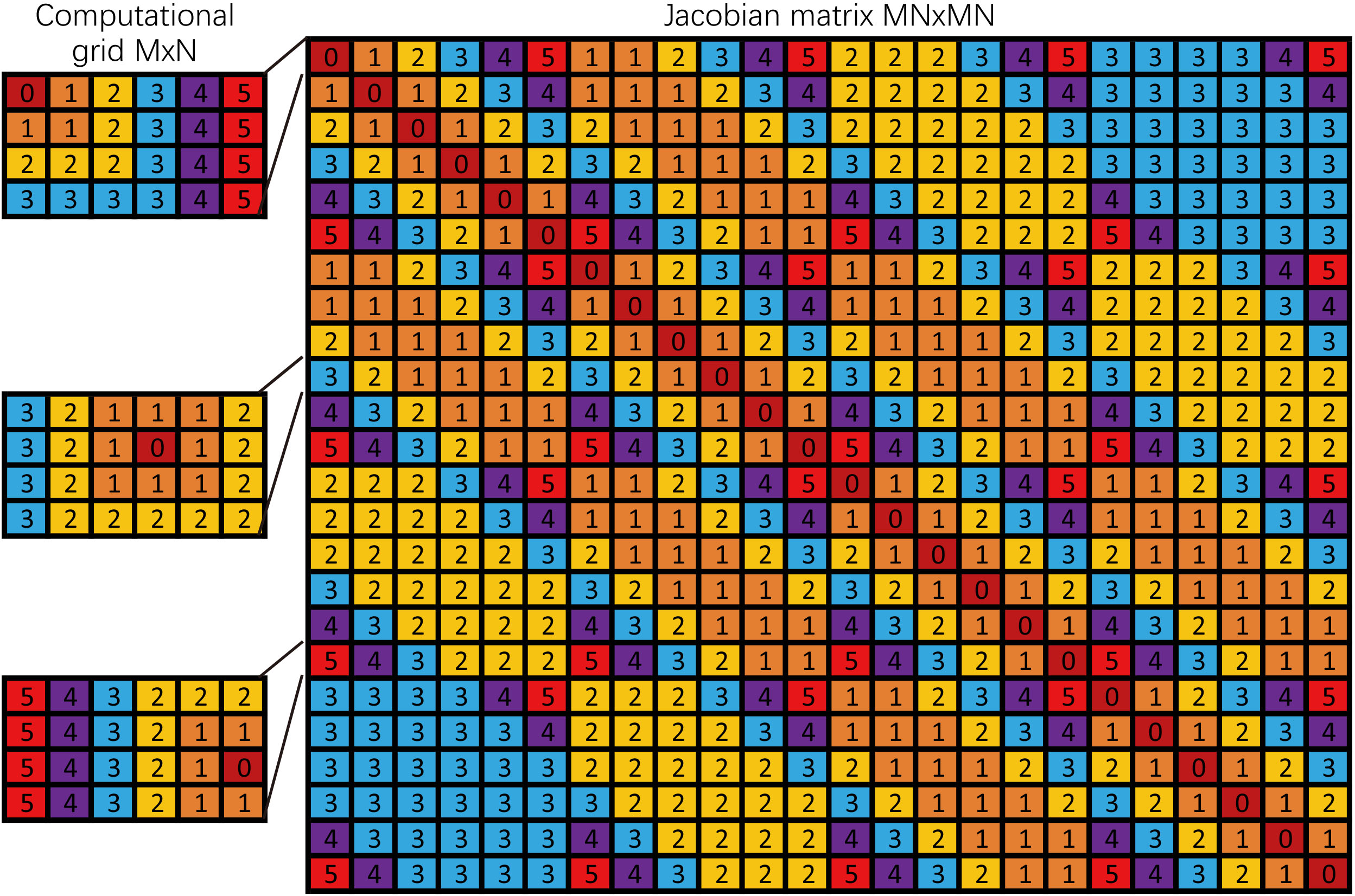
The model (synthetic) gravitational field 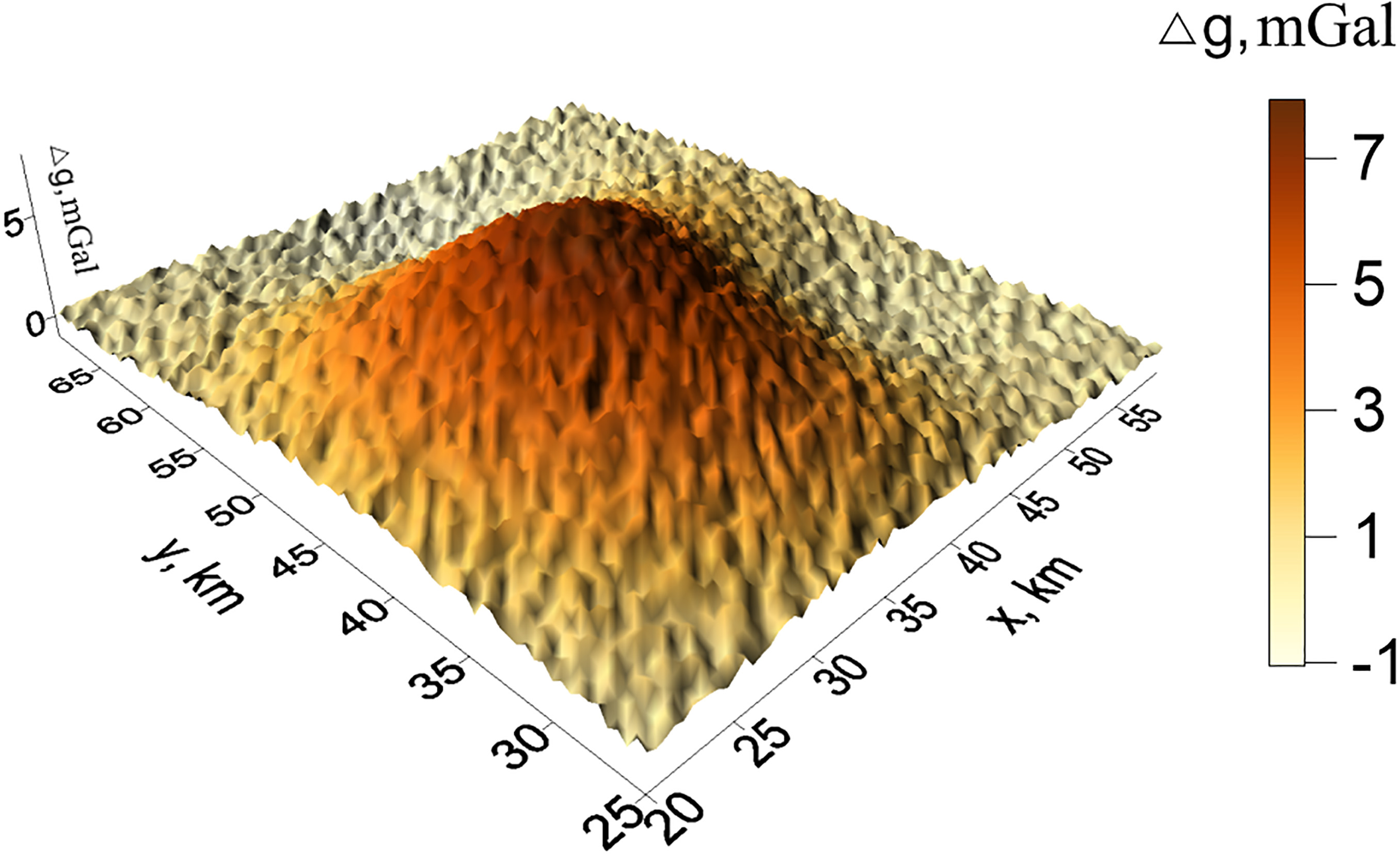
This algorithm reduces the number of calculated elements in comparison with the band matrix Eq. (4).
The test problem of finding the interface between two layers for the area 40
Figure 5 shows the model gravitational field
This surface is shown in Fig. 6. The noise with 10% peak value and zero mean value was added to the field. Density contrast was
The stopping rule was
The problem was solved by three variants of the algorithm:
For the band matrix with the bandwidth parameter
Results of the numerical experiments
The original surface 
The reconstructed surface 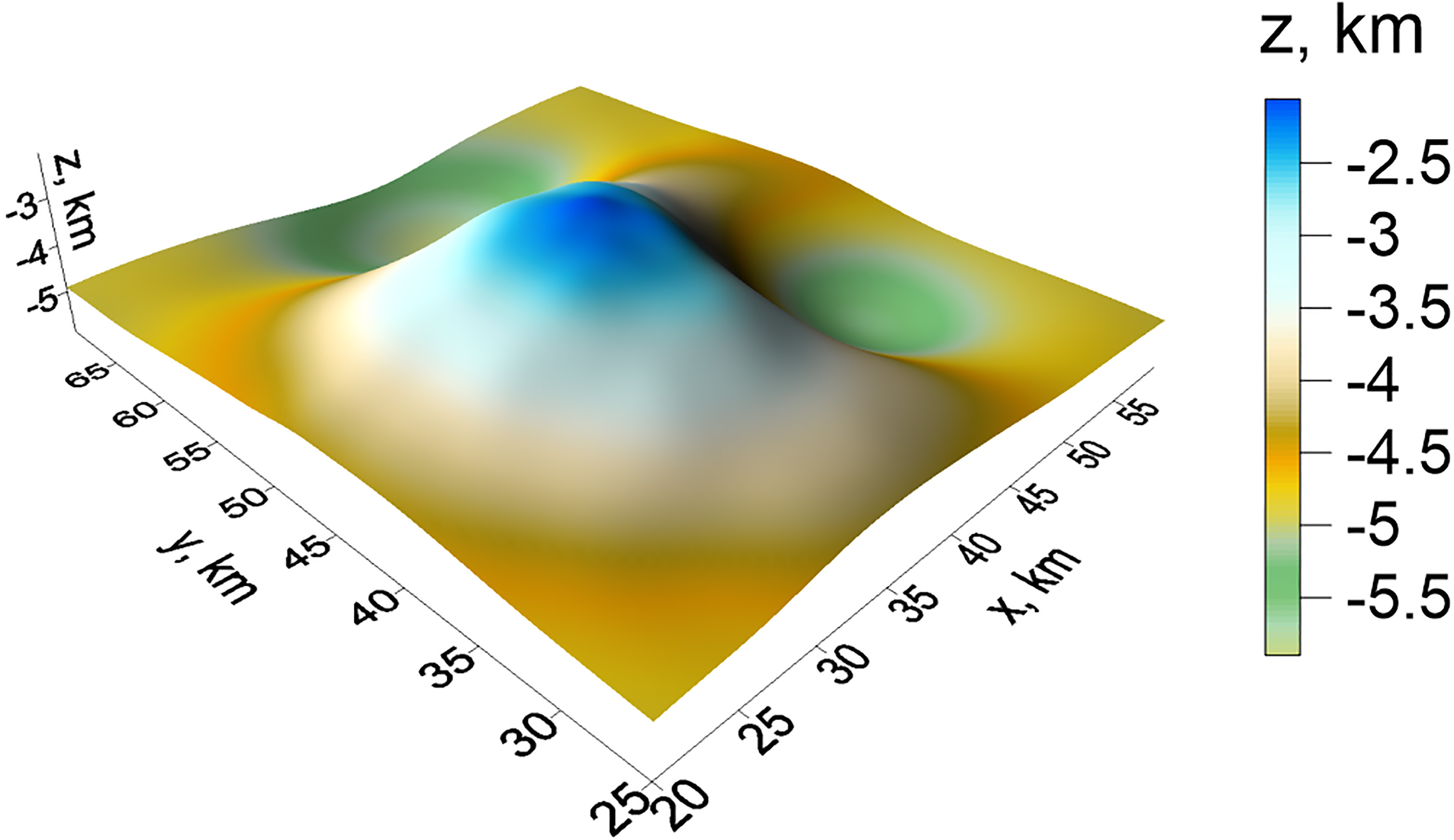
The difference 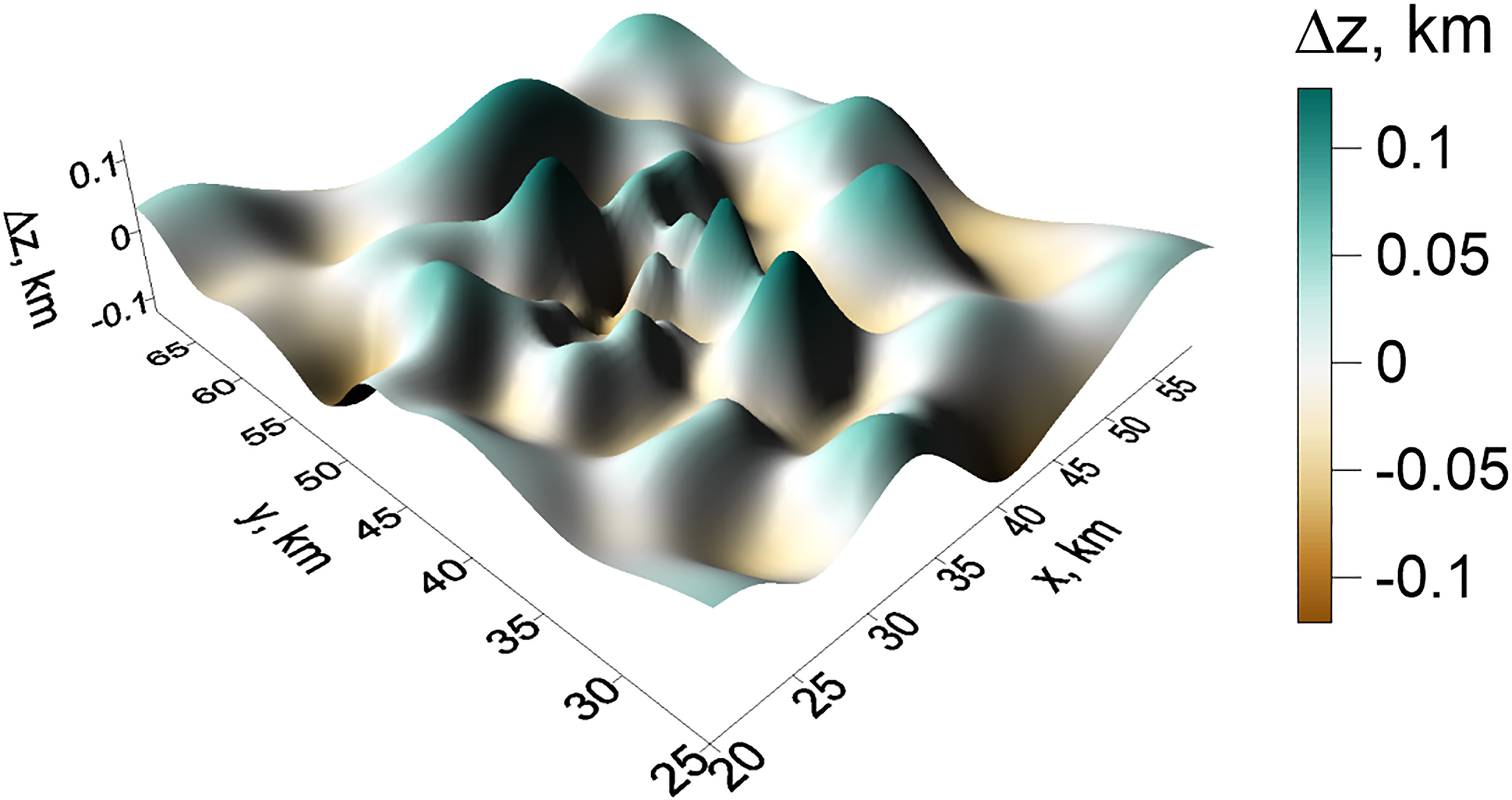
Figure 7 shows the reconstructed interface. The solving process took 10 iterations. Resulting relative error is
Table 1 shows the execution times
The optimized parallel algorithms for solving the nonlinear inverse potential problem of finding a boundary surface between two layers were constructed and investigated. The algorithms are based on the linearized conjugate gradient method.
The main idea of optimizations consists in approximating the Jacobian matrix of the integral operator by excluding the less significant elements and using either the band matrix or neighborhood of the observation point.
The parallel algorithms were developed for solving the inverse gravimetry problem of finding a boundary surface and were implemented for multicore CPU using the OpenMP technology.
A model problem with synthetic gravitational data was solved for a large grid. The experiment shows that the proposed optimizations reduce the computational time by 40% using the band matrix and to 55% using the neighborhood.
The speedup and efficiency of the parallel algorithms were studied. The algorithms show good scaling with 97% efficiency.
Footnotes
Acknowledgments
This work was partially supported by the Center of Excellence “Geoinformation technologies and geophysical data complex interpretation” of the Ural Federal University Program.