Molecular structures and calculations of reactivity descriptors of new di-organotin (IV) phenoxyacetohydroxamate complexes: Insights from density functional theory
Available accessResearch articleFirst published online February, 2020
Molecular structures and calculations of reactivity descriptors of new di-organotin (IV) phenoxyacetohydroxamate complexes: Insights from density functional theory
The new diorganotin (IV) phenoxyacetohydroxamate complexes of composition [MeSn(HL)] (I) and [- BuSn(HL)] (II) (where KHL potassium phenoxyacetohydroxamate (PhOAHK CHOCHCONHOK); [MeSn (CHOCHCONHO)] (I) and [-BuSn(CHOCHCONHO)] (II) have been synthesized by the reactions of MeSnCl and -BuSnCl with biologically important potassium phenoxyacetohydroxamate ligand (KHL) in predetermined 1:2 molar ratio (metal:ligand) in anhydrous methanol benzene under reflux and thoroughly characterized by various spectral techniques. The gas phase optimized geometry computed by using the B3LYP/6-311G (d,p) method has depicted distorted octahedral geometry. The molecular properties such as ionization potential (IP), electron affinity (EA), chemical potential (), hardness (), softness (S), electronegativity () and electrophilicity index () have been calculated from the energies of frontier molecular orbitals (HOMO-LUMO energy values) to have an insight into energy distortion and energetic behaviour.
Hydroxamic acids a family of weak organic acids of general formula RC (O) N (R’) OH have been a subject of much research interest as bioactive compounds as naturally occurring (siderophores) trishydroxamate compounds Desferrioxamine B (Desferal), that sequester and solubilize iron [1]. The diverse structures displayed by hydroxamic acids in solid as well as solution state have generated a particular attention as these exhibit keto-enol tautomerism [1] with respect to the C-N bond with keto (hydroxamic, Z conformer) and enol (hydroximic Z isomer) structures predominating in acidic and alkaline medium respectively [2]. Numerous studies on hydroxamic acids and their metal complexes have been reported in solution determining dissociation and stability constants [3, 4]. The substituted hydroxamic acids usually occur as iminol tautomers. The simplest acetohydroxamic acid has been reported to exist as a mixture of three isomers by quantum-chemical calculations [5] and low temperature matrix isolation studies. The matrix-isolation and computational study of salicylhydroxamic acid and its photochemical degradation have been reported [6]. Hydroxamic acids are known to undergo Lossen rearrangement to yield isocyanates [7] which are unstable in solution and immediately hydrolyze to amines [8] but may be stabilized in low temperature matrices.
The coordination chemistry of hydroxamic acids has seen tremendous developments due to their excellent chelating ability [1]. Hydroxamate ligands typically coordinate as a bidentate chelating ligand by coordination of the carbonyl oxygen and the deprotonated OH group to the metal center. Besides common (O, O) bonding mode of hydroxamate ligands the (N, O), (N, N) and bridging bis-chelating modes forming metallocrowns are known to play vital roles in affecting the versatile biological activity [9]. The fact that the nature of the substituents at the aromatic ring viz. the electron withdrawing substituents (NO, F, Cl) exhibit higher biological activity than those with electron donating groups (NH, OH) has paved a way for the design of prospective metallopharmaceuticals [10, 11].
The organotin (IV) complexes among organometallic compounds of main group elements have aroused enormous research interest over the years [12, 13] because of their structural complexities [14] and potential applications in diversified fields [15, 16]. The synthesis of biologically valuable compounds with diverse structures particularly possessing anti-bacterial, anti-fungal and anti-tumor properties has been the major thrust in organotin chemistry [17]. The biochemical activity of organotin (IV) complexes is reported to be affected by the structure of the molecule, metal nuclearity, coordination number and the nature of allyl/aryl groups attached to tin atom [9]. Hence, their structural characterization is of relevance for establishing possible structure-activity relationships as polymeric diorganotin arylhydroxamate complexes with [RSnL] with R -Bu are more active than related mononuclear [RSn(HL)] complexes. Furthermore, the inhibitory potencies are related to their lipophilic properties and the electron withdrawing ability of the substituent at aryl ring.
Compared to extensively studied transition metal hydroxamates [18, 19, 20, 21, 22] scant reports describe tin and organotin (IV) hydroxamates [23, 24]. We have recently reported the synthesis and characterization of new diorganotin (IV) complexes of phenoxyacetohydroxamate ligand hence the present paper as an extension to the earlier work [25] reports the DFT calculations implemented in B3LYP/6-311G (d,p) level of theory to have insights from molecular structures. The molecular properties viz. ionization potential (IP), electron affinity (EA) and global descriptive parameters like chemical potential (), hardness (), softness (S), electronegativity () and electrophilicity index () have been evaluated from HOMO-LUMO frontier molecular orbitals energy values [8].
Experimental
Computational details
All calculations were performed with the GAUSSIAN 09 package [26], using B3LYP exchange correlation function and the molecular structures were visualized with the Avogadro software.
The geometry of the complexes was fully optimized in the gas phase using B3LYP/6-311G (d,p) basis set for H, C, N, O, Cl and Sn atoms without using any symmetry constraint [27]. The choice of the B3LYP functional was supported by its good performance in geometry optimization and quite accurate prediction of reaction enthalpies [28, 29, 30, 31]. The harmonic vibrational frequencies were calculated at the same level of theory to ensure the true absolute minima. For open-shell systems (radicals and radical cations), the unrestricted method B3LYP/6-311G (d,p) was thoroughly applied. The molecular properties such as ionization potential (IP), electron affinity (EA), chemical potential (), chemical hardness (), softness (S), electronegativity () and electrophilicity index () have been deduced from HOMO-LUMO analysis employing B3LYP/6-311G (d,p) method.
Results and discussion
The diorganotin (IV) phenoxyacetohydroxamates (I) and (II) have been synthesized according to the following equations (Scheme 1).
Synthesis of complexes.
The complexes are melting solids and soluble in organic solvents viz. methanol, benzene and dimethylsulphoxide. The characterization of complexes has been accomplished by physicochemical, spectroscopic techniques (infrared, H nuclear magnetic resonance) and mass spectrometry. The [O, O coordination] through carbonyl and hydroxamic oxygen atoms and distorted octahedral geometry around the mononuclear tin has been inferred. The antimicrobial activity studies of complexes have demonstrated their potential as organotin drug compounds [22].
Energy and geometry optimized molecular structure
Computational methods offer a unique ability to generate optimal geometry being one of the attractive and useful methods to determine various aspects of molecular structure, stability and reactivity.
The quantum mechanical calculations constitute the suitable tools for the determination of structures of chemical compounds. The optimized molecular geometries of free hydroxamate ligands and newly synthesized di-organotin (IV) complexes have been computed using quantum mechanical calculations by DFT-B3LYP/6-311G (d,p) approach. The optimized energetically lowered but most stable geometry was chosen and bond lengths and bond angles were computed.
CHOCHCONHOH
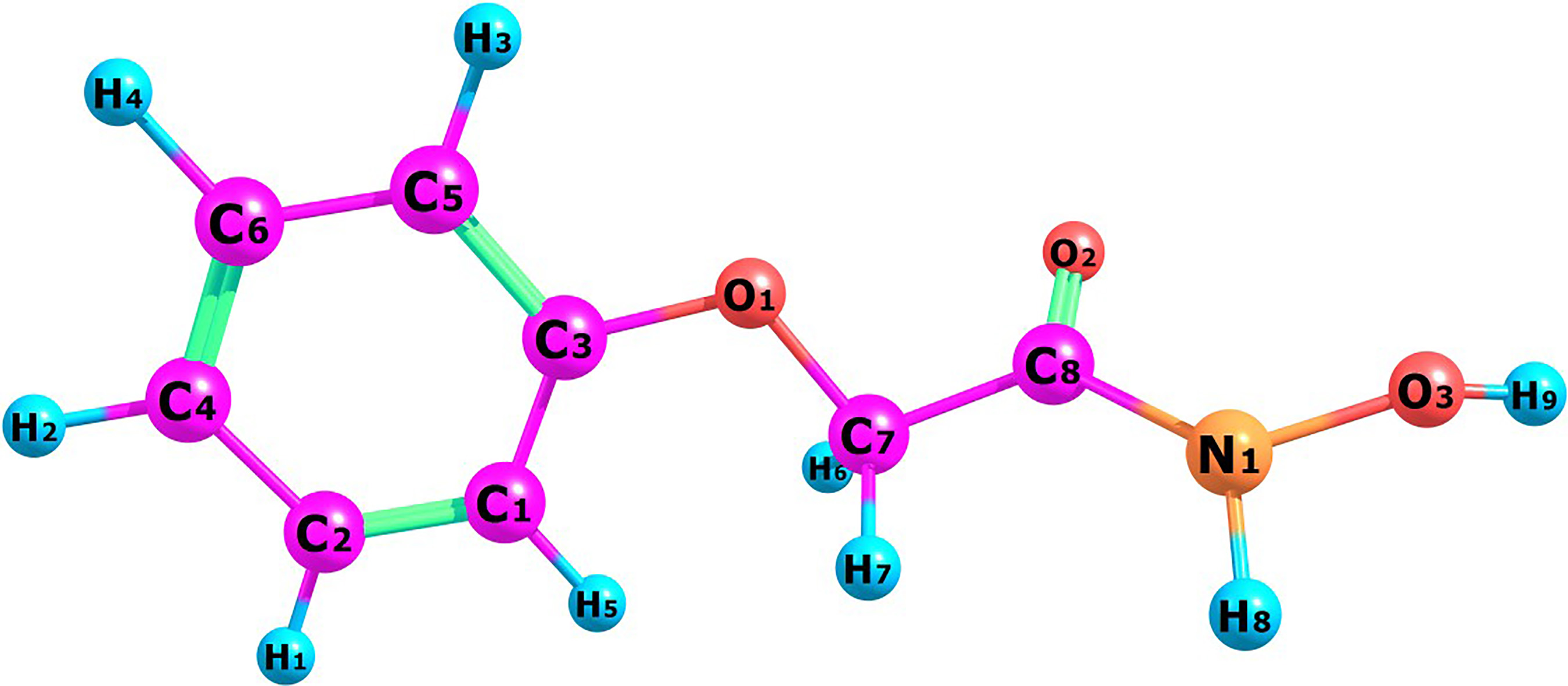
The molecular structure of phenoxyacetohydroxamic acid (Fig. 1) showed the important C8-O2, N1-O3 and C8-N1 bond lengths as 1.203, 1.397 and 1.331 A respectively and bond angles of magnitude C8-N1-O3 115.051; O2-C8-N1 119.291; O2-C8-C7 124.447 and C7-C8-N1 116.261 (Tables 1 and 2).
Structure of phenoxyacetohydroxamic acid (CHOCHCONHOH PhOAH).
[MeSn(CHOCHCONHO)] (I)
In MeSn(PhOAH) (I) the endocyclic C-O (C9-O4 1.222; C8-O1 1.224 A) bond lengths have been observed to be slightly increased relative to free ligand by 0.019, 0.021 Å respectively. The NO (N1-O2 1.365, N2-O3 1.379 A) bond lengths are slightly decreased by 0.032, 0.018 A. The endocyclic C-N (C8-N1 1.304; C9-N2 1.302 A) bond lengths are however shortened by 0.027 and 0.029 Å respectively compared to free ligand. The Sn-O bond distances Sn-O2 2.205 and Sn-O3 2.172 A (involving hydroxamic oxygen) are shorter than the Sn-O bond distances Sn-O1 2.563 and Sn-O4 2.419 A (involving carbonyl oxygen). The shorter bond length of tin oxygen is close to sum of their covalent radii (2.098 A) [32] while the longer bond length (2.398 A) is much shorter compared to van der Waals radii (4.00 A) however is in line with diorganotin (IV) derivatives of substituted benzohydroxamic acids [33].
The bond angles around tin atom have been observed to lie in 67.128–143.306 range (Tables 1 and 2). The C17-Sn-C18 bond angle 114.131 formed at tin metal linked with two methyl groups is indicative of cis conformation at metal center [24] (Fig. 2).
Structure of [MeSn(PhOAH)].
[-BuSn(CHOCHCONHO)] (II)
In n-BuSn(PhOAH) (II) the endocyclic C-O (C9-O5 1.228, C8-O2 1.252) bond lengths have been observed to be slightly increased by 0.025, 0.049 Å respectively relative to free ligand. The NO (N1-O3 1.348, N2-O4 1.370 A) bond lengths are slightly decreased by 0.049, 0.027 A upon complexation. The endocyclic C-N (C8-N1 1.293, C9-N2 1.303 A) bond lengths are shortened by 0.038, 0.028 Å respectively compared to free ligand. The Sn-O bond distances Sn-O3 2.371 and Sn-O4 2.212 A (involving hydroxamic oxygen) are shorter than the Sn-O bond distance Sn-O2 2.413 and Sn-O5 2.449 A (involving carbonyl oxygen). The bond angles around tin atom have been observed to lie in 71.099–151.711 range (Tables 1 and 2). The C17-Sn-C24 bond angle 151.711 formed at tin metal linked with two n-butyl groups is indicative of trans conformation at metal center [24] (Fig. 3).
Selected optimized geometrical parameters bond lengths (Å) of PhOAH, [MeSn(PhOAH)] and [-BuSn(PhOAH)]
PhOAH
[MeSn(PhOAH)] (I)
[-BuSn(PhOAH)] (II)
C8-O2 (1.203)
C9-O4 (1.222)
C9-O5 (1.228)
N1-O3 (1.397)
C8-O1 (1.224)
C8-O2 (1.252)
C8-N1 (1.331)
N1-O2 (1.365)
N1-O3 (1.348)
C7-C8 (1.445)
N2-O3 (1.379)
N2-O4 (1.370)
O1-C7 (1.390)
C8-N1 (1.304)
C8-N1 (1.293)
N1-H8 (1.023)
C9-N2 (1.302)
C9-N2 (1.303)
C3-O1 (1.347)
Sn-O2 (2.205)
Sn-O3 (2.371)
O3-H9 (1.078)
Sn-O3 (2.172)
Sn-O4 (2.212)
Sn-O1 (2.563)
Sn-O2 (2.413)
Sn-O4 (2.419)
Sn-O5 (2.449)
Sn-C17 (2.154)
Sn-C17 (2.175)
Sn-C18 (2.160)
Sn-C24 (2.170)
Selected optimized bond angles () of PhOAH, [MeSn(PhOAH)] and [-BuSn(PhOAH)]
PhOAH
[MeSn(PhOAH)] (I)
[-BuSn(PhOAH)] (II)
C8-N1-O3 115.051
C17-Sn-C18 114.131
C17-Sn-C24 151.711
O2-C8-N1 119.291
O2-Sn-O3 83.212
O4-Sn-O2 75.822
O2-C8-C7 124.447
O4-Sn-O1 133.419
O3-Sn-O5 141.743
C7-C8-N1 116.261
O1-Sn-O2 67.128
O2-Sn-O3 71.315
O3-N1-H8 27.599
O3-Sn-O4 71.220
O4-Sn-O5 71.099
C3-O1-C7 116.578
O1-Sn-O3 85.203
O3-Sn-O24 84.006
C8-N1-H8 23.497
O2-Sn-O4 143.306
O3-Sn-O5 141.743
O4-Sn-C17 83.905
O2-Sn-C17 101.958
O1-Sn-C17 73.909
O4-Sn-C17 100.424
O3-Sn-C18 116.725
O3-Sn-C17 86.569
O2-Sn-C18 83.383
O5-Sn-C17 85.700
O4-Sn-C18 85.133
Sn-O5-C9 110.404
O1-Sn-C18 141.281
O5-C9-N2 121.996
Sn-O1-C8 111.638
C9-N2-O4 123.740
O1-C8-N1 120.423
N2-O4-Sn 112.620
C8-N1-O2 122.080
Sn-O3-N1 107.572
N1-O2-Sn 118.562
O3-N1-C8 123.355
Sn-O4-C9 111.378
N1-C8-O2 121.767
O4-C9-N2 120.965
C8-O2-Sn 115.950
C9-N2-O3 122.743
Sn-O3-N1 107.572
Structure of [-BuSn(PhOAH)].
The selected bond lengths and bonds angles of HL and (I) and (II) complexes are listed in Tables 1 and 2.
The distortions in the coordination sphere of the tin metal ion from an ideal octahedral geometry may be due to the following structural constraints imposed by the hydroxamate ligand framework: (i) The bond angles formed with two methyl/butyl groups linked to tin metal C17-Sn-C18 (114.131) and C17-Sn-C24 (151.711) in (I) and (II) respectively are much smaller than that expected for a regular octahedral angle (180). (ii) The two small Sn-O bond lengths (Sn-O2 2.205; Sn-O3 2.172) and (Sn-O4 2.212; Sn-O2 2.413) have led to small bond angles (O2-Sn-O3 83.212) and (O4-Sn-O2 75.822) in (I) and (II) respectively. The other two larger bond lengths (Sn-O1 2.563; Sn-O4 2.419) and (Sn-O3 2.371; Sn-O5 2.449) are associated with large bond angles (O4-Sn-O1 133.419) and (O3-Sn-O5 141.743) in respective complexes [34].
The sum of the bond angles in equatorial plane in (I) [O2-Sn-O3 83.212; O4-Sn-O1 133.419; O1-Sn-O2 67.128 and O3-Sn-O4 71.220] has been found to be 354.979 and in (II) [O2-Sn-O3 71.315; O4-Sn-O5 71.099; O3-Sn-O5 141.743 and O4-Sn-O2 75.822] 359.979 which is indicative of co-planarity of ligand in complexes.
It is quite interesting to note that for the most prevalent six coordination number for numerous tin complexes octahedral geometry has been demonstrated. The steric and electronic restrictions imposed by ligands may also modify geometry as the idealized angles for octahedral geometries of magnitude 90 and 180, 90, 120 and 180 may vary.
In order to have an insight into the computed molecular structures of new diorganotin (IV) phenoxyacetohydroxamates, a comparison of important bond lengths (Table 3) and bond angles (Table 4) with those from X-ray crystal structures of six-coordinate mononuclear diorganotin (IV) hydroxamates are presented and a good correlation has been observed.
Bonding parameters (Bond lengths (Å)) of diorganotin (IV) hydroxamates from X-Ray crystallography
Bonding parameters (Bond angles ()) of diorganotin (IV) hydroxamates from X-Ray crystallography
Complex
O-Sn-O
C-Sn-C
References
BuSn(mbbha)
O1-Sn1-O2
O3-Sn1-O4
O1-Sn1-O3
O2-Sn1-O4
C1-Sn1-C5
35
(72.08)
(70.60)
(73.99)
(143.42)
(144.68)
[(CH)Sn{ONC (O) CHCl-4}]
O1-Sn1-O3
O2-Sn1-O4
O1-Sn1-O2
O3-Sn1-O4
C1A-Sn1-C1B
33
(67.64)
(72.82)
(76.43)
(143.17)
(142.7)
[(CH)Sn{ONC (O) CHOCH-4}]
O1-Sn1-O3
O2-Sn1-O4
O1-Sn1-O2
O3-Sn1-O4
C1A-Sn1-C1B
33
(69.99)
(71.82)
(75.56)
(142.96)
(140.8)
[MeSn{3, 4-FCH C (O) NHO}]
O3-Sn1-O4
O1-Sn1-O2
O1-Sn1-O3
O2-Sn1-O4
C16-Sn1-C15
36
(67.91)
(73.03)
(78.35)
(141.02)
(142.4)
MeSn(PhOAH) (I)
O1-Sn-O2
O3-Sn-O4
O2-Sn-O3
O4-Sn-O1
C17-Sn-C18
This study
(67.128)
(71.220)
(83.212)
(133.419)
(114.131)
-BuSn(PhOAH) (II)
O2-Sn-O3
O4-Sn-O5
O4-Sn-O2
O3-Sn-O5
C17-Sn-C24
This study
(71.315)
(71.099)
(75.822)
(141.743)
(151.711)
HOMO-LUMO analysis
The HOMO-LUMO energies for the ligand and complexes have been computed in order to find out the energy distribution and energetic behaviour. The HOMO and LUMO energies represent the ability to donate and gain an electron respectively. The high HOMO energy corresponds to the more reactive molecule in the reactions with electrophiles while low LUMO energy is essential for molecular reactions with nucleophiles.
The computed HOMO and LUMO energy values for ligand PhOAH have been found to be 5.698 eV and 1.187 eV respectively. While MeSn(PhOAH) and -BuSn(PhOAH) showed the respective values as 5.042 eV and 1.118 eV; 3.98 eV and 1.32 eV.
The negative magnitude of E and E is indicative of their stability. The energy gap between HOMO and LUMO gives information about the eventual charge transfer interaction within the molecule as an important stability index. A molecule with large HOMO-LUMO gap is described as a hard molecule, small and much less polarizable. The soft systems have small HOMO-LUMO gap, large and highly polarizable. The magnitude of HOMO-LUMO energy gap of magnitude 4.511, 3.924 and 2.66 eV in PhOAH, MeSn(PhOAH) (I) and -BuSn(PhOAH) (II) has suggested the hard nature of the ligand than complexes.
Global reactivity descriptors
From the energies of the frontier molecular orbitals HOMO and LUMO useful in quantum chemical calculations information regarding ionization potential (IP), electron affinity (EA), electronegativity (), electrophilicity index (), hardness (), softness (s) and chemical potential () to deduce the relations among energy, structure and reactivity characteristics of complexes has been gathered. The ionization potential (IP) and electron affinity (EA) are given as: IP E and EA E. The chemical potential () which is the escaping tendency of electrons from a stable system; hardness ()- the resistance to alteration in electron distribution correlated with the stability and reactivity of a chemical system; softness (S)- the inverse of hardness; electronegativity ()- the negative of a partial derivative of energy E of an atomic or molecular system with respect to the number of electrons N with a constant external potential (r) and global electrophilicity index () [37] which assesses the lowering of energy due to maximal electron flow between donor and acceptor can be calculated from HOMO-LUMO energy values. For closed-shell molecules, using Koopman’s theorem [38] these descriptors are given by the following equations:
The calculated values of reactivity descriptors of phenoxyacetohydroxamic acid and di-alkyltin (IV) derivatives are given in (Table 5). The negative chemical potential of ligands and complexes are indicative of their stability suggesting that these do not undergo decomposition into elements. The magnitude of chemical hardness of PhOAH and its complexes (2.225, 1.962 and 1.33 eV) supported by HOMO-LUMO gap suggest their hardness signifying the resistance towards deformation of the electron cloud of chemical system under small perturbations and are less polarizable. The calculated electrophilicity index values of ligand as well as (I) and (II) (2.626, 2.417 and 2.640 eV) which are related to chemical potential and hardness are considered to be the better descriptor of global chemical reactivity. The small magnitude (0.221, 0.254 and 0.376 eV) of global softness of ligand as well as complexes have excluded the possibility of their soft nature.
Global reactivity descriptors for ligand and di-organotin (IV) hydroxamates
Ligand/complex
HOMO-LUMO
I.P.
E.A
()
()
()
(S)
()
energy gap (eV)
(eV)
(eV)
(eV)
(eV)
(eV)
(eV)
(eV)
PhOAH
4.511
5.698
1.187
3.442
3.442
2.626
0.221
2.255
MeSn(PhOAH) (I)
3.924
5.042
1.118
3.080
3.080
2.417
0.254
1.962
-BuSn(PhOAH) (II)
2.66
3.98
1.32
2.650
2.650
2.640
0.376
1.33
Conclusions
The new diorganotin (IV) phenoxyacetohydroxamates of composition [MeSn(CHOCH CONHO)] (I), and [-BuSn(CHOCHCONHO)] (II) derived from potassium phenoxyacetohydroxamate successfully synthesized and thoroughly characterized by various physicochemical and spectral techniques have been studied by DFT (employing B3LYP) method using 6-311G (d,p) basis set to have an insight into the coordination environment. The interesting structural feature of the ligand and the corresponding complexes in terms of computed bond lengths that the Sn-O (hydroxamic) bonds are shorter than the Sn-O (carbonyl bonds) have suggested the formation of coordinate bond through the carbonyl oxygen and strong covalent bond with hydroxamic oxygen. The lower C=O bond lengths in complexes than in free ligand further substantiate the complexation. The C-Sn-C bond angles at the tin metal indicate considerable distortion from octahedral geometry. The geometry of (I) and (II) conform to cis and trans-distorted octahedral respectively. The planarity of ligand around tin seems to be dependent upon the alkyl group linked to tin evidenced from the sum of the bond angles at metal atom in equatorial plane. The results from global reactivity descriptors have shown hard nature of ligand and complexes.
Footnotes
Acknowledgments
The authors thank Department of Physics, Himachal Pradesh University, Shimla for carrying out computational studies.
References
1.
CoddR., Traversing the coordination chemistry and chemical biology of hydroxamic acids, Coord. Chem. Rev.252 (2008), 1387–1408.
2.
KakkarR.GroverR. and ChadhaP., Conformational behavior of some hydroxamic acids, Org. Biomol. Chem.1 (2003), 2200–2206.
3.
SenthilnithyR.de CostaM.D.P. and GunawardhanaH.D., The pKa values of ligands and stability constants of the complexes of Fe (III), Cu (II) and Ni (II) with some hydroxamic acids: a comparative study of three different potentiometric methods, J. Natn. Sci. Foundation Sri Lanka36(3) (2008), 191–198.
4.
Nguyen-van-DuongM.K.GuillotV.NicolasL.GaudemerA.LowryL.SpasojevicI. and LA., Crumbliss, synthesis, ligand pKa, and Fe (III) complexation constants for a series of bipodal dihydroxamic acids, Inorg. Chem.40 (2001), 5948–5953.
5.
Munoz-CaroC.NinoA.SenentM.L.LealJ.M. and IbeasS., Modeling of protonation processes in acetohydroxamic acid, J. Org. Chem.65(2) (2000), 405–410.
6.
KaczorA.SzczepanskiJ.ValaM. and ProniewiczL.M., Matrix-isolation and computational study of salicylhydroxamic acid and its photochemical degradation, Phys. Chem. Chem. Phys.7 (2005), 1960–1965.
7.
DooleyC.M.DevocelleM.McloughlinB.NolanK.B.FitzgeraldD.J. and SharkeyC.T., A novel family of hydroxamate-based acylating inhibitors of cyclooxygenase, Mol. Pharmacol.63 (2003), 450–455.
8.
NishinoN. and PowersJ.C., Peptide hydroxamic acids as inhibitors of thermolysin, Biochem.17 (1978), 2846–2850.
9.
ShangX.CuiJ.WuJ.PombeiroA.J.L. and LiQ., Polynuclear diorganotin (IV) complexes with arylhydroxamates: syntheses, structures and in vitro cytotoxic activities, J. Inorg. Biochem.102 (2008), 901–909.
10.
O’BrienE.C.RoyS.L.LevaillainJ.FitzgeraldD.J. and NolanK.B., Metal complexes of salicylhydroxamic acid and O-acetylsalicylhydroxamic acid, Inorg. Chim. Acta.266 (1997), 117–120.
11.
LiQ.Fa’timaM.Guedes da SilvaC.JinghuaZ. and PombeiroA.J.L., Diorganotin (IV) derivatives of arylhydroxamic acids: synthesis, properties and antitumor activity, J. Organomet. Chem.689 (2004), 4584–4591.
12.
GielenM., An overview of forty years organotin chemistry developed at the Free Universities of Brussels ULB and VUB, J. Braz. Chem. Soc.14 (2003), 870–877.
13.
DasM.K. and DeS., Studies on the diorganotin (IV) complexes of some dihydroxamic acids, J. Organomet. Chem.495 (1995), 177–184.
14.
YinH.DongL.HongM. and CuiJ., Structural diversity of organotin (IV) complexes self-assembled from hydroxamic acid and mono- or dialkyltin salts, J. Organomet. Chem.696 (2011), 1824–1833.
15.
PizarroA.M.HablemariamA. and SadlerP.J., Activation Mechanisms for Organometallic Anticancer Complexes, in: Med. Organomet. Chem., Topics in Organometallic ChemistryJaouenG. and Metzler-NolteN., Eds., 32, 21, 2010.
16.
CarraherC.E. and RonerJ.M.R., Organotin polymers as anticancer and antiviral agents, J. Organomet. Chem.751 (2014), 67–82.
17.
JainM.GaurS.DiwediS.C.JoshiS.C.SinghR.V. and BansalA., Nematicidal, insecticidal, antifertility, antifungal and antibacterial activities of salicylanilide sulphathiazole and its manganese, silicon and tin complexes, Phosphorus, Sulfur Silicon Relat. Elem.179 (2004), 1517–1537.
18.
BissetW.JacobsH.KoshtiN.StarkP. and GopalanA., Synthesis and metal ion complexation properties of a novel polyethyleneimine N-methylhydroxamic acid water soluble polymer, React. Funct. Polym.55 (2003), 109–119.
19.
CareriM.DallawalleF. and TegoniM., Zagoni, Pentacopper (II) 12-metallacrown-4 complexes with α- and β-aminohydroxamic acids in aqueous solution: a reinvestigation, J. Inorg. Biochem.93 (2003), 174–180.
20.
Parac-VogtT.N.PaccoA.NockemmanP.YuanY.F.Gorller-WalrandC. and BinnemansK., Mandelohydroxamic acid as ligand for Copper (II) 15-Metallacrown-5 Lanthanide (III) and Copper (II) 15-Metallacrown-5 uranyl complexes, Eur. J. Inorg. Chem.7 (2006), 1466–1476.
21.
EdwardsD.C. and MyneniS.C.B., Hard and soft X-ray absorption spectroscopic investigation of aqueous Fe (III)-hydroxamate siderophore complexes, J. Phys. Chem.109 (2005), 10249–10256.
22.
BrownD.A.FitzpatrickN.J.Muller-BunzH. and RyanA.T., Di-, Tri-, and tetranuclear zinc hydroxamate complexes as structural models for the inhibition of zinc hydrolases by hydroxamic acids, Inorg. Chem.45 (2006), 4497–4505.
23.
DrovetskaiaT.V.YashinaN.S.LeonovaT.V.PetrosyanV.S.LorberthJ.WocadloS.MassaW. and PeblerJ., Synthesis and structures of some diethyl- and diphenyltin bishydroxamates, J. Organomet. Chem.507 (1996), 201–205.
24.
NaqeebullahY.FarinaK.M.ChanL.K.RajabN.F. and OoiT.C., Diorganotin (IV) derivatives of N-methyl p-fluorobenzo-hydroxamic acid: preparation, spectral characterization, X-ray diffraction studies and antitumor activity, Molecules18 (2013), 8696–8711.
25.
ChoudharyV.K.KumarA. and SharmaN., Potential bioactive mononuclear diorganotin (IV) phenoxyacetohydroxamate complexes: synthesis, characterization and antimicrobial evaluation, Main Group Met. Chem.41(1–2) (2018), 27–32.
BeckeA.D., Density-functional thermochemistry. III. The role of exact exchange, J. Chem. Phys.98 (1993), 5648–5652.
28.
ToscanoM. and RussoN., Soybean aglycones antioxidant activity. A theoretical investigation, J. Comput. Theor. Chem. (2015), 2210–271.
29.
LeopoldiniM. and Prieto PitarchI., Structure, conformation, and electronic properties of apigenin, luteolin, and taxifolin antioxidants. A first principle theoretical study, J. Phys. Chem. B108 (2004), 92–94.
30.
LeopoldiniM.RussoN.ToscanoM. and ChiodoS., Iron chelation by the powerful antioxidant flavonoid quercetin, J. Agric. Food Chem.54 (2006), 6343–6351.
31.
MazzoneG.RussoN. and ToscanoM., Density functional predictions of antioxidant activity and UV spectral features of nasutin a, isonasutin, ellagic acid and one of its possible derivatives, J. Agric. Food Chem.61 (2013), 9650–9657.
32.
ZhangR.WangQ.LiQ. and MaC., Syntheses and characterization of triorganotin (IV) complexes of schiff base derive from 4-amino-5-phenyl-4H-1,2,4-triazole-3-thiol and 5-amino-1,3,4-thiadiazole-2-thiol with p-phthalaldehyde, Inorg. Chim. Acta.362 (2009), 2762–2769.
33.
LiQ.FátimaM.Guedes da SilvaC. and PombeiroA.J.L., Diorganotin (IV) derivatives of substituted benzohydroxamic acids with high antitumor activity, Chem. Eur. J.10 (2004), 1456–1462.
34.
SirajuddinM.AliS.MckeeV.SohailM. and PashaH., Potentially bioactive organotin (IV) compounds: synthesis, characterization, in vitro bioactivities and interaction with SS-DNA, Eur. J. Med. Chem.84 (2014), 343–363.
35.
IrshadA.KhanN.FarinaY.BalochN., SamiullahAliA.MundL.K. and MurtazaG., Attiq-ur-rehman, synthesis, spectroscopic characterization, X-ray diffraction studies and in-vitro antibacterial activities of diorganotin (IV) derivatives with N-methyl-4-bromobenzohydroxamic acid, Inorg. Chim. Acta469 (2018), 280–287.
36.
ShangX.ArmandoJ.PombeiroJ.L. and LiQ., Mononuclear diorganotin (IV) complexes with arylhydroxamates: syntheses, structures and assessment of in vitro cytotoxicity, Appl. Organomet. Chem.21 (2007), 919–925.
37.
ParrR.G. and PearsonR.G., Absolute hardness: companion parameter to absolute electronegativity, J. Am. Chem. Soc.105 (1983), 7512–7516.
38.
KoopmansT., Über die zuordnung von wellenfunktionen und eigenwerten zu den einzelnen elektronen eines atoms, Physica1 (1934), 104–113.