



Abstract
In order to analyze the performance indicators of the train network and explore the factors affecting the performance indicators of the train network, the model of Ethernet is improved according to the three-layer modelling mechanism of OPNET. The topology model, node model, process model, data packet format model and link model of the multi-marshalling Ethernet backbone network are built, and the links of the network are made under different load conditions. The simulation results show that the high-speed EMU train network based on ARCNET protocol can meet the requirements of the train communication network in terms of real-time and reliability, but the network has the disadvantage of low data transmission rate. Therefore, the backbone network of Ethernet train has great engineering application value in the train network.
Introduction
With the development of economy, people’s living standard is getting higher and higher. At the same time, the frequency of national travel is also constantly improving, passengers also have high requirements on the safety, comfort and timeliness of the means of transport [1]. In order to pass the time on the vehicles, many passengers often use mobile Internet equipment, which requires that the vehicles have high broadband capacity, especially passengers travelling by train [2]. In addition, the number of passengers on the train is not comparable to that of airplanes and buses, so the safety requirements in the process of train operation are higher. The safety of trains and the requirement of passengers for broadband capability of trains are directly related to the train communication network [3].
There are many methods for simulation of train communication network at home and abroad. The main methods are to use OPNET simulation software to establish the model of train communication network, to simulate and analyze the performance of the network, and to use MATLAB and other mathematical software to establish the mathematical model of the network, and to analyze the network performance on the basis of the model [4]. After consulting the relevant information, it is found that whether at home or abroad, the simulation research of train communication network is aimed at eight carriages of trains, using OPNET or MATLAB software to establish network model, and to simulate and analyze the performance of the network. At present, the largest marshalling of suburban trains is 15 compartments. There are few simulation studies on the performance of multi-marshalling train network with 16 compartments, which is basically in a blank state [5]. Therefore, this study uses OPNET software, a relatively advanced network simulation software, to build a 16-compartment multi-marshalling train communication network model, to simulate and analyze the performance of multi-marshalling train communication network, which fills in the blank of domestic and foreign research, and has very important practical significance [6].
Methodology
In reality, the window control strategy used by TCP has some shortcomings. It is easy to cause burst of messages. The rate is limited by the size of the window. The loss of multiple messages in a window is not easy to recover, and so on. At present, the theory and method of rate-based congestion control has become a research hotspot [7]. Network congestion control mainly adopts simple open-loop and closed-loop control. Because the control problem in the network is very complex, it is difficult to model, analyze and control with traditional methods, so intelligent control method can be tried. In terms of traffic control and congestion control in networks, the physical quantities of control are the rate of sending data frames and the allocation of resources such as buffers in nodes [8].
Because there are many stochastic and uncertain factors in the network, it is difficult or impossible to establish an accurate and deterministic model for the system. In this case, fuzzy control is often very effective. Of course, other intelligent control methods can also be used. In recent years, people have done a lot of work in using control and optimization theory to analyze the steady and dynamic performance of existing congestion control and design new congestion control algorithm, which have made a good start.
ABR service flow control model is an online control model based on feedback control. Given the desired buffer queue value, the feedback value is the actual queue value of the network node or receiving terminal. In the fuzzy-PID control model of the network node buffer cell occupancy shown in Fig. 1, the specific operation process of the control mechanism is that the digital communication network is usually composed of a series of locally distributed sources, terminals and intermediate nodes [9]. The data packets excited by the source end are transmitted to the terminal nodes through a series of intermediate nodes. For convenience, only a network model that includes a pair of source terminal nodes is considered.
Network node queue fuzzy PID control model.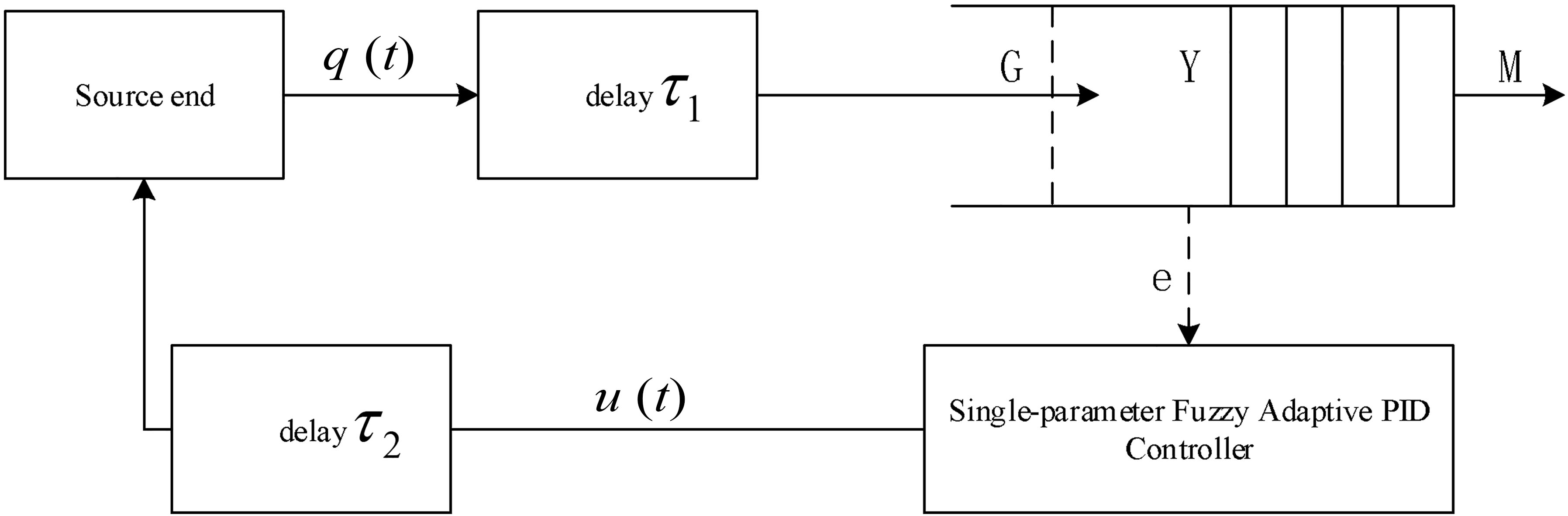
Equivalent structure diagram of networked closed-loop control system.
It is assumed that
The corresponding differential equation is:
After discretization:
Among them,
Structure and algorithms of single-parameter fuzzy adaptive PID controller
Generally, the PID controller has to adjust three parameters
Fuzzy-PID on-line tuning control structure diagram.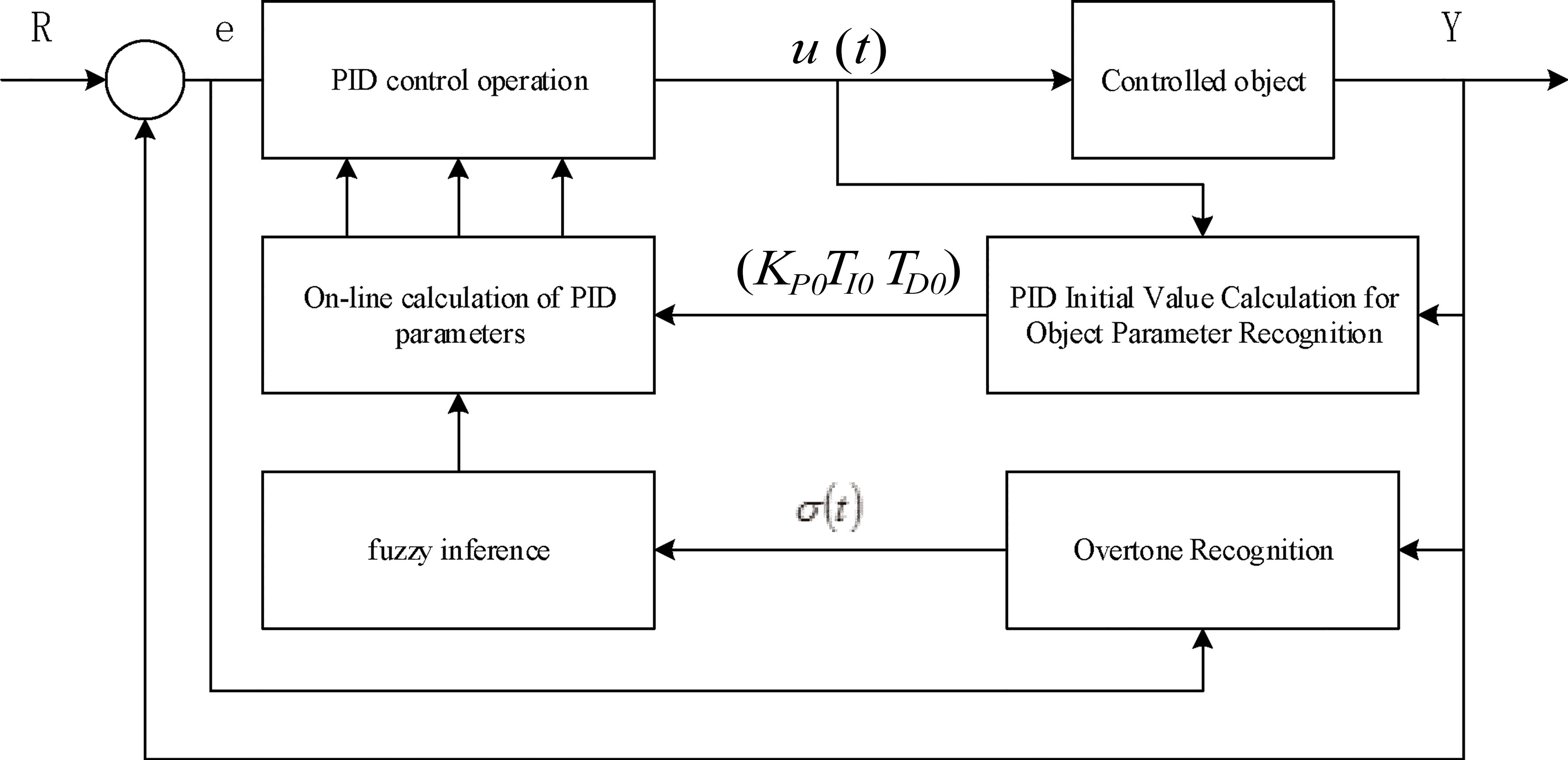
Firstly, the system controllability and
Nowadays, with the rapid development of network technology and the rapid momentum of network construction, how to effectively establish network model, design network protocols, optimize existing network model and compare the advantages of various networks need the support of network simulation. Network simulation is a technology specializing in network research, which abstracts the network into a data model by means of network simulation software tools, simulates the actual operation of the network and evaluates it from the simulation results. OPNET has become one of the most popular simulation software in the industry with its extensive model support, flexible system architecture and rich programming interface. This design uses OPNET to simulate the communication of high-speed EMU train.
OPNET Modeler network simulation software provides a comprehensive simulation development environment for the modelling of communication networks and distributed systems. OPNET uses models to simulate systems, and the way to analyze the behavior and performance of various models is to simulate discrete events. The tools needed in each simulation stage are integrated by OPNET Modeler to form a large-scale simulation system. The system is a combination of model design tools, simulation core, statistics collection tools and statistical analysis tools. The network model created by such a large-scale OPNET Modeler simulation system can be used to study the behavior of the system. Performance can also be used to grant “end users” special modelling environments in the form of products, such as ITGuru modules. All systems created with OPNET Modeler consist of a series of objects whose properties are configurable. A class is the sum of some objects, whose characteristics are described by the class in terms of behavior and attributes. OPNET Modeler also supports user-defined new classes in order to build models that can be used for broader system performance research.
OPNET simulation software provides a large number of types related to information processing and communication, which can highly support the simulation of distributed systems and communication networks. The design of OPNET model is hierarchical, which can naturally correspond to the hierarchical structure of the actual communication network. Using graphical editors to define and edit models is widely used in most links of OPNET programming modelling. These editors are mapped to OPNET modelling process by simulation system specifications, which allow the use of advanced programming language. This provides wider support for distributed and communication systems. In such an environment, they can be truly used. There are known algorithms, transmission technology and communication protocol implementation simulation. OPNET simulation software can compile model description code automatically. The result of compilation is to generate efficient and executable discrete event simulation program implemented by C language. Because of its advanced simulation configuration and simulation structure, OPNET can minimize the compiler’s requirements for the system. The network communication simulation software has a series of comprehensive simulation and analysis tools. The organic combination of these tools can also make the simulation output graphically expressed.
In addition, OPNET has such features as interactive analysis of simulation results, animation display of statistical parameters over time, collaborative simulation with third-party simulators, and application programming interface (AP).
Establishment of ARCNET network simulation model
Aiming at the simulation of ARCNET network performance, the network model of eight carriages is established, and the network performance is analyzed and studied. The optimized AECNET network model is established, and the network performance is simulated. However, by investigating the research status of train network simulation at home and abroad, it is not difficult to find that the simulation of network performance for 16 carriages is in a blank state. The main purpose is to establish a multi-group ARCNET network model for 16 carriages, analyze and study the network performance, and fill in the blank of domestic and foreign research on 16 carriages train communication network simulation. By using OPNET software and three-tier modelling mechanism, the topological model of 16 carriage network models is established, and the performance of the network is simulated.
The network topology model is a dual bus structure. Its broadcasting bus is a passive transmission medium. If the node has data to transmit, it will directly transmit to the bus. At this time, all nodes on the bus will know the arrival of data. The data transmission medium of train communication network is optical fiber, and the data transmission rate is 2.5 Mbps.
In Fig. 4, tokens are transmitted between nodes, and the data transmission path is consistent with the token transmission path. The token is transmitted from Node 1 to Node 16 in turn. When the token is transmitted to Node 16, it is transmitted from Node 16 to Node 1. Like the token transmission process, the data in the network is also transmitted in this way, so the data transmission forms a closed logical loop. In Fig. 4, there are two buses in the network, thus forming a physical bus and a logical double-loop network structure. The double rings include a main ring and a backup ring. If the main ring fails, it switches to the backup ring for data transmission.
Network topology.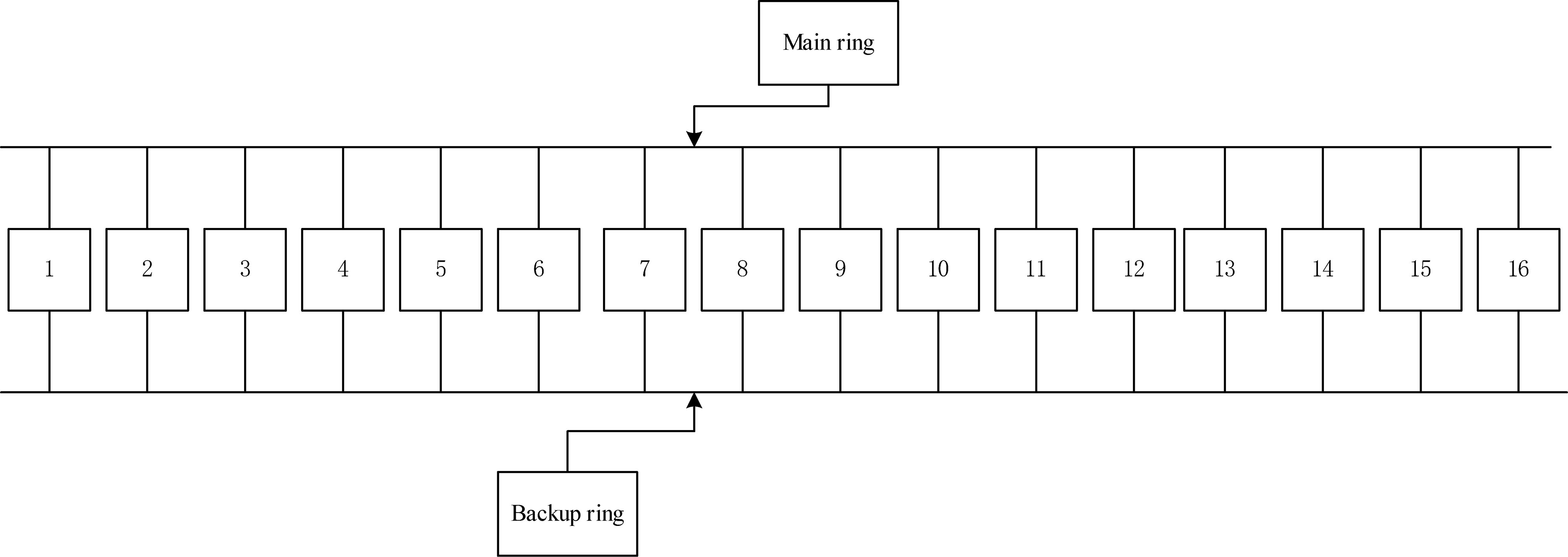
As shown in Fig. 4, the terminal devices in the 16 carriages are replaced by Nodes 1 to 16. After each node receives the token, it begins to send data to its next logical node through the bus. According to the relevant regulations, the data transmission rate on the bus is 2.5 Mbps. The bus above the topology diagram is defined as the main ring, and the bus below is defined as the standby ring. The main ring and the standby ring switch each other, which avoids the loss of data packets and the transmission delay of the network, and ensures the reliability and real-time of the network. In this design, the scenario of network topology is 500 m
With the rapid development of science and technology and the rapid improvement of people’s living standards, the requirement of train communication network is becoming higher and higher. The operation of EMUs is an urgent need for the development of rail transit. ARCNET network has been applied in high-speed EMU trains, but this technology is still in the stage of research, digestion and absorption in China, and it cannot be developed independently. The network model of ARCNET is established. With a thorough understanding of ARCNET protocol, the principle of modelling and the function of the model are analyzed. By analyzing the train operation process, various data generated in train operation are collated and the train operation simulation data model is established.
Based on OPNET platform, the train network of high-speed EMU is modelled according to different network protocols, and then the network performance simulation is carried out. After running and debugging the model, the communication control function of ARCNET network simulation model of high-speed EMU is finally realized, and the simulation results of network switching performance are obtained. Based on these results, the real-time and reliability of the train network are analyzed.